ReactJS development services for web apps that stay fast
Our ReactJS development services are for businesses that need a web app, customer portal, dashboard or SaaS front end that stays fast and easy to change as it grows. We plan the component architecture, build on React 19 with TypeScript, connect your APIs and test it, so your team keeps shipping without rewrites.
React development is designing, building and maintaining user interfaces with React, the open-source JavaScript library created at Meta and now hosted by the React Foundation. ReactJS development services cover component architecture, state and data handling, API integration, testing, performance and upgrades.
React is a UI library, not a full framework: routing and rendering come from Next.js, React Router or Vite.
New apps should not start on Create React App, which the React team deprecated in February 2025.
Slow React apps usually suffer from too much JavaScript, not from React itself.
You should own the repository, cloud accounts and design files from day one.
Best for
Web apps, dashboards, portals and SaaS products with lots of interaction and frequent releases
What you get
Architecture plan, reusable components, tested features, a CI/CD pipeline, documentation and handover
Typical timeline
Discovery in 1 to 2 weeks. A focused first release usually in 8 to 16 weeks, depending on scope; a single feature or small app ships sooner. Larger platforms ship in phases.
Pricing
Driven by screens, integrations, design work and the engagement model. Published vendor pricing we reviewed runs from about $10,000 for a small build to well over $100,000 for complex platforms. Our development projects run from under $1,000 to $30,000+, depending on scope. We quote after a free scoping call.
What our ReactJS development services include
New builds usually start with the first two workstreams; existing apps with performance and upgrades.
Our ReactJS web application development services cover single-page apps, customer portals, admin dashboards and SaaS front ends in React and TypeScript. New projects start on Next.js or React Router, or on Vite when the app sits behind a login, following the React team's advice since it deprecated Create React App in February 2025.
Component architecture and design systems
We turn your designs into reusable components, such as buttons, forms, tables and layouts, documented in Storybook and checked for accessibility. New screens are assembled from parts that already work, so the interface stays consistent. No designs yet? Our website UI/UX design team creates them in Figma.
State, data fetching and API integration
Many of the hardest React bugs come from data: stale caches, race conditions and forms that lose input. We pick the lightest tool that fits, from React's built-in state and Actions to TanStack Query or Redux Toolkit, and connect to REST or GraphQL APIs. No backend yet? Our API development team builds it alongside.
Server Components and server rendering
React 19 made Server Components stable. They render on the server, at build time or per request, so their code and libraries stay out of your JavaScript bundle. We use them through Next.js development when pages must rank or load fast on mobile, and keep client rendering where it is simpler.
Performance and Core Web Vitals
We profile with React DevTools, split code by route, lazy-load heavy widgets and remove unused dependencies. The React Compiler, stable since October 2025, adds memoization automatically, replacing most hand-written useMemo and useCallback. We judge responsiveness by Interaction to Next Paint against Google's 200 millisecond threshold.
Migration, upgrades and maintenance
We move apps off Create React App, class components, AngularJS or jQuery in stages, so the product keeps working while screens are replaced. We upgrade to React 19.x and apply security patches promptly, as with the critical Server Components vulnerability of December 2025. Ongoing care runs through our website maintenance plans.
What a well-built React app changes for your business
Good ReactJS web development services show up in release speed, page speed and how easily someone else can pick up the code.
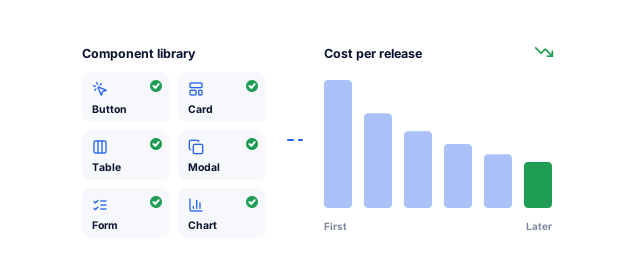
In a component-based app, a new screen reuses tested building blocks instead of starting from a blank file. The first weeks go into that foundation; after that, each release costs less than the last. That is why React suits products with a long roadmap, and why we build the component library first.
A large talent pool for whoever maintains it next
React is one of the most used web technologies: 41.5% of the 10,281 developers who answered the question in the 2026 Stack Overflow Developer Survey had done extensive work with it in the past year. Any capable React developer, including your own future hires, can pick up a well-documented codebase.
Pages that download less JavaScript
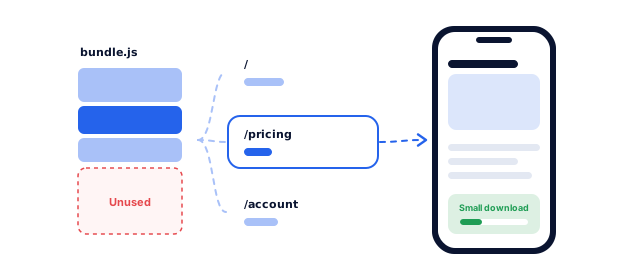
The median mobile page downloads 558 KB of JavaScript, and 206 KB of it goes unused during load, according to the HTTP Archive Web Almanac 2024. Route-based code splitting, Server Components and a strict dependency budget keep each page small, which matters most for customers on mid-range phones and slow networks.
Public pages that search engines and AI tools can read
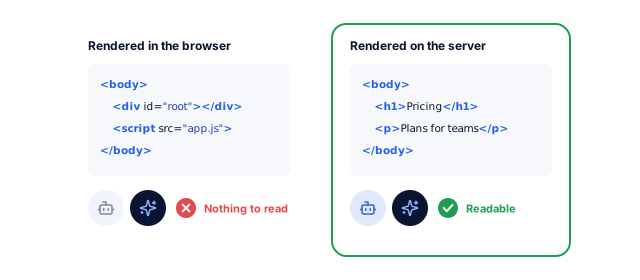
A React app rendered only in the browser depends on the crawler running your JavaScript. Google does, but a Vercel analysis found that major AI crawlers such as GPTBot and ClaudeBot do not. Rendering public pages on the server puts the content in the first HTML response. Pair that with our technical SEO services so the pages around your app can rank.
A realistic path to mobile apps
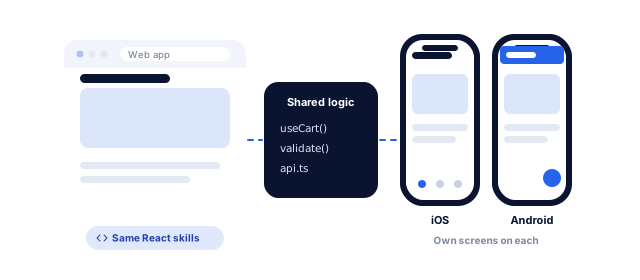
React Native lets a team reuse its React skills, and some business logic, for iOS and Android apps. It does not make a mobile app free, since screens are still built for each platform, but it often lowers the cost. Our mobile app development team helps you decide between shared code and fully native apps.
Code that survives a change of team
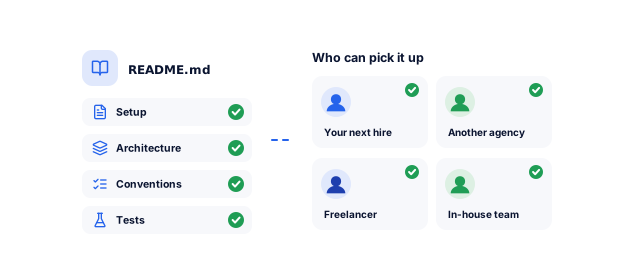
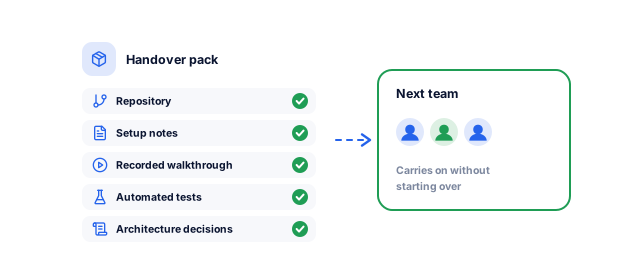
Typed code, automated tests, written architecture decisions and a pipeline that blocks broken builds mean the app does not depend on the memory of the people who wrote it. At handover you get the repository, setup notes and a recorded walkthrough, so another team can continue without starting over.
Not sure whether your React app needs a rebuild or a tune-up?
Tell us what you need. We look at your React app, its versions and performance, and tell you in writing whether to rebuild or tune it up, with a price range and timeline.
Your free project planFor what you need
1What we would buildYour product, codebase and roadmap
2A price range and timelineFor the budget you pick, with the options that fit
3The stack we would useAnd how your team runs it after launch
A specialist walks you through it on a call
Our React development process, from scoping to handover
Our ReactJS development services follow the same six stages whether you hire dedicated developers or buy a fixed-scope project.
We map users, screens, integrations and constraints, and agree what the first release must do. Existing apps get a code audit first: bundle size, outdated dependencies, test coverage and state flow.
Scope and user stories
Code audit for existing apps
Estimate and release plan
A fixed scope or a clear sprint backlog
Architecture and design system
We choose the framework, rendering approach, state tools and folder structure, and turn the designs into a component inventory. Each major decision is written down with its reason, for whoever joins later.
Architecture decision records
Component inventory
Clickable prototype where useful
An agreed blueprint before code
Build in two-week sprints
Features are built in TypeScript with pull request reviews and unit tests in Vitest or Jest with React Testing Library. Each sprint ends with a demo on staging, and you reprioritize the backlog with us.
Working features on staging
Sprint demo and notes
Updated backlog
Progress you can see every two weeks
Testing, accessibility and performance
Playwright end-to-end tests cover the journeys that make money, such as sign-up, checkout or booking. We test against WCAG 2.2 AA and run bundle analysis and Lighthouse on every release candidate.
End-to-end test suite
Accessibility checklist
Performance budget
A release you can trust
Launch and monitoring
We deploy through a CI/CD pipeline to Vercel, AWS, Azure or your own servers, with error tracking and real-user monitoring live before launch. For the first two weeks we check errors and performance daily and fix what real traffic reveals.
CI/CD pipeline
Error and performance monitoring
Launch checklist
A calm launch with full visibility
Handover or ongoing development
You receive the repository, documentation and a recorded walkthrough. Then keep a dedicated developer for features, upgrades and patches, or take the app in-house.
Documentation and walkthrough
Upgrade and patch plan
Retainer or handover
An app your team can own
React development for the product you are building
As a ReactJS app development company, we adapt the architecture to the product.
01 / 05
SaaS products and dashboards
SaaS front ends are tables, filters, charts and settings screens that change every month. We build a typed component library first, cache server state so dashboards stay fresh without hammering your API, and add feature flags for staged releases. For billing and multi-tenancy, see SaaS application development and custom dashboard development.
Headless storefronts use React for product listing, search, cart and checkout, fed by Shopify, a commerce API or a headless CMS. You gain speed, design freedom and server-rendered product pages that load fast and get indexed, but also take on work a theme would handle. When a theme covers your store, our Shopify team builds on it for less. See ecommerce website development and headless CMS development.
Patient portals, booking and staff dashboards need accessible forms and careful handling of personal data. We keep sensitive data out of browser storage, enforce role-based screens and log access on the server. improveFX also runs its own clinic software, Nabhaya Clinic, and built the hospital software in our AkosMD case study. See our healthcare work.
Enterprise React work usually means replacing an old internal system screen by screen, with single sign-on, role-based access and audit logs. Old and new run side by side behind one login until the last screen moves. When the back end needs replacing too, our legacy system modernization and MERN stack development teams join the plan.
A first release should prove demand, not cover every edge case. We cut scope to the journeys that test your idea, use proven libraries for authentication, payments and email, and keep the architecture simple enough to change direction, on a codebase that can grow into a full web app.
A sample of the checklist. Every project gets its own, signed off with you.
Yours to keep, always. Everything is set up in your name, and if you leave we remove our access and hand over the documentation.
Code and repository
Domain and hosting accounts
CMS admin and content
Design files
Documentation and logins
Who React development from improveFX is for
As a ReactJS web development company, we build front ends for products that keep growing, and match any part plain React does not suit to the right improveFX team.
You are building a web app, portal, dashboard or SaaS front end
Your product has a long roadmap and frequent releases
You want to click through working software every two weeks, not only at launch
You want the repository and accounts in your own name
We can also help when
You need a first release live in weeks: we cut it to the journeys that test your idea and ship the rest in phases
Your site is mostly public content that must rank: we build it with Next.js on the same React components
You want a fixed price while the scope is still moving: a 1 to 2 week discovery turns it into a scope we can price, or dedicated developers start on a monthly fee
You only need a marketing site, not an app: we build a lean WordPress or Webflow site on a short timeline
Why choose improveFX as your ReactJS development company
Our ReactJS web app development services are delivered by 25+ in-house specialists in New Delhi, never freelancers. One team can build your app, the marketing site around it and the technical SEO that gets it found: one plan instead of three vendors.
02
Your code and accounts from the first commit
The repository lives in your GitHub, GitLab or Bitbucket organization, and hosting, domains and third-party services are registered to you. We work on rolling agreements with transparent monthly reporting, and if you move on, you keep everything.
03
A track record you can check
We have delivered 170+ projects for 120+ clients in the US, UK, Canada, Australia, Europe and India. Clients rate us 4.9 on Clutch from 221 reviews and 4.8 on Google from 189, and stay with us 1.6 years on average. Read our case studies or book a call.
Results we can put numbers on
Results from our website and software projects, with the full story behind each number.
"From designing a high-converting website to managing our SEO, Google Ads, and Google Business Profile, improveFX delivered exceptional results across every channel."
210%more qualified leads
185%organic and local traffic growth
92%keywords on page one
Maureen CappalloBroker and founder, Momentus Real Estate Group
"They revolutionized our online presence with a 60% increase in web traffic through strategic e-commerce SEO and content optimization."
60%more organic traffic
47%more sales
Eric NoahPresident, Eric Originals & Antiques Ltd.
"Visionstar Technologies' online presence transformed significantly with a 40% boost in customer engagement, all thanks to their exceptional website structuring and SEO tactics."
+40%qualified leads
32%lower cost per acquisition
Thomas MorelFounder, Visionstar Technologies
"Their strategic approach to our website and SEO resulted in a 60% increase in local inquiries, revolutionizing our automobile service business."
60%more local inquiries
87%more organic traffic
Mike SteffanFounder, Sabulski Window Tinting
"Their SEO strategy helped us achieve top search rankings, while their Facebook Ads campaigns drove a steady flow of qualified prospects."
Most React projects cost between about $10,000 for a small app and well over $100,000 for a complex platform, based on published vendor pricing we reviewed.
For ReactJS app development services, cost depends on screens, user roles, integrations, design work and testing needs. Dedicated developers and team extension are billed monthly per engineer. We send a written estimate after a free scoping call, with each phase priced separately.
How long does it take to build a React web app?
A focused first release usually takes 8 to 16 weeks after a 1 to 2 week discovery phase. Larger platforms ship in phases rather than all at once.
Integrations, complex permissions and unclear requirements add time; existing designs and APIs save it. You get a release plan with milestones before work starts, and a staging link every two weeks shows whether it is holding.
Should I hire a ReactJS developer as a freelancer or through a company?
For a small, well-defined task, a freelance ReactJS developer or a short fixed-scope job from us both work. Choose a development company when the app also needs design, back-end work, testing and long-term upkeep.
A freelancer is one person: holidays, illness or a new job stop the work. From improveFX you can hire a dedicated React developer or small team, billed monthly, add engineers to your own team, or buy a fixed-scope project. All are in-house employees in New Delhi, not subcontractors.
Is a ReactJS development company in India a good choice for US, UK or Australian projects?
It can be, if the company works in your tools, overlaps with your working hours, and puts code ownership in writing.
Hiring ReactJS developers in India can cost less than hiring locally, but the saving disappears if communication is poor. Ask how sprints are reported, who reviews code and whether you own the repository. improveFX reports monthly to clients across the US, UK, Canada, Australia, Europe and India.
Is React good for SEO?
React can rank well, but a page rendered only in the browser relies on crawlers running JavaScript. Google does; many AI crawlers do not.
For marketing pages, product pages and articles, we render HTML on the server or at build time, usually with Next.js; pages behind a login do not need it. Our technical SEO services then handle metadata, structured data, internal links and Core Web Vitals.
When should we use plain React, and when Next.js?
Use plain React with Vite for apps behind a login, such as dashboards, admin tools and portals. Use Next.js when public pages must rank or load fast on the first visit.
Next.js adds routing, server rendering and image optimization, but needs a Node.js server or a platform such as Vercel; a Vite app is static files you can host almost anywhere. Many products use both, sharing one component library. Our Next.js development services page covers rendering and hosting choices.
Can you migrate our app from Create React App, Angular or jQuery?
Yes. We migrate in stages, replacing screens or routes one at a time, so your product keeps working and development never freezes for a big rewrite.
Create React App projects usually move to Vite or Next.js with few code changes. AngularJS and jQuery apps take longer, because logic is rewritten as components. Both versions run behind the same domain until the old one can be switched off.
Which React version and tools do you use?
New projects start on the current React 19.x release, which was React 19.3 as of September 2026, with TypeScript throughout.
Our usual toolkit: Next.js, React Router or Vite; TanStack Query or Redux Toolkit for data and state; Storybook; Vitest or Jest with React Testing Library; and Playwright for end-to-end tests. We check the React versions page and changelog before every upgrade.
Who owns the code, and what happens if we stop working together?
You do. The repository, hosting, domains and third-party accounts are in your name from the first commit, and we work on rolling agreements.
If you move the app in-house or to another vendor, we hand over documentation, setup notes and a recorded walkthrough, and answer questions during the transition. Before handover we check that nothing depends on an account only we control.
Ready to plan your website?
Tell us what you need built, or book a strategy call with our team.
What we would build, and on which platform
A price range and timeline for your budget
A call with a specialist to plan the next steps, no obligation
A specialist replies personally 4.9 from 566 client reviews