We develop custom hospital management systems for hospitals and health systems that want a platform they fully own, complete with source code and IP rights. We also license Nabhaya HMS, our production-ready product, which is already live in 50+ hospitals, including facilities with 100+ beds. The same experienced team will develop a custom HMS for your hospital if you choose to have one. Same rigorous codebase standards. Share your requirements and constraints, and we’ll show you the clearer, more cost-effective path to a system you control.
Companies that chose us for their digital transformation



















Most hospitals arrive here in one of four situations. Running on spreadsheets and disconnected tools. Stuck with a legacy HMS that staff has quietly stopped using. Already on Epic or Meditech and missing one piece. Or ready to own a platform outright. Each needs a different answer, and the wrong one gets expensive fast. We’ll tell you which one you’re in, even if it isn’t the one we’d rather sell.

We build your platform from the ground up. You own the source code, the IP, and the roadmap. Best when your model is genuinely different.

Our own product, live in 50+ hospitals, configured to your departments and workflows. You go live sooner. We keep the roadmap moving.

Replatform the system your staff works around. We migrate patient history, reconcile records, and run parallel until you're confident enough to switch.

Already on Epic, Oracle Health, or Meditech? We build the module you're missing and the ADBM, HL7, or FHIR interfaces to connect it.
Every vendor publishes a module list. Lists don’t tell you whether the pharmacy module handles consignment stock or whether case management knows the difference between observation and inpatient status. So here is each module described by what goes wrong without it and what it has to do to be worth building. All six run in production inside Nabhaya HMS today.
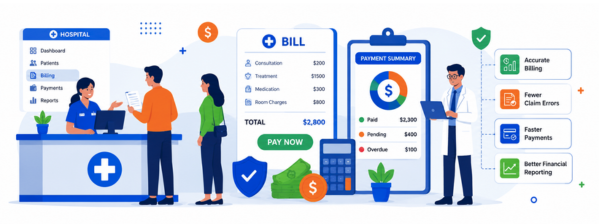
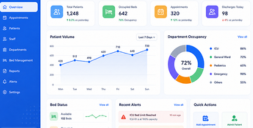
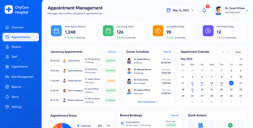
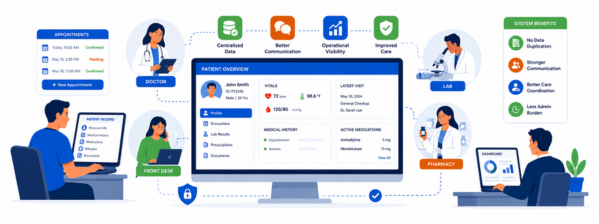
Bad data enters at registration and gets expensive downstream. A wrong policy number becomes a denied claim six weeks later. Hospital patient management software has to verify eligibility at the desk, carry one patient identity across every department, and show bed status in real time rather than on a whiteboard someone updates when they remember. Admission, transfer, and discharge events should fire automatically, not get typed twice.
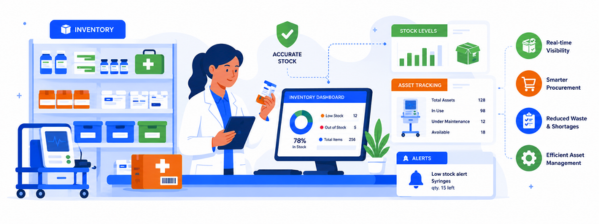
Most hospitals find their inventory problem at the write-off. Expired stock, duplicate purchase orders, and a crash cart missing an item nobody logged. Hospital inventory management software needs batch and lot tracking, expiry alerts weeks ahead, par levels per department, and consignment stock kept separate from owned. Controlled substances get their own audit trail. Scanning happens at the point of use, not at the end of a shift.
Nobody budgets for the infusion pump that gets rented because three are missing. Hospital asset management software tracks every device by serial number through its full lifecycle, schedules preventive maintenance before it lapses, and records calibration and service history a surveyor can inspect. Location tracking matters more than most vendors admit. So does recall handling: when a manufacturer issues one, you need every affected unit identified in minutes, not days.
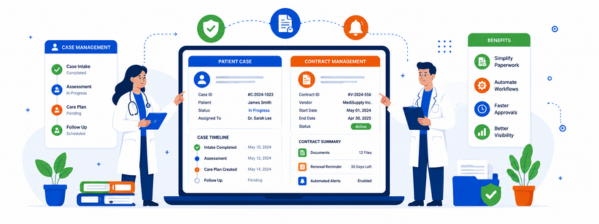
Case managers hold length of stay, and length of stay holds margin. Hospital case management software has to get observation versus inpatient status right, flag authorization gaps before the payer does, surface discharge barriers while there is still time to clear them, and manage post-acute referrals without a fax machine. Utilization review criteria need applying consistently, and every decision needs a defensible record when the denial arrives.
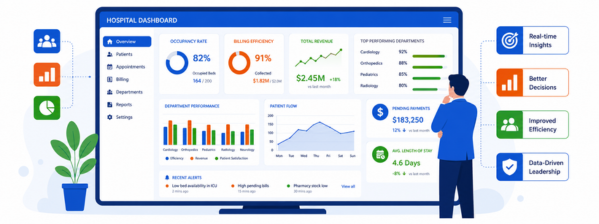
Hospitals lose money to contracts they own but cannot find. Hospital contract management software keeps payer agreements, GPO and vendor terms, and physician arrangements in one repository with renewal and auto-renewal dates that alert someone in time. The valuable part is variance: modeling expected reimbursement against what actually paid, so underpayments surface as a report instead of a rumor. Physician agreements need their own audit trail for compliance review.
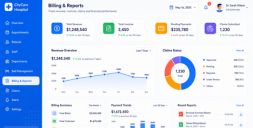
Kodiak Solutions put 2025 initial denial rates at 11.6% and revenue leakage at $48.4 billion. Most of that starts upstream, not in billing. Revenue cycle features have to catch eligibility and authorization problems at registration, apply coding rules before submission, and track every claim through adjudication with a worklist that prioritizes by dollar value and appeal deadline. The clean claim rate is the number that tells you whether the build worked.
Get a free proposal with real numbers, honest timelines, and no lock-in. Judge us on that.
Six phases, each with a time range you can put in front of a board. Compliance runs as a gate inside every sprint, not a phase we bolt on before launch. The Nabhaya HMS compresses design and build. And we’ll tell you what your own team has to commit to before we quote anything.

2 to 4 weeks. We shadow admissions, the floor, pharmacy, and billing before writing a line of spec. You leave with a mapped current state, an integration inventory, and a scope you can challenge.
1 week. This is where custom and Nabhaya get decided, on your numbers rather than ours. You get both scoped, side by side, with the honest cost of ownership over five years.

3 to 5 weeks. Screens get tested with the nurses and clerks who will actually use them at 2am. We count clicks per task and cut them before development starts, not after go-live complaints.
3 to 9 months. Two-week sprints, each ending with working software your team can open and test. Every sprint closes with a security and audit-trail review, so compliance is never something we discover late in the project.

2 to 6 weeks. The phase that quietly sinks most HMS projects. We migrate, reconcile record counts against your source system, run both in parallel, and keep a rollback path open until you sign off.

4 weeks, then ongoing. We staff the floor during cutover week, not a ticket queue. Hypercare runs for four weeks with same-day fixes, then moves to a support agreement with response times written into it.
These are the six questions that come up on every call, usually in this order, usually after the demo has gone well. Most vendor pages answer them with a badge or a promise. Here are the mechanisms instead, including the parts that are hard and the ones where we’d push back on your requirement.
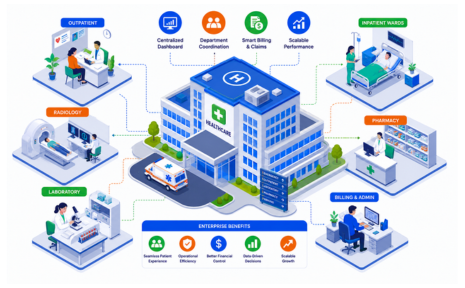
Badges are not architecture. What matters is role-based access scoped to the job rather than the department, encryption at rest and in transit, and an immutable audit trail that records who opened which record and when. Access reviews run quarterly, not at go-live. We sign a BAA, we test before release rather than after, and we hand you the evidence your compliance officer will ask for.
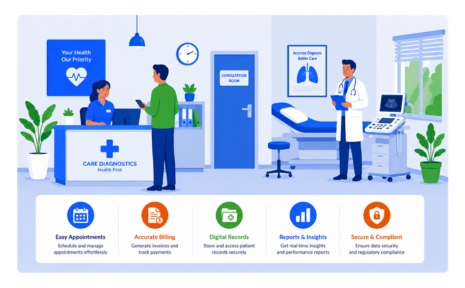
This is the question with a deadline attached. CMS-0057-F requires impacted payers to run four FHIR APIs by January 1, 2027, and providers are expected to submit prior authorization electronically from the 2027 reporting period. We build HL7 v2 interfaces for lab and radiology traffic and FHIR R4 for everything modern, and we inventory every integration in discovery so nothing surfaces in month five.
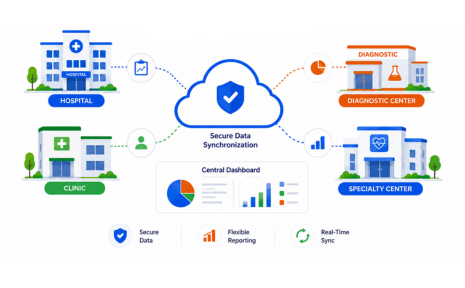
Hospitals do not close, so downtime planning is a build requirement rather than a support policy. That means read-only downtime views that keep working when the primary system does not, printed contingency forms your staff has already rehearsed, and a documented recovery procedure with a named owner. Our support agreements carry response times in writing, tiered by severity, with a path to an engineer rather than a queue.
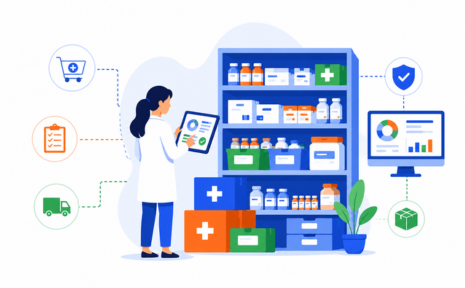
This is where most HMS projects quietly fail. Software gets installed, staff builds workarounds, and two years later the paper log is back. Black Book Research found that nurses lose close to 40% of a shift to documentation, so every extra click has a cost. We test screens with the people who will use them, train by role rather than by module, and staff the floor during cutover.
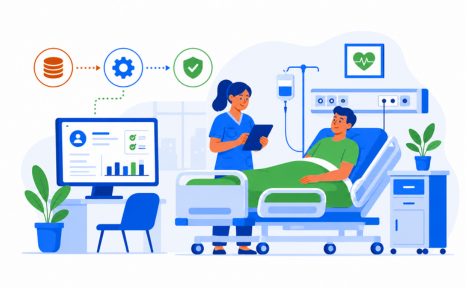
Software that works at 30 beds behaves differently at 300. The failures show up in concurrency at shift change, in OT scheduling conflicts, and in pharmacy reconciliation when three departments touch the same stock. Nabhaya HMS runs in hospitals of 100+ beds daily, which is where we learned this. Multi-facility adds another layer: shared master data, separate reporting, and one patient identity across sites.
On a custom build, yes. Source code, database schema, and documentation transfer to you at every milestone, not at final payment, so you are never one dispute away from losing your platform. IP is assigned in the contract, not promised in a call. On the Nabhaya HMS, you license the product and own your data outright, with a documented export in open formats whenever you ask for it.
Every vendor in this category will tell you to build. We have both a product and a development team, which means we have a commercial reason to recommend either one. That is exactly why we run the comparison on your numbers before we quote. Three outcomes are possible, and one of them means you don’t hire us.

A custom build earns its cost when your model is the reason patients choose you. Specialty hospitals with workflows with no product are anticipated. Groups planning to license the platform to peers. Organizations where the software becomes an asset on the balance sheet rather than a line in the operating budget. If none of that describes you, custom is usually the expensive way to get what a configured product already does.

If your requirements look like most hospitals’ requirements, you are paying for a rebuild of solved problems. Nabhaya HMS already handles admissions, beds, pharmacy, labs, and billing in facilities of 100+ beds, and the configuration covers more than buyers expect. You go live sooner on software other hospitals have already broken, and we have already fixed it. The trade is real: we hold the roadmap, and you license rather than own.
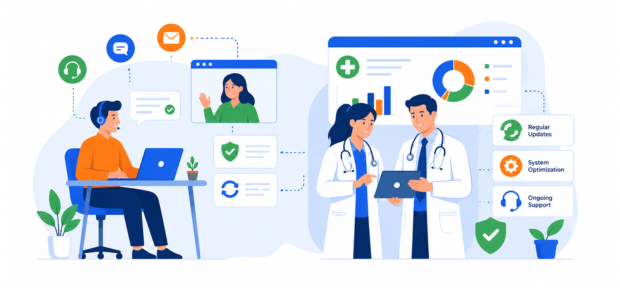
If you already run Epic, Oracle Health, or Meditech and the gap is one department, replacing the whole system is the wrong project. A module and a clean interface cost a fraction and carry a fraction of the risk. That recommendation costs us the larger contract, and we make it anyway. Getting this right is why hospitals come back for the bigger project later.
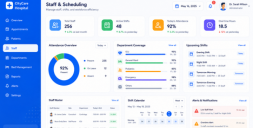
Almost nobody buys the whole stack at once, and the hospitals that try usually regret it. The HMS goes in first because everything else reads from it. Then the pieces that touch patients and staff get added, one budget cycle at a time. These are the ones hospitals ask us for most, in roughly the order they ask.
Every app added after the HMS inherits its data model, its auth, and its audit trail. Build them on the same foundation, and integration is a configuration task. Build them separately, with different vendors, and you are paying to reconcile three versions of the same patient.
Video visits that write back to the same chart. Scheduling, consent, waiting room, and documentation, so a virtual encounter is not a second system to reconcile.
Where patients book, pay, and read results without calling the front desk. Every call it removes is staff time back, and portal adoption is measurable from week one.
The clinical record itself: notes, orders, e-prescribing, decision support. Built to interoperate rather than to lock you in, with FHIR R4 endpoints from day one.
Claims, coding, denials, and appeals in one worklist. The module that pays for the rest of the project if it moves your clean claim rate a few points.
Referral sources, patient outreach, and follow-up campaigns that respect PHI rules. Most hospitals run this on a generic CRM and quietly break compliance doing it.
Length of stay, denial trends, bed utilization, and department margin in one place. Board-ready numbers that come from the source system rather than a monthly spreadsheet.
These are the questions we get asked most, answered the way we’d answer them on a call. The security, uptime, and ownership questions are handled in more depth further up the page. Everything below covers the practical parts: cost, timelines, what an HMS actually is, and how to pick a partner.