



















Next.js development services for sites that load fast and rank

Our Next.js development services are for businesses whose website or web app has to load fast and be found: marketing sites, storefronts, content platforms and SaaS products. We build on Next.js 16 with the App Router, choose how each page renders, and set up metadata, structured data and Core Web Vitals monitoring from the first sprint.

  • 120+clients served
  • 4.8
    189 reviews
  • 1.6 yrsaverage client relationship
app/blog/page.tsxtests
  1. export default async function Page() {
  2. const posts = await getPosts();
  3. return <PostList posts={posts} />;
  4. }
  • Tests passing
  • Code reviewed
  • Deployed to staging

120+ businesses chose us for their digital growth

  • AkosMD Hospital
  • Amita Naithani Resort Wear
  • Momentus Real Estate Group
  • CleverBoss
  • MastersBuddy
  • Foley Mansfield
  • Pomegranate Health
  • Trunk Box Baby
  • Hunt Ortmann
  • Immigration Desk
  • Urology Partners
  • Jodi Carlton
  • Ecom Fashion
  • Eye on Security
  • Disability Solutions
  • One400
  • Eric Originals
  • Sabulski Window Tinting
  • History of Soccer

Next.js development at a glance

Next.js development is building websites and web apps with Next.js, the open-source React framework created by Vercel. Next.js development services cover architecture, choosing how each page renders, data fetching and caching, APIs, SEO metadata, performance, hosting setup and upgrades.

  • Next.js 16.4 recommends Cache Components for every app and turns them on in new projects.
  • Rendering is chosen per route and, with Cache Components, per component: static, revalidated, per request or streamed.
  • Server-rendered HTML reaches crawlers that do not run JavaScript, including major AI crawlers.
  • Vercel is optional: Next.js runs on any Node.js server or in Docker.
Best for
Marketing sites, ecommerce, content-heavy sites and SaaS products where speed and search traffic matter
What you get
Rendering plan, App Router build, CMS and API integrations, SEO metadata, monitoring, documentation and handover
Typical timeline
Marketing sites in about 4 to 8 weeks, sooner for a site of a few pages. Storefronts and web apps in about 8 to 16 weeks for a first release. Migrations depend on page count.
Pricing
Driven by templates, integrations, content migration and hosting. Published agency rates we reviewed for a dedicated Next.js developer run about $1,500 to $6,500 a month. Our website projects run from under $1,000 to $30,000+, depending on scope. We quote after a free scoping call.

What our Next.js development services include

A new site starts with the first three; an existing app usually starts with upgrades and caching.

Get a free proposal

Next.js websites and web apps

We build on the App Router with TypeScript, using Server Components by default and Client Components only where a page needs interaction. We follow the current release, Next.js 16.4, which ships React 19.3 and turns on Cache Components in new projects. Apps entirely behind a login go to our React development team, on Vite.
Rendering and caching strategy

Each route gets the cheapest rendering that keeps it fresh: prerendered, regenerated when content changes, rendered per request, or a static shell with personalized parts streamed in. With Cache Components we mark cacheable parts with "use cache", and use ensureStatic so a dynamic widget cannot quietly make a fast page slow.

Technical SEO built into the build

The Metadata API sets titles, descriptions, canonical URLs, hreflang alternates and Open Graph tags for every route, and we generate the sitemap, robots rules and JSON-LD from the same content. Our technical SEO services team reviews staging before launch, so SEO is built into the templates, not patched on later.

Headless CMS and commerce integrations

We connect Next.js to Sanity, Contentful, Strapi, headless WordPress or the Shopify Storefront API, with draft previews so editors see changes before they go live. When an editor publishes, only the affected pages refresh. See our headless CMS development service for content modeling and editor training.

APIs, authentication and server logic

Route Handlers and Server Actions cover forms, webhooks and light APIs inside the same project, and proxy.ts (the replacement for middleware in Next.js 16) handles redirects and access checks. When the back end needs queues, heavy integrations or mobile clients, our Node.js development and API development teams build it as a separate service.

Upgrades, migrations and security patches

We move sites from the Pages Router, Create React App, Gatsby or a traditional CMS to the App Router, and upgrade older apps to Next.js 16, where Turbopack is the default bundler. Since July 2026 Next.js publishes pre-announced security releases roughly once a month, and our website maintenance plans apply them on schedule.

What Next.js changes for your traffic and conversions

Good Next.js web development services show up in what crawlers see, how fast pages feel on a phone, and how easily your team can publish.

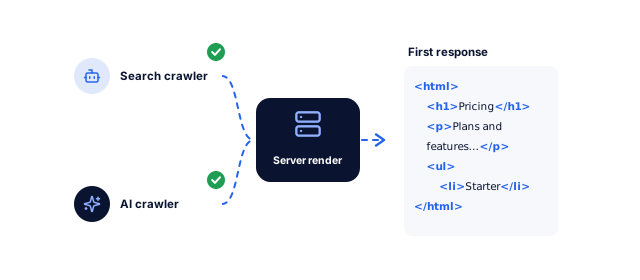
A search crawler and an AI crawler both receiving server-rendered HTML with the page content already in the first response

Content crawlers can read on the first request

Google renders JavaScript, but pages can wait in a render queue, and its own JavaScript SEO guide says server-side or pre-rendering is still a great idea because not all bots run JavaScript. A Vercel analysis found that major AI crawlers, including GPTBot and ClaudeBot, do not. Server-rendered Next.js pages put your content in the HTML for all of them.

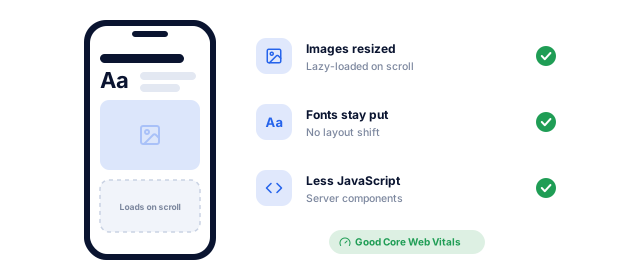
A page on a mid-range phone with resized, lazy-loaded images, fonts that load without shifting the layout and less JavaScript, giving good Core Web Vitals

Faster pages on real phones

Only 43% of mobile sites had good Core Web Vitals in the HTTP Archive Web Almanac 2024, against 54% on desktop. Next.js gives us the tools to close that gap: next/image resizes and lazy-loads images, next/font removes layout shift from web fonts, and Server Components keep JavaScript off pages that do not need it.

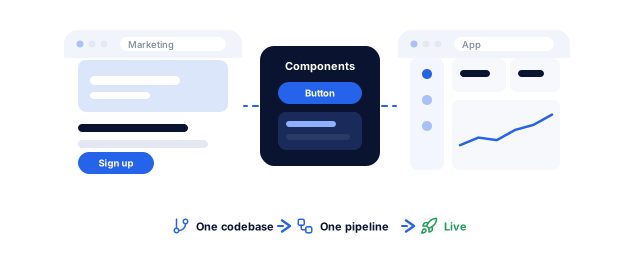
One codebase serving the marketing pages and the logged-in app from a shared component library, with one deployment pipeline

Marketing site and product in one codebase

Many companies run a marketing site on one platform and the product on another, with two design systems drifting apart. Next.js can serve both: static marketing pages and a logged-in app sharing one component library, one deployment pipeline and one set of analytics. Brand changes ship once.

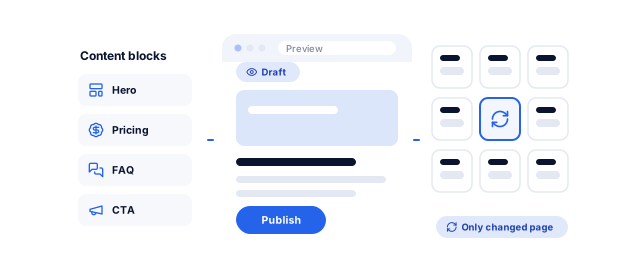
Editors building a page from structured content blocks, previewing the draft on the real design and publishing, with only the changed page refreshed

Editors publish without waiting for a developer

With a headless CMS behind Next.js, marketers create and update pages from structured content blocks, preview drafts on the real design, and publish when ready. On-demand revalidation refreshes only the pages that changed, so a large site does not need a full rebuild for every edit.

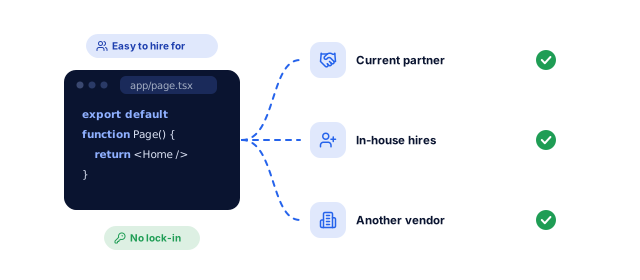
A widely used framework codebase that the current partner, new in-house hires or another vendor can all support, so you stay free to change

A framework many developers already know

In the 2026 Stack Overflow Developer Survey, 20.6% of the 10,281 developers who answered had done extensive work with Next.js in the past year, about one in five. That makes it easier to hire for, hand over and support than a niche framework, and keeps you free to change vendors.

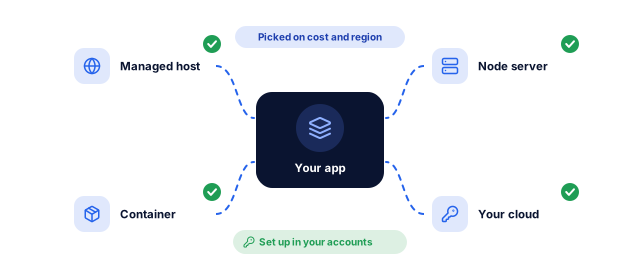
One app packaged to run on a managed platform, a Node.js server, a container or your own cloud account, chosen on cost, region and compliance

No lock-in to one host

Next.js runs on Vercel, but its deployment documentation confirms that a Node.js server or Docker container supports every feature. Since Next.js 16.2, a stable Adapter API gives Netlify, Cloudflare and AWS a documented way to support it. We pick hosting on cost, region and compliance, and set it up in your accounts.

Is your current site slow, or invisible to search and AI tools?

Tell us what you need. We look at your current site and stack, and send a written plan for a Next.js build or fix, with a price range, a timeline and what we would do first.

What do you need?

Free, with no obligation. Rather talk? Book a 30-minute call

Our Next.js development process, from audit to launch

End-to-end Next.js development services, with developers and SEO specialists working together from the first week.

Book a strategy call
  1. Discovery and audit

    We agree goals, page types, integrations and who will edit content. For an existing site we crawl every URL and record Search Console, analytics and Core Web Vitals data as the baseline to beat.

    • Scope and page inventory
    • SEO and performance baseline
    • Estimate and release plan
    A plan built on your own data
  2. Rendering plan and architecture

    Each route type gets a rendering and caching decision, written down with the reason. We design the content model, choose the CMS and hosting, and plan data flow before any page is built.

    • Route-by-route rendering plan
    • Content model
    • Hosting and environment plan
    No expensive surprises later
  3. Design system and build

    We build components, then templates, then pages, in two-week sprints with pull request reviews and a staging link each sprint. Editors get the CMS early, so real content replaces placeholders long before launch.

    • Component library
    • Templates and pages on staging
    • Sprint demos
    Progress you can click through
  4. SEO, accessibility and performance checks

    We crawl staging with JavaScript off to confirm content is in the HTML, validate metadata and structured data, test against WCAG 2.2 AA, and run Lighthouse on every key template.

    • Crawl report
    • Structured data validation
    • Performance budget per template
    A site search engines can read
  5. Launch and migration

    For migrations we map every old URL to its new one with 301 redirects and test the map. Search Console and analytics are checked on launch day, with error tracking and real-user monitoring already live.

    • Redirect map and tests
    • Launch checklist
    • Monitoring dashboards
    Rankings and data carried over
  6. Monitor, upgrade and grow

    After launch we watch indexing, Core Web Vitals and errors, and apply Next.js security releases as announced. Keep a dedicated developer for features and upgrades, or take the code in-house with full documentation.

    • Monthly report
    • Security and upgrade plan
    • Handover or ongoing development
    A site that stays current

Next.js development for your type of site

Our Next.js app development services change with how your site makes money.

01 / 05

Marketing and lead generation sites

Service businesses need pages that load instantly, rank locally and turn visitors into calls and form fills. We prerender almost every page, handle forms with Server Actions connected to your CRM, and build campaign pages from reusable sections. See landing page development for campaign builds.

02 / 05

Ecommerce storefronts

A headless storefront pairs Shopify or another commerce platform with pages you fully control. Product pages are prerendered and revalidated when stock or prices change, while cart and checkout stay dynamic. Headless adds build and running costs, so when a theme covers what your store needs, our Shopify website development team builds on it, and Next.js can come later. Compare routes in ecommerce website development.

03 / 05

Content and publishing sites

Blogs, resource hubs and documentation sites with thousands of pages need fast builds and fresh content. We regenerate only the pages that changed, generate sitemaps automatically and give editors structured content blocks. Our content marketing team can plan the content itself.

04 / 05

SaaS products and web apps

One Next.js project can hold your marketing pages, pricing, docs and the logged-in product, with authentication and API calls handled on the server. Public pages stay static and indexable; dashboards render per user. For billing, multi-tenancy and admin tools, see web app development and SaaS application development.

05 / 05

International and multi-language sites

Next.js supports locale-based routing through dynamic route segments, and the Metadata API outputs hreflang alternates for each language and region. We set up a URL structure per market, manage translations through the CMS and give each locale its own sitemap entries. Our international SEO services team handles local keyword research.

Next.js rendering options compared

Each route can render differently, and the choice drives speed, hosting cost and what crawlers see.

Book a strategy call
ApproachHow it worksWhat crawlers seeBest forHosting needs
Static prerenderingHTML built once at build time and served from a CDNFull HTML on the first requestMarketing pages, docs, landing pagesAny static host or CDN
Incremental Static RegenerationStatic pages refreshed on a schedule or when content changesFull HTML; may be briefly staleProduct, category and article pagesNode.js server, Docker or a platform adapter
Request-time renderingHTML rendered on the server for every requestFull HTML, always currentSearch results, personalized or fast-changing pagesNode.js server, Docker or a platform adapter; more compute
Cache Components with streamingStatic shell served at once, dynamic parts streamed in the same responseStatic content in the HTML; dynamic parts followPages mixing shared content with user-specific partsNode.js server, Docker or a platform adapter
Client-side renderingBrowser builds the page with JavaScript after loadLittle content for crawlers that do not run JavaScriptScreens behind a loginAny host; static export works

Based on the Next.js documentation for deploying and Incremental Static Regeneration, and the Next.js 16.4 release notes. Static export does not support Incremental Static Regeneration or other server features.

Your Next.js project, week by week

A typical 8-week marketing site; a site of a few pages needs fewer build weeks, and storefronts and web apps follow the same phases over 8 to 16 weeks.

Book a strategy call
  1. 1Weeks 1 to 2

    Audit and rendering plan

    • Page inventory, goals and integrations agreed
    • SEO and Core Web Vitals baseline from your own data
    • Rendering and caching decision for each route
    • From you: Search Console, analytics and CMS access, brand assets

    By week 2, you have a written plan, a content model and an estimate.

  2. 2Weeks 3 to 6

    Components, templates and pages

    • Component library first, then templates, then pages
    • CMS set up early so editors load real content
    • A staging link and demo every two weeks
    • From you: page copy, images and feedback on each demo

    By week 6, every template works on staging with real content.

  3. 3Weeks 7 to 8

    Checks and launch

    • Staging crawled with JavaScript off; metadata and structured data validated
    • WCAG 2.2 AA and Lighthouse checks on each template
    • 301 redirect map tested for every old URL
    • From you: final approval and domain or DNS access

    By week 8, the site is live, with Search Console and analytics checked the same day.

What you sign off, step by step

You approve each stage before the next one starts, and the project ends with a site you own and the documents to run it.

Along the way you get

  • A sitemap and plan before any design
  • Designs and builds for you to approve, step by step
  • A staging site to test before anything goes live
  • Speed, accessibility and SEO checks before launch
Release checklistSample
  1. 1Architecture and API planApproved
  2. 2Repository and CI pipelineSet up
  3. 3Automated testsPassing
  4. 4Staging environmentLive
  5. 5Security reviewPassed
  6. 6Performance budgetMet
  7. 7DocumentationWritten
  8. 8Handover sessionBooked
A sample of the checklist. Every project gets its own, signed off with you.

Yours to keep, always. Everything is set up in your name, and if you leave we remove our access and hand over the documentation.

  • Code and repository
  • Domain and hosting accounts
  • CMS admin and content
  • Design files
  • Documentation and logins

Who Next.js development from improveFX is for

We build Next.js sites and apps for businesses that win customers through search and speed, and match any part it does not suit to the right improveFX service.

Book a strategy call

A good fit if

  • Your pages need search traffic and fast loads on phones
  • You run a marketing site, storefront, content site or SaaS product
  • You want SEO planned into the build, not added after launch
  • You want the code and hosting accounts in your own name

We can also help when

  • You need a few pages live fast: we build a small Next.js site, or a lean WordPress or Webflow site, on a short timeline
  • Your app lives entirely behind a login: our React team builds it on Vite, which is simpler to host
  • A standard theme already covers your store: our Shopify team builds on it, and headless can follow if you outgrow it
  • Your editors rely on WordPress: we keep it as a headless CMS behind Next.js, so they keep the editor they know

Why choose improveFX as your Next.js development company

01

Developers and SEO specialists on one team

Our Next.js development services are usually bought for speed and search traffic. Our 25+ in-house specialists in New Delhi include developers and SEO specialists, so rendering, metadata, redirects and Core Web Vitals are planned together, never passed to freelancers.

02

Your code, hosting and accounts

The repository sits in your GitHub or GitLab organization, and Vercel, AWS or other hosting accounts are registered to you, with our access added to yours. We work on rolling agreements with transparent monthly reporting on releases, performance and hosting costs, and if you leave, everything stays with you, documented.

03

Migrations handled with search in mind

Replatforming is where rankings are most often lost. In our Eric Originals case study, a Shopify migration planned together with SEO was followed by a 1,900% rise in organic traffic. We apply the same redirect and content discipline to Next.js migrations. Across 170+ projects for 120+ clients, we are rated 4.9 on Clutch from 221 reviews.

Results we can put numbers on

Results from our website and software projects, with the full story behind each number.

See all case studies
Eric OriginalsJewelry ecommerce

+1,900%

organic traffic

A struggling jewelry website became a steady source of buyers

Read the case study
Momentus Real Estate GroupReal estate

210%

more qualified leads

Website, SEO, Google Ads and Business Profile working as one

Read the review
MastersBuddyStudy abroad consulting

160+

keywords in Google's top 10

A new consultancy broke into one of India's most competitive markets

Read the case study

What our website clients say

"From designing a high-converting website to managing our SEO, Google Ads, and Google Business Profile, improveFX delivered exceptional results across every channel."
210%more qualified leads
185%organic and local traffic growth
92%keywords on page one
Maureen CappalloBroker and founder, Momentus Real Estate Group
"They revolutionized our online presence with a 60% increase in web traffic through strategic e-commerce SEO and content optimization."
60%more organic traffic
47%more sales
Eric NoahPresident, Eric Originals & Antiques Ltd.
"Visionstar Technologies' online presence transformed significantly with a 40% boost in customer engagement, all thanks to their exceptional website structuring and SEO tactics."
+40%qualified leads
32%lower cost per acquisition
Thomas MorelFounder, Visionstar Technologies
"Their strategic approach to our website and SEO resulted in a 60% increase in local inquiries, revolutionizing our automobile service business."
60%more local inquiries
87%more organic traffic
Mike SteffanFounder, Sabulski Window Tinting
"Their SEO strategy helped us achieve top search rankings, while their Facebook Ads campaigns drove a steady flow of qualified prospects."
55%more organic traffic
4.7xreturn on ad spend
75%keywords on page one
Amita NaithaniCo-founder, Amita Naithani Resort Wear

Next.js development questions, answered

Not seeing yours? Ask us directly and a specialist will reply personally.

How much do Next.js development services cost?

Cost depends on the number of templates, integrations, content to migrate and the engagement model. Published agency rates we reviewed for a dedicated Next.js developer run about $1,500 to $6,500 a month.

A few templates with forms and a CMS sit at the low end; a storefront with search, customer accounts and ERP sync at the high end. Fixed-scope projects are priced per release after a free scoping call. Hosting is billed separately by your provider and depends on traffic and how much rendering happens per request.

How long does Next.js website development take?

A marketing site usually takes about 4 to 8 weeks; a storefront or web app about 8 to 16 weeks for a first release.

Migrations depend on page count, redirects and content clean-up. Ready designs, a chosen CMS and clean source content shorten the schedule; custom integrations and approval rounds lengthen it. You see progress on a staging link every two weeks.

Is Next.js good for SEO?

Yes, when pages are rendered on the server or at build time. Crawlers then get the full content in the HTML without running JavaScript.

Next.js also provides the Metadata API for titles, canonicals and hreflang, image and font optimization for Core Web Vitals, and file-based sitemaps. None of it ranks a page alone; content and links still matter, which is where our technical SEO services come in.

What is the difference between React and Next.js?

React is a library for building user interfaces. Next.js, sometimes written NextJS, is a React framework that adds routing, server rendering, caching, image optimization and API routes.

If your app lives entirely behind a login, plain React with Vite may be simpler and cheaper to host. If public pages need to rank and load fast, Next.js usually fits better. Our React development team builds both, often sharing one component library.

Do I have to host Next.js on Vercel?

No. Next.js runs on any Node.js server or in a Docker container with every feature, and can be exported as a static site with fewer features.

Vercel, the company behind Next.js, offers the simplest setup. AWS, Google Cloud, Netlify and Cloudflare are common alternatives, made more consistent by the Adapter API, stable since Next.js 16.2. We compare cost, regions and compliance with you.

Can you migrate our site to Next.js without losing rankings?

Yes, if the migration is planned around search from the start. Most ranking losses after a migration come from missing redirects, changed URLs and lost content.

We crawl the old site, map every URL to its new home with 301 redirects, keep titles and content that already rank, and check Search Console daily after launch. Some short-term movement is normal; we cannot guarantee rankings, but we can remove the avoidable risks.

Should we use the App Router or the Pages Router?

Use the App Router for new projects. Server Components, Cache Components and the newest caching and navigation features are built for it.

The Pages Router is still supported, so a working Pages Router site does not need an urgent rewrite. We usually migrate in stages: new sections go into the App Router while older pages keep working, and the rest move as they need changes.

Can I hire dedicated Next.js developers from improveFX?

Yes. You can hire a dedicated Next.js developer or a small team who works only on your product, billed monthly.

You can also extend your existing team with one or two of our engineers, or buy Next.js development services as a fixed-scope project at an agreed price. All our developers are in-house employees in New Delhi, not contractors, working on rolling agreements.

Which version of Next.js do you build on?

New projects start on the current release, Next.js 16.4 as of October 2026, with Cache Components enabled, which the Next.js team now recommends for every app.

Next.js 17 is expected to make Cache Components the default. Existing apps on Next.js 13, 14 or 15 can be upgraded in steps, with Next.js 16's breaking changes, such as async params and proxy.ts, tested on staging one at a time.

How do I choose a Next.js development agency?

Ask how they decide rendering per page, how they protect rankings during a migration, and who owns the code and hosting. Clear answers matter more than a long portfolio.

A good Next.js website development agency can show a staging site that works with JavaScript disabled, explain its caching choices in plain words, and name the version it builds on. Also ask how security releases are applied after launch.

Ready to plan your website?

Tell us what you need built, or book a strategy call with our team.

  • What we would build, and on which platform
  • A price range and timeline for your budget
  • A call with a specialist to plan the next steps, no obligation
Vikash Kumar PalRoshan Kumar JhaAbhishek Kumar Jha A specialist replies personally 4.9 from 566 client reviews
What do you need help with?

Pick all that apply.

Next, a few details about your business on our contact page. It takes about a minute.

Prefer to talk now? Book a strategy call