improveFX builds predictive data analytics services around one question: what decision changes when you know what’s coming? Our data scientists audit your data, model the outcome that matters (churn, demand, credit risk, parts usage), then push scores into the CRM, ERP, or dashboard your team already opens. You get forecasts people act on, not another report.
Companies that chose us for their digital transformation

















Some teams come to us with a clean warehouse and a use case ready to model. Others have spreadsheets and a hunch. Both are fine starting points. Our predictive analytics consulting services break into four engagements you can take separately or run end-to-end, from a two-week readiness assessment through to fully managed predictive analytics as a service once your models are live.

We audit your data, score which use cases are actually modelable, and hand you a costed roadmap ranked by business value, not technical novelty.

Our data scientists build and validate forecasting models on your data, then prove each one outperforms your current process before anything reaches production.

We wire predictions into Salesforce, HubSpot, your ERP, or support desk, so the people making the decision see the score in context.

Ongoing monitoring, drift alerts, and scheduled retraining on a monthly retainer, so accuracy holds as your customers, pricing, and market shift.
The algorithm is rarely the hard part. What changes by industry is the data you can legally use, the cost of a wrong prediction, and how fast someone has to act on it. A churn model for a bank carries regulatory weight a retailer never will. Here’s how we approach predictive data analytics services in the five sectors where clients see returns soonest.
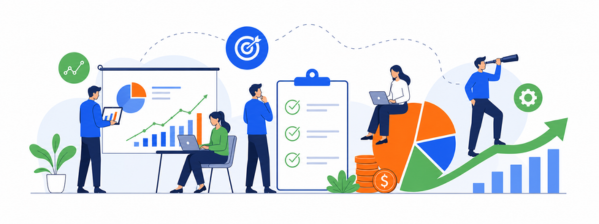
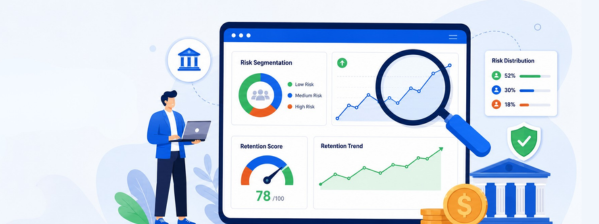
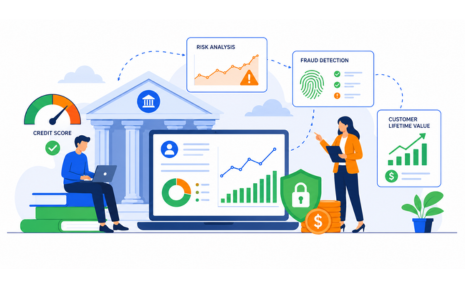
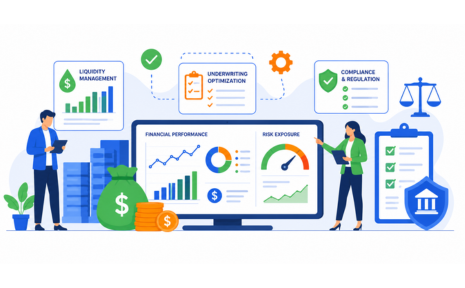
Credit risk scoring, transaction fraud detection, deposit attrition, and collections prioritization. Predictive analytics for banking and financial services carries a burden retail models don’t: every decline needs a defensible reason. We build with explainable methods like gradient-boosted trees paired with SHAP attribution, document feature lineage for model risk review, and keep adverse action reasoning traceable back to the input that drove it.
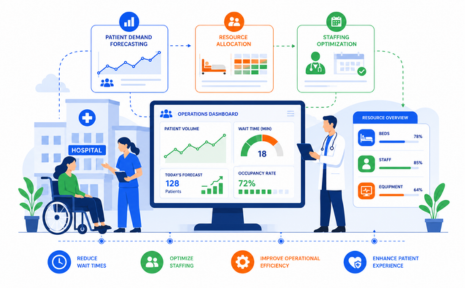
Readmission risk, appointment no-shows, bed and staffing demand, and medication stockouts. Healthcare predictive analytics consulting lives or dies on two things: PHI handling that survives a HIPAA audit and clinician trust. We work inside de-identified environments wherever possible, validate against clinical outcomes rather than statistical scores alone, and surface predictions in the EHR workflow so nobody has to open a second system mid-shift.
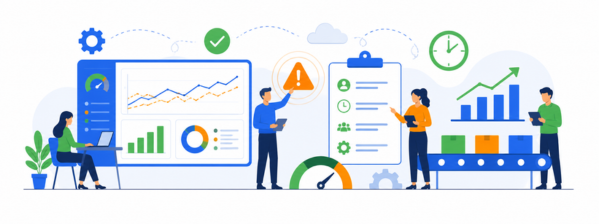
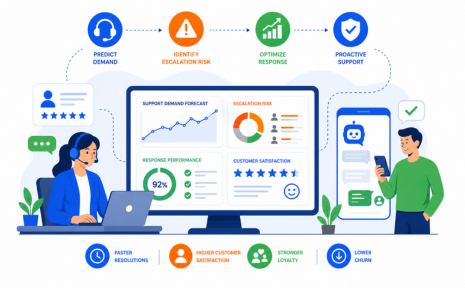
Support data is the most underused predictive asset most companies own. Predictive analytics in customer service forecasts ticket volume by channel so staffing matches demand, flags which open tickets will escalate before they do, and scores which accounts are quietly heading for cancellation. We push those signals into Zendesk, Intercom, or Freshdesk as queue priority, so agents act on them without changing how they work.
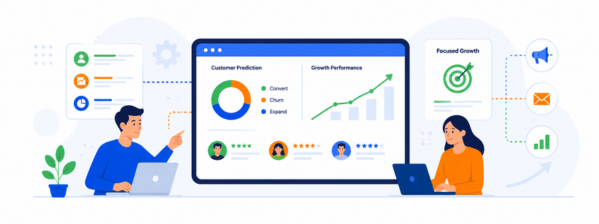
SKU-level demand forecasting, lifetime value modeling, next-best-offer, and markdown timing. Our predictive analytics marketing services also answer the question most attribution tools dodge: which channel will return the most on the next dollar, not the last one. We combine first-party purchase history with campaign data to forecast incremental revenue by channel, then feed budget recommendations back into your ad platforms weekly.
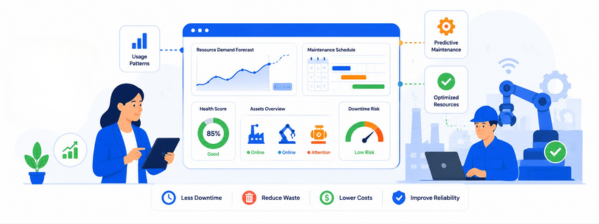
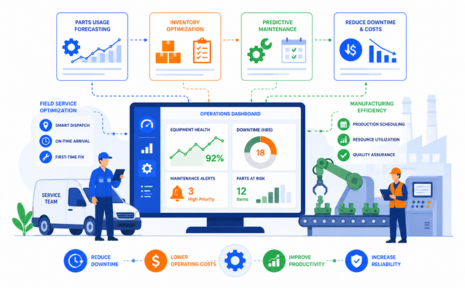
Field service teams lose margin in two ways: parts sitting in a warehouse and a second truck roll because the tech arrived without the right part. Predictive analytics for parts usage in a service business forecasts consumption by part, region, and equipment age, then sets van stock levels accordingly. The payoff shows up twice: a higher first-time fix rate and less cash tied up in shelves and vans.
Get a free proposal with real numbers, honest timelines, and no lock-in. Judge us on that.
Most predictive data analytics service projects fail quietly after the budget is spent. Ours are built to fail early and cheaply, or not at all. Two checkpoints in this process exist purely to end the engagement if the data won’t support a reliable forecast or if the model can’t beat what you’re already doing.

We start with the decision, not the data. Who acts on this forecast, what do they do differently, and what is that worth? If nobody can answer, we don't model it.
We profile your sources for volume, history depth, label quality, and gaps. You get a written verdict: ready to model, fixable in weeks, or not viable yet. Stopping here costs you two weeks.
Before we build anything, we measure how accurate your current process already is, whether that's a planner's spreadsheet or gut feel. That number becomes the bar every model has to clear.
We train candidate models and test them on data they've never seen, reporting MAPE for forecasts or precision and recall for classification. If none beats your baseline, we say so, and you stop there.
Scores go into the system your team already uses, with the reason codes behind them. A rep sees why an account is flagged, not just a number, so they trust it enough to act.
We watch for data drift and accuracy decay, retrain on a set schedule, and review performance with you quarterly. Models degrade as markets move. Yours gets maintained like the asset it is.
There’s no single predictive model, only the right one for a specific question. Choosing well is most of the job, and it’s what separates the best data analytics service for business predictions from a team that reaches for a neural network by default. Here’s what we use, and the business question each one is built to answer.
Demand, revenue, ticket volume, cash flow, and parts consumption. Anything measured repeatedly over time. We use methods like Prophet, ARIMA, and gradient-boosted regressors depending on how seasonal and noisy your history is. The main requirement is depth: two to three years of clean history lets a model separate real seasonality from noise. Accuracy is reported as MAPE against your current forecast.
Churn risk, credit default, fraud, lead conversion, and ticket escalation. Classification scores each record with a probability rather than a yes or no, which matters because it lets you set your own threshold. A retention team chasing the top 5% of risk needs a different cutoff than one chasing the top 30%. We tune that with you, using precision and recall, not accuracy alone.
Predictive customer segmentation groups accounts by how they actually behave rather than by the personas marketing wrote three years ago. Clustering surfaces segments nobody defined in advance, which is usually where the interesting ones hide. It’s often the first useful output of an engagement, because it needs no labeled outcome data and gives teams something to act on within weeks.
Fraudulent transactions, equipment about to fail, a supplier quietly drifting out of spec. Anomaly detection works when the thing you’re looking for is rare and you don’t have many examples of it, which breaks most classification approaches. We build it where the cost of missing an event is high, and the cost of a false alarm is manageable, and we tune that balance explicitly.
Product recommendations, cross-sell prompts, and next-best-offer for a rep on a call. These models learn from what similar customers did next, then rank options by expected value rather than raw likelihood. The distinction matters: recommending the thing someone was going to buy anyway looks great in a dashboard and adds nothing. We optimize for incremental revenue instead. It’s a harder target and a more honest one.
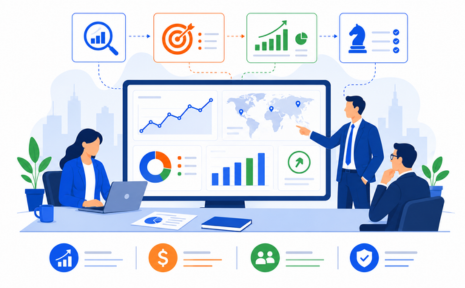
When a prediction affects credit, employment, insurance, or care, the model has to justify itself. We favor methods that stay interpretable, like regularized regression and gradient-boosted trees with SHAP attribution, over deep learning that can’t show its reasoning. You get per-decision factor breakdowns your compliance team can document, and your customers can be told. In regulated work, that’s not a preference. It’s the requirement.
A predictive model is only half the work. The other half is acting on it, and that’s where being a marketing and engineering team changes things. The people building your churn score also know what a retention campaign costs to run, so what we build is shaped by what you can actually do with it.
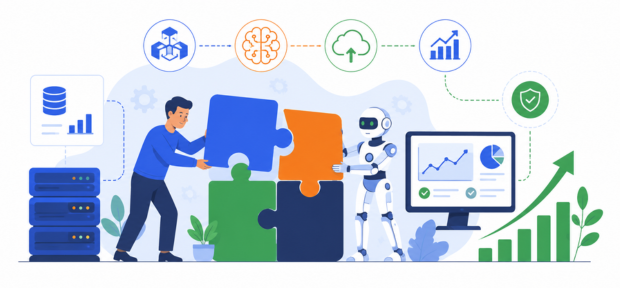
Our data scientists sit alongside the people who run paid media, email, and CRM for the same clients. When a model flags a churn risk, the retention sequence that responds to it is built by someone down the hall. There is no handoff between the team that predicts and the team that acts, which is usually what decides whether predictive analytics solutions and services turn into revenue.
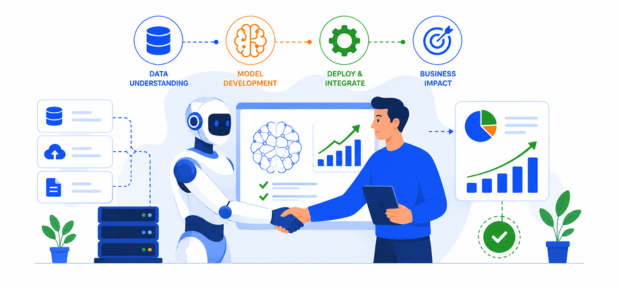
You’ll work with the same data scientist who scoped your project through to the day it goes live. We’re 25 specialists, not 250, and that’s deliberate. The person who understands your business on day one is the same person building on day thirty, and decisions get made in a Slack thread rather than a change request queue. It’s the main reason projects here move quickly.
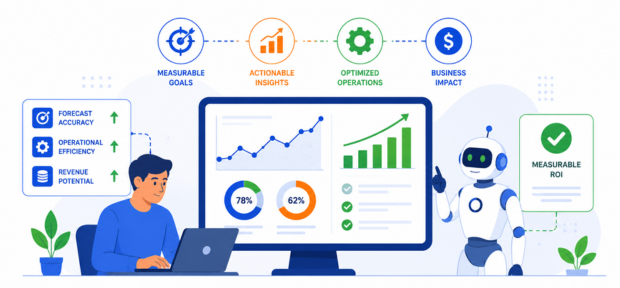
Every engagement runs under an NDA with scoped, revocable access to only the systems a model needs. We work inside your own cloud environment wherever you’d prefer, and we don’t feed client data into third-party AI tools to train anything. Models, code, and documentation transfer to your repository at handover, so nothing you paid for lives somewhere you can’t reach.
A forecast gets more useful when something acts on it. A churn score paired with an automated retention sequence beats a churn score in a report. These are the AI and machine learning services we build alongside predictive models, most often in the same engagement, and each one is a place a prediction can go to work.
Most clients begin with one model and one use case, then add the layer that acts on it once the forecast proves out. Nothing here requires a platform rebuild, and each service works on its own if that’s all you need right now.
A dedicated churn model scores every account by cancellation risk and the reasons behind it, so retention effort goes to the customers who can still be saved.
We turn reviews, support tickets, and survey text into structured signals, giving churn and satisfaction models the qualitative inputs that raw numbers alone will never capture.
Chatbots that know what a customer is likely to do next, routing high-risk accounts to a human and handling routine questions without one. Predictions make deflection smarter.
Custom ML beyond forecasting: image classification, document extraction, matching engines, and the models that don't fit a standard predictive analytics brief. If your problem is unusual, it starts here.
The layer that makes a prediction act. Scores trigger sequences, task assignments, and alerts automatically, so nobody has to notice a dashboard changed. This is where forecasts become routine operations.
When predictions need a home your off-the-shelf CRM can't provide, we build the system around them, with scores, reason codes, and actions in one place.
These are the questions that come up on almost every discovery call, answered the way we’d answer them on the call. If yours isn’t here, ask us. We’d rather give you a straight answer now than have it come up later.