
Heuristic evaluation
Key journeys reviewed against Jakob Nielsen's 10 usability heuristics and platform conventions. Each issue is logged with a screenshot, the principle it breaks and a severity rating.
Our UX audit services find where people struggle on your website or app, why, and which fixes matter most. You get a written audit report: every finding with evidence, a severity score and a recommended fix, ranked by impact and effort. Where targeted fixes do the job, we can build them; where a journey needs more, the audit becomes the redesign brief.
 4.9
 Written by Supriya Karmakar, Content Writer


















A UX audit is a structured review of a website or app that finds usability, accessibility and conversion problems. Our UX audit services combine expert review, analytics, usability testing and WCAG 2.2 checks into a fix list with evidence for each finding.
Six methods, each finding different problems, mixed to fit your goals, traffic and budget.
Get a free proposalKey journeys reviewed against Jakob Nielsen's 10 usability heuristics and platform conventions. Each issue is logged with a screenshot, the principle it breaks and a severity rating.
We check tracking, then use GA4 funnels, Search Console and product data to find where people drop off. Microsoft Clarity or Hotjar recordings show what they did there.
Automated scans with axe, WAVE and Lighthouse, plus keyboard and screen reader tests with NVDA and VoiceOver, including the newer WCAG 2.2 criteria such as target size. Findings map to success criteria.
People from your audience attempt real tasks while thinking aloud. We measure task success and time, and clip the moments they get stuck.
Core Web Vitals (LCP, INP and CLS), plus key journeys tested on real phones: tap targets, form keyboards, sticky elements and shifting layouts.
Labels, hierarchy, copy, trust signals, pricing clarity, forms and calls to action, benchmarked against the competitors your customers compare.
An audit is worth paying for only if it changes what your team builds next.
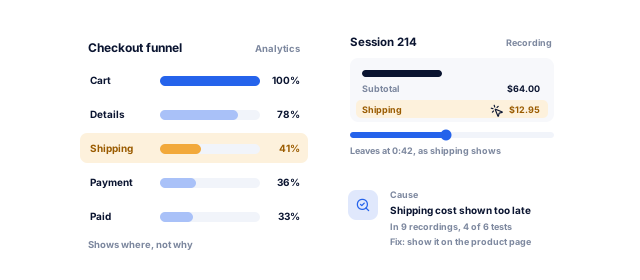
Analytics shows that visitors abandon step two of checkout. Recordings and testing show why, such as a shipping cost shown too late, so a drop-off becomes a fixable cause.
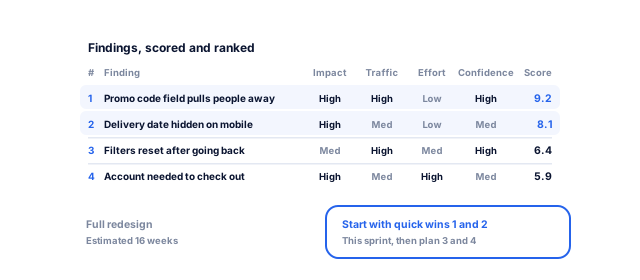
Every finding is scored for impact, traffic, effort and confidence. Where a few targeted fixes do the job, we start there; where a journey needs rethinking, we design it.
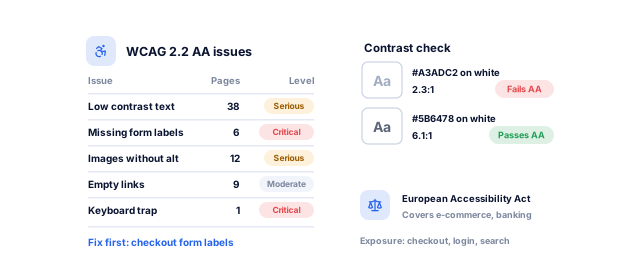
The WebAIM Million 2026 found detectable WCAG failures on 95.9% of the top one million home pages, with low-contrast text on 83.9%. The European Accessibility Act covers services such as e-commerce and banking. We show your exposure and what to fix first.
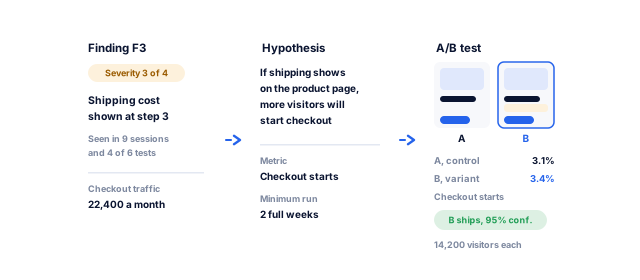
Findings become the backlog for conversion rate optimization: clear hypotheses, A/B tested where traffic allows, so you learn which changes move sign-ups, leads or sales.
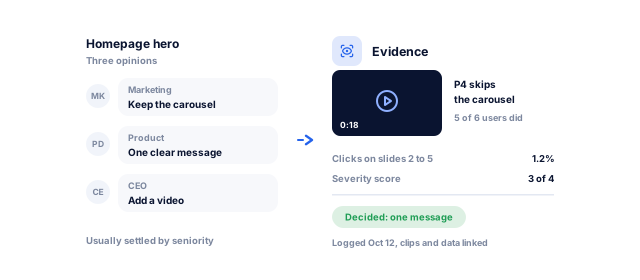
Clips of real users, funnel data and severity scores give marketing, product and leadership the same facts, so decisions get faster.
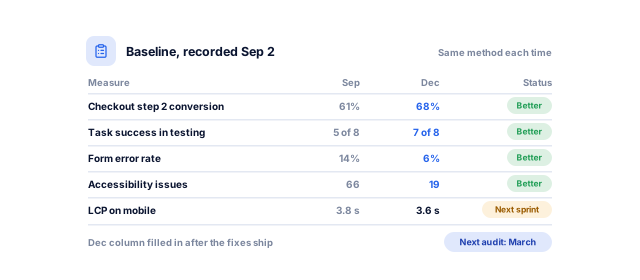
We record conversion by step, task success, errors, accessibility issues and Core Web Vitals. After fixes ship, the same measures show what improved.
Tell us which journey worries you most. We take a first look and tell you in writing whether targeted fixes or a redesign makes more sense, with a price range and timeline for either.
Six steps, and you see findings as they emerge rather than only at the end.
Book a strategy callWe agree what success looks like, such as more completed checkouts, and confirm journeys, devices and methods in writing.
We check that GA4 records events correctly, analyze funnels and device splits, and review recordings at the drop-off points.
Reviewers run the heuristic evaluation while an accessibility specialist tests against WCAG 2.2, logging every issue with evidence.
Where scope includes testing, people who match your audience complete task-based sessions, and clips confirm or challenge the expert findings.
Findings are scored for severity, traffic, effort and confidence, ranked on an impact and effort matrix, and walked through live.
Your team or ours builds the fixes. We review the work against the findings, then re-test against the baseline.
The journeys that matter depend on what you sell and how people use it.
Search, filters, product pages, cart and checkout, checked for surprises such as late shipping costs or forced sign-up. Our Shopify website team can build the fixes. See our ecommerce work.
Sign-up, onboarding, the first moment of value, errors and empty states. Our SaaS development team can ship the changes. More on our SaaS work.
Does a visitor understand the offer, trust you and finish the form? We review proof, calls to action and forms field by field, often on high-traffic landing pages.
Navigation, gestures, permission requests and offline states against iOS and Android conventions, tested on real devices with VoiceOver and TalkBack. Our app UI/UX design team redesigns the screens.
Booking flows, forms and portals checked for clarity, error recovery, text size and plain language. We build healthcare software ourselves in Nabhaya Clinic. See our healthcare work.
No single method finds every problem, so we combine at least three.
Book a strategy call| Method | What it finds | What it misses | Typical effort | Tools we use |
|---|---|---|---|---|
| Heuristic evaluation | Breaks of usability principles, quickly | How your real users behave | 2 to 5 days | Nielsen's heuristics, Figma |
| Analytics and funnel review | Where people drop off, and how many | Why they leave | 2 to 4 days | GA4, Search Console |
| Recordings and heatmaps | Rage clicks, dead clicks, form struggles | Intent and expectations | 2 to 3 days | Microsoft Clarity, Hotjar |
| Usability testing | Why people struggle, in their words | How often it happens at scale | 1 to 3 weeks with recruitment | Moderated and unmoderated sessions |
| Accessibility audit | Barriers for keyboard, screen reader and low-vision users | Problems unrelated to access | 3 to 10 days | axe, WAVE, Lighthouse, NVDA, VoiceOver |
| Performance and mobile review | Slow, unstable or hard-to-tap pages | Content and flow problems | 1 to 2 days | PageSpeed Insights, real devices |
Effort ranges are our typical estimates for three to five key journeys; larger products take longer.
An expert review takes 1 to 2 weeks; with testing and a full accessibility review, 3 to 6.
Book a strategy callBy the end of week 1, you know where people drop off.
By the end of this phase, every finding has evidence behind it.
By the final week, you have a ranked fix list and a baseline to measure against.
You approve each stage before the next one starts, and every file we make is yours to keep and edit.
Yours to keep, always. Everything is set up in your name, and if you leave we remove our access and hand over the documentation.
For teams that want to know what to fix first, and why.
Book a strategy callAudits are run by designers, developers and conversion specialists who work on website UI/UX design every week, so each fix is specific enough to build and realistic about effort.
Every finding ties to a heuristic, a WCAG criterion, a data point or a user clip. We say plainly when evidence is weak, and never pad the report.
You keep the report, recordings and data. Our team can design and build the fixes, keep the site healthy through website maintenance and re-test against the baseline.
These numbers come from our SEO, marketing and software work. Design results come from testing with real users or comparing two page versions.
See all case studies
Eric OriginalsJewelry ecommerce
+1,900%
organic traffic
MastersBuddyStudy abroad consulting
160+
keywords in Google's top 10
AkosMDHealthcare, Arizona
+57%
patient footfall
"From designing a high-converting website to managing our SEO, Google Ads, and Google Business Profile, improveFX delivered exceptional results across every channel."
 Maureen CappalloBroker and founder, Momentus Real Estate Group
"They revolutionized our online presence with a 60% increase in web traffic through strategic e-commerce SEO and content optimization."
 Eric NoahPresident, Eric Originals & Antiques Ltd.
"Visionstar Technologies' online presence transformed significantly with a 40% boost in customer engagement, all thanks to their exceptional website structuring and SEO tactics."
"Their strategic approach to our website and SEO resulted in a 60% increase in local inquiries, revolutionizing our automobile service business."
"Their SEO strategy helped us achieve top search rankings, while their Facebook Ads campaigns drove a steady flow of qualified prospects."
 Amita NaithaniCo-founder, Amita Naithani Resort Wear
Ask us anything else, or tell us which journey worries you most.
A UX audit from $1,000. Our design projects run from under $500 to $10,000+, depending on scope.
One or two key journeys reviewed by experts sit at the low end. More journeys or platforms, usability testing with recruited participants and a full WCAG 2.2 review push it higher; participant incentives and paid testing tools may cost extra. Before you pay, we can redesign one problem screen as a free sample concept.
An expert review of key journeys usually takes 1 to 2 weeks. An audit with usability testing and a full accessibility review usually takes 3 to 6 weeks.
Recruiting test participants is often the longest step, especially for specialist B2B or healthcare audiences. Quick access to analytics, a staging site and the people who know the product shortens everything, and we share findings as we go.
Every finding with its evidence, the heuristic or WCAG criterion it breaks, a severity score, an effort estimate and a recommended fix, ranked on an impact and effort matrix.
It opens with a one-page summary and the top fixes, then findings by journey, marked on screenshots. You also get session clips, raw data, baseline measures and a live walkthrough, and you keep everything.
Usability testing is one method. A UX audit is the wider review that can include it, alongside a heuristic evaluation against Jakob Nielsen's 10 usability heuristics, analytics, and accessibility and performance checks.
Testing shows why real users struggle, but with a small group and a few tasks. Expert review and analytics cover the whole product quickly and show scale. We combine at least three methods, so you get both breadth and explanation.
Ours does. We check against WCAG 2.2 with automated scans plus manual keyboard and screen reader testing. WCAG 2.2 AA is the target we check against, not a legal certification.
A light review covers key journeys and common failures such as low contrast, missing alt text and unlabeled fields. A full audit checks every template against each AA success criterion, the level most accessibility laws reference.
Read-only access to GA4 and Google Search Console, a login or test account for any gated areas, and ideally a staging site.
If you use Microsoft Clarity, Hotjar or product analytics, read access helps; if not, we can set up Clarity, which is free, and collect a few weeks of recordings. Past research, customer feedback and support tickets often point straight at the problems.
Start with the audit. It tells you what is actually broken, so any redesign fixes real problems instead of repainting them.
Where the audit finds a handful of high-impact issues, we ship targeted fixes, which is faster and cheaper. Where it finds structural problems, such as navigation that does not match how customers think, our designers run the redesign with the audit as its brief, so none of the research is wasted.
Yes. Our designers and developers design and build the fixes, or review your own team's work against the findings.
Quick wins such as copy, form fields and contrast can often ship within days. Larger changes go through design and testing first, with two rounds of revisions at each stage. After release, we re-test the affected journeys against the audit baseline, so you see what each change achieved.
Tell us what you need designed, or book a strategy call with our team.


 A specialist replies personally 4.9 from 566 client reviews