We design websites, SaaS platforms, and mobile app interfaces around real user research, session data, and conversion goals. Every screen ships as a documented design system your developers can build without guesswork. You get UI/UX design services that reduce friction, lift conversions, and keep improving after launch, backed by measurement rather than opinion.
Companies that chose us for their digital transformation



















Most teams do not come to us because their website looks dated. They come because something measurable is broken: visitors leave before converting, developers rebuild the same components twice, or nobody can explain why a layout was chosen. Our UI/UX design services start by identifying which of these is costing you the most, then fix the cause rather than the symptom. Here are the four we are asked to solve most often.

You are paying for visitors who bounce before acting. We redesign the paths to conversion using session data, heatmaps, and tested layouts that hold attention.

Layouts chosen by preference invite endless revisions. Our website UI/UX design work is grounded in user interviews, analytics, and usability testing, so approvals move faster.

Handoff gaps create design debt and rebuilt components. We deliver documented design systems and responsive specs, then support your engineers until the build matches.

Slow, inaccessible interfaces cost users and rankings. Our mobile UI/UX design work meets WCAG 2.2 AA standards and protects your Core Web Vitals scores.
Most projects start in one place and grow into another. A website redesign uncovers a dashboard problem, or a mobile app needs to match the site it came from. We structure our UI/UX design services so those pieces stay connected: one research base, one design system, and one team. Below is what each engagement covers, what you receive, and where it typically fits.
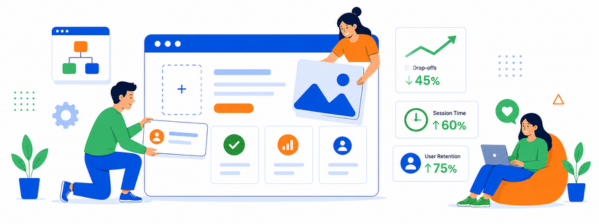
This is where most engagements begin. We audit how visitors currently move through your site, then rebuild the structure around the actions that matter: navigation, page hierarchy, forms, and calls to action. You get wireframes, responsive high-fidelity screens, and a component library covering every breakpoint. Website UI/UX design here is judged on conversion and task completion, not on how the homepage looks in a portfolio.
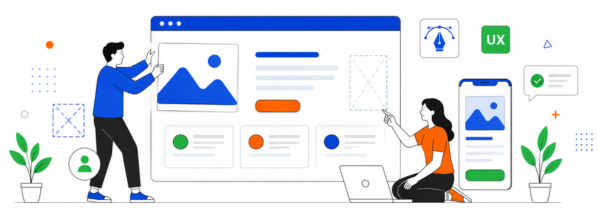
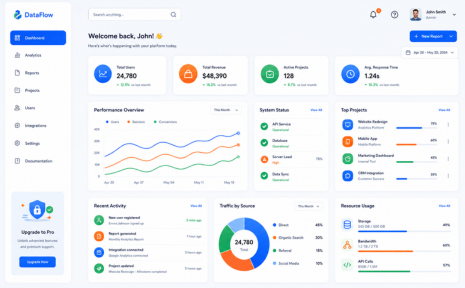
Complex products fail quietly. Users stop using features they cannot find, and churn shows up two quarters later. Our SaaS UI/UX design services focus on information architecture, data density, and onboarding flows that get users to first value quickly. We map real workflows with your customer-facing teams, simplify permission and settings layers, and design dashboards that stay readable as your feature set expands.
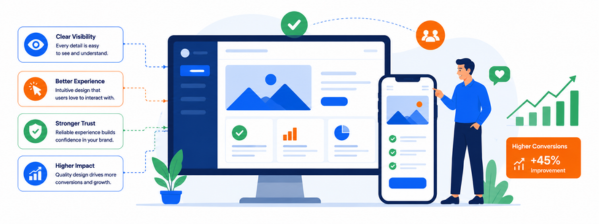
Phone screens punish anything unclear. Our mobile app UI/UX design services cover both iOS and Android conventions, thumb-reach layouts, offline and error states, and the small interactions that make an app feel finished. We design against real device constraints rather than desktop mockups scaled down, and we deliver assets and specs your development team can implement without translating our intent.
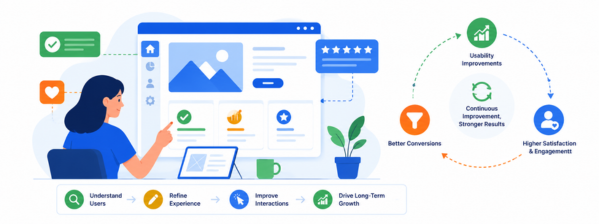
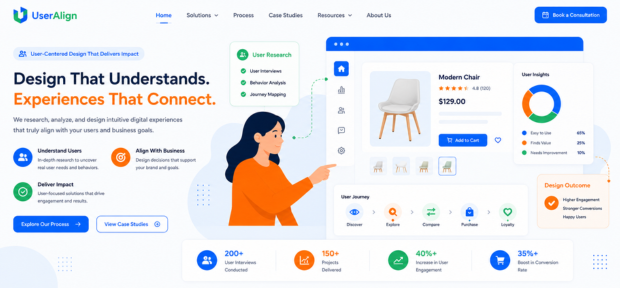
Every extra step between product and payment costs revenue. For e-commerce businesses, we redesign category browsing, filtering, product pages, cart, and checkout as one continuous path, then validate it with usability testing before launch. We also design the parts most stores neglect: search results, out-of-stock states, returns, and post-purchase screens that decide whether a first order ever becomes a second.
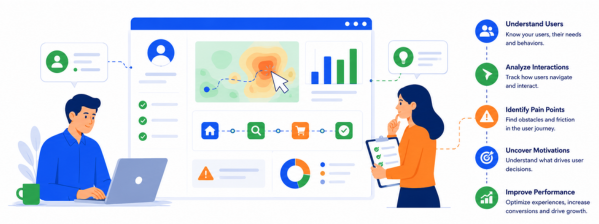
Sometimes you need a decision, not a deliverable. Our UX and UI design consulting services give you an audit of what is failing and why, backed by user interviews, heuristic review, analytics, and moderated usability sessions. You receive a prioritized findings document with effort and impact scoring, so your team can act on the highest-value fixes immediately, with or without our design work attached.
A design file is not a product. We build design systems with named tokens, documented components, states, and usage rules, so your interface stays consistent as more people contribute to it. Because we also run development inhouse, our UI/UX design and development services close the usual gap: our designers stay involved through the build, review the frontend against the spec, and fix mismatches before release.
Get a free proposal with real numbers, honest timelines, and no lock-in. Judge us on that.
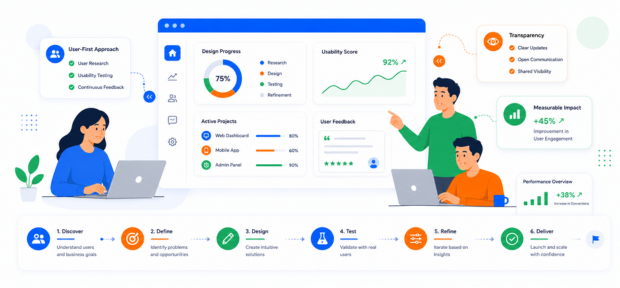
Our UI/UX design process follows the same six steps on every engagement, so you always know what is being produced, what we need from you, and when. Each step ends with a deliverable you review and approve before we move forward. Nothing is built on assumptions, and no phase runs longer than the work requires.
We review your current site or product, analytics, and support tickets to find where users drop off. You get a documented list of friction points ranked by revenue impact before any design starts.
We interview your customers and internal teams, then validate what we hear against behavioral data. This produces the personas, journey maps, and evidence base that every later design decision is measured against.

We restructure navigation, page hierarchy, and user flows, then build low-fidelity wireframes for every key screen. Structure gets approved here, while changes are still cheap and fast to make, not after visual design begins.

We apply your brand to high-fidelity screens across every breakpoint, then package the result as a design system with tokens, components, and states your team can reuse indefinitely without redrawing anything from scratch.
Interactive prototypes go in front of real users before development. We fix what testing exposes and run every screen against WCAG 2.2 AA, so compliance is not a post-launch retrofit.

Our designers stay through development, reviewing the front end against the spec. After launch, we track conversion, task completion, and Core Web Vitals, then recommend the next round of improvements.
Design patterns that work for a retail checkout fail in a clinical dashboard. Rather than claim every vertical, we list the industries where we have shipped repeatedly and understand the constraints, the regulations, and the users. If yours is not here, tell us anyway, and we will say honestly whether we are the right fit.
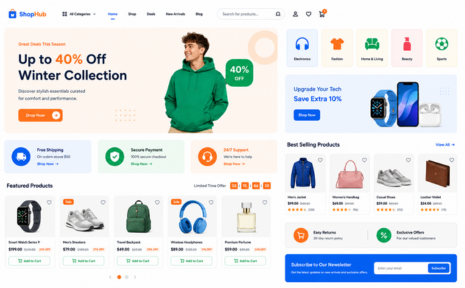
Feature-rich products lose users at the same three places: signup, first configuration, and the moment a workflow spans more than one screen. Our SaaS UI/UX design services target those points specifically. We design onboarding that reaches first value quickly, settings and permissions that non-technical users can navigate, and dashboards that hold up when your data volume triples. Design decisions are validated with your customer success team, not assumed.
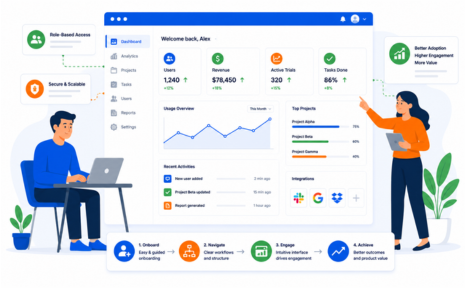
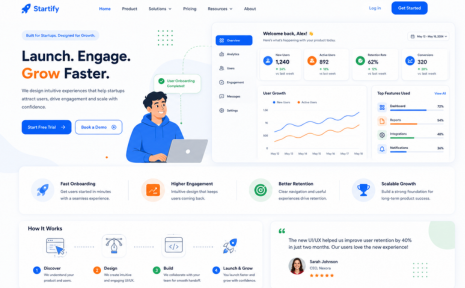
B2B buyers research quietly and rarely decide alone. B2B website UX/UI design has to serve a technical evaluator, a finance approver, and an end user on the same page without confusing any of them. We structure content hierarchy, proof placement, and lead capture around that reality, and we design the gated resources, pricing pages, and demo flows that carry a long sales cycle.
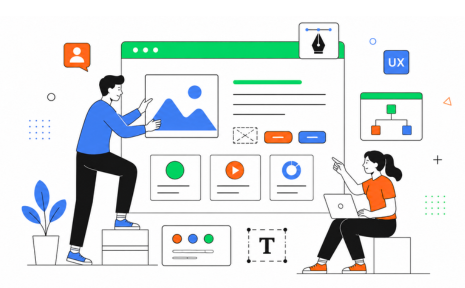
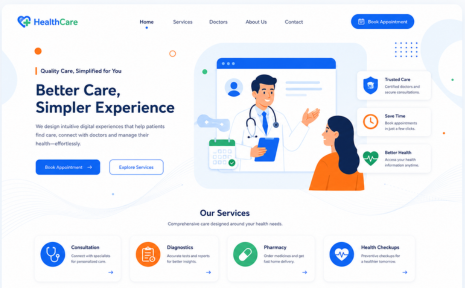
Clinical users work under time pressure and cannot afford ambiguity. Our UI/UX design services for healthcare applications prioritize error prevention, legible data density, and clear consent and privacy flows. We design patient portals, appointment systems, and provider dashboards with HIPAA-conscious information handling and WCAG 2.2 AA accessibility, then test with the real people who will use them under load.
Most storefronts win or lose the sale on a phone screen. For e-commerce businesses we design around catalog scale, so filtering stays usable at ten products or ten thousand, and around trust, so shipping costs, returns policies, and reviews appear before hesitation sets in. We also design the repeat-purchase surfaces most stores ignore: account areas, reorder flows, and subscription management that quietly drives lifetime value.
Property search is a filtering problem disguised as a browsing problem. We design map and list views that stay fast with large inventories, comparison tools that help buyers shortlist without spreadsheets, and inquiry flows that capture intent at the exact moment it appears. Agent-side dashboards get the same attention, since listings only stay accurate when updating them takes seconds rather than minutes.
Learners abandon courses in the gap between enrolling and starting. We design onboarding, progress tracking, and lesson navigation that keep momentum, plus instructor and admin views that make course creation manageable. Accessibility is non-negotiable here, so every interface we ship meets WCAG 2.2 AA and works with keyboard navigation and screen readers from day one. We also design for shared and low-bandwidth devices, which is how many learners attend.
Most agencies on your shortlist can produce good-looking screens. The differences show up later: when the build begins, when the numbers come in, and when you want to change something without calling anyone. The three below come from how our company is structured, not from promises made on a sales call.
Design studios hand over a file and leave. Because our UI/UX design and development services sit in one company, your designers review the front end as it is built, answer questions in the same channel as your engineers, and catch mismatches before release rather than in a QA ticket. Nothing gets lost in translation, because there is no translation step.
A redesign is a hypothesis until data confirms it. We instrument the interfaces we design, then track conversion rate, task completion, drop-off points, and Core Web Vitals against the baseline we recorded before work started. You receive a post-launch report with what improved, what did not, and what we recommend changing next. Design accountability does not end at the handoff.
Every file, component, and design token we produce belongs to you, documented well enough that another team could pick it up tomorrow. We do not hold source files hostage or build dependencies that require us. Engage us for a single project, a monthly retainer, or as an extension of your in-house team, and change that arrangement whenever your roadmap changes.
A website is rarely the only place your brand meets a customer. The app, the campaign landing page, the onboarding email, and the ad creative all carry the same interface language, or they quietly contradict it. These design services run on the same system we build for your site, handled by the same team.
Recognition is what makes a second visit feel familiar and a third one feel trusted. When your site, app, landing pages, and emails are built from one component library, that consistency happens automatically instead of being policed. It also cuts production time on everything you make afterward.
The mobile counterpart to your website work. We extend the same design system into native app patterns, so users moving between web and app never have to relearn anything.
A structured review of your current interface against usability heuristics, accessibility standards, and conversion data. Useful when you suspect a problem but cannot yet name it.
Single-purpose pages designed around one conversion goal, built to match your paid campaigns rather than your site navigation, and shipped fast enough to test while the campaign runs.
Responsive templates that render correctly in Outlook as well as everywhere else, using your existing type scale and colors so campaigns look like the site they link to.
Post and ad creative drawn from the same visual system, sized correctly for each platform, and templated so your marketing team can produce new variations without a designer.
The build step for everything above. Our developers work from the design system we deliver, so the live site matches the approved screens instead of drifting during implementation.
These are the questions that come up most often on first calls, answered the way we would answer them on the phone. If yours is not here, ask us directly. You will get a straight answer before anyone sends you a proposal and a free UX teardown of your current site if you want one.