
















NLP development services that turn messy text into usable data

Our NLP development services are for teams buried in text: support tickets, emails, contracts, claims, reviews, call transcripts and internal documents. We build natural language processing systems that classify, extract, search and summarize that text, using large language models where they help and smaller, cheaper models where they are enough, and we measure accuracy on your own documents before anything goes live.

  • 170+projects delivered
  • 25+in-house specialists in New Delhi
  • 4.9
    221 reviews
Inbox: sorted automatically1,240 today
Refund requestOrder #5521BillingRouted
Contract renewalClause 7.2 flaggedLegalReview
Delivery delayCustomer emailSupportRouted
Invoice INV-993Amount and due date foundFinanceExtracted
What it handles
  • Sorted by topic and urgency
  • Key fields pulled from documents
  • Spot-checked by a person

120+ businesses chose us for their digital growth

  • AkosMD Hospital
  • Amita Naithani Resort Wear
  • Momentus Real Estate Group
  • CleverBoss
  • MastersBuddy
  • Foley Mansfield
  • Pomegranate Health
  • Trunk Box Baby
  • Hunt Ortmann
  • Immigration Desk
  • Urology Partners
  • Jodi Carlton
  • Ecom Fashion
  • Eye on Security
  • Disability Solutions
  • One400
  • Eric Originals
  • Sabulski Window Tinting
  • History of Soccer

NLP solutions at a glance

Natural language processing (NLP) is the branch of AI that lets software read, sort and write human language. NLP development services build systems that classify text, extract names, dates and amounts, search documents by meaning and summarize them, then connect the results to your workflows, so people stop reading and retyping text by hand.

  • A labeled test set from your own data decides which approach wins, not a vendor demo.
  • LLMs are quick to prototype but cost more per document; smaller models often win at high volume.
  • Measure precision and recall per category or field, not one overall accuracy figure.
  • Decide where your data may be processed before you choose a model provider.
Best for
Teams handling large volumes of emails, tickets, documents, reviews or transcripts, in one language or several
What you get
Evaluation set, working NLP pipeline, integration with your systems, accuracy report, monitoring and documentation
Typical timeline
A proof of concept on your data in 4 to 6 weeks. Production systems typically take 3 to 6 months, depending on integrations and languages.
Pricing
Our AI projects run from under $5,000 to $100,000+, depending on scope. A fixed-price proof of concept on your own data starts from $3,000, so you see results before you commit to a build. Model usage is billed by the provider. Custom quote after a free use-case review.
Your data
A signed NDA before you share anything, a data processing agreement when you need one, a BAA for US patient data, and your data never trains any model outside your project.

What our NLP development services include

Six capabilities, combined around the text your team handles most. Evaluation and privacy run through all of them.

Get a free proposal

Text classification and routing

Tickets, emails, claims and forms are sorted by topic, intent, urgency and team on arrival, by a fine-tuned small model from Hugging Face or an LLM with worked examples, depending on volume and how stable your categories are. Low-confidence predictions go to a person, not the wrong queue.
Entity extraction and document processing

Named entity recognition, built with spaCy pipelines or LLM extraction, pulls names, dates, amounts, order numbers and clauses from emails, PDFs and scanned forms after OCR. Fields are checked against business rules and delivered as clean JSON to your ERP, CRM or database; uncertain fields go to a review queue, and our computer vision team helps with image-heavy documents.

Semantic search and RAG

Search by meaning across manuals, policies, contracts and past tickets. We index documents as embeddings in pgvector, Elasticsearch or a managed vector database, and use retrieval-augmented generation (RAG) to answer questions with links to the passages used, within your existing permissions.

LLM summarization

Call transcripts, email threads, case files and reports become short summaries in a template your team agrees, such as issue, actions and next step, grounded in the source and tested for omissions and invented details. For a conversational front end, see our chatbot development service.

Multilingual NLP

We detect each message's language, then process it in that language or translate first, whichever tests better. Accuracy is reported per language, because a model that works well in English can be weaker in Hindi, Arabic or Portuguese, and native speakers review samples where errors are costly.

Evaluation, privacy and monitoring

Every system ships with a labeled test set and a report of precision and recall per category or field. Personal data can be redacted before text reaches an external model, models run in the cloud region you choose, and weekly samples and alerts catch accuracy drops after launch.

What natural language processing solutions change in daily work

Good NLP removes repetitive reading, not judgment. These are the changes we design for and measure.

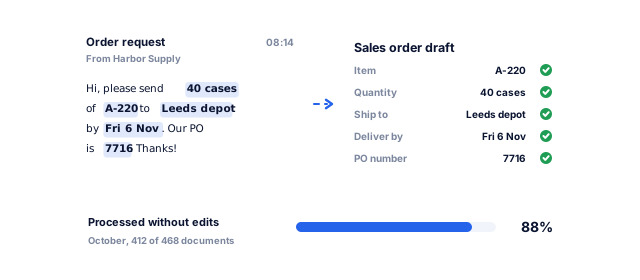
A customer email asking for an order with the item, quantity, depot, date and PO number highlighted, turned into a sales order draft that passes its checks, and the share of documents processed this month without edits

Less time reading and retyping

Teams that copy details from emails and PDFs into another system spend hours on work a pipeline does in seconds. Extraction with validation rules handles routine documents end to end, people review only the exceptions, and we count the share processed without edits, so time saved is measured.

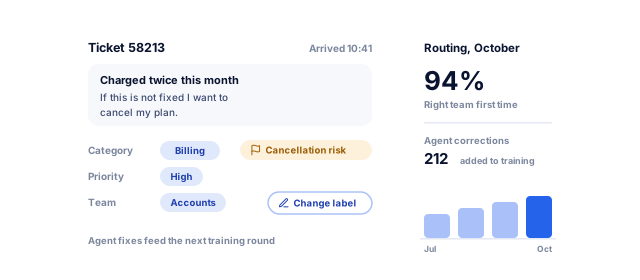
A support ticket labeled on arrival with its category, priority and team and flagged as a cancellation risk, with a one click way to correct a label, beside the monthly routing report and corrections fed into training

Tickets reach the right team first time

Misrouted tickets bounce between queues while customers wait. Classification on arrival sets category, priority and team and flags urgent issues such as cancellations. Routing accuracy is reported monthly, and agents' one-click corrections feed the next round of training.

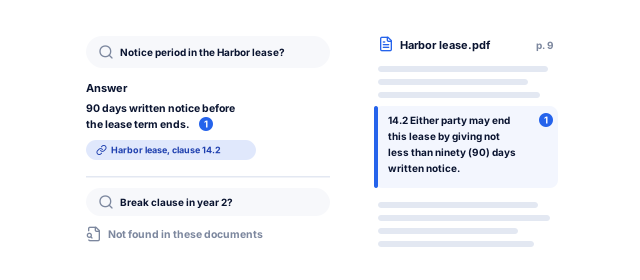
A question about a lease answered with a citation that opens the exact clause highlighted in the source document, and a second question answered with not found instead of a guess

Answers with sources, not guesses

Language models can state wrong answers confidently. A Stanford RegLab and HAI study found that even specialized legal research tools produced incorrect information more than 17% of the time. Our search and RAG systems cite the passage behind every answer and say "not found" rather than guess.

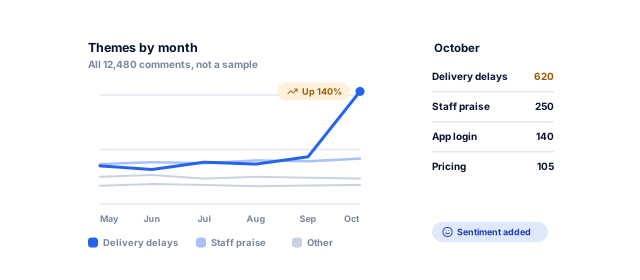
Every customer comment grouped into themes by month, with a delivery delays theme jumping sharply in October and flagged, beside October counts for each theme

Customer feedback measured, not sampled

Reviews, surveys and support conversations show what customers think, but few teams read more than a sample. Topic modeling groups every comment into themes you can track, with alerts when one suddenly grows. Our sentiment analysis services add how customers feel about each theme, and why.

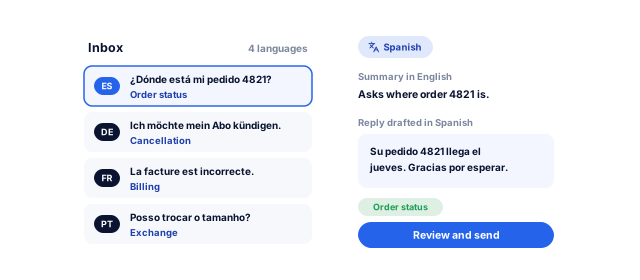
An inbox with messages in Spanish, German, French and Portuguese, each classified by topic, and the open message summarized in English with a reply drafted in Spanish for review

Service in more of your customers' languages

In a CSA Research survey of 8,709 consumers in 29 countries, 76% preferred to buy products with information in their native language, and 40% said they never buy from websites in other languages. Multilingual NLP lets a small team classify, answer and summarize messages in languages it does not speak.

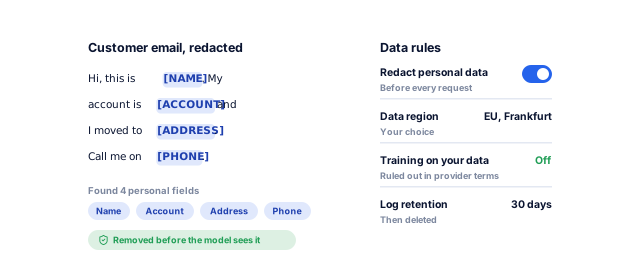
A customer email with the name, account number, address and phone number replaced by tokens before the text reaches the model, beside data rules for redaction, the data region, no training on customer data and log retention

Sensitive text handled under your rules

Contracts, medical notes and customer emails need care. We redact personal data where possible, keep processing in the geography you choose and use providers whose terms rule out training on your data, such as Azure OpenAI. Builds are designed for GDPR and UK GDPR, HIPAA for health records and India's DPDP Act.

Not sure whether you need an LLM or a simpler model?

Tell us what you need. We look at the text you handle and the work it creates, and send a written plan with the right approach, from a simple classifier to a language model, a price range and a timeline.

What do you need?

Free, with no obligation. Rather talk? Book a 30-minute call

Our NLP development process, from sample data to production

  1. Use case and data review

    We map the text you handle, the action that follows and where errors would hurt, check volumes, languages and personal or regulated data, and agree success in numbers your team cares about.

    • Use case brief
    • Data and privacy assessment
    • Success metrics agreed
    A clear target before any build
  2. Labeled evaluation set

    Your experts label a representative sample, usually a few hundred items, with guidelines we write together and fix wherever labelers disagree. This test set is the yardstick for every approach and stays with you.

    • Labeling guidelines
    • Labeled test set
    • Agreement check between labelers
    A fair way to compare approaches
  3. Prototype and compare

    We test the simplest approach that could work beside an LLM, measuring precision, recall, cost per document and speed on the same test set, failures included, so you choose with the trade-offs in view.

    • Prototype results
    • Cost per document estimate
    • Recommended approach
    Evidence for the build decision
  4. Build and integrate

    We build the pipeline: ingestion, OCR where needed, the model, validation rules, a review queue and outputs into your helpdesk, CRM, ERP or database through documented APIs, with logging and redaction built in.

    • Production pipeline
    • Integrations and API docs
    • Review queue for low-confidence items
    Text flowing into your systems automatically
  5. Pilot with human review

    The system runs on live traffic while people check its outputs for several weeks; we fix weak categories and set confidence thresholds so automation only handles what it handles well.

    • Pilot accuracy report
    • Tuned thresholds
    • Team training
    Proven accuracy on real traffic
  6. Monitor and improve

    Weekly sampling, your team's corrections and monthly reports keep accuracy visible. When new categories, products or languages appear, we update prompts or retrain and re-run the test set before release, tracking cost per document too.

    • Monthly accuracy report
    • Retraining or prompt updates
    • Change log
    Accuracy that holds as your text changes

NLP use cases by industry

The same building blocks apply everywhere; the documents, risks and rules differ by industry.

01 / 05

Customer support and contact centers

Support teams see the fastest return: tickets routed on arrival, suggested replies from your help center, call summaries in the CRM and recurring issues surfaced weekly. Pair it with sentiment analysis for customer mood and workflow automation for the follow-up actions.

02 / 05

Healthcare

Clinics and hospitals handle referral letters, discharge summaries, lab reports and patient messages. NLP extracts key details into the patient record, sorts messages by urgency and drafts summaries for clinicians to approve, with patient data kept in compliant infrastructure. See our Nabhaya Clinic software and our work for healthcare providers.

03 / 05

Legal and compliance

Law firms and compliance teams review contracts and correspondence for clauses, dates, parties and obligations. Extraction highlights renewal dates, liability caps and non-standard terms, search finds every contract with a given clause, and every item links to its source text for lawyers to review. See our work for legal businesses.

04 / 05

Ecommerce and retail

Retailers use NLP to clean product attributes from supplier descriptions, group reviews into themes such as sizing or delivery, and power site search that understands what shoppers mean. Better product data also helps your recommendation engine. See our work for ecommerce businesses.

05 / 05

Finance, insurance and back office

Invoices, claims, bank statements and onboarding documents arrive in many layouts. Document processing extracts the fields, checks them against your rules and sends only exceptions to a person, with every posted field linked to its source. Our invoice and billing automation work connects extraction to approval and payment.

Rules, classic machine learning or an LLM: which NLP approach fits?

Our NLP development services use rules, open-source tools such as spaCy and Hugging Face models, and LLM APIs, testing the cheapest option that could work first.

Book a strategy call
ApproachWorks well forCost and speedWatch out for
Rules and patterns (regular expressions, spaCy matchers)Fixed formats such as invoice numbers, dates and postcodesCheapest and instantBreaks when wording or layout changes
Classic machine learning (TF-IDF with logistic regression)High-volume text classification with stable categoriesLow cost; runs anywhereNeeds labeled examples for each category
Fine-tuned small transformer (BERT-family models from Hugging Face)Classification and entity extraction at volumeModerate to train; cheap to runNeeds labeled data and ongoing ML upkeep
LLM with prompts (GPT, Claude, Gemini)Prototypes, varied documents, summarizationFast to build; pay per useCost at high volume; output varies; can invent details
LLM with retrieval (RAG)Questions and search over your own documentsModerate; depends on document volumeAnswers are only as good as retrieval; needs citations and permissions
Self-hosted open-weight LLM (Llama, Mistral)Strict data residency or very high volumeInfrastructure cost instead of per-use feesNeeds GPU operations and its own evaluation

Rules of thumb from our own projects. We build any of these and often combine two; a test on your own labeled sample decides which.

Your NLP project, week by week

A proof of concept on your data first, then the production build.

Book a strategy call
  1. 1Weeks 1 to 2

    Use case and test set

    • Text sources, volumes, languages and personal data mapped
    • Success metrics agreed in numbers your team uses
    • Labeling guidelines written; a few hundred items labeled
    • From you: sample documents and experts to label them

    By week 2, you have a labeled test set to score every approach on.

  2. 2Weeks 3 to 6

    Proof of concept

    • Simplest workable approach tested beside an LLM
    • Precision and recall per field on unseen documents
    • Outputs checked against the source text
    • Cost per document and speed for each option
    • From you: a decision owner to choose the approach

    By week 6, you choose the approach with results on your own documents in front of you.

  3. 3Week 7 onward

    Build, pilot and handover

    • Production pipeline, review queue and integrations
    • Pilot on live traffic with human review
    • Confidence thresholds tuned and your team trained
    • From you: system access, reviewers and go-live sign-off

    Production systems typically go live within 3 to 6 months, with monthly accuracy reports after that.

What you sign off, step by step

You approve each stage before the next one starts, and nothing goes live until it beats the agreed baseline on data it has never seen.

Along the way you get

  • A test set of real questions before launch
  • Answers checked against your own sources
  • Guardrails tested with hard and off-topic questions
  • A person to hand over to when the assistant is unsure
Assistant go-live checklistSample
  1. 1Use cases and test questionsApproved
  2. 2Knowledge sources connectedDone
  3. 3Answer accuracy on the test setPassed
  4. 4Guardrails and refusalsTested
  5. 5Handoff to a personTested
  6. 6Privacy and security reviewPassed
  7. 7Channels liveLive
  8. 8Monitoring and answer reviewSet up
A sample of the checklist. Every project gets its own, signed off with you.

Yours to keep, always. Everything is set up in your name, and if you leave we remove our access and hand over the documentation.

  • Source code and repository
  • Trained models and prompts
  • Your data and its labels
  • Cloud and model provider accounts
  • Documentation and evaluation reports

Who NLP development from improveFX is for

We build NLP for teams that spend hours reading, sorting or retyping text.

Book a strategy call

A good fit if

  • Support teams sorting large volumes of tickets, emails or chats
  • Operations teams retyping data from PDFs, forms and invoices
  • Legal, compliance and insurance teams searching long documents
  • CX teams who want every review and survey comment read

We can also help when

  • No labeled data yet: we use labels already in your systems, and your experts label a few hundred more
  • A ready API or LLM prompt covers most of it: we set it up, test it on your sample and build only the gap
  • Data that cannot leave your environment: we redact it first or run an open-weight model on your servers
  • You need answers in conversation: our chatbot development team builds that on the same pipeline

Why work with improveFX as your NLP company

01

Evaluation before promises

We do not quote an accuracy figure before testing on your data. Every project starts with a labeled sample, compares at least two approaches and reports precision, recall and cost per document. If rules or a small model beat an LLM for your task, we build the cheaper option, even when an LLM would make a better demo.

02

Models, integrations and cloud in one team

An NLP model is a small part of a working system. Our 25+ in-house specialists also build the ingestion, review screens, APIs and cloud setup around it, so text moves from inbox to database without manual steps, with alerts when something fails.

03

Your data, prompts and code

Code, prompts, labels, test sets, fine-tuned models and evaluation reports belong to you and live in accounts you own. We work on rolling agreements with transparent monthly reporting. Clients in the US, UK, Canada, Australia, Europe and India rate us 4.9 on Clutch from 221 reviews and stay with us 1.6 years on average.

Results we can put numbers on

Numbers from our client work, measured in each client's own analytics. For NLP, your first numbers come from a proof of concept on your own documents, before you commit to a build.

See all case studies
MastersBuddyStudy abroad consulting

160+

keywords in Google's top 10

A new consultancy broke into one of India's most competitive markets

Read the case study
AkosMDHealthcare, Arizona

+57%

patient footfall

An Arizona hospital became the first call for urgent care

Read the case study
Eric OriginalsJewelry ecommerce

+1,900%

organic traffic

A struggling jewelry website became a steady source of buyers

Read the case study

What our clients say

"From designing a high-converting website to managing our SEO, Google Ads, and Google Business Profile, improveFX delivered exceptional results across every channel."
210%more qualified leads
185%organic and local traffic growth
92%keywords on page one
Maureen CappalloBroker and founder, Momentus Real Estate Group
"They revolutionized our online presence with a 60% increase in web traffic through strategic e-commerce SEO and content optimization."
60%more organic traffic
47%more sales
Eric NoahPresident, Eric Originals & Antiques Ltd.
"Visionstar Technologies' online presence transformed significantly with a 40% boost in customer engagement, all thanks to their exceptional website structuring and SEO tactics."
+40%qualified leads
32%lower cost per acquisition
Thomas MorelFounder, Visionstar Technologies
"Their strategic approach to our website and SEO resulted in a 60% increase in local inquiries, revolutionizing our automobile service business."
60%more local inquiries
87%more organic traffic
Mike SteffanFounder, Sabulski Window Tinting
"Their SEO strategy helped us achieve top search rankings, while their Facebook Ads campaigns drove a steady flow of qualified prospects."
55%more organic traffic
4.7xreturn on ad spend
75%keywords on page one
Amita NaithaniCo-founder, Amita Naithani Resort Wear

NLP questions, answered

Not seeing yours? Ask us directly and a specialist will reply personally.

What do NLP development services include?

NLP development services include text classification, entity extraction, document processing, semantic search, summarization and multilingual processing, plus the evaluation, integration and monitoring around them.

A typical project combines two or three of these around one workflow, such as routing support tickets or extracting fields from claims. We scope around the text you handle and test on your data before building.

How much do natural language processing solutions cost?

Our AI projects run from under $5,000 to $100,000+, depending on scope. A fixed-price proof of concept on your own data starts from $3,000, so you see results before you commit to a build. A single classifier on clean, already-labeled text in one language sits toward the lower end; many fields or languages, scanned documents, several integrations and strict compliance move it higher.

Running costs are LLM usage or GPU hosting, billed by the provider, plus monitoring. At high volume a small fine-tuned model can cost far less to run than an LLM, so our proposal shows both costs for each option.

How long does an NLP project take?

A proof of concept on your data usually takes 4 to 6 weeks. A production system with integrations typically takes 3 to 6 months.

Labeling the test set and connecting to your systems take more time than the model itself. Each extra language adds evaluation work. Projects move faster when a subject expert on your side can answer labeling questions within a day or two.

Do we need an LLM, or is a simpler NLP model enough?

Often a simpler model is enough. For classification with stable categories and high volume, a small fine-tuned model is usually cheaper and more consistent than an LLM.

LLMs shine with varied documents, summarization, open questions and little labeled data. Many systems mix both: rules for fixed formats, a small model for routing and an LLM for summaries. We compare them on your own test set first.

How do you measure NLP accuracy?

We measure against a labeled test set from your own data, reporting precision and recall for each category or field rather than one overall number.

Precision shows how often the system is right when it acts; recall shows how much it catches. For summaries, reviewers score samples for omissions and invented details. After launch, weekly sampling and your team's corrections keep the numbers current.

How do you stop LLMs from making things up?

You cannot remove the risk entirely, so we design around it: answers come from retrieved passages of your documents, cite them, and say "not found" when the source is missing.

We also restrict outputs to set formats, validate extracted values against business rules and test with questions that have no answer. High-risk outputs, such as legal or medical text, go to a person for approval.

Is our data safe if you use OpenAI, Claude or Gemini?

Yes. Your data is never used to train any model outside your project: we sign an NDA before any data is shared, and use business or enterprise offerings whose terms rule out training on your data, in regions that match your rules.

Where data cannot leave your environment, we redact it first or run an open-weight model on your own infrastructure. If a system screens job applicants or makes similar decisions about people, the EU AI Act treats it as high-risk, and we build in the records and human oversight it requires.

Which languages can your NLP solutions handle?

Modern models handle most widely spoken languages, including English, Spanish, French, German, Arabic, Hindi and Portuguese, but accuracy varies by language and task.

We build a test set for each language that matters to you and report results separately. For less common languages or heavy local slang, we may translate first or collect extra labeled examples, and native speakers review samples where mistakes would be costly.

How much training data do we need?

For LLM-based approaches, a few hundred labeled examples may be enough to test with. A fine-tuned model typically needs labeled examples for every category or field, often hundreds each.

Existing records often provide labels for free: ticket categories your agents already chose, or fields already typed into your CRM. We check those first, since they cost less than labeling from scratch, and clean them where they are inconsistent.

How is NLP different from sentiment analysis or a chatbot?

NLP is the wider field. Sentiment analysis and chatbots are specific applications built with it.

Sentiment analysis measures how people feel in reviews, surveys or calls, and chatbots hold conversations with customers or staff. NLP also covers classification, extraction, search and summarization behind the scenes. See our sentiment analysis and chatbot development services, or contact us to discuss which fits.

Ready to put AI to work?

Tell us what you want AI to do with your data, or book a strategy call with our team.

  • What AI can do with your data, and how to measure it
  • A fixed-price proof of concept on your data, from $3,000
  • A call with a specialist to plan the next steps, no obligation
Vikash Kumar PalRoshan Kumar JhaAbhishek Kumar Jha A specialist replies personally 4.9 from 566 client reviews
What do you need help with?

Pick all that apply.

Next, a few details about your business on our contact page. It takes about a minute.

Prefer to talk now? Book a strategy call