


















Ecommerce SEO services that turn category and product pages into sales

Our ecommerce SEO services are for online stores that want more revenue from search without paying for every click. We fix how Google crawls your catalog, decide which category, filter and product pages deserve to rank, mark up products so they qualify for Google's shopping results, and write the category content shoppers read before they buy.

  • $5M+revenue generated for clients
  • 4.9
    221 reviews
  • 120+clients served across six markets
stonewashed linen sheet set queen
AI overview: Lunemoor sells stonewashed linen sheet sets in queen size, with free returns within 30 days.
LLLunemoor Linen4.8 rating · 312 reviews · In stock#1
CHCorvane Home4.4 rating · Ships in 5 to 7 days#2

120+ businesses chose us for their digital growth

  • AkosMD Hospital
  • Amita Naithani Resort Wear
  • Momentus Real Estate Group
  • CleverBoss
  • MastersBuddy
  • Foley Mansfield
  • Pomegranate Health
  • Trunk Box Baby
  • Hunt Ortmann
  • Immigration Desk
  • Urology Partners
  • Jodi Carlton
  • Ecom Fashion
  • Eye on Security
  • Disability Solutions
  • One400
  • Eric Originals
  • Sabulski Window Tinting
  • History of Soccer

Ecommerce SEO at a glance

Ecommerce SEO is the work of making an online store's category and product pages rank in search and AI shopping results. Ecommerce SEO services cover site architecture, faceted navigation and crawl control, product structured data, category and product content, internal links and authority, so shoppers searching for what you sell land on pages ready to buy.

  • Category pages usually win broad searches; product pages win model, size and variant searches.
  • Every filter combination can become a URL. Decide which ones deserve indexing before Google decides for you.
  • Product markup plus a Merchant Center feed gives products the widest eligibility for Google's shopping results.
  • Judge the work on organic revenue by category, not on traffic alone.
Best for
Online stores on Shopify, WooCommerce, Adobe Commerce, BigCommerce or a custom build, especially catalogs with filters and variants
What you get
Catalog audit, category and facet plan, product schema and feed fixes, category and product content, links, revenue reporting
Typical timeline
Audit and crawl fixes in 4 to 8 weeks. Category rankings usually move in 3 to 6 months, with revenue growth building over 6 to 12 months.
Pricing
Driven by catalog size, platform, technical debt and content needed. Published agency plans we reviewed start at about $2,500 to $3,000 a month. We quote after a free audit.

What our ecommerce SEO services include

Ecommerce SEO optimization runs as six workstreams, weighted to your catalog. A 200-product store and a 50,000-product store need very different mixes, so we scope after the audit.

Get a free proposal

Category architecture and keyword mapping

We map how shoppers search onto your catalog: broad terms to categories, attribute searches such as "waterproof hiking boots for women" to subcategories or curated filter pages, and model or SKU searches to product pages. Keyword research decides which categories to create, merge or retire, so each URL has one job and no two pages compete for the same query.

Faceted navigation and crawl control

Every combination of size, color, price and brand filters can become its own URL, so even a modest catalog can expose more filter pages than products. Following Google's faceted navigation guidance, we decide per facet: open it as a landing page, canonicalize it, or block it in robots.txt. Empty combinations return a 404, and parameters keep one fixed order.

Product schema and merchant listings

We implement Product, Offer, AggregateRating, BreadcrumbList, shipping and return policy markup in JSON-LD, validated in Google's Rich Results Test. Google says providing both structured data and a Merchant Center feed maximizes eligibility for its shopping experiences, so we check that feed prices, availability and GTINs match what each product page shows.

Category and product page content

On page SEO for ecommerce starts with category pages: a short intro that helps people choose, buying advice, FAQs and links to subcategories, placed so products stay visible. Product pages get unique descriptions, spec tables, sizing details and review content instead of manufacturer copy shared with every other retailer. Titles and headings follow our on-page SEO checklist.

Catalog-level technical SEO

Our ecommerce technical SEO services cover the problems catalogs create: duplicate product URLs from collections and variants, pagination, internal search pages in the index, soft 404s on sold-out items, redirect chains after replatforms and slow templates. The technical SEO team fixes them in your theme or codebase, then checks Core Web Vitals for category and product templates separately.

Authority and AI shopping visibility

Stores earn links through gift guides, original product data, brand and supplier partnerships and digital PR, not bought link packages. We also test how your products appear in Google AI Mode, AI Overviews, ChatGPT and Perplexity for real buying questions, and make specs, prices and comparisons easy to quote through our AI SEO work.

Store problems ecommerce SEO fixes, and what changes

Good SEO services for ecommerce websites start with the problems that cost sales. These are the ones we find most often when we audit SEO for an ecommerce website.

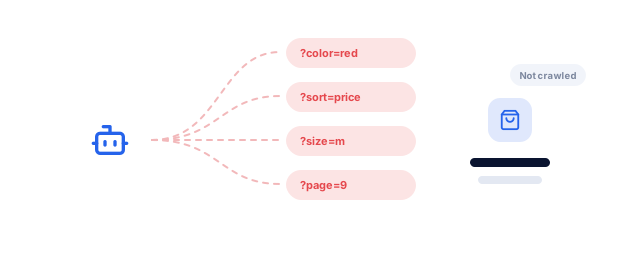
A crawler spending its visits on filter and duplicate URLs instead of the pages that matter

Google spends its visits on the wrong URLs

When filters, sort orders and tracking parameters create endless URLs, Googlebot can spend its time there while new products wait. Google's crawl budget guide recommends blocking unimportant URLs in robots.txt and notes that noindex does not save crawling, because Google still requests the page. Cleaning this up helps new and updated products get discovered sooner.

A category page with filters and a product grid built to rank for the category search

Category pages that cannot compete

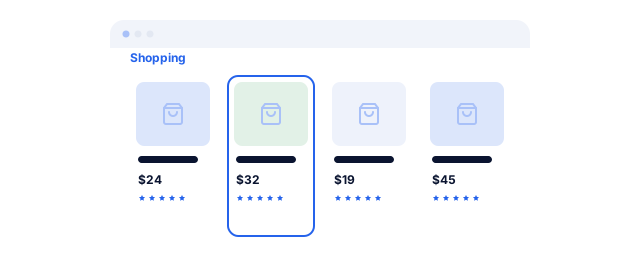
Many category pages are a product grid with a generic title, no helpful text and few internal links pointing in. They lose broad searches to marketplaces and to competitors with stronger pages. A title that matches the search, useful copy, subcategory links and breadcrumbs give each category a real chance at the broad terms most shoppers start with.

Products shown in shopping results with images, prices and ratings

Products missing from shopping results

Missing GTINs, markup prices that differ from the page and availability that never updates can keep products out of merchant listings or get them disapproved in Merchant Center. Google's Shopping Graph holds over 50 billion product listings, with more than 2 billion refreshed every hour, according to Google. Accurate, consistent product data is what keeps yours in that pool.

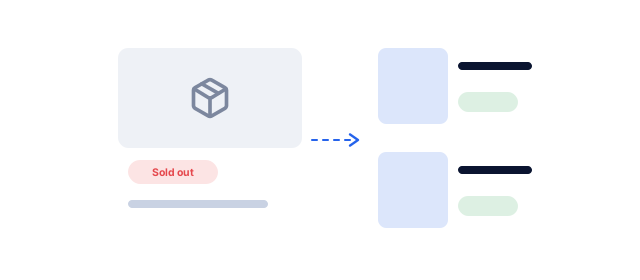
A sold-out product page kept useful with alternatives instead of a dead end

Sold-out and discontinued products leaking value

Deleting a sold-out product throws away its links and rankings, while leaving a dead end frustrates shoppers. We keep temporarily unavailable products live with accurate availability and alternatives, 301 redirect discontinued items to the closest replacement or category, and return a 404 or 410 only when nothing relevant exists. Seasonal categories keep one permanent URL year after year.

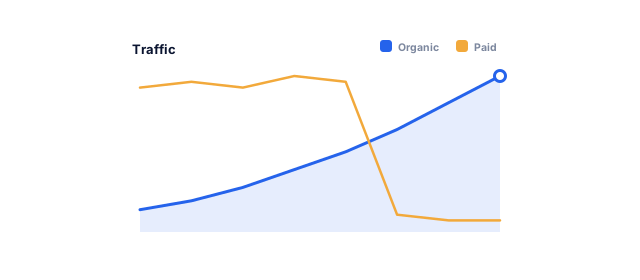
Paid traffic that stops when the budget stops, beside organic traffic that keeps growing

Revenue that depends on shopping ads

Shopping campaigns and Performance Max stop the day the budget stops. Organic category and product rankings keep bringing shoppers without a cost per click. E-commerce made up 17.1% of total US retail sales in the second quarter of 2026, per U.S. Census Bureau data. Search term data from PPC management shows which organic pages to build first.

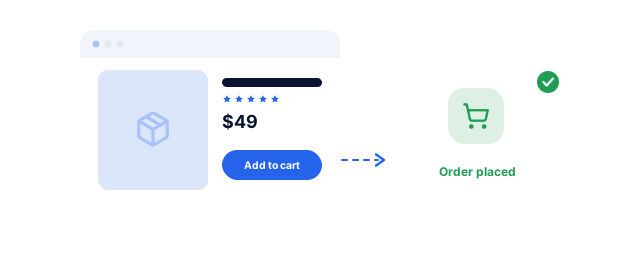
A product page leading to the cart and a completed order

Traffic that never turns into orders

A store can grow sessions from blog posts that never sell anything. We report organic revenue, orders and conversion rate by category and landing page in GA4, next to Search Console clicks, so you can see which categories earn and which only attract browsers. When pages rank but do not convert, conversion rate optimization tests fix the page itself.

Not sure whether the catalog or the content is holding you back?

Send us your store URL. We will crawl it, check how Google indexes your categories, filters and products, and send a short written list of what we would fix first, whether or not you hire us.

Free, with no obligation. Rather talk? Book a 30-minute call

Our ecommerce SEO process, from first crawl to revenue

  1. Catalog and technical audit

    Our ecommerce SEO audit services start with a full crawl in Screaming Frog, compared against what Search Console shows as indexed, plus log files where your host provides them. We review category, filter, product and search templates, structured data, Merchant Center diagnostics and Core Web Vitals.

    • Indexation and crawl waste report
    • Template-level issue list
    • Revenue baseline by category from GA4
    A fix list ranked by revenue impact
  2. Keyword map and ecommerce SEO strategy

    Every category, subcategory and product type is mapped to the searches it should win, with volume, difficulty and current revenue side by side. We decide which filter pages to open for indexing, which categories to create or merge, and the order of work. You approve the ecommerce SEO strategy before any content budget is spent.

    • Keyword-to-URL map
    • Facet indexing rules
    • 12-month roadmap
    One clear job for every URL
  3. Technical fixes

    Our developers implement fixes in your theme, plugins or codebase: canonical and robots rules, internal links, pagination, redirects, schema and template speed. Changes go to staging first, then we validate them after release with a recrawl and the URL Inspection tool.

    • Shipped fixes with a change log
    • Validated structured data
    • Clean XML sitemaps by page type
    A catalog Google can crawl efficiently
  4. Category and product content

    Writers brief from the keyword map and from what shoppers ask: reviews, support tickets, site search terms and People Also Ask. We write category intros, buying guides, FAQs and product descriptions, and set title and meta templates where a catalog is too large to edit by hand.

    • Category copy and FAQs
    • Rewritten descriptions for top sellers
    • Title and meta templates
    Pages that answer buying questions
  5. Authority building

    We build links to the categories and guides that drive revenue, through gift guides, original data, manufacturer and stockist pages, product reviews and niche publications. Link targets follow the keyword map, so authority reaches pages that sell, not only the home page.

    • Link prospect list
    • Outreach and digital PR
    • Internal link updates
    Stronger category rankings
  6. Reporting and iteration

    Each month you get organic revenue, orders and rankings by category, product issues from Merchant Center and Search Console, and a list of what we shipped. Every quarter we revisit the keyword map against new products, seasons and what AI shopping answers cite.

    • Monthly revenue-led report
    • Quarterly roadmap review
    • Seasonal category plan
    Decisions made on revenue by category

Ecommerce SEO for your platform and situation

The fundamentals stay the same on every platform. The fixes, limits and risks do not, so we plan for the one you run.

01 / 05

Shopify stores

Shopify manages hosting and sitemaps for you, but fixes URL prefixes such as /products/ and /collections/, and many themes link to collection-based duplicate product URLs. Apps can add scripts that slow every page. Our Shopify SEO services work inside theme code, Shopify Markets and app stacks. The Eric Originals case study shows a Wix to Shopify migration that went on to grow organic traffic by 1,900%.

02 / 05

WooCommerce stores

WooCommerce gives you full control over URLs and templates, which also means more ways to get them wrong. Product attribute archives, tag pages, filter plugins and slow shared hosting are the usual culprits. Our WooCommerce SEO services cover Yoast SEO or Rank Math settings, variable products, caching and hosting, with WordPress developers on the same team who can change templates directly.

03 / 05

Large catalogs

Stores with tens of thousands of products on Adobe Commerce (Magento), BigCommerce, Salesforce Commerce Cloud or a headless build need decisions made at template level, because nobody can edit 40,000 pages by hand. We use log file analysis, XML sitemaps split by product type and indexation tracking per template. For governance across teams, brands and release cycles, see our enterprise SEO services.

04 / 05

Stores selling in several countries

Selling abroad adds currencies, delivery terms and hreflang to every category and product URL. Product markup has to show the right currency for each locale, and Merchant Center needs a feed per country. Our international SEO services plan the URL structure and localization, while the ecommerce work keeps each market's catalog clean and indexable, so near-identical country catalogs do not compete with each other.

05 / 05

Replatforms and new stores

A platform migration is the riskiest moment in a store's search life: URLs change, redirects get missed and rankings drop. We map every old URL to its new one, test structured data and internal links on staging, and watch Search Console daily after launch. If the new store is still being built, our ecommerce website development team can build SEO into the first template.

Which ecommerce platform is best for SEO?

No platform ranks a store on its own. They differ in how much control you get and which problems you inherit, so ecommerce SEO best practices look different on each.

FactorShopifyWooCommerceAdobe Commerce (Magento)Headless or custom
URL controlFixed prefixes such as /products/ and /collections/Full control through WordPress permalinksFull control through URL rewritesWhatever you build
Filter URLsBuilt-in filters add parameters to collection URLsDepends on the filter plugin you chooseLayered navigation creates parameter URLs at scaleYou decide, including how filters render
Structured dataTheme dependent, often incompleteBasic Product markup, extended by SEO pluginsTheme and extension dependentBuilt from scratch
Main speed leverTheme code and installed appsHosting, caching and pluginsServer, caching and extensionsRendering approach and hosting
InternationalShopify Markets, with hreflang added for youMultilingual plugins such as WPMLStore views per language or countryFully custom, more to maintain
Best fitStores that want low maintenance and fast setupStores that want content and URL control on WordPressLarge, complex catalogs with a development teamBrands with engineering resources and unusual needs

Based on platform documentation and our implementation work, October 2026. Platforms change their features often, so we confirm current behavior during every audit.

Why work with improveFX as your ecommerce SEO company

01

Ecommerce SEO experts and developers in one team

Most store fixes live in theme code, templates, feeds and redirects. Our 25+ in-house specialists put marketing and engineering under one roof, so the ecommerce SEO specialist who finds a canonical problem works next to the developer who ships the fix. When a store needs new templates or a rebuild, our Shopify website development team handles it.

02

Proof from a real store

We are a Shopify Partner and Google Premier Partner, and our ecommerce work is public. For Eric Originals, a jewelry business, we migrated the store from Wix to Shopify with one-to-one redirects, restructured the catalog, added structured data and built links. Organic traffic grew by 1,900% and sales by 76%. Read the full case study.

03

Revenue reporting, your data

Monthly reports show organic revenue and orders by category, plus every change we shipped. We work on rolling agreements, and you keep ownership of Search Console, GA4, Merchant Center, content and code. Clients rate us 4.9 on Clutch from 221 reviews and stay 1.6 years on average. See how we work with ecommerce businesses.

Results we can put numbers on

SEO results from our case studies and client reviews, led by an ecommerce store.

See all case studies
Eric OriginalsJewelry ecommerce

+1,900%

organic traffic

A struggling jewelry website became a steady source of buyers

Read the case study
MastersBuddyStudy abroad consulting

160+

keywords in Google's top 10

A new consultancy broke into one of India's most competitive markets

Read the case study
Momentus Real Estate GroupReal estate

210%

more qualified leads

Website, SEO, Google Ads and Business Profile working as one

Read the review

What our SEO clients say

"Their SEO strategy helped us achieve top search rankings, while their Facebook Ads campaigns drove a steady flow of qualified prospects."
55%more organic traffic
4.7xreturn on ad spend
75%keywords on page one
Amita NaithaniCo-founder, Amita Naithani Resort Wear
"From designing a high-converting website to managing our SEO, Google Ads, and Google Business Profile, improveFX delivered exceptional results across every channel."
210%more qualified leads
185%organic and local traffic growth
92%keywords on page one
Maureen CappalloBroker and founder, Momentus Real Estate Group
"We now rank for highly competitive keywords while our PPC campaigns deliver qualified leads at a lower cost."
80%keywords on page one
620%return on investment
52%lower cost per lead
Divyanshi HirparaFounder, Trunkboxbaby
"Our marketing reach expanded by 50% after implementing their innovative SEO and content writing services. They truly understand the e-commerce landscape."
43.6%more sales
621%return on investment
63%keywords on page one
Allen RayFounder, Ecom Fashion
"They revolutionized our online presence with a 60% increase in web traffic through strategic e-commerce SEO and content optimization."
60%more organic traffic
47%more sales
Eric NoahPresident, Eric Originals & Antiques Ltd.

Ecommerce SEO questions, answered

Not seeing yours? Ask us directly and a specialist will reply personally.

What do ecommerce SEO services include?

Ecommerce SEO services include a catalog audit, keyword mapping for categories and products, faceted navigation and crawl fixes, product structured data, category and product content, link building and revenue reporting.

The mix depends on your catalog. A small store usually needs content and authority more than crawl work, while a store with thousands of products and filters often gains most from technical cleanup first. We scope after a free audit, so you only pay for what your store needs.

How much do ecommerce SEO services cost?

Cost depends on catalog size, platform, technical debt and how much content is needed. Published agency plans we reviewed start at about $2,500 to $3,000 a month, with most stores paying roughly $2,500 to $8,000.

If you are looking for affordable ecommerce SEO services, a focused scope helps: fix crawling and the top 20 categories first, then expand. One-off audits and migrations are usually priced as projects. We quote after a free audit, with every workstream priced as its own line.

How long does ecommerce SEO take to show results?

Crawl and indexing fixes usually show in Search Console within 4 to 8 weeks. Category rankings typically move in 3 to 6 months, and revenue growth builds over 6 to 12 months.

Stores with existing authority and clear technical problems move faster than new stores in crowded niches. Seasonal categories need work several months before the season. We do not guarantee rankings, and we will tell you if a category looks too competitive for your budget.

Which ecommerce platform is best for SEO?

Shopify, WooCommerce, Adobe Commerce, BigCommerce and headless builds can all rank well. The best ecommerce platform for SEO is the one whose limits you can live with and whose problems your team can fix.

Shopify trades URL control for low maintenance. WooCommerce gives full control but depends on hosting and plugins. Adobe Commerce suits large catalogs with developers. If SEO is your main concern, the bigger risk is usually a badly planned migration, not the platform itself.

Should I optimize category pages or product pages first?

Usually category pages. They target the broader searches with the most demand and pass authority down to the products they list.

Product pages come first when shoppers search by model number, brand and product name, as with electronics, spare parts or branded goods. We check Search Console and your keyword map to see which page type already earns impressions, then start where the gap between impressions and clicks is largest.

How do you handle faceted navigation and filter URLs?

We decide facet by facet: filters with real search demand become indexable landing pages, and the rest are canonicalized or blocked in robots.txt so they do not waste crawling.

A "black dresses" filter may deserve its own optimized page; a "sort by price" or "4 filters at once" URL does not. We follow Google's faceted navigation documentation, return a 404 for empty filter combinations, and test the rules on staging before release, because a wrong robots.txt line can hide whole categories.

Do you offer ecommerce SEO audit services or consulting on their own?

Yes. You can hire us as an ecommerce SEO consultant for a one-off audit and roadmap, and have your own team or developers implement it.

The audit covers crawling and indexation, faceted navigation, duplicate URLs, structured data, Merchant Center diagnostics, Core Web Vitals, content and links, with each issue ranked by revenue impact. Many clients later move to a managed retainer because fixes ship faster when one team owns them.

How do I choose the best ecommerce SEO agency?

Ask ecommerce SEO agencies how they would handle your filter URLs and sold-out products, and ask for an ecommerce case study with revenue, not just traffic. Clear, specific answers are a good sign.

Lists of the best ecommerce SEO companies rarely test this. Also check who implements technical changes, whether they report revenue by category, how long the minimum contract is, and whether you keep ownership of every account, feed and piece of content. Be wary of anyone promising a fixed multiple of your sales.

Can ecommerce SEO help my products appear in AI shopping results?

Yes, to a degree. AI shopping answers draw on product data, reviews and pages that explain products clearly, so accurate markup, feeds and helpful content improve your chances of being cited.

Adobe reported that traffic from generative AI tools to US retail sites rose 693.4% year over year in the 2025 holiday season, per its January 2026 release. We test buying questions in Google AI Mode, ChatGPT and Perplexity, and our GEO services go deeper on tracking AI visibility.

How is SEO for ecommerce websites different from regular SEO?

Ecommerce SEO deals with problems lead-generation sites rarely have: thousands of similar product pages, filters that multiply URLs, stock that changes daily, product feeds and shopping results.

The principles are shared, but the priorities differ. A service business usually needs a few strong service pages and local visibility, which our organic SEO services cover. A store needs catalog structure, crawl control and product data to be right before content and links can pay off.

Ready to grow online?

Get a free analysis of your website's performance, SEO and user experience, or book a strategy call with our team.

  • A review of your site's speed, SEO and user experience
  • Fixes ranked by impact, with the effort each one takes
  • A call with a specialist to plan the next steps, no obligation
Vikash Kumar PalRoshan Kumar JhaAbhishek Kumar Jha A specialist replies personally 4.9 from 566 client reviews
What do you need help with?

Pick all that apply.

Next, a few details about your business on our contact page. It takes about a minute.

Prefer to talk now? Book a strategy call