
Delivery baseline with DORA metrics
Before changing anything, we calculate the five DORA delivery metrics from your Git history, map every step a change waits on, and fix the slowest first.
Our DevOps and CI/CD services are for software teams on AWS, Azure or Google Cloud that want every release small, tested and easy to reverse. We build pipelines in GitHub Actions, GitLab CI/CD, Azure Pipelines or Jenkins, package apps with Docker, define infrastructure in Terraform, configure servers with Ansible and watch each deploy in Prometheus and Grafana.
 4.9
 Written by Abhishek Kumar, Content Writer

















Cloud DevOps and CI/CD is releasing software through automated pipelines, with the cloud infrastructure underneath defined as code. DevOps and CI/CD services cover pipelines, infrastructure as code, testing and security gates, so teams ship small changes often and recover fast.
Most work starts with the baseline and one pipeline.
Get a free proposalBefore changing anything, we calculate the five DORA delivery metrics from your Git history, map every step a change waits on, and fix the slowest first.
Pipelines live as code in GitHub Actions, GitLab CI/CD, Azure Pipelines or Jenkins. Each build runs tests and scans, then promotes one versioned Docker image from staging to production.
Cloud resources are defined in Terraform or OpenTofu, CloudFormation or Bicep, and server configuration in Ansible. Every change arrives as a pull request with its plan attached.
Staging that matches production, blue-green or canary releases with automatic rollback, and feature flags that separate deploying code from releasing it.
Unit, integration and contract tests, flaky tests quarantined, and load checks with our cloud performance optimization team.
Code, dependency, image and secret scanning on every pull request. Pipelines sign in with OpenID Connect tokens instead of stored keys, and our cloud security and compliance team maps controls to your audits.
Teams hire DevOps consultants when releases are slow, risky or both.
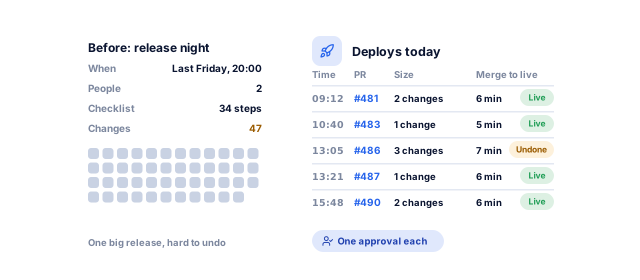
When a deploy takes minutes instead of an evening, teams stop batching changes into big, risky releases. Each change is small enough to test and roll back alone.
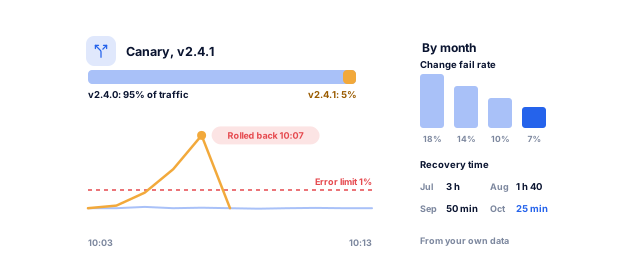
Canary releases send a new version to a small share of traffic and roll back when health checks fail. Change fail rate shows whether releases are getting safer.
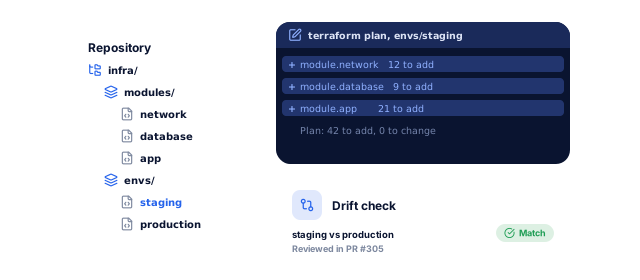
Hand-built servers drift until staging stops predicting production. Infrastructure as code rebuilds any environment from the repository, alongside tested cloud backup and disaster recovery.
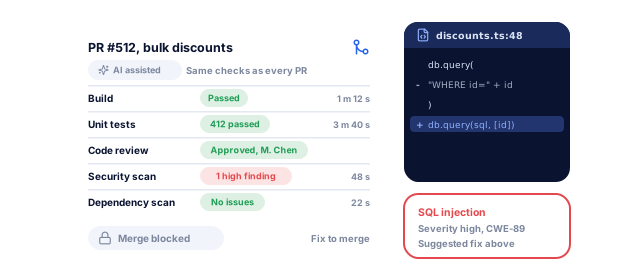
In the 2025 DORA report, 90% of respondents used AI at work and 30% had little or no trust in AI-generated code. Automated tests and scans hold the bar.
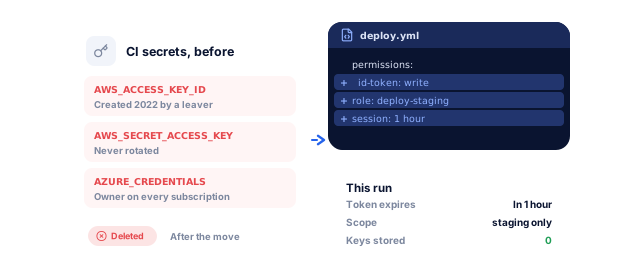
Stored pipeline keys leak and outlive their owners. GitHub Actions, GitLab CI/CD and Azure Pipelines all support short-lived federated credentials; we move you to them, one role per environment.
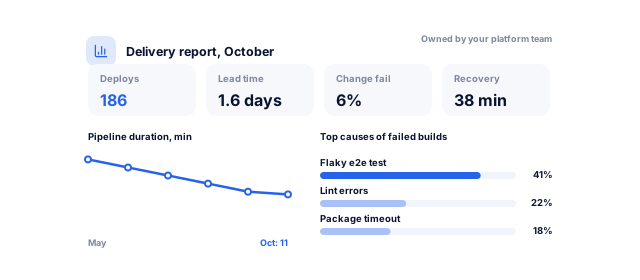
A monthly report shows delivery metrics and why builds fail. DORA found 90% of organizations use at least one internal platform; we keep yours small and documented.
Give us read-only access to one repository and its pipeline. We will map how a change reaches production today, measure the slow steps and send a written plan you can use with or without us.
We read your pipelines, infrastructure code and incidents, and check where credentials live.
Where releases slow down, in numbersWe choose tools with you. You approve the design and budget before we build.
An agreed plan and budgetOne real service goes to production with a tested rollback. Existing resources are imported into Terraform state, not recreated.
One service shipping the new wayScanning, policy checks and federated credentials, tuned to block real risk, not noise.
Security checks on every changeThe first pipeline becomes templates for other services, and your developers learn to change pipelines.
Every team on the same safe pathMonthly delivery metrics and upgrades to runners, plugins and providers. We run the platform, or hand it over in full.
Improvement you can measureThe practices stay the same; the tools and constraints change.
Preview environments per pull request, feature flags, safe migrations and canary releases watched by error rate. Our SaaS application development team ships features through the same pipeline.
Reusable workflows, protected environments and OIDC sign-in, with self-hosted runners where builds must reach a private network in AWS or Google Cloud.
YAML pipelines, classic releases retired, and workload identity federation, which Microsoft recommends. Our Azure management team can run the estate after launch.
Jobs move into Jenkinsfiles, unused plugins go and agents run as short-lived containers, often on Kubernetes. If GitHub Actions would cost less, we price both and move you if you choose.
The pipeline becomes audit evidence: required reviewers, recorded approvals and software bills of materials. We built the hospital system in our AkosMD case study for a healthcare client.
The right CI/CD platform usually sits next to your code and identity provider.
Book a strategy call| Factor | GitHub Actions | GitLab CI/CD | Azure Pipelines | Jenkins |
|---|---|---|---|---|
| Cloud sign-in without stored keys | OIDC token per job | OIDC ID tokens per job | Workload identity federation | Agents under a cloud role you build and secure |
| Fits best when | Your code is on GitHub | You want source, CI and scanning in one product | You run on Azure and Microsoft tooling | You need deep customization on your own infrastructure |
| Watch out for | Third-party actions: pin and review them | Runner sizing and compute minutes on hosted plans | Classic release pipelines never moved to YAML | Plugin upkeep, security patches and controller backups |
Based on GitHub, GitLab and Microsoft documentation, checked October 2026. AWS CodePipeline and Google Cloud Build also suit single-cloud teams.
The free review sets your exact plan; this is the usual shape.
Book a strategy callBy week 2, you have an agreed design, plan and budget.
By week 4, one service ships to production the new way.
By week 12, depending on estate size, every team deploys the same safe way.
You approve each step before we change anything, and everything we set up stays in your accounts.
Yours to keep, always. Everything is set up in your name, and if you leave we remove our access and hand over the documentation.
Teams that want releases to be small, frequent and uneventful.
Book a strategy callPipelines break where code meets infrastructure. We build custom software and apps as well as cloud platforms, so we fix slow tests or migration scripts ourselves.
When we run the platform, an engineer responds to critical incidents 24x7 and other issues are handled in business hours. Our case studies show how we report each month.
Cloud accounts stay in your name, and we work through roles you can remove. Infrastructure code, runbooks and diagrams sit in your repository, ready for another team.
These numbers come from our SEO, marketing and software work, measured in each client’s own analytics. Your cloud numbers start with the free review.
See all case studies
MastersBuddyStudy abroad consulting
160+
keywords in Google's top 10
AkosMDHealthcare, Arizona
+57%
patient footfall
Eric OriginalsJewelry ecommerce
+1,900%
organic traffic
"From designing a high-converting website to managing our SEO, Google Ads, and Google Business Profile, improveFX delivered exceptional results across every channel."
 Maureen CappalloBroker and founder, Momentus Real Estate Group
"They revolutionized our online presence with a 60% increase in web traffic through strategic e-commerce SEO and content optimization."
 Eric NoahPresident, Eric Originals & Antiques Ltd.
"Visionstar Technologies' online presence transformed significantly with a 40% boost in customer engagement, all thanks to their exceptional website structuring and SEO tactics."
"Their strategic approach to our website and SEO resulted in a 60% increase in local inquiries, revolutionizing our automobile service business."
"Their SEO strategy helped us achieve top search rankings, while their Facebook Ads campaigns drove a steady flow of qualified prospects."
 Amita NaithaniCo-founder, Amita Naithani Resort Wear
Not seeing yours? Ask us directly and a specialist will reply personally.
DevOps and CI/CD services include a delivery audit, pipeline design and build, infrastructure as code, environments, automated testing, security gates and documentation.
With improveFX, scope also covers federated cloud credentials, canary or blue-green releases, developer training and a monthly DORA report. You can stop after the build, or keep us on to run, upgrade and improve the platform every month.
Builds are quoted as a project after a free review. Ongoing cloud management with improveFX runs from under $1,000 to $15,000+ a month, depending on your environment.
One cloud account, a few services and business-hours support sit at the low end; several accounts, clouds and environments, compliance needs and 24x7 cover for critical incidents sit at the high end. Your cloud bill from AWS, Microsoft or Google is separate from our fee.
A production pipeline for one service usually takes about 2 to 4 weeks, including tests, security scans and a tested rollback.
Bringing an existing estate under infrastructure as code takes about 4 to 12 weeks, depending on how much was built by hand. Later services move faster once the first pipeline becomes a template. We settle access and approvals in week one.
Usually the one next to your code: GitHub Actions for GitHub, GitLab CI/CD for GitLab and Azure Pipelines for Azure DevOps. Jenkins suits deep customization on your own infrastructure.
Small changes, fast tests and federated credentials matter more than the brand. If your current tool blocks those practices, we plan and run the move; if not, we improve what you have.
Terraform or OpenTofu creates cloud resources and suits teams on several clouds; CloudFormation or AWS CDK suits AWS-only teams, and Bicep suits Azure. Ansible does a different job: it configures servers and software once they exist.
Many estates use Terraform and Ansible together. Terraform needs remote state with locking, while Bicep needs no state file. Every change is previewed in its pull request.
No. Many teams get the full benefit of CI/CD on a managed container service such as Amazon ECS, Google Cloud Run or Azure Container Apps, and we set those up and run them.
Kubernetes earns its place with many services, fine networking control or one platform across clouds. Then our Kubernetes management team builds and runs the clusters your pipelines deploy to.
Yes. Where pipelines are sound, we improve them rather than rebuild. We act as DevOps consultants while your engineers build, or as a managed DevOps service that builds and runs the platform.
A common middle path: we build the first pipeline and templates, train your team, then stay on for upgrades and critical incidents. Handover is a change of access, not a migration.
We treat the pipeline as production: short-lived credentials, least-privilege deploy roles, protected environments and scanning on every change. We sign an NDA before any access is shared.
Approval records, scan results and software bills of materials become evidence for SOC 2, ISO 27001, PCI DSS or HIPAA audits. For GDPR, UK GDPR and India's DPDP Act, we keep personal data out of test data and build logs.
Tell us what worries you about your cloud, or book a strategy call with our team.


 A specialist replies personally 4.9 from 566 client reviews