We design and build custom mobile apps for iOS, Android, and cross-platform that help businesses grow in a mobile-first world. Our mobile app development services build apps that work flawlessly across platforms, devices, and ecosystems. You get an app developed by a team of senior engineers, code you own outright, and a release cadence that continues past launch week.
Companies that chose us for their digital transformation
















Most agencies list every platform and let you guess which one you need. That choice matters far more than the list does, because it sets your budget, your timeline, and what you’ll pay to maintain the app in year two. Below is what each of our mobile app development services is best at, and just as usefully, who each one is the wrong fit for.

Native Swift and SwiftUI builds for iPhone and iPad. Best when you need deep hardware access or flagship performance. Less suited to Android-heavy audiences.

Native Kotlin and Jetpack Compose builds, tested on the devices your users actually own. Best for wide reach. Heavier QA load than iOS.

One Flutter or React Native codebase shipping to both stores, hybrid builds included. Best for speed and budget. Wrong for heavy device-level processing.

Monitoring, OS-update compatibility, and a planned feature release every few weeks after launch. Best for teams without an in-house mobile crew. Available standalone.
Plenty of agencies list twenty industries on this page. Listing an industry is easy. Knowing that Samsung’s battery optimizer will kill your BLE connection, or that push notifications can’t carry PHI, takes shipping apps in that industry and getting it wrong once. These are the five we’ve done enough of to tell you what breaks before you find out for yourself, on your budget.
Healthcare apps live or die on details nobody mentions in the pitch. Push notifications can’t contain PHI, so the notification says “new message” and the payload waits behind auth. We build to HIPAA and HITECH, sign a BAA before a line of code, integrate with Epic and Cerner over HL7 FHIR, and log every PHI read, not just every write. Auditors ask for those.
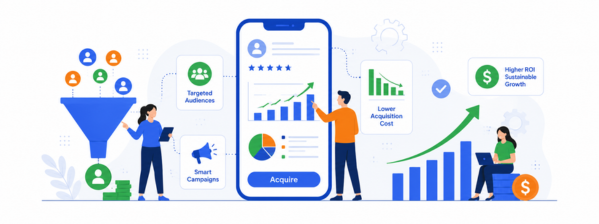
Fintech apps carry a compliance load that shapes the architecture, not just the checklist. We build for PCI DSS and SOC 2, wire up KYC and AML flows, and connect to Plaid, Stripe, or your core banking provider. One detail that catches teams out: certificate pinning breaks the app when your provider rotates certs, so we ship a remote-config kill switch from version one.
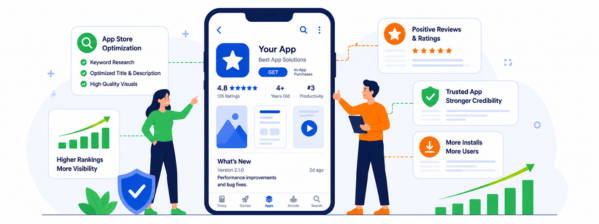
Ecommerce apps usually fail at the same two points: checkout and re-engagement. We build headless storefronts on Shopify, Magento, Adobe Commerce, or BigCommerce, with Apple Pay and Google Pay wired in because manual card entry on mobile kills conversion. Worth knowing early: Apple takes a cut on digital goods sold in-app, but physical goods are exempt. That distinction can change your entire catalog strategy.
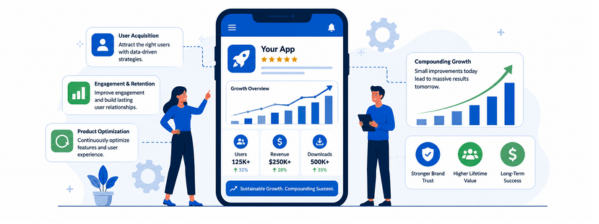
IoT apps are mostly a connectivity problem wearing an app costume. We handle BLE pairing, MQTT messaging, Matter and Thread, plus over-the-air firmware updates from inside the app. The part that surprises hardware teams: Android manufacturers ship aggressive battery optimizers, and Samsung or Xiaomi will quietly kill your background BLE connection. We test on real devices from each, not just a Pixel.
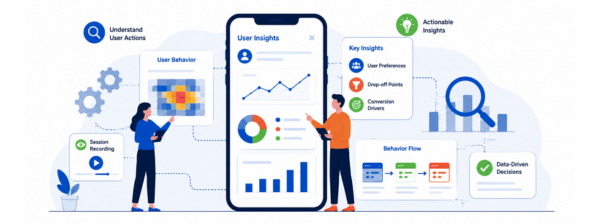
Field and logistics apps run where connectivity doesn’t. We build offline-first, with a local database, queued actions, and conflict resolution that decides what wins when two drivers edit the same job. Background location is the other trap: iOS only offers “Always Allow” on a second prompt, and users decline it if you ask on day one. We time that request around a moment the driver already understands.
Get a free proposal with real numbers, honest timelines, and no lock-in. Judge us on that.
Most agency process diagrams are decoration. Six arrows, no dates, nothing you can hold anyone to. Ours shows what happens at each stage of our mobile app design and development services, roughly how long it takes, and what lands in your hands. Timelines assume a mid-sized app. Yours gets exact numbers during scoping.

Weeks 1 to 2. We map features, pick your platform, and price the build. You leave with a written scope, a fixed estimate, and a launch date. If the numbers don't work, you walk with the scope doc.

Weeks 2 to 6. Wireframes first, then visual design in your brand. You get a clickable prototype you can hand to real users before we write production code. Changes here cost hours. Later they cost weeks.
Weeks 5 to 20. Senior engineers build in two-week sprints. Each sprint ends with a working build installed on your own device and a demo call. You see real progress every two weeks, not at the end.
Runs alongside development. Testing runs alongside development, not after it. We test on the actual iPhone and Android models your analytics show, plus older OS versions. Simulators miss the bugs that generate one-star reviews.
Weeks 1 to 2 after code freeze. We handle submission, store listings, and screenshots. Apple review takes 24 hours to a week, and rejections happen. We budget for one round, because privacy labels and account deletion catch most teams out.

Ongoing. Crash monitoring, OS-update compatibility, and a planned feature release every few weeks. iOS and Android ship major versions annually, and apps that skip a cycle start breaking quietly. We handle both cycles.
These are the six questions that decide whether a project works, and most get answered vaguely on agency websites. Here are ours, written so you can hold them against anyone else you’re considering. The best mobile app development service companies will answer all six in writing. If one won’t answer the code ownership question, that tells you something.
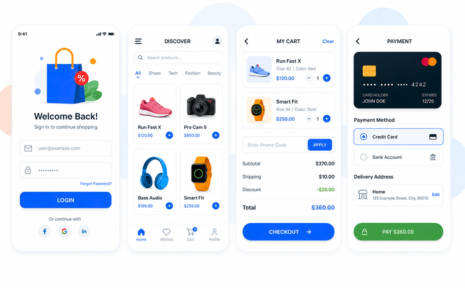
Four things, roughly in order. Number of platforms, because native iOS and native Android are two builds. Backend complexity, since an app talking to your existing systems costs more than one with a fresh database. Compliance load, because HIPAA and PCI add audit work to every sprint. And integrations, where each third-party system is its own small project. Feature count matters least.
Three ways. Fixed price works when the scope is clear, which is most first builds after a proper discovery. Time and materials suit ongoing work where priorities shift. A dedicated team makes sense past roughly six months, when you’d rather have capacity than a scope document. We’ll tell you which one fits your project, including when the fixed price would cost you more.
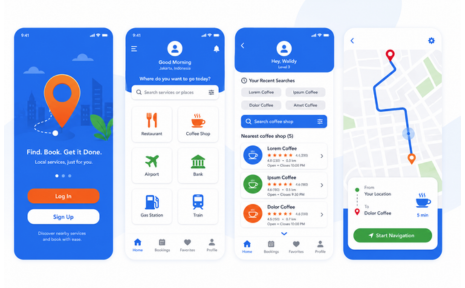
You do, from the first commit. Your source code lives in your repository, under your organization’s account, not ours. IP transfers are on signature, not on final payment, which is a distinction worth checking in any contract you sign. We also hand over App Store and Play Store accounts in your company’s name. If you leave, nothing is held hostage, and nothing needs migrating.
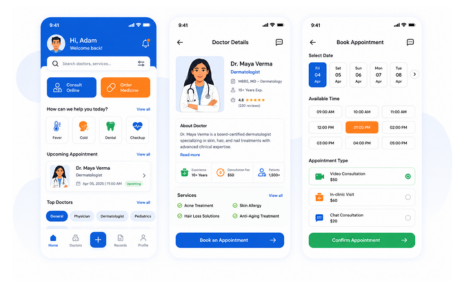
The engineers you meet during scoping. We don’t run a senior-pitch, junior-build model, which is the most common complaint we hear about previous agencies. You get names, LinkedIn profiles, and years on the platform before you sign. If someone rotates off mid-project, you hear it from us first, with a two-week overlap so context transfers properly. That’s in the contract.
Directly, and we’d rather explain it than have you guess. Our engineering team is in India, with a four-hour overlap with US Eastern time built into every day. Sprint demos and scoping calls happen in your morning. Async updates land before you start work. Clients who’ve had bad offshore experiences usually had no overlap and no named contact. Both are fixable, and we fixed them.
Often, yes. We start with a paid code audit, usually a week, which tells you whether the codebase is worth keeping or whether a rebuild costs less than the repairs. Roughly half the time it’s salvageable. You get the audit either way, including a recommendation to rebuild if that’s what the code says. Handovers go faster when the previous team’s repo is intact.
Every agency page on this topic lists a project count and moves on. A number that big tells you almost nothing about how your project will go. What matters more is whether the team behind our custom mobile app development services is permanent, what they’ve kept running for years, and whether any of it can be checked without calling us.
We’re a full-service agency, and our mobile team is a standing team, not people borrowed from web projects when work comes in. The advantage of the wider agency is that your app’s backend, admin panel, and web platform get built by people sitting next to the mobile engineers. Nobody emails a spec across a vendor boundary and waits three days for a reply.
280+ apps have been live on the App Store and Google Play since 2021, across healthcare, fintech, retail, and connected devices. Our longest-running client has been on the same codebase with us for 4+ years and 70+ releases, which is a harder number to hit than a project count. We can point you to the store listings for most of them on the first call.
The framework you build shapes your hiring, your maintenance cost, and how the app feels three years from now. Each page below goes deep on one option, with the trade-offs written out rather than glossed over. If you already know what you need, go straight there. If not, the note underneath helps.
Pick native iOS or Android if performance or hardware access drives your product. Pick Flutter or React Native if you’re shipping the same experience to both stores on one budget. Pick hybrid only for internal tools. We’ll confirm it during the scope for free.
One Dart codebase for iOS and Android with pixel-identical UI on both. Best when brand consistency matters more than platform-native feel. Widely used for design-heavy consumer apps.
JavaScript and React across both platforms, with easy access to native modules. Best if your web team already writes React and you want shared hiring and shared logic.
Swift and SwiftUI builds for iPhone, iPad, and Apple Watch, including App Store submission and review handling. Best when iOS users generate most of your revenue.
Kotlin and Jetpack Compose builds tested across manufacturers, screen sizes, and OS versions. Best for reaching the widest possible audience, and essential in most markets outside North America.
Web technologies wrapped in a native shell using Ionic or Capacitor. Best for content-driven internal tools where launch speed beats polish. Cheapest route, with real performance limits.
A native storefront on top of your existing Magento or Adobe Commerce catalog, using the GraphQL API. Keeps one product source of truth and one order pipeline.
Ten questions that come up on almost every first call, answered the way we’d answer them live. Some numbers below are ranges, because scope really does move them. Where we can give a real figure, we have. Where the answer is “we don’t do that”, we’ve said so.