When someone searches for what you do and adds “near me,” the decision usually gets made inside the top three map results. If you are not there, you are not being considered. improveFX is a local SEO company that works on the signals that actually move map pack position. Google Business Profile optimization, review velocity, citation consistency, and location pages written for how people in your area genuinely search.
Companies that chose us for their digital transformation



















Local rankings are not decided the way organic rankings are. Google weighs three things when it builds a map pack: how close you are to the searcher, how relevant your business looks for that query, and how prominent you are across the wider web. Most local SEO campaigns stall because they treat local SEO like regular SEO and only ever touch one of the three. Here is how we work on all of them.

These are the three factors Google names for local ranking. Proximity you cannot change. Relevance and prominence you can. We work both: primary and secondary category selection, service descriptions, and on-page location signals for relevance, then reviews, local links, and brand mentions for prominence.

A profile is not something you fill in once and forget. Categories, services, attributes, photos, Posts, and Q&A all carry weight, and Google changes what counts without announcing it. We treat your Google Business Profile as a live asset and audit it every month, not every launch.

Volume matters, but so do recency, response rate, and the words your customers actually use. We build a review process your team can run without chasing it, then put those reviews where they influence both your map pack position and the person deciding between you and the listing above you.

Google cross-checks your name, address, and phone number across directories, aggregators, and data providers. One old suite number sitting on a citation site creates doubt, and doubt costs position. We audit and correct your local SEO citations, then keep them consistent as things change.
Local SEO gets measured differently from organic SEO, and it should be. The outcomes arrive sooner, attribute more cleanly, and sit closer to revenue. A ranking improvement here shows up as a phone ringing, not as a line moving on a traffic chart. Here is what our local SEO marketing services are built to move.

Local SEO moves faster than organic SEO because you are competing inside a radius rather than a country, and the ranking signals respond more quickly than in traditional SEO. Google Business Profile corrections and citation cleanup often shift the map pack position within four to eight weeks. It is the quickest form of organic ranking to drive customers to your stores.
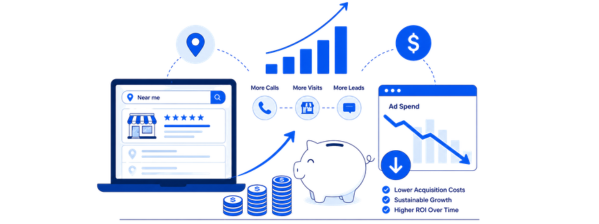
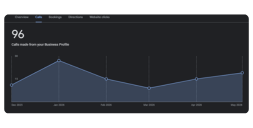
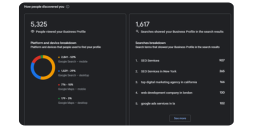
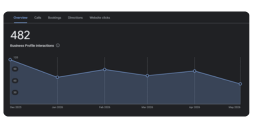
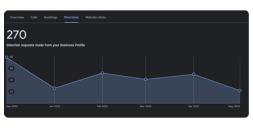
Local search produces actions you can attribute without guesswork. Your Google Business Profile reports calls, direction requests, and website clicks directly. Add call tracking, and you can see which searches produced which conversations, which makes the budget conversation with your finance team considerably shorter.
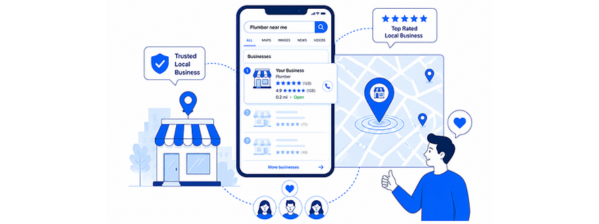
Most local service businesses pay Angi, Thumbtack, or Yelp for leads that get sold to three competitors at the same time. Ranking in your own map pack means the enquiry reaches you first and only you. Every position gained is a lead you stop renting.
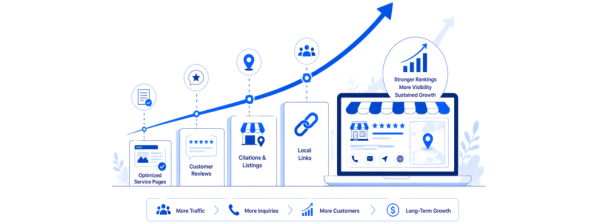
Reviews are the only local asset that improves your position and your conversion rate simultaneously. A stronger review profile lifts you in the map pack, and it also decides which of the three listings someone actually calls. Nothing else in local SEO does both jobs at once.
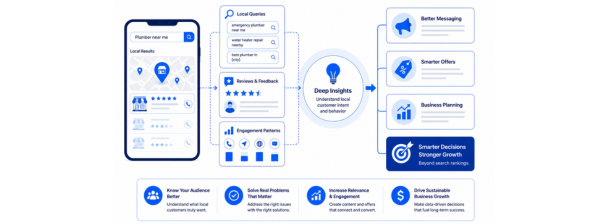
Once you rank in your primary area, the same structure extends outward. Location pages, local links, and service-area targeting let you move into adjacent towns/cities one at a time, with a known cost and a known timeline. Growth becomes a map instead of a guess.
Get a free proposal with real numbers, honest timelines, and no lock-in. Judge us on that.
In local SEO, the order matters more than it does anywhere else. Build citations before your business data is correct, and you just replicate the error across fifty directories. Chase reviews before your profile is categorized properly, and the signals point at the wrong searches. These six steps run in this sequence for a reason.

We run a geo-grid scan to see where you rank across your whole service area rather than only at your own address, audit your Google Business Profile against every category option available to you, check citations for inconsistencies, and analyze who currently holds the map pack positions you want.

We define which locations you can realistically win, which services to lead with in each, and which keyword belongs on which page. Trying to rank a single page across six towns is the most common local SEO mistake, and this step exists to prevent it.

Primary and secondary categories, service listings, attributes, business description, products, photos, and Q&A. Category selection alone can move you several positions, and it is the setting most businesses get wrong. We also set up Posts as an ongoing activity rather than a one-time task.

We correct your name, address, and phone details across major data aggregators, industry directories, and old listings still carrying a former address or number. Then we build the local SEO citations that matter in your sector, rather than bulk-submitting to 300 sites nobody visits.

Each service and each area gets a page built to rank, with the LocalBusiness schema, genuine location signals, and content specific enough that it could not be copied for a different town. We also clear the technical issues holding those pages back.

We set up a review request process your team can sustain without nagging, earn links from local publications, associations, and event sponsorships, and then track rankings by location alongside calls and direction requests. Each month, you get the numbers and a call about what changes next.
A law firm chasing three high-value cases a month and a restaurant filling Friday night covers are not solving the same problem, and neither is a single-location dentist compared with a franchise running forty branches. Local search behaves differently in every industry: the queries people use, the platform they check first, the signals that decide who gets called, and how quickly a search turns into a booking. As a local SEO company, we build each campaign around those specifics rather than running the same checklist across every client. Here is how our local SEO services adapt across the industries we work in most often.
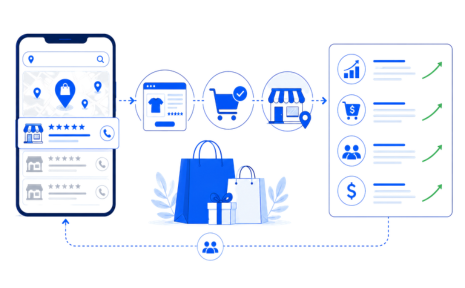
Plumbers, electricians, HVAC contractors, roofers, and landscapers face a version of local search that most guides ignore entirely. You have no premises customers walk into, so proximity starts working against you the moment a job sits outside your immediate area. Our local SEO for service area businesses begins with configuring your service area correctly inside Google Business Profile, then building a separate page for each trade and town combination instead of one page listing thirty locations and hoping Google sorts it out. We grow review volume steadily and deliberately, because in the trades the gap between position one and position four is usually review count rather than website quality. For most contractors, this is also the point where paid lead platforms stop being necessary.
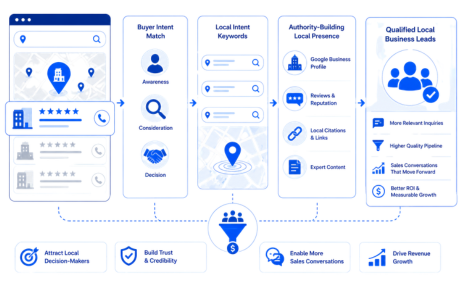
Legal searches carry some of the highest values in local search, which is exactly why Avvo, FindLaw, Justia, and Super Lawyers occupy so many of the positions you want. Outranking a directory means offering depth at the local level that a national listing page cannot match. We build practice-area pages by location, so someone searching for a specific matter in a specific city reaches your firm rather than a directory selling their details to four competitors. Alongside that, we strengthen your Google Business Profile against firms carrying a decade of review history, structure attorney bio pages to support expertise signals, and keep every line of copy inside the advertising rules your state bar enforces. Compliance is part of the brief here, not something checked afterwards.
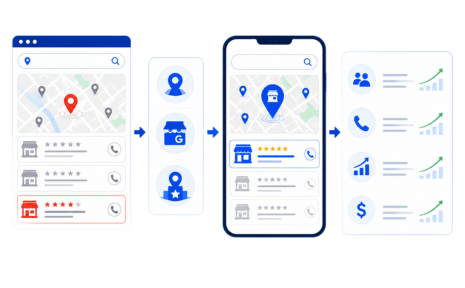
Accounting demand is seasonal in a way most local SEO strategies never account for. Searches spike ahead of filing deadlines and go quiet between them, which means your rankings need to be established months before the traffic arrives rather than during it. We work backwards from your busy season: citations cleaned and listings corrected early, service pages published with enough time to mature and index properly, and review activity concentrated at the point where it will influence decisions. We also target the specific services people genuinely search for, such as tax resolution, industry-specific bookkeeping, or business formation, rather than competing only on “accountant near me” where every firm in the city is fighting over the same three map positions.
Most restaurant discovery never reaches your website at all. It happens inside Google Maps, where photos, menu accuracy, attributes, popular times, and how quickly you respond to reviews decide whether someone books with you or with the place two streets over. Our local SEO optimization for hospitality concentrates effort where the decision actually gets made: a complete and current profile, menu data structured so Google can read it, photography refreshed regularly because Maps rewards recent activity, and a review response routine your team can realistically maintain during service. Website work still matters for reservations, private hire, and events, but it sits second in the order. We optimize for the search that ends in a table tonight, not for traffic that browses and leaves.
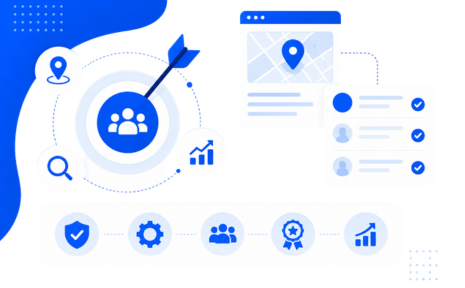
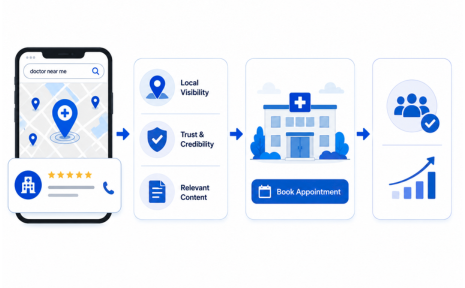
Patients search in three distinct ways, by symptom, by treatment name, and by which insurance you accept, and each of those deserves its own page rather than one services page attempting to cover everything. Health content is also held to a higher standard by Google’s quality raters, which makes practitioner credentials, citations, and factual accuracy genuine ranking factors here in a way they are not in other industries. We build location and treatment pages that satisfy those requirements while staying inside your compliance and advertising restrictions, structure profiles so a group practice surfaces the right practitioner for the right query, and manage review generation carefully given the privacy constraints healthcare providers work under. The number we report on is appointment requests, not sessions.

Forty locations is not one campaign repeated forty times. At scale, it becomes a governance problem, and it fails in predictable ways: inconsistent business data spread across hundreds of listings, profiles competing against each other for the same searches, location pages produced by find-and-replace that Google reads as duplicates, and franchisees making well-intentioned changes that quietly break the structure. Our local SEO solutions for multi-location businesses start with a data model, so every listing draws from a single source of truth. From there, we build location pages differentiated by genuine local content, set templates and permissions franchisees can work within safely, and report performance location by location so you can see which markets are underperforming and why.
Local SEO covers an unusually wide quality range. At one end sit listing services that update your opening hours and email you a screenshot. At the other end are agencies like us doing genuine local search work and reporting on numbers you can take to a board meeting. Three things tell you quickly which one you are dealing with, and we would suggest asking every local SEO agency on your shortlist about all three.
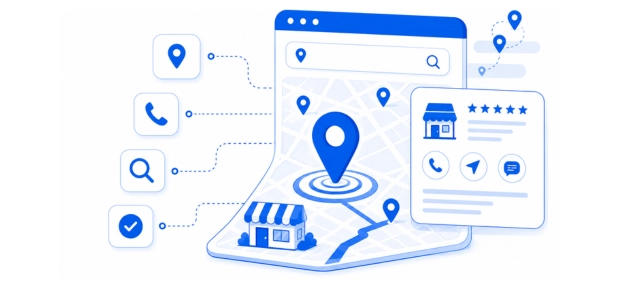
Search your own business name from your own premises, and you will always look like you rank well, because proximity is quietly doing the work for you. It tells you almost nothing about what a customer four miles away sees. We measure using geo-grid scanning, which checks your position from dozens of points across your service area and shows precisely where you fall out of the map pack. That grid is usually the most uncomfortable and most useful thing a client sees in month one. It also makes the plan obvious, because you stop guessing which areas need attention and start working on the ones where you disappear. Every monthly report shows the grid again, so progress is visible geographically rather than hidden inside a single average position.
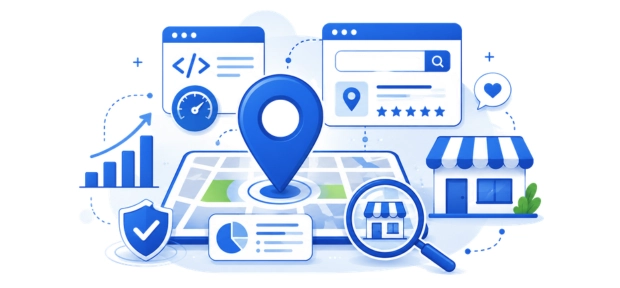
Local discovery has shifted, and a lot of local SEO advice has not caught up. AI Overviews now answer a share of “best [service] near me” queries by pulling from Google Business Profile data, reviews, and third-party sources instead of sending anyone to a website. Maps handles more discovery than it did three years ago. Google has also become considerably more aggressive about filtering reviews it judges suspicious. Our cutting-edge local SEO strategies account for all of it: structured data machines can parse, profile content written to be extracted rather than only browsed, entity consistency across the sources AI systems reference, and review generation that survives filtering because it is genuine. The fundamentals still matter. They are no longer the whole job.
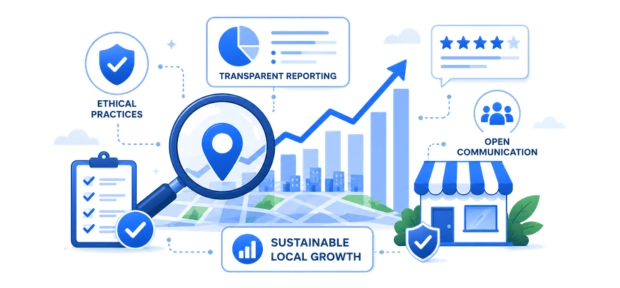
This is the question worth asking every agency you speak to. Some create your Google Business Profile under their own account, which means the asset you spent two years building walks out the door with them if the relationship ends. We work as a manager on profiles you own, using your accounts, with your ownership and full access at every stage. We work on rolling agreements rather than annual lock-ins for the same reason: retention should come from results, not from contract terms. And if your profile is ever suspended, which happens to entirely legitimate businesses more often than most owners realize, we handle the reinstatement ourselves rather than pointing you at a support form.
Local SEO does one job extremely well, and it is a narrow one by design. The services below are the ones that sit closest to it, either supporting the foundation underneath your location pages or extending your reach past the area you already own.
Local SEO has a ceiling, and the ceiling is geographic. Once you hold the map pack across your service area, further growth comes from one of two directions: deeper work on the site itself, or extension into new markets and channels. These six services are the ones our local clients move into most often, and two or three of them usually run alongside a local campaign from the start rather than after it.
Local SEO wins the searches happening inside your radius. Organic SEO wins the ones outside it: informational queries, comparison research, and the broader terms your service pages could rank for nationally. Most businesses need both, and content built for one routinely strengthens the other.
Location pages cannot rank if Google struggles to crawl them, and slow mobile pages lose local traffic fastest because near me searches happen on phones. Technical SEO covers site speed, indexation, schema, and internal structure, all of which sit directly underneath your local performance.
Local SEO scales to a city. International SEO scales to a country. If you are opening in a new market, hreflang configuration, country targeting, and properly localized content prevent the duplication and cannibalization problems that come from running near-identical pages across regions.
Retailers with physical stores compete in two places at once: the map pack for local stock and the organic results for product searches. Ecommerce SEO handles product schema, category structure, and local inventory signals so both sides reinforce each other instead of running separately.
Most local business websites run on WordPress, and most carry the same set of problems: plugin conflicts, bloated themes, unmanaged or duplicated schema, and load times that hurt on mobile. We fix these at the platform level so your location pages have a foundation capable of ranking.
Shopify handles a lot automatically and gets a few things wrong by default, including duplicate collection URLs and limited control over structured data. For stores with physical locations, we align the storefront with your local listings so both point at the same verified business.
These are the questions that come up in nearly every local SEO conversation we have, including the ones agencies usually avoid answering directly. If yours is not covered, a local SEO consultant can walk you through it on a call.