Inventory management software development for stock you can trust at every location
Our inventory management software development team builds stock systems for businesses that hold goods in more than one place: warehouses, stores, vans, marketplaces and your own website. You get one live stock figure per item and location, barcode or RFID scanning that keeps it accurate, reorder rules that raise purchase orders before you run out, and sync with your ecommerce platform, POS and accounting.
Inventory management system development at a glance
Inventory management software development is the design and build of a system that records every unit of stock by item, location and status, and updates it from scans, sales, purchases and transfers, so sales channels, buyers and finance work from one stock figure.
One warehouse and standard products? We set up and connect an off-the-shelf tool, and build only what it lacks.
Accuracy starts with scanning discipline and clean item data. Software only records what people scan.
Reorder points need real supplier lead times and demand history.
Decide which system owns stock before integrating anything.
Best for
Multi-location retailers, distributors, ecommerce brands and manufacturers whose stock rules or volumes outgrow standard tools
What you get
Stock model, web and mobile scanning apps, reorder logic, ecommerce, POS and accounting integrations, data migration and support
Typical timeline
Discovery in 2 to 3 weeks. A first release with stock, scanning and one sales channel in about 3 to 4 months. More channels and forecasting in later phases.
Pricing
Driven by locations, channels, hardware and integrations. Our software projects run from under $5,000 to $100,000+, depending on scope. We quote each phase after discovery.
What our inventory management software development includes
Six capability areas around one stock ledger. We scope only what your operation needs.
Every item is tracked by location and status: on hand, reserved, in transit, damaged or on hold. Transfers between warehouses, stores and vans are sent and received in two steps, so stock never vanishes in between. Bin locations and per-location reorder rules are added where needed.
Barcode and RFID capture
We work with GS1 barcodes (UPC, EAN and GS1-128) and QR codes on rugged scanners, phones or USB scanners, and print labels where needed. UHF RFID reads many items at once. A 2018 Auburn University RFID Lab study found order errors 69% of the time in legacy data, against under 0.01% of orders with RFID.
Reorder points and purchasing
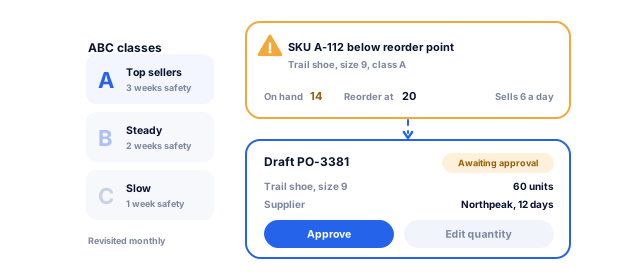
Reorder points equal average daily demand times supplier lead time, plus safety stock, and are recalculated as sales change. Below the point, the system drafts a purchase order to the preferred supplier for approval. Goods received update stock, cost and lead-time history, so the next reorder uses what actually happened.
Batches, serials and expiry
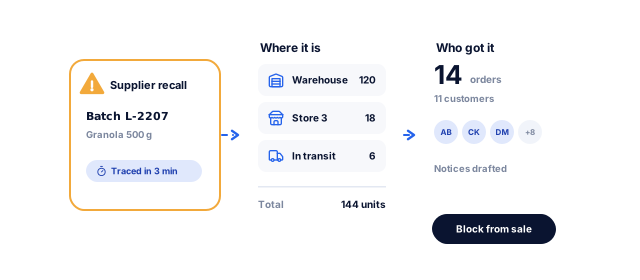
For food, medicines, cosmetics and electronics, stock is tracked by batch or serial number with expiry dates. The system picks first-expiry-first-out, blocks expired or recalled batches from sale, and traces any batch to its customers. Clinics get the same logic in our Nabhaya Clinic product.
Ecommerce, POS and accounting sync
Stock pushes to Shopify, WooCommerce and Amazon through their APIs, and online orders return as reservations, so channels never sell the same unit twice. Sales from your POS system deduct stock as they happen, and stock value and cost of goods sold post to QuickBooks Online, Xero or Zoho Books.
Counts, adjustments and reporting
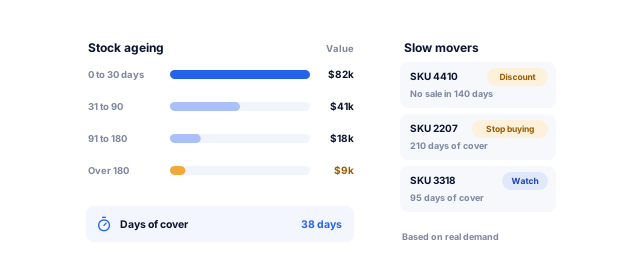
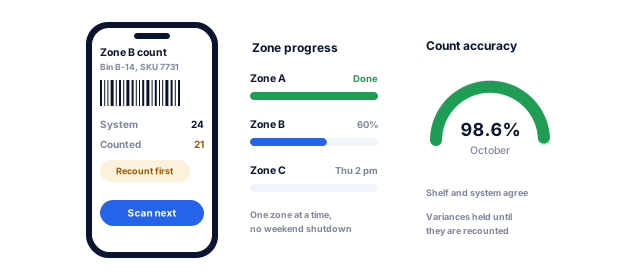
Cycle counts by zone or ABC class replace one stressful annual stocktake. Every adjustment needs a reason code and is logged with user and time, so shrinkage is visible. Reports show stock value, ageing, slow movers and stockout days by item and location, ready for a custom dashboard.
What better inventory control changes
Good inventory software shows up in cash, sales and staff hours. We scope for these outcomes.
US manufacturers and traders held $2,818.8 billion in inventory at the end of August 2026, an inventories-to-sales ratio of 1.33, according to the US Census Bureau. Reorder points based on real demand cut overstock on slow movers, and ageing reports show what to discount. We track stock value and days of cover.
Fewer stockouts on what actually sells
Most stockouts hit fast movers whose reorder point was set once and never revisited. ABC analysis puts the most safety stock on items that drive revenue, alerts fire before stock runs out, and purchase orders are drafted for a buyer to approve. We measure stockout days per item before and after go-live.
No overselling across channels
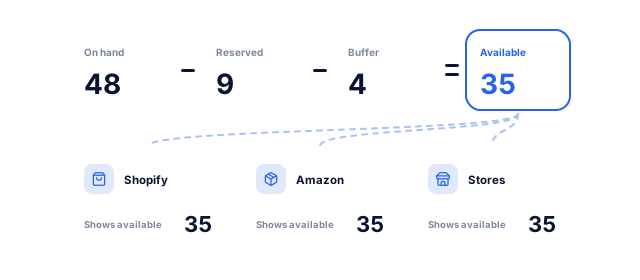
When Shopify, Amazon and your stores each hold their own stock number, the same unit gets sold twice. With one system owning stock, every channel shows available-to-sell: on hand, minus reservations and a safety buffer you control. That is omnichannel inventory in practice. We watch orders cancelled for stock reasons.
Faster, more accurate counts
Scanning replaces paper count sheets, and cycle counts spread the work across the year instead of closing a warehouse for a weekend. Variances are flagged for a recount before they post, and count accuracy is reported monthly.
Traceability when something goes wrong
A supplier recall or customer complaint should take minutes to trace, not a day of searching invoices. With batch and serial tracking, you see every location holding the affected stock and every customer who received it, then block it from sale in one action.
Stock value finance can trust
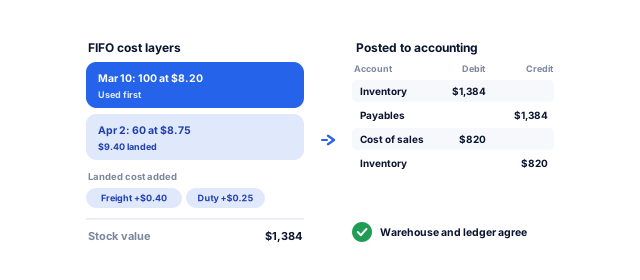
Costing follows your accountant's method, usually FIFO or weighted average, and landed costs such as freight and duty are added to the right items. Stock value and cost of goods sold post to accounting automatically, so the balance sheet and the warehouse agree at month-end without a manual journal.
Wondering if Zoho Inventory or Cin7 would do the job?
Tell us what you need. We look at your locations, SKUs and sales channels, and tell you in writing whether a tool like these, set up by us, will do the job or a custom system pays back, with a price range and timeline.
Your free software planFor what you need
1What we would build firstYour users, workflows and the systems it connects to
2A price range and timelineFor the budget you pick, with a phased option
3Build, buy or configureAnd how your team runs it after launch
A specialist walks you through it on a call
Our inventory system development process
Six steps of inventory management software development, starting on the warehouse floor rather than in a meeting room.
We walk receiving, putaway, picking, transfers and counting at your sites, review the item master and count a sample of locations. Duplicate SKUs, missing units and unclear locations break integrations, so we find them first.
Process walk-through notes
Item master quality report
Sample count accuracy
You know where accuracy is lost
Build or buy, then scope
We test your must-have workflows against off-the-shelf options. If one fits, we set it up and connect it to your channels and accounting. If not, we scope locations, channels, roles, hardware and integrations, and price phase one as a fixed quote.
Options comparison
Scope and integration map
Fixed quote for phase one
A decision based on your workflows
Stock model, hardware and prototype
We design the stock ledger, location model and costing rules, and choose scanners, label printers and RFID readers. Scanning screens are prototyped on real devices in your warehouse, because a screen that works at a desk can fail with gloves on.
Data model and costing rules
Hardware shortlist
On-device prototype
Screens your staff can actually use
Build and integrate in sprints
The stock ledger comes first, then scanning, purchasing and each sales channel, with a staging demo every two weeks. Integrations are tested in sandboxes, such as a Shopify development store, before touching live data.
Fortnightly demos
Integration test reports
Updated backlog
Working software early
Opening count and go-live
We map and clean items, suppliers and open orders from spreadsheets or the old system, rehearse the import, then load opening stock from a full count. Go-live runs one location at a time, and old records retire once counts and channel stock agree.
Migrated item master
Verified opening stock
Staff training by role
Stock figures everyone trusts from day one
Support and tuning
After launch we monitor sync failures, review reorder parameters with your buyers monthly, and adjust safety stock as demand changes. Forecasting follows once there is enough clean history.
Monitoring and support plan
Monthly reorder review
Roadmap for next features
Rules that keep up with demand
Inventory management software for your business model
The stock ledger is the same everywhere. The rules on top change with how you sell.
01 / 05
Retail chains and multi-store
Store chains need stock by store, transfers from a central warehouse, and replenishment that knows what each store sells. We build store-level reorder rules, transfer requests and receiving on a handheld, and the same system can feed custom POS system development if your checkout needs it too.
Online sellers juggle Shopify, Amazon, wholesale orders and often a 3PL warehouse. We sync available-to-sell to each channel, handle bundles, kits and preorders, and import 3PL stock reports so differences surface quickly. As a Shopify Partner, our Shopify development team can change the store side too.
Distributors buy in pallets, store in cases and sell in units, with customer allocations and backorders. We build unit conversions, allocation rules, backorder queues, landed cost and pick lists ordered by bin. When orders, jobs and billing should share a system with stock, our business management software service builds it.
Makers track raw materials, work in progress and finished goods. We build bills of materials and assembly orders that consume components and produce finished stock, so shortages show before a job starts. For production planning across sites and full accounting, we extend it through ERP software development.
Medicines need batch and expiry tracking, controlled-drug registers and dispensing tied to prescriptions. For clinics in India, our Nabhaya Clinic product already does this, with pharmacy billing, purchase orders and GST invoices. For hospital stores and multi-site groups, we build custom, as in our hospital management system work.
Growing sellers with several channels and standard processes
Unusual rules, high volumes or many systems to connect
Locations and channels
Several locations; other channels through apps
Multi-warehouse on most paid plans; channels vary
Any structure, including vans, bins and 3PLs
Reorder logic
Low-stock alerts; purchasing varies by plan
Reorder alerts and purchase orders on most products
Your own formulas, approvals and supplier rules
Barcode and RFID
Barcode scanning; RFID usually needs add-ons
Barcode scanning; RFID varies by product
Barcode, QR and RFID around your process
Cost model
Included in the platform plan
Monthly subscription by plan, users or orders
Build cost, then hosting and support with no subscription
Ownership
Data in the vendor's platform
Data in the vendor's platform; export available
You own the code, data and hosting accounts
Main risk
Outgrowing it as channels multiply
Workarounds and add-ons piling up
Higher upfront cost and ongoing support
Features and prices change often, so confirm them on each vendor's site. A common middle path, which we also build, is an inventory SaaS plus custom integrations for the workflows it cannot handle.
Your inventory system project, week by week
A first release with stock, scanning and one sales channel usually goes live in 3 to 4 months.
Our own Nabhaya Clinic product handles batches, expiry, purchase orders, goods receipts and pharmacy billing for clinics every day, and our team hosts and supports it. That taught us that scanning screens, reason codes and reconciliation matter more than feature lists.
02
Store, stock and marketing in one team
improveFX is a Shopify Partner, with marketing and engineering under one roof. The people who build your stock system can also fix the storefront, product feeds and ecommerce SEO, so an integration problem does not bounce between vendors. All 25+ specialists work in-house in New Delhi.
03
Your code, your data, rolling terms
You own the source code, database, documentation and the cloud accounts it runs on, with no per-user charges from us. Support runs on rolling agreements with monthly reporting. Clients rate us 4.9 on Clutch from 221 reviews and stay 1.6 years on average. See our case studies.
Results we can put numbers on
Results from our case studies and client reviews, including custom hospital software and Shopify ecommerce work.
"From designing a high-converting website to managing our SEO, Google Ads, and Google Business Profile, improveFX delivered exceptional results across every channel."
210%more qualified leads
185%organic and local traffic growth
92%keywords on page one
Maureen CappalloBroker and founder, Momentus Real Estate Group
"They revolutionized our online presence with a 60% increase in web traffic through strategic e-commerce SEO and content optimization."
60%more organic traffic
47%more sales
Eric NoahPresident, Eric Originals & Antiques Ltd.
"Visionstar Technologies' online presence transformed significantly with a 40% boost in customer engagement, all thanks to their exceptional website structuring and SEO tactics."
+40%qualified leads
32%lower cost per acquisition
Thomas MorelFounder, Visionstar Technologies
"Their strategic approach to our website and SEO resulted in a 60% increase in local inquiries, revolutionizing our automobile service business."
60%more local inquiries
87%more organic traffic
Mike SteffanFounder, Sabulski Window Tinting
"Their SEO strategy helped us achieve top search rankings, while their Facebook Ads campaigns drove a steady flow of qualified prospects."
How much does inventory management software development cost?
Our software projects run from under $5,000 to $100,000+, depending on scope. One location, one channel and barcode scanning sit at the low end; many locations and channels, RFID, batch tracking and migration from several systems push it to the high end.
Scanners, label printers and RFID tags are bought separately. After launch you pay hosting and support, not a subscription that grows with users. We give a fixed quote for each phase.
How long does inventory management system development take?
A first release with the stock ledger, scanning and one sales channel usually takes about three to four months, including two to three weeks of discovery. Further channels, RFID and forecasting follow in later phases.
You see working screens on staging every two weeks. Messy item data, integrations and hardware lead times stretch timelines most, so we audit the item master and order devices early.
Should we use off-the-shelf inventory software or build custom?
If you sell through one main platform, run a few locations and follow standard processes, an off-the-shelf tool will do, and we set it up and connect it to your channels and accounting. When workarounds and add-ons cost more than a system of your own, we build custom.
Shopify, Square and Lightspeed include inventory for many single-brand sellers; Zoho Inventory, Cin7, inFlow and Sortly cover multi-channel and multi-warehouse needs. Custom fits unusual rules, high volumes or RFID at scale.
Can it sync stock with Shopify, Amazon and our POS?
Yes. Shopify, WooCommerce and Amazon (through its Selling Partner API) all support stock updates and order imports, and most modern POS systems offer APIs or webhooks.
The key design choice is that the inventory system owns stock and each channel receives available-to-sell. Orders flow back as reservations, failed syncs are retried, and a nightly reconciliation flags any channel that drifts.
Do we need RFID inventory tracking, or are barcodes enough?
Barcodes are enough for most businesses. RFID is worth it when you count large numbers of items often, such as apparel, high-value goods or returnable assets.
RFID reads many tags at once without line of sight, which speeds counts and receiving but adds tags, readers and tuning. We often start with GS1 barcodes and add RFID where counting time is the bottleneck.
How does automatic reordering work?
The system compares available stock with a reorder point and drafts a purchase order when stock falls below it. The reorder point is average daily demand multiplied by lead time, plus safety stock.
For example, an item selling 20 units a day, with a 7-day lead time and 60 units of safety stock, reorders at 200. We use recent sales and actual lead times, and buyers approve every order.
Which costing method does the system use?
The one your accountant uses, usually FIFO or weighted average cost, so stock value matches your books.
LIFO is permitted under US GAAP but prohibited under IFRS (IAS 2), so outside the US it is rarely an option. Landed costs such as freight and duty can be added to item cost, and adjustments post to accounting with a reason code.
Will scanning work in a warehouse with poor Wi-Fi?
Yes, if it is designed for it. Scanning apps can store transactions on the device and sync when the connection returns.
We decide case by case which actions are safe offline. Receiving and counting usually are; selling the last unit usually is not, because two devices could promise the same stock. We test on your devices, in your building, before go-live.
Can you add demand forecasting or AI later?
Yes, once you have clean sales history, ideally a year or more so seasonality shows. Forecasting built on bad data makes worse decisions faster.
Most businesses start with reorder points and ABC analysis, then add forecasting for their top items. Our predictive data analytics team builds models that feed suggested order quantities into purchasing, where buyers accept or override them.
Who owns the code and the stock data?
You do. The source code, database, documentation and hosting accounts belong to you, and our access is added to your accounts.
There is no per-user charge from improveFX. If you move development in-house or to another team, you take everything with you, including integration credentials and deployment scripts. Ownership is written into the agreement.
Ready to plan your software?
Tell us how the work runs today, or book a strategy call with our team.
What we would build first, or what to buy and configure
A price range and timeline for your budget
A call with a specialist to plan the next steps, no obligation
A specialist replies personally 4.9 from 566 client reviews