Our ERP software development team builds systems for manufacturers, distributors, construction firms, and service companies that have outgrown spreadsheets and disconnected tools. We map how your business actually runs, then deliver working modules in phases so daily operations never stall. The result is one system for finance, inventory, projects, and people, with source code you own outright.
Companies that chose us for their digital transformation


















No two ERP projects start in the same place. Some businesses are moving off spreadsheets for the first time. Others are stuck with a system that no longer fits or a platform that needs new modules to keep up. We scope custom ERP software development around what you already own, so you pay to fix the gap rather than rebuild what still works.

For teams running on spreadsheets and standalone apps. We map your workflows, then build finance, inventory, and operations modules in the order you need them.

Your current ERP is slow, unsupported, or holding back growth. We migrate your data, rebuild what matters, and retire the old system without losing history.

Already on SAP, NetSuite, Odoo, or Dynamics? We build the modules, workflows, and reports your team keeps rebuilding by hand in spreadsheets.

Connect your ERP to accounting, CRM, ecommerce, and shop floor tools so one record updates everywhere. We migrate your data with no gap in operations.
An ERP system is only worth building if it changes how work actually gets done. The right ERP system software pulls finance, inventory, production, and people into one record set, then removes the manual steps between them. Here is what that looks like in practice and the specific gains our clients ask us to build for when we scope a project.
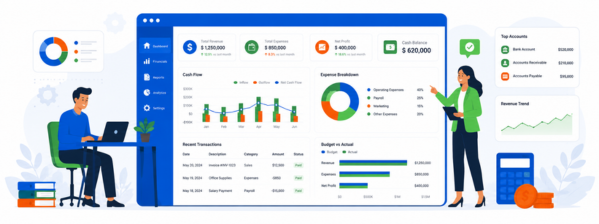
Most operational problems trace back to the same cause: sales, finance, and the warehouse each keep their own numbers. Your ERP replaces that with a single record every department writes to and reads from. When a quote becomes an order, stock, revenue recognition, and the production schedule all update together. Nobody reconciles by email, and nobody argues about whose spreadsheet is current.
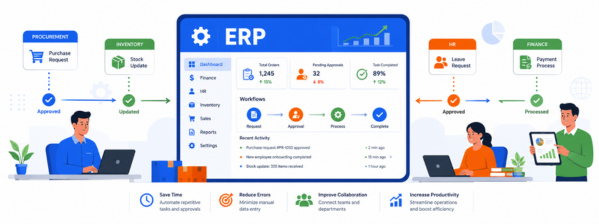
Custom ERP accounting software gives you the general ledger, accounts payable and receivable, and multi-entity reporting in the same system that holds your operational data. Margin by job, customer, or SKU stops being a month-end exercise and becomes a live number. Your controller closes faster because the entries are already there, and your board reports pull from the system rather than a rebuilt spreadsheet.
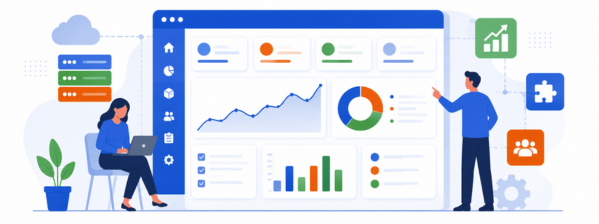
Approvals, purchase orders, and invoices are where hours disappear. We build rules into your ERP so a low stock level triggers a purchase requisition, an approved timesheet flows into payroll and job costing, and an overdue invoice chases itself. Your team stops re-keying the same information into three tools and starts working the exceptions instead. We automate stable rules and leave judgment calls to people.
Distribution ERP software earns its cost the first time it prevents a stockout or a duplicate purchase order. We build multi-warehouse stock tracking, batch and serial traceability, reorder points, and supplier lead time history into one view. Sales sees what is actually available before promising a date, and procurement buys against demand signals instead of last quarter’s guesswork. Inventory stops being a monthly count and becomes a daily decision.
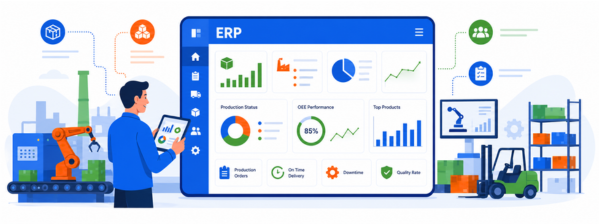
The best ERP software for manufacturing tracks a job from work order to shipment, with real time machine, labor, and material cost against it. Construction and field service teams get the same logic applied to projects, subcontractors, change orders, and progress billing. Either way you learn whether a job made money while you can still do something about it, not ninety days later.
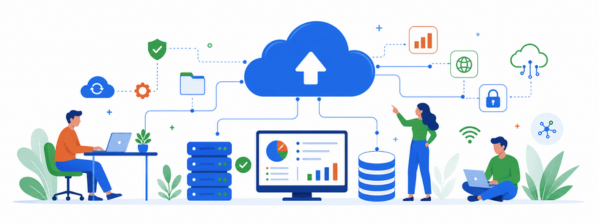
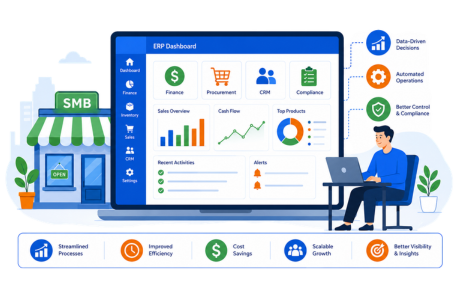
Cloud-based ERP software means your plant supervisor, remote sales rep, and accountant work from the same live data on whatever device they have. We build role-based permissions so people see only what their job requires, keep an audit trail on every record change, and size the infrastructure so adding a warehouse or fifty users does not mean re-architecting the system.
Get a free proposal with real numbers, honest timelines, and no lock-in. Judge us on that.
Most ERP projects fail on schedule, not on code. Any ERP software development company can list stages, so we have added the two things buyers actually ask for: how long each phase takes, and how much of your team’s time it needs. Timelines below reflect a mid-sized build and get confirmed in discovery.
Weeks 1 to 3. We sit with the people doing the work, document how orders, inventory, and approvals move today, and agree what the ERP must fix. Expect two to three sessions per department.
Weeks 3 to 6. Our custom ERP software developers map the data model, module boundaries, integrations, and permission structure, then price the build. Compliance needs like SOC 2 or HIPAA are designed in here, not bolted on later.

Week 6 onward, releases every two weeks. We build the module that hurts most first, ship it to a working environment every two weeks, and let you use it. QA runs alongside development rather than waiting until the end.
Runs alongside the build. We move history from your spreadsheets or legacy ERP, reconcile it against your books, and connect accounting, CRM, ecommerce, and shop floor tools. Nothing goes live until the numbers match.

Two to four weeks per phase. We train department by department, then switch on modules in stages while the old process runs in parallel. If something breaks, your business keeps operating and we fix it that week.

Ongoing. After launch, we monitor performance, track adoption by team, and hold a quarterly review to decide what gets built next. You keep the source code and the documentation either way.
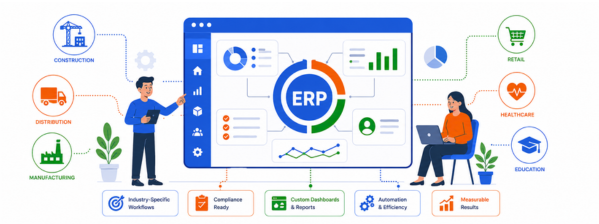
A generic ERP forces every industry into the same data model, which is why so many go unused. We build around the workflows that define your sector, from small business ERP software for a thirty-person shop to multi-site systems running several legal entities. Below are the sectors where our team has the deepest operational knowledge.
Healthcare ERP has to satisfy HIPAA before it does anything else, so we design access control, audit logging, and encryption at the architecture stage. From there, we build supply and pharmaceutical inventory with expiry tracking, staff scheduling against credentials, procurement across departments, and revenue cycle reporting. Integrations with EHR platforms are handled through documented interfaces rather than direct database access.
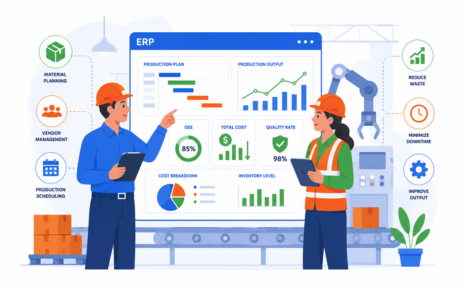
The best ERP software for manufacturing starts with the bill of materials and works outward. We build BOM versioning, work order routing, machine and labor capture, scrap tracking, and quality holds, then tie all of it to job costing. For a small manufacturing business, that usually means starting with production scheduling and inventory before touching finance, because that is where the money is leaking.
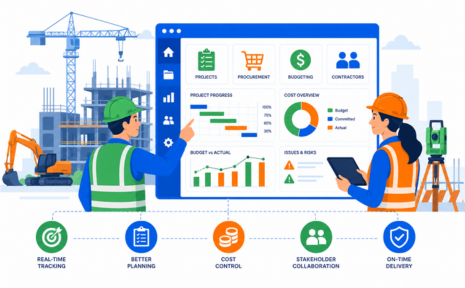
Construction ERP software lives or dies on job costing. We build estimating that carries into the budget, change order tracking that protects your margin, subcontractor compliance and lien waiver management, progress billing with AIA formats, and equipment allocation across sites. ERP software for builders also has to work from a phone in a trailer, so mobile field entry is designed in, not added later.
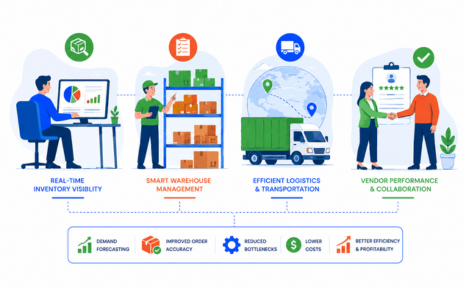
Distribution ERP software has to handle the messy parts: multiple units of measure, customer-specific pricing tiers, backorders, drop shipping, and returns. We build warehouse management with pick paths and barcode scanning, landed cost calculation so your margins are real, and EDI connections to the retail partners who require them. Everything reconciles to the general ledger without a monthly export or a manual journal entry.
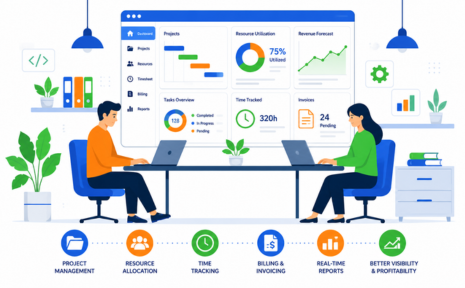
Retail ERP work is mostly a synchronization problem. We connect Shopify, Amazon, marketplaces, and your physical locations to one inventory pool, so a sale in any channel updates stock everywhere within seconds. Add purchase planning based on sell-through rate, returns processing that puts sellable stock back into circulation, and margin reporting by channel rather than one blended number that hides your worst performer.
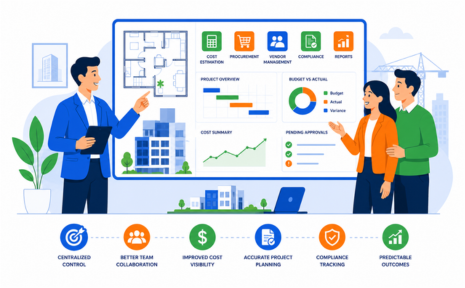
If you bill for time, your ERP is really a utilization system. We build resource scheduling, time and expense capture that people will actually use, project profitability by consultant and client, retainer and milestone billing, and pipeline visibility that feeds capacity planning. Field service teams get dispatch, route optimization, parts consumption, and job completion capture from the technician’s phone, even when there is no signal on site.
Choosing the best ERP software development company is hard because every vendor’s pitch sounds identical. So here are the three things we would check if we were in your seat, and where we stand on each. If another firm answers these better, hire them. It is a big commitment either way.
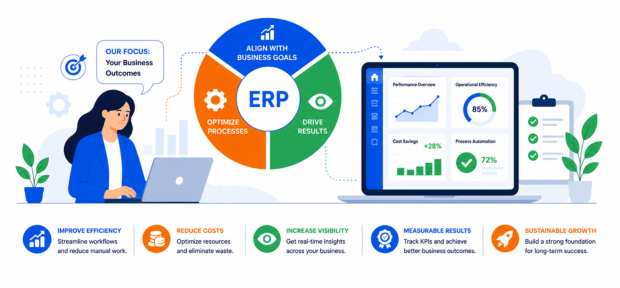
Any custom ERP software development company can build what you describe. The harder job is telling you what you actually need. We run discovery before pricing, and sometimes that discovery ends with us recommending you configure an off-the-shelf platform instead of building. That costs us a project and saves you six figures, which is why we would rather find out early.
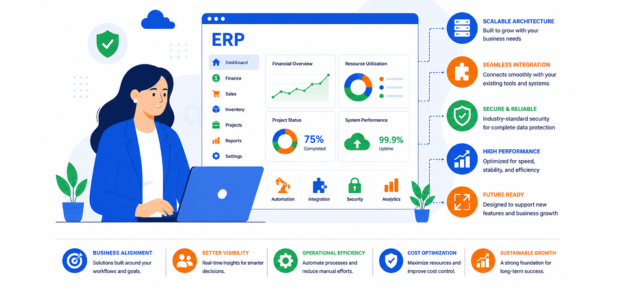
When we hand over an ERP system, you get the source code, the database schema, the API documentation, and the deployment setup. No per-seat licensing, no annual fee that climbs as you hire, and no clause that makes leaving expensive. If you decide to move the work in-house or to another team next year, you can. That constraint keeps us honest.
Most ERP projects are not lost in development. They are lost three months after go-live, when half the team quietly goes back to spreadsheets. We track login rates, module usage, and where people work around the system, then fix the friction. A quarterly review decides what gets built next based on what your team is actually doing, not what the original scope document assumed.
A full ERP is not always the right first move. Sometimes one system is causing most of the pain, and fixing that buys you two years before you need the rest. These are the platforms we build most often around ERP work, each one able to stand alone or become a module later.
If one department is struggling and the rest are fine, a single platform usually solves it faster and cheaper. If the same data is being re-entered in four places, you need an ERP. We will tell you which situation you are in during discovery, before anything is quoted.
Built for teams whose sales process does not fit Salesforce. Pipeline, quoting, and customer history in one place, ready to connect to your ERP when finance follows.
The fastest ERP module to justify on its own. Multi-location stock, reorder points, barcode scanning, and landed cost, without waiting for a full ERP build.
Onboarding, leave, attendance, appraisals, and payroll inputs in one system. Most clients start here when headcount passes fifty and spreadsheets stop being defensible to an auditor.
For businesses that bill by project. Budgets, timelines, resource allocation, and profitability per job, with the costing logic an ERP would use anyway, so nothing is wasted later.
If your data is fine but your reporting is not, start here. Live dashboards pulling from the systems you already run, no ERP replacement required.
For software that still works but nobody wants to touch. We rebuild it on a current stack, keep the business logic, and move the data without losing history.
These are the questions that come up on almost every first call, answered the way we would answer them on the phone. If yours is not here, ask us directly. We would rather have an awkward conversation early than a surprise halfway through a build. Every answer reflects how we actually run projects, not a best-case scenario.