



















Ecommerce website development built around how you sell

Our ecommerce website development services help retailers, D2C brands and wholesalers launch or rebuild an online store that takes real orders, from a lean theme-based store that goes live quickly to a custom or headless build. We help you choose the platform, whether Shopify, WooCommerce, headless or fully custom, then design and build a store with a quick checkout, clean product data and the integrations your team relies on.

  • 170+projects delivered
  • $5M+revenue generated for clients
  • 4.9
    221 reviews
New arrivalLinen overshirt$68
SML
Add to cart
Checkout3 steps
  • Cart
  • Shipping and tax
  • Payment, with wallets

120+ businesses chose us for their digital growth

  • AkosMD Hospital
  • Amita Naithani Resort Wear
  • Momentus Real Estate Group
  • CleverBoss
  • MastersBuddy
  • Foley Mansfield
  • Pomegranate Health
  • Trunk Box Baby
  • Hunt Ortmann
  • Immigration Desk
  • Urology Partners
  • Jodi Carlton
  • Ecom Fashion
  • Eye on Security
  • Disability Solutions
  • One400
  • Eric Originals
  • Sabulski Window Tinting
  • History of Soccer

Ecommerce website development at a glance

Ecommerce website development is the design, build and integration of an online store: choosing a platform, structuring the catalog, building product and checkout pages, connecting payments, shipping, tax and inventory systems, and making the site fast and secure.

  • Choose the platform for your catalog, integrations and team, not for a theme demo.
  • Most lost revenue sits in checkout and surprise delivery costs, not on the home page.
  • Product data and integrations take longer than design, so plan them first.
  • A replatform needs a 301 redirect for every old URL, or search traffic can drop.
Best for
Retailers, D2C brands, wholesalers and manufacturers, from a first small store to a full replatform
What you get
Platform recommendation, UX and design, store build, payments and shipping, integrations, data migration, QA and launch support
Typical timeline
A theme-based store with a standard catalog launches sooner. A focused Shopify or WooCommerce store takes about 6 to 10 weeks; custom, headless or integration-heavy builds take 3 to 6 months.
Pricing
Driven by platform, catalog size, custom design and integrations. Published agency pricing we reviewed started at about $5,000 to $15,000 for a focused store. Our website projects run from under $1,000 to $30,000+, depending on scope. We quote after a free scoping call.

What our ecommerce website development services include

Six workstreams, from platform choice to support after launch. A small store or a redesign may need only some of them, and you pay only for those.

Get a free proposal

Platform selection and architecture

We compare Shopify, WooCommerce, BigCommerce, headless and custom options against your catalog size, variant structure, integrations, team skills and three-year running costs. You get a written recommendation that spells out the trade-offs. If a headless front end is justified, our headless CMS development team plans how content and commerce data flow between systems.
Ecommerce website design and development

Category pages, filters, search and product pages do most of the selling, so we design them first. Variant pickers, size guides, stock messages, delivery estimates and reviews are planned in wireframes, then built mobile first and checked against WCAG 2.2 AA. Our website UI/UX design team creates a design system, so new pages stay consistent after launch.

Checkout, payments and tax

We set up gateways such as Shopify Payments, Stripe, PayPal, Adyen or Razorpay, add Apple Pay and Google Pay, and offer buy now, pay later where it suits your price point. Card details go into the gateway's hosted fields, so card numbers never touch your server and PCI DSS scope stays small. Tax, duties and shipping rates are set per market.

Catalog, inventory and order integrations

We connect ERPs such as NetSuite, Microsoft Dynamics 365 Business Central and Odoo, plus PIM, 3PL, shipping and marketplace tools, through native connectors or custom API development. First we agree which system owns stock, prices and product data, then we sync on a schedule that stops overselling.

Speed and SEO foundations

We set a budget for apps and scripts, serve images in modern formats through a CDN, and test Largest Contentful Paint, Interaction to Next Paint and Cumulative Layout Shift before launch. Product schema, crawlable category filters, canonical tags and clean URLs are built in, so ecommerce SEO can start on a sound base instead of a fix list.

Migration, launch and support

Moving from Wix, Magento, WooCommerce or another platform means moving products, variants, customers, order history and URLs. We map every old URL to its new one, run trial imports before the real one, and freeze changes before cutover. After launch, website maintenance covers updates, app reviews, security checks and small improvements.

What a well-built store changes for your business

Online sales made up 17.1% of US retail sales in the second quarter of 2026, according to U.S. Census Bureau data. Most stores lose part of that demand in a few predictable places.

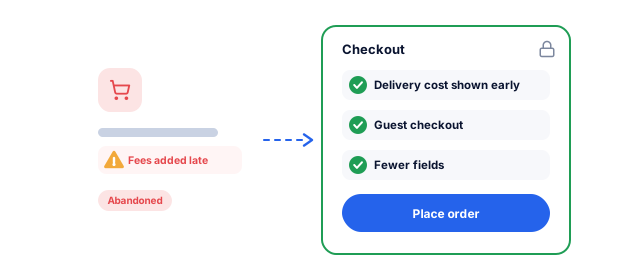
A cart abandoned over late fees beside a checkout that shows delivery costs early, offers guest checkout and asks for less

Fewer abandoned checkouts

Baymard Institute puts the average documented cart abandonment rate at 70.22%, across 50 studies. Among shoppers who were not just browsing, the top reasons were extra costs (40%), being made to create an account (18%) and a long or complicated checkout (17%). We show shipping and duties early, keep guest checkout, and cut form fields to the minimum.

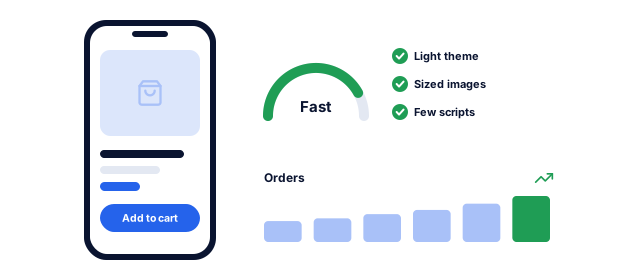
A product page loading fast on a phone because the theme, images, apps and scripts were kept light at build time, with orders rising

Faster pages, more orders

In a study commissioned by Google and run by 55 and Deloitte across 37 brand sites, a 0.1 second improvement in mobile speed lifted retail conversion rates by 8.4%, and shoppers spent 9.2% more. Speed is mostly decided at build time: theme weight, image handling, and the apps and tracking scripts that load on every page.

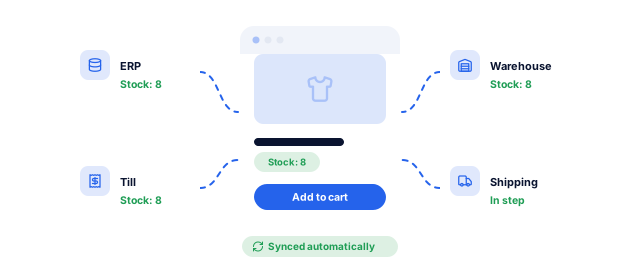
The store, ERP, warehouse and till all showing the same stock level, kept in step automatically instead of copied by hand

No overselling or manual order entry

When stock lives in one system and orders in another, someone spends every morning copying data, and customers still buy items that are already gone. Connecting the store to your ERP, warehouse or POS keeps stock counts and order status in step, so staff stop retyping orders and out-of-stock refunds end.

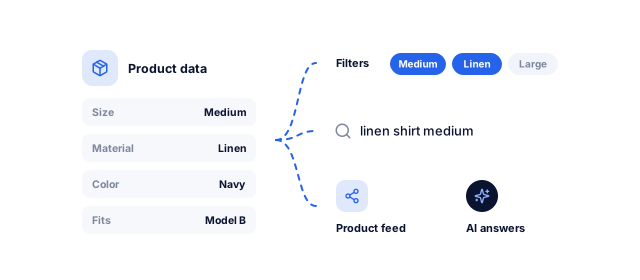
Clean product attributes such as size, material and fit driving filters, on-site search, the product feed and AI shopping answers

A catalog shoppers can actually search

Clean product attributes drive filters, on-site search, Google Merchant Center feeds and the product details AI shopping answers draw on. We define attributes and naming rules before import, so a shopper filtering by size, material or compatibility sees the right products.

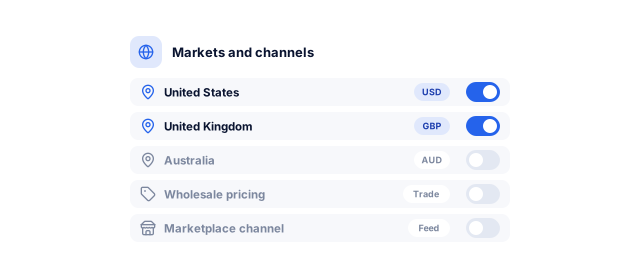
Store settings where new currencies, languages, wholesale pricing and a marketplace channel can be switched on later without a rebuild

Room to add markets and channels

A store planned for growth can add currencies, languages, wholesale pricing or a marketplace channel without a rebuild. We set up Shopify Markets or WooPayments multi-currency with your roadmap in mind, so selling into the UK or Australia later becomes a configuration project rather than a new website.

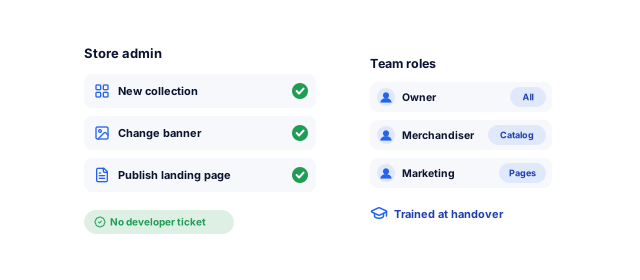
A store admin where the team launches collections, changes banners and publishes landing pages, with roles and permissions set at handover

A store your team can run

Your team should be able to launch a collection, change a banner or publish a landing page without waiting for a developer. We set up roles and permissions, build editable page sections, and train your team at handover.

Not sure which platform fits your catalog?

Tell us what you need. We look at your catalog, checkout and the systems your store connects to, and send a written plan with the platform we would choose, a price range and a timeline.

What do you need?

Free, with no obligation. Rather talk? Book a 30-minute call

Our ecommerce website development process, from scope to first orders

  1. Discovery and platform decision

    We run a requirements workshop, review your current store and catalog, and map every system the store must talk to. Then we compare platforms on fit and three-year cost, and agree scope, budget and a launch date.

    • Requirements and integration map
    • Platform recommendation with running costs
    • Scope, timeline and milestones
    An approved platform, scope and budget
  2. UX and design

    We plan the category structure from your product data and search demand, wireframe the key templates, then design them mobile first.

    • Sitemap and category structure
    • Wireframes for key templates
    • Design system and page designs
    Designs signed off before any code
  3. Build and integrations

    We build on a staging store under version control, configure payments, shipping, tax and apps, and connect your ERP, inventory or fulfillment systems. Integrations are tested with sample orders, including refunds, partial shipments and out-of-stock cases.

    • Staging store you can review
    • Payment, shipping and tax setup
    • Tested integrations
    A working store in staging
  4. Data migration and SEO safeguards

    Products, variants, images, customers and order history move in trial runs first, then get checked against the source. Every old URL gets a permanent redirect, and titles, descriptions and structured data carry across, in line with Google's site move guidance.

    • Migrated and verified data
    • URL redirect map
    • Metadata and schema carried over
    Nothing important lost in the move
  5. Testing and launch

    We test on real phones and browsers, place sandbox orders through each payment method, check accessibility and page speed, and confirm GA4 ecommerce events fire correctly. Launch follows a written checklist with a rollback plan, timed away from your busiest trading hours.

    • Cross-device QA report
    • Analytics and conversion tracking verified
    • Launch and rollback checklist
    A planned, low-risk go-live
  6. Monitor and improve

    After launch we watch Google Search Console for crawl errors, track Core Web Vitals from real users and review the checkout funnel step by step. A ranked list of improvements feeds ongoing work if you want it.

    • Redirect and error checks
    • Funnel and speed review
    • Improvement backlog
    A store that keeps improving

Ecommerce builds for the way you sell

These are the builds we plan most often, by platform and business model.

01 / 05

Shopify and Shopify Plus stores

Shopify suits most D2C brands and growing retailers because hosting, security and checkout are handled for you. For Shopify ecommerce website development we customize a Theme Store theme for a quick launch or build a custom Online Store 2.0 theme, set up Shopify Markets for selling abroad, and keep the app list short so the store stays quick. See our Shopify website development service.

02 / 05

WooCommerce stores

WooCommerce runs inside WordPress, so it suits brands that publish a lot of content or want full control of code and hosting. We build custom themes and extensions, choose hosting that can carry your peak traffic, and limit plugins to the ones you need. Updates and security matter more here than on hosted platforms. Read about our WooCommerce website development work.

03 / 05

Headless and custom ecommerce

Custom ecommerce website development makes sense when a platform cannot model how you sell: product configurators, rental or subscription logic, marketplaces, or several storefronts sharing one back end. We build headless front ends in Next.js on top of Shopify, BigCommerce or commercetools, or a fully custom stack when nothing else fits. It costs more than a hosted store, so on a tighter budget we start on Shopify or WooCommerce and add the custom piece, such as a configurator, as an app.

04 / 05

B2B and wholesale portals

B2B ecommerce website development adds company accounts, customer-specific catalogs and prices, payment terms, quantity rules and quick reordering. Shopify B2B now runs on the Basic, Grow, Advanced and Plus plans, although direct company catalogs and deposit payments are Plus only. For complex pricing rules we connect the portal to your ERP, so prices and credit limits are managed in one place.

05 / 05

Retailers with shops and marketplaces

If you also sell in physical stores or on Amazon, we connect online and in-store stock so both show the same count, set up click and collect and cross-channel returns, and feed marketplace listings from one product source. Where an off-the-shelf POS does not fit, we build custom POS systems. See how we support ecommerce businesses.

Shopify, WooCommerce, headless or custom: which fits?

Platform choice sets your running costs and limits for years, so we settle it first.

Book a strategy call
FactorShopifyWooCommerceHeadlessCustom build
Hosting and securityHosted by Shopify, including checkout securityYou choose the host and run updatesFront end hosted separately; the commerce engine runs checkoutYou host, secure and patch everything
Build costLow to moderateLow to moderateHighHighest
Running costsMonthly plan, paid apps and payment feesHosting, paid extensions and maintenance timeCommerce plan, front-end hosting and a developer retainerHosting, monitoring and a development team on call
FlexibilityThemes, apps and Shopify Functions; checkout changes through Shopify's extensionsFull code access; almost anything is possibleFull control of the front end; back-end limits remainNo limits, but you build and maintain every feature
Content and SEOGood; content tools are basicStrong, thanks to WordPressAs good as the front end you buildAs good as the front end you build
Best whenMost D2C brands and growing retailers that want low maintenanceContent-heavy stores and teams already on WordPressHigh-traffic brands needing custom experiences or several storefrontsBusiness models no platform can handle
Main riskApp sprawl that slows the store and adds feesPlugin conflicts and slow hosting at scaleTwo systems to maintain and a bigger budgetLong build and reliance on the team that wrote it

Based on platform documentation and typical project scopes. Subscription and payment fees vary by plan and country. BigCommerce and Adobe Commerce (Magento) are also assessed during platform selection where they fit.

Your ecommerce website project, week by week

Timings are for a focused Shopify or WooCommerce store. A theme-based store with a small catalog moves through these phases faster; custom, headless and integration-heavy builds take 3 to 6 months.

Book a strategy call
  1. 1Weeks 1 to 2

    Discovery and platform decision

    • Requirements workshop and integration map
    • Platform recommendation with three-year running costs
    • Scope, budget, milestones and a launch date
    • From you: catalog export, brand assets and system access

    By week 2, you have an approved platform, scope and launch date.

  2. 2Weeks 3 to 7

    Design, build and integrations

    • Category structure and wireframes for key templates
    • Mobile-first designs, signed off before any code
    • Staging store with payments, shipping and tax set up
    • ERP, inventory or fulfillment integrations tested
    • From you: design feedback and final product content

    By week 7, you can place test orders on a working staging store.

  3. 3Weeks 8 to 10

    Migration, testing and launch

    • Trial and final data imports, checked against the source
    • Redirect map for every old URL
    • Cross-device QA, sandbox orders and GA4 event checks
    • From you: launch sign-off and staff available for training

    By week 10, your store is live, with redirects and tracking checked.

What you sign off, step by step

You approve each stage before the next one starts, and the project ends with a site you own and the documents to run it.

Along the way you get

  • A sitemap and plan before any design
  • Designs and builds for you to approve, step by step
  • A staging site to test before anything goes live
  • Speed, accessibility and SEO checks before launch
Store launch checklistSample
  1. 1Catalog and collectionsImported
  2. 2Payments and shippingTested
  3. 3Checkout on phonesTested
  4. 4Product schemaValid
  5. 5Core Web VitalsPassed
  6. 6Redirect mapReady
  7. 7Analytics and pixelsFiring
  8. 8Staff trainingBooked
A sample of the checklist. Every project gets its own, signed off with you.

Yours to keep, always. Everything is set up in your name, and if you leave we remove our access and hand over the documentation.

  • Code and repository
  • Domain and hosting accounts
  • CMS admin and content
  • Design files
  • Documentation and logins

Who ecommerce website development from improveFX is for

From a first small store to a full replatform, we scope the build to your catalog, budget and launch date.

Book a strategy call

A good fit if

  • You are launching a store and want payments, shipping and tracking right from day one
  • You want the platform chosen on your catalog, integrations and three-year costs
  • Your store must connect to an ERP, inventory, POS or 3PL system
  • You are replatforming and need to keep the search traffic you have

We can also help when

  • You need to sell soon: we launch a theme-based Shopify or WooCommerce store with your core range, then add features after launch
  • Your budget is small: we start with a well-built theme and only the essential apps, and plan custom work for when sales justify it
  • You want B2B or custom features without a custom-build budget: we start with Shopify B2B or WooCommerce extensions and build custom only where they fall short
  • Your product data is messy or spread across systems: we clean and structure it before import and map every old URL to a redirect

Why choose improveFX as your ecommerce website development company

01

A Shopify Partner with design, code and marketing in one team

Our 25+ in-house specialists in New Delhi, India cover UX, development, SEO and paid media, so product pages, tracking and site structure are ready for campaigns on day one. As a Shopify Partner, Google Premier Partner and Meta Business Partner, we keep up with the platforms your store depends on.

02

Launches that protect search traffic

A replatform can erase years of rankings if redirects and metadata are handled carelessly. For Eric Originals, we set one-to-one 301 redirects for every URL, removed duplicate pages and rebuilt the catalog structure during a Wix to Shopify move. Organic traffic later rose from 445 to 8,900 visits a month.

03

You own the store, on rolling terms

Your store, theme code, apps, domain and data sit in accounts you control from day one. Support and improvement run on rolling agreements with transparent monthly reporting, not lock-in contracts. Clients in the US, UK, Canada, Australia, Europe and India rate us 4.9 on Clutch from 221 reviews, and stay with us for 1.6 years on average.

Certified partners on the platforms we manage for you

  • Shopify Partner

Results we can put numbers on

These figures come from completed client work, including the Eric Originals Shopify migration and the SEO that followed.

See all case studies
Eric OriginalsJewelry ecommerce

+1,900%

organic traffic

A struggling jewelry website became a steady source of buyers

Read the case study
Momentus Real Estate GroupReal estate

210%

more qualified leads

Website, SEO, Google Ads and Business Profile working as one

Read the review
MastersBuddyStudy abroad consulting

160+

keywords in Google's top 10

A new consultancy broke into one of India's most competitive markets

Read the case study

What our website clients say

"From designing a high-converting website to managing our SEO, Google Ads, and Google Business Profile, improveFX delivered exceptional results across every channel."
210%more qualified leads
185%organic and local traffic growth
92%keywords on page one
Maureen CappalloBroker and founder, Momentus Real Estate Group
"They revolutionized our online presence with a 60% increase in web traffic through strategic e-commerce SEO and content optimization."
60%more organic traffic
47%more sales
Eric NoahPresident, Eric Originals & Antiques Ltd.
"Visionstar Technologies' online presence transformed significantly with a 40% boost in customer engagement, all thanks to their exceptional website structuring and SEO tactics."
+40%qualified leads
32%lower cost per acquisition
Thomas MorelFounder, Visionstar Technologies
"Their strategic approach to our website and SEO resulted in a 60% increase in local inquiries, revolutionizing our automobile service business."
60%more local inquiries
87%more organic traffic
Mike SteffanFounder, Sabulski Window Tinting
"Their SEO strategy helped us achieve top search rankings, while their Facebook Ads campaigns drove a steady flow of qualified prospects."
55%more organic traffic
4.7xreturn on ad spend
75%keywords on page one
Amita NaithaniCo-founder, Amita Naithani Resort Wear

Ecommerce website development questions, answered

Not seeing yours? Ask us directly and a specialist will reply personally.

How much does ecommerce website development cost?

Our website projects run from under $1,000 to $30,000+, depending on scope. A theme-based store with standard payments and a clean product spreadsheet sits at the low end; custom design, a migration with redirects and each integration move it up. Published agency pricing we reviewed started at about $5,000 to $15,000 for a focused store.

Custom, headless and B2B builds with ERP integration often pass $100,000. Running costs sit on top: platform plan, paid apps or extensions, hosting, payment fees and maintenance. We quote after a free scoping call, with one-time and monthly costs shown separately.

How long does it take to build an ecommerce website?

A theme-based store with a standard catalog launches soonest. A focused Shopify or WooCommerce store usually takes about 6 to 10 weeks, and custom, headless or integration-heavy builds about 3 to 6 months.

Product data and integrations move the schedule most. A clean spreadsheet of 200 products imports in days; thousands of variants spread across old systems take longer to clean up. If the date is fixed, we can launch your core range first and add products and features after go-live.

Which is better for my store: Shopify, WooCommerce or a custom build?

Shopify suits most brands that want low maintenance, WooCommerce suits content-heavy stores that want full control, and custom builds suit business models no platform handles.

We decide on your catalog structure, integrations, team skills and three-year running costs. Headless sits in between: a platform such as Shopify runs the back end while a custom front end gives you design and speed freedom, at a higher cost.

What do ecommerce website development services include?

They cover platform selection, UX and design, the store build, payments, shipping and tax setup, integrations, data migration, testing and launch.

Good ecommerce website development services also cover what happens around launch: SEO safeguards for redirects and metadata, analytics and conversion tracking, staff training and post-launch support. Our written plan lists each one before you sign.

Should I hire an ecommerce website developer or an agency?

A freelance ecommerce website developer can handle a small store with a clear scope; an agency adds design, integrations and SEO in one team. We take on both: small theme-based stores launched quickly, and larger builds and migrations.

With one ecommerce website development agency, one team owns the result. Whoever you hire, check live stores they have built, ask who handles redirects during a migration, and make sure the store and code are registered in your name.

Can you migrate my store without losing SEO traffic?

Yes, if the migration is planned as an SEO project. Every old URL needs a permanent redirect to its closest new page, and titles, descriptions and structured data must carry across.

Google notes that rankings can fluctuate for a few weeks after a move. We crawl the old site first, test redirects on staging, and monitor Search Console after launch. On the Eric Originals move, organic traffic later grew from 445 to 8,900 visits a month.

Do you build B2B ecommerce websites?

Yes. We build B2B and wholesale stores with company accounts, customer-specific pricing and catalogs, payment terms, quantity rules and quick reorder.

Shopify B2B covers many wholesale needs and is available from the Basic plan up, with some features reserved for Plus. When pricing rules are complex or live in an ERP, we connect the portal to that system or build a custom B2B front end.

Can the store connect to our ERP, inventory or accounting software?

Yes. We connect stores to ERPs, inventory, warehouse, accounting and CRM systems through native connectors where they exist, and custom APIs where they do not.

The key decision is which system owns each piece of data: stock, prices, product content and customer records. We document that, set sync schedules and error alerts, and test with real order scenarios before launch.

Do you include SEO in the build?

Yes, the technical SEO foundations are part of every build: clean URLs, crawlable filters, canonical tags, Product schema, XML sitemaps and fast templates.

Ongoing keyword research, category content and link building are a separate service. Our ecommerce SEO team can start straight after launch, using the same analytics setup, so you see how search traffic turns into orders.

What happens after the store launches?

We monitor errors, redirects, speed and the checkout funnel closely for the first weeks, and fix issues quickly.

After that, most clients keep us on a rolling maintenance and improvement agreement covering platform updates, app reviews, security checks and new features. You keep full ownership of the store, code and accounts, so you can also take the work in-house or contact us only when you need help.

Ready to plan your website?

Tell us what you need built, or book a strategy call with our team.

  • What we would build, and on which platform
  • A price range and timeline for your budget
  • A call with a specialist to plan the next steps, no obligation
Vikash Kumar PalRoshan Kumar JhaAbhishek Kumar Jha A specialist replies personally 4.9 from 566 client reviews
What do you need help with?

Pick all that apply.

Next, a few details about your business on our contact page. It takes about a minute.

Prefer to talk now? Book a strategy call