Most websites don’t underperform because they look bad. They underperform because the structure fights the buyer. Navigation that hides what people came for, pages too slow to hold the click, and a CMS your team can’t update without raising a ticket. Our custom website development services fix the layer underneath, where the real damage is being done. improveFX builds websites with intent first, structure second, and design third. We map what your buyers are actually searching for, then build the pages, journeys, and technical foundation that turn that demand into inquiries. Whether that runs on WordPress, Shopify, a custom CMS, or a headless stack depends entirely on your team and your roadmap, never on what’s easiest for us to build.


Companies that chose us for their digital transformation

















Custom is not automatically the right answer. If you need a five-page brochure site that will not change much, a website builder will do the job for a fraction of the cost, and we will say so on the call rather than sell you something you don’t need. Custom website development earns its cost when your site has a real job to do that a template cannot handle. Qualifying leads before they reach your sales team, carrying a catalogue that keeps growing, serving several audiences at once, or talking to the systems your business already runs on. These are the four situations we get brought into most often.

Traffic arrives, reads a page or two, and leaves. The design isn't the problem. The path is. We audit where visitors drop off, rebuild the journey around what people came to do, and rewrite the structure so the next step is always obvious. Most redesign projects we take on start here.

Visitors browse, add to cart, and disappear before payment. Custom ecommerce website development lets us fix the parts that off-the-shelf themes handle badly: product filtering, search, variant logic, and a checkout with nothing in the way. We build on Shopify, WooCommerce, or fully custom, depending on your catalogue and margins.

Every small change needs a developer. Plugins conflict. Page speed keeps sliding. When a site has been patched for years, more patching costs more than rebuilding. We migrate to a custom CMS or a clean WordPress build your marketing team can actually use, and we carry your rankings across intact.

A first website sets the ceiling on everything you do after it. We start with keyword and competitor research rather than a design file, so the structure is built around demand that already exists. You launch with pages that can rank, a stack you own outright, and room to grow into.
“Custom” is one of the vaguest words in this industry. It can mean a genuinely bespoke build or a marketplace theme with the colors changed, and most agencies never itemize the difference. So here is ours, layer by layer. Our custom website development services include all six layers below on every project, and scope only changes how deep each one goes. If you’re comparing website development services across two or three agencies right now, this is a fair checklist to hold every one of them to.
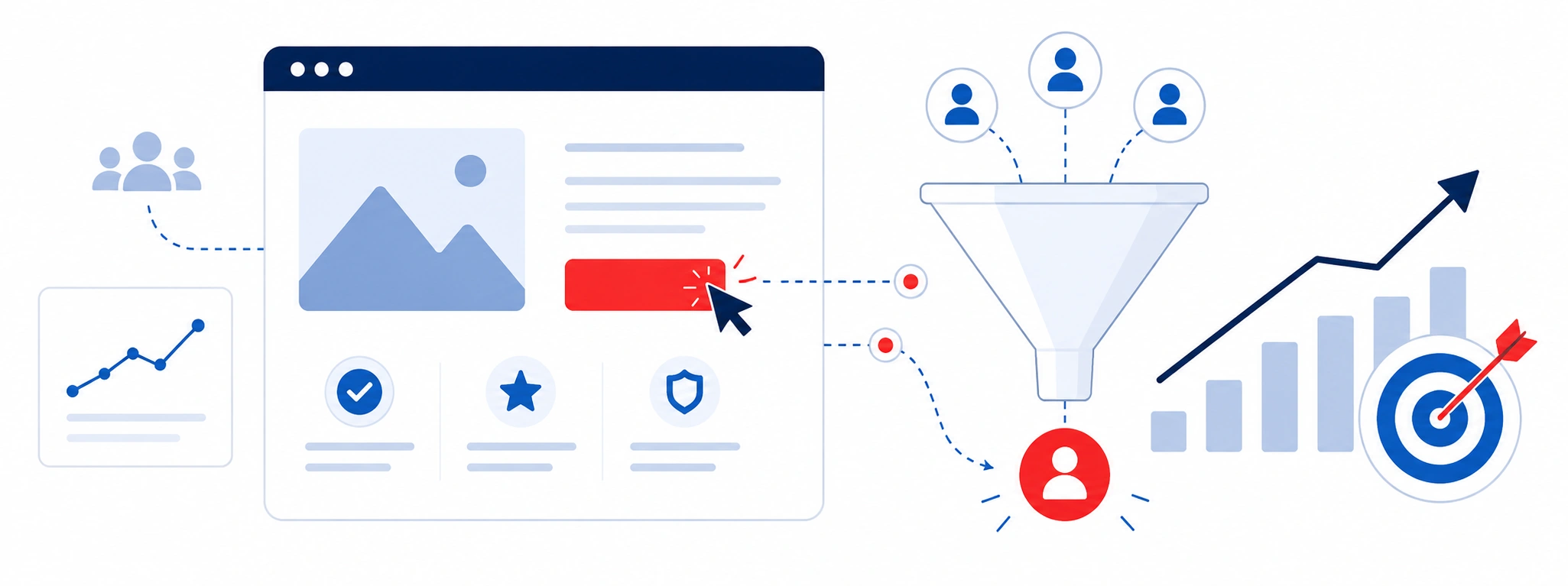
Nothing gets designed until we know what your market is searching for and why. We pull the queries buyers actually use, sort them by intent, since someone comparing vendors needs a very different page from someone ready to buy, and study what currently ranks so we know what your page has to beat. That research becomes your sitemap. Most agencies sell website development and SEO services as two separate engagements months apart. We start with the research because the structure of the site depends on it.
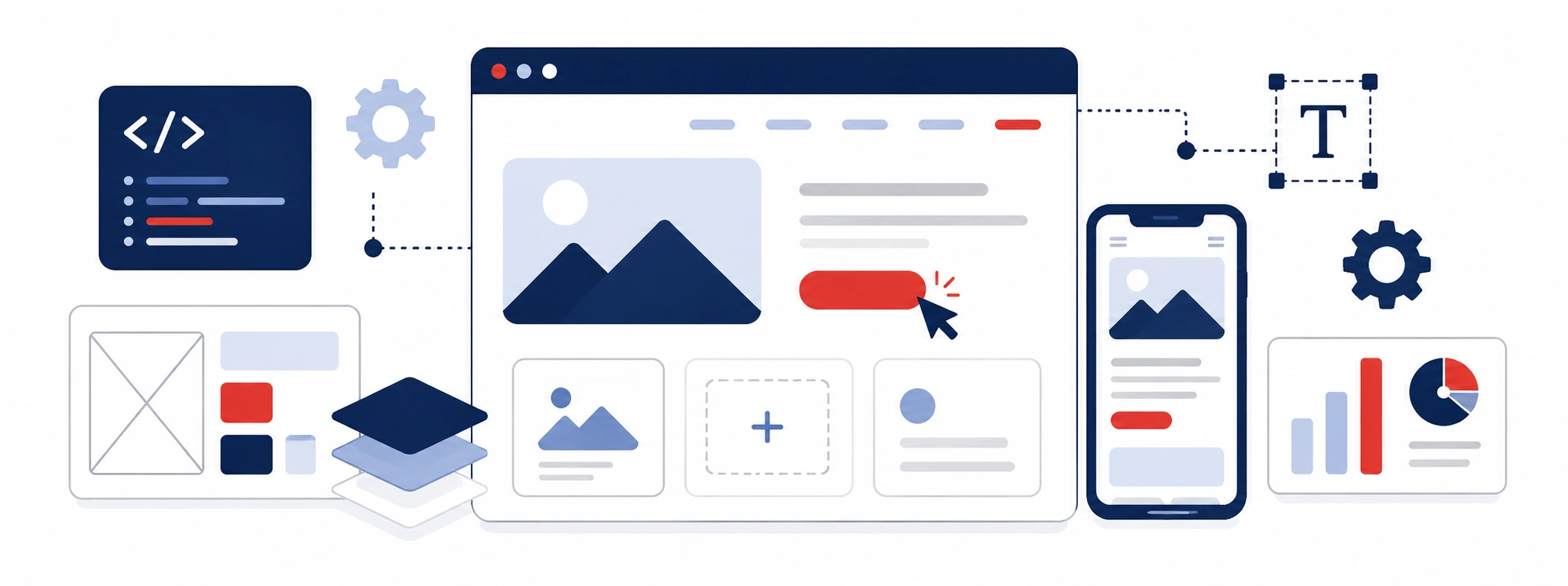
Structure decides whether people find what they came for. Every page gets assigned a job, then we map the routes between them, set the URL hierarchy, and plan the internal linking before a single wireframe exists. Alongside that, we define the conversion paths: what a first-time visitor sees, what a returning buyer sees, and where the next step sits on every template. This is the most expensive thing to get wrong, because every page built afterwards inherits the mistake.
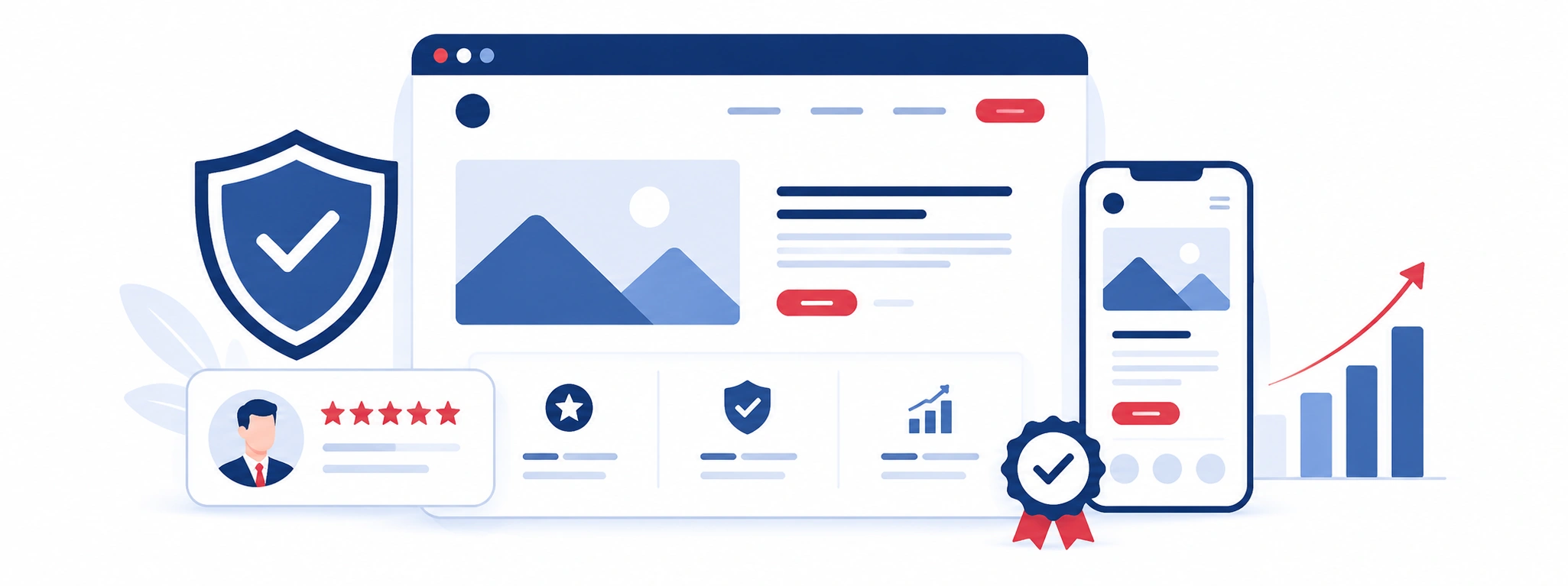
No templates and no marketplace theme with your logo dropped into it. Custom website design and development starts with a component system, meaning buttons, cards, forms, and page types built once and reused, so the site stays visually consistent as it grows and your team can publish new pages without breaking the design. The front end is hand-built and tested across browsers, screen sizes, and real devices, with motion used to direct attention rather than decorate.
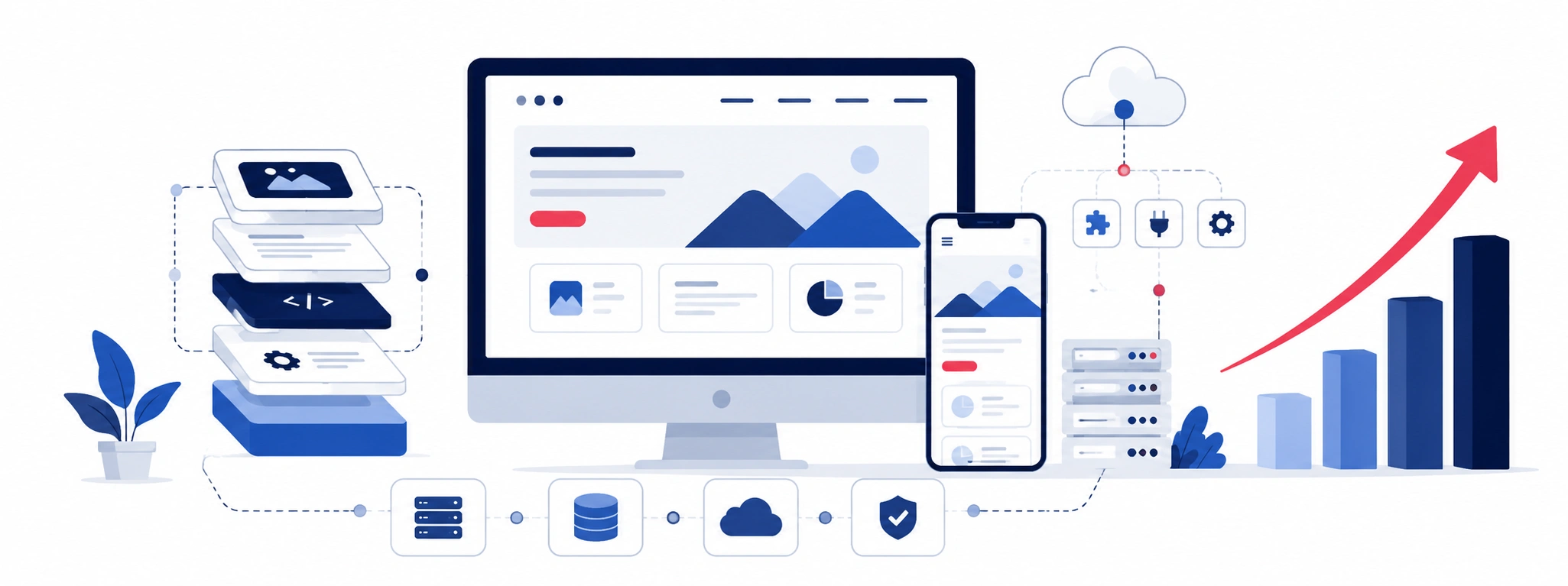
This is the layer your team lives in every week. We build the CMS around how you actually publish, so adding a case study, editing a service page, or launching a campaign landing page never needs a developer. The stack follows your team rather than our preference: custom WordPress website development, where your marketers want a familiar editor; custom CMS website development, when nothing off the shelf fits your content model; and custom PHP website development or a headless architecture when the site has heavy lifting to do behind the scenes. Where it has to talk to your CRM, payment gateway, or booking system, we build and document those integrations properly instead of stacking plugins and hoping they hold.
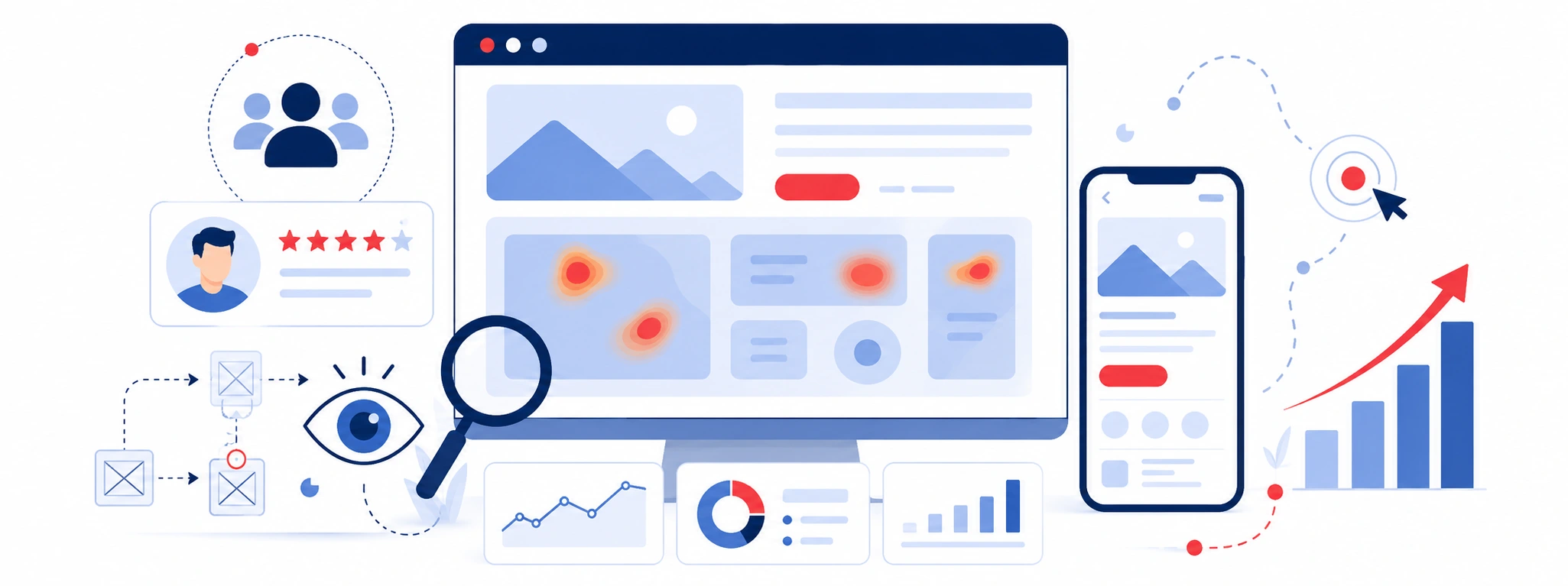
Speed is a build decision, not a post-launch fix. We set a performance budget at the start: optimized images, controlled third-party scripts, sensible caching, and a target of passing Core Web Vitals on mobile at launch rather than chasing them afterwards. Accessibility follows WCAG 2.1 AA, so the site works with screen readers and keyboard navigation, which is increasingly a legal requirement as well as a decency one. Our custom website developers close off the security fundamentals before handover: SSL, hardened admin access, and a defined update policy.
Search is no longer ten blue links. Your pages now need to be readable by crawlers and quotable by the AI assistants answering questions about your market. We ship clean semantic markup, structured data covering your organization, services, and FAQs, a crawlable internal link graph, and content formatted so a language model can lift a clear, correct answer out of it. Most agencies still sell this as an add-on months after launch. We build it in because retrofitting it means rewriting the page.
Get a free proposal with real numbers, honest timelines, and no lock-in. Judge us on that.
Every website development services company will show you a portfolio. Far fewer will show you how a project actually runs, which is the part that decides whether yours ships on time and on budget. The complaint we hear most about a previous agency is rarely about design quality. It’s about not knowing what was happening, for how long, or why the invoice kept growing. So here are all six stages: what comes out of each one, how long it usually takes, and what we need from you to keep it moving. Choosing a custom website development company is mostly a bet on how they run projects, and you should be able to place that bet with the facts in front of you.

A 30-minute conversation about what your site needs to do, what's broken now, and what you're working with. You leave with a straight answer on whether a custom build is the right call, including when that answer is no. No cost, no slide deck, no obligation. Usually booked within 48 hours of your inquiry.

We map your market's search intent, audit the competitors currently outranking you, and turn both into a keyword-to-page plan and a proposed sitemap. You get a written scope with fixed pricing and a delivery date before any design work starts. Typically 1 to 2 weeks. We need analytics access and an hour with whoever owns your sales conversations.

Every page gets a wireframe and a content brief before design begins, so you approve structure and messaging separately from how things look. Moving a block in a wireframe costs minutes. Moving it in a built page costs days. Typically 1 to 2 weeks. We need your sign-off on the sitemap and a decision on which existing content carries over.

We build a component system, design the key page templates, then apply them across the site. Two revision rounds are included, and we would genuinely rather you were blunt in them. Typically 2 to 3 weeks. We need your brand assets and consolidated feedback from one decision-maker to make most of it with higher productivity.

Your custom website developer builds the front end, configures the CMS, and connects your integrations on a staging URL you can open any time to see exactly where things stand. Weekly written updates, no black box. Typically 3 to 6 weeks depending on integration complexity. We need final content and access to any third-party systems we're connecting.

Full QA across devices and browsers, redirect mapping so the rankings you already earned survive the move, then launch. You receive a recorded walkthrough of your CMS, every credential, and outright ownership of the code. 30 days of post-launch support is included, with an optional retainer after that only if you want one.
We lose a few projects because of this section, and we’re comfortable with that. A custom build is a serious investment, and it is genuinely the wrong choice for some businesses, so the most useful thing we can do here is answer the hard questions straight rather than steer everyone toward a yes. Several of the answers below argue against hiring us at least some of the time. Read them before you spend money on custom website development services with us or with anyone else.

The advantages of website builders over custom development are real and worth stating plainly. They cost a fraction as much; you can build it in a weekend, you don’t need a developer to change a headline, and hosting, security patches, and platform updates are handled for you. If you need a five to ten-page site that presents your business clearly and won’t change structurally for the next couple of years, Squarespace, Wix, or a standard Shopify theme will do that job well, and paying an agency five figures to do the same thing would be a poor use of your budget. The line where builders stop working is specific: when you need a content structure they don’t support, integrations they can’t handle, page speed they can’t deliver at scale, or the ability to publish hundreds of pages that each need to rank independently. Below that line, use a builder.
This is the comparison most businesses are actually making, and a well-built theme is a legitimate option. The difference doesn’t show on launch day, when a properly configured theme can look excellent. It shows in month eight. Themes ship with code for every feature their author imagined, most of which your site will never use, and that weight becomes load time you can’t fully engineer away. Their page structures are fixed, so your content bends to fit the template rather than the reverse. And every theme update carries a risk of breaking the customizations you paid to have layered on top of it. Custom website design & development means the codebase contains only what your site needs and the structure follows your content, which matters most if you publish regularly or compete seriously in search.
Page count matters far less than people expect. What moves the number is the count of unique page templates, since ten pages built from three templates costs dramatically less than ten pages each needing its own; how many systems the site integrates with and how well documented those APIs are; whether your content is ready or needs writing; whether you’re migrating an existing site with rankings that have to survive; and how many people hold approval rights. That last one is the most consistently underestimated. Customized website development quoted by any honest agency comes after discovery, not before, because none of those variables are visible from the outside. If someone gives you a firm figure on a first call without asking about your integrations, they are guessing, and you will meet the real number later.
Ask this of every agency you shortlist and ask for the answer in writing. With us, you own the code, the design files, the content, and the domain outright once the final invoice clears. The site runs on hosting in your name rather than ours, and you hold the credentials from launch day. If you decide to move to a different agency or bring development in-house next year, you take everything, and nothing breaks. The alternative arrangement is more common than most buyers realize: proprietary platforms with no export path, hosting only the agency can access, or a license that lapses when the relationship does. None of that is improper. All of it is worth knowing before you sign rather than eighteen months later.
This is where rebuilds most often go wrong, and the damage typically isn’t visible for six to eight weeks, long after everyone has celebrated the launch. Rankings fall when URLs change without redirects, when titles and headings get rewritten without checking what they were ranking for, when internal linking is restructured and important pages quietly lose their support, or when the new site is simply slower than the old one. None of that is unavoidable. Before we migrate anything, we crawl the existing site, record which URLs earn traffic and for which queries, map every old URL to its replacement, and preserve the page-level signals that are already working. Expect some movement in the first few weeks regardless. Expect recovery, not collapse.
“Custom” is not a protected term, and a meaningful share of quotes carrying that label are a licensed theme with the colors changed. Four questions separate them. Ask which theme or starter framework the build begins from, and expect a specific answer rather than “we build from scratch” with nothing behind it. Ask to see a staging URL from a project currently in progress, not only finished screenshots. Ask who writes the front-end code, whether it’s in-house or subcontracted, and where. Ask what happens to your site if the agency closes next year. Put all four to us as well. Any agency that becomes defensive about them has already answered the question you were really asking.
Platform choice is where a lot of website projects quietly go wrong, usually because the agency recommends whatever it builds fastest. We work across all three platforms below and hold no preference between them. The right one for your project falls out of three questions: who needs to edit the site week to week, what the site has to do beyond publishing pages, and where your business expects to be in three years. Every one of our website development services starts by answering those rather than arriving with the answer already decided.
You don’t need to turn up knowing which one you want. The same discovery phase that scopes your custom website development project settles the platform question. We work through your content model, the systems you need to connect to, how technical your team is, and your growth plans, then recommend a platform with the reasoning documented so you can push back on it.
Our WordPress website development services build custom themes around how your team publishes, not a marketplace theme's assumptions. Best when you publish often and marketers edit without developers.
Our Shopify website development services cover custom themes, app integrations, and checkout optimization for catalogs outgrowing the defaults. Best for businesses that would rather sell than maintain infrastructure.
Next.js development services suit web applications, portals, and content sites large enough that render speed becomes a ranking factor. Heavier to maintain, so we recommend it when requirements justify it.
improveFX is a 25+ person team that has been building and ranking websites since 2021. We’re deliberately small. Every project is staffed by people whose names you’ll know, and there is no layer of account management sitting between you and whoever is writing your code. That structure isn’t a growth strategy; it’s a quality one. A custom website development agency can take on volume or take responsibility for outcomes, and we picked the second.
Most projects run with three people: a strategist who owns the research and site structure, a designer, and the developer building it. That’s the whole team, and the person you meet on your discovery call is the same person running your project six weeks later, not a salesperson who hands you off once the contract is signed. Front-end and back-end development happen in-house rather than being subcontracted out. That’s precisely why we’re comfortable telling you to ask that question of every agency on your shortlist.
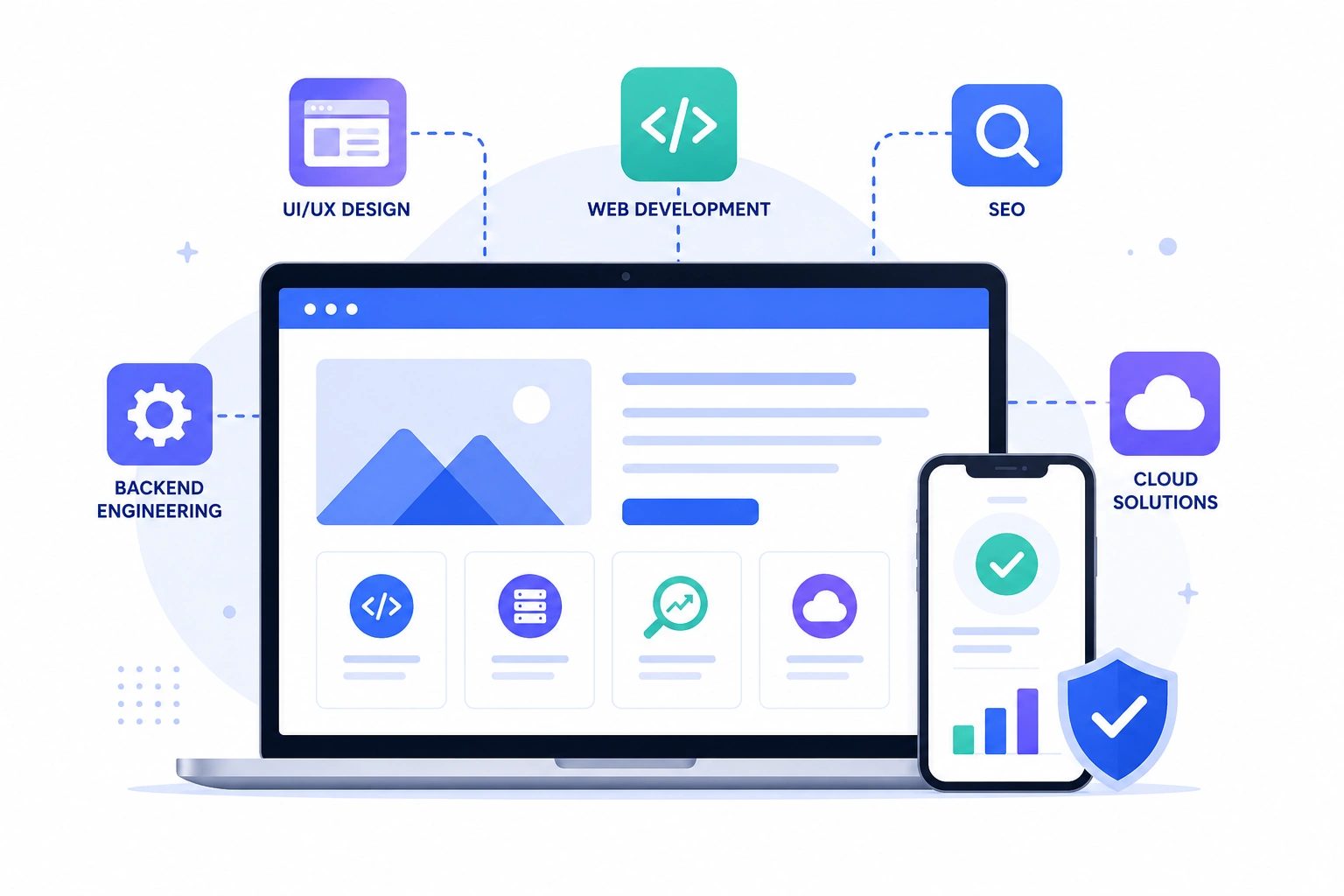
Most agencies design a site, build it, then pass it to an SEO team to fix afterward. We work in the opposite order. Research into what your market is searching for and why produces the sitemap, which makes the structure of your site a search decision before it is ever a design decision. That sequence is unusual for a custom website development company, and it’s the reason our builds tend to gain traction on their own rather than waiting on a separate optimization project six months later. If your website has to earn traffic rather than simply receive it, this is the difference that matters most.
Fixed scope and fixed price agreed before design begins. A named delivery date. Core Web Vitals passing on mobile at launch. Full ownership of code, design files, and hosting transferred at handover. Thirty days of post-launch support included. Plenty of agencies will say all of that on a call. Fewer will put it in the agreement, which is where ours sits. And if we’re going to miss a milestone, you hear about it the week it happens rather than the week delivery was due.
These are the questions that come up on almost every first call about custom website development services, answered the way we’d answer them on the phone. If yours isn’t here, ask us directly. We’d rather answer before you commit.