Webflow website development for design-led sites your team can run
Our Webflow website development team builds design-led marketing sites for startups, SaaS, fintech and B2B companies that want a distinctive site their marketing team can update without developers. We turn your Figma designs into clean Webflow builds with structured CMS collections, purposeful interactions, localization and the integrations your sales team relies on.
Webflow website development is the design, build and launch of a website on Webflow, a hosted visual development platform. It covers translating designs into responsive layouts, structuring CMS collections, building interactions, setting up localization, SEO settings and integrations, and training editors, so marketing teams can publish and update pages without writing code.
Webflow suits design-led marketing sites; for complex stores and heavy custom logic, we build on Shopify, WordPress or custom code.
Plan the CMS before design: collections, reference fields and plan limits shape every template.
Use animation with intent, and respect visitors who turn motion off.
Keep the site in your own Webflow Workspace, with agency access added to it.
Best for
Startups, SaaS, fintech and B2B companies whose marketing team wants to own the website
What you get
Platform fit check, CMS model, Figma to Webflow build, interactions, integrations, SEO setup, migration and editor training
Typical timeline
Most marketing sites take about 5 to 10 weeks from discovery to launch. Large CMS, multi-language or migration projects take longer.
Pricing
Driven by page templates, CMS complexity, interactions, locales and integrations. Published 2026 agency pricing we reviewed put typical Webflow marketing sites at about $5,000 to $15,000. Our website projects run from under $1,000 to $30,000+, depending on scope. We quote a fixed price after discovery.
What our Webflow website development services include
Six workstreams that turn a design into a site your team can grow. The CMS and editor experience get as much attention as the visuals.
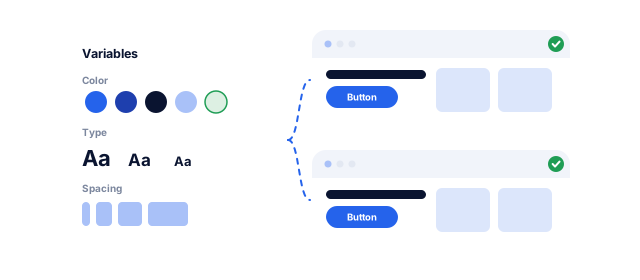
We build your Figma designs in Webflow with a consistent class system such as Client-First, global variables for color and type, and reusable components for navigation, cards, forms and calls to action. Layouts are tested at every breakpoint, and new pages reuse clean HTML and CSS instead of restyling from scratch.
CMS collections and templates
Blog posts, case studies, team members, integrations and resources become CMS collections with typed and reference fields. One template renders every item consistently, with filtering and search added through tools such as Finsweet Attributes. We check item and locale limits on your plan against your content before design.
Interactions and animation
Animation-rich sites can impress or exhaust. We use Webflow Interactions, Lottie and, where needed, GSAP for effects that explain something, keep them off the elements that decide Largest Contentful Paint, respect visitors' reduced-motion settings, and test every effect on a mid-range phone.
Localization and multi-language
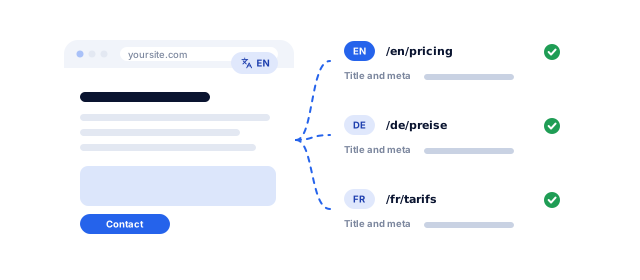
With Webflow Localization, each site has one primary locale and secondary locales by plan, with localized text, slugs, SEO titles and descriptions, and CMS item variants. We plan the URL structure, translation workflow and language switcher with our international SEO team, so each market sees the right version.
Integrations and custom code
We connect forms to HubSpot or Salesforce, add GA4 and Google Tag Manager with consent settings, and use Zapier or Make where Webflow has no native option. Memberships, gated content and calculators use tools such as Memberstack or custom JavaScript, and the Webflow Data API syncs content with other systems.
SEO setup and launch
Every page gets editable titles, descriptions, Open Graph images and clean headings, and CMS templates generate them from fields automatically. We add Schema.org JSON-LD, set 301 redirects for changed URLs, connect Google Search Console and check speed before launch. Our Webflow SEO team can take it from there.
What a well-built Webflow site changes for your marketing team
Webflow runs 0.8% of all websites, according to W3Techs, far fewer than WordPress. It is a specialist tool, and on the right site, built well, it changes how a marketing team works.
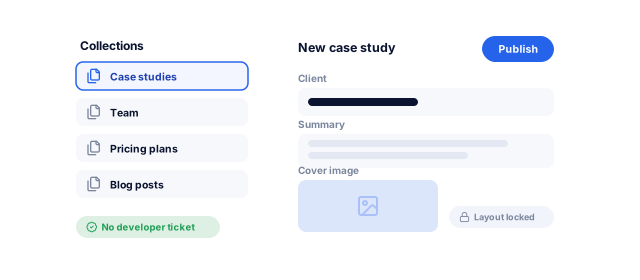
When the site is built from components and CMS templates, your team can publish a case study, launch a campaign page or update pricing in the Editor without touching layout, and developers stay free for integrations. That only works if the component library and CMS are planned up front, so we model content before design.
No plugin updates to babysit
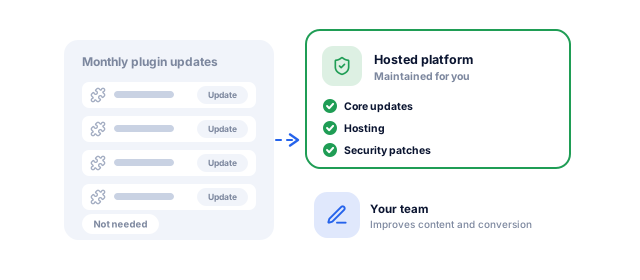
Webflow hosts the site and maintains the platform, so there are no core or plugin updates to test each month and fewer moving parts for attackers to target. Your upkeep shifts from patching software to improving content and conversion. Integrations and custom code still need care, which our website maintenance plans cover.
Faster pages out of the box
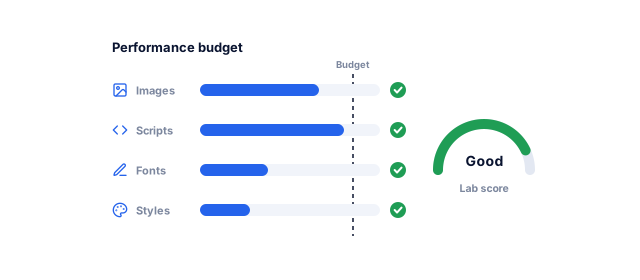
The HTTP Archive Web Almanac 2025 reports a median mobile Lighthouse performance score of 58 for Webflow sites against 41 for WordPress, and a median Lighthouse SEO score of 100 against 92. A platform does not guarantee speed, though: oversized images and heavy scripts slow any site, so we set a performance budget.
A brand that looks the way it was designed
Theme-based sites often drift from the original design as pages are added. In Webflow, the design system lives in shared classes, variables and components, so new pages inherit the same spacing, type and color, and the build stays close to the Figma file over time.
New markets without a second website
Research from CSA Research, based on 8,709 consumers in 29 countries, found that 76% of online shoppers prefer to buy with information in their native language. Native localization lets one Webflow site serve several languages with translated pages, slugs and metadata, instead of running and paying for a separate site per market.
The right platform when Webflow is not
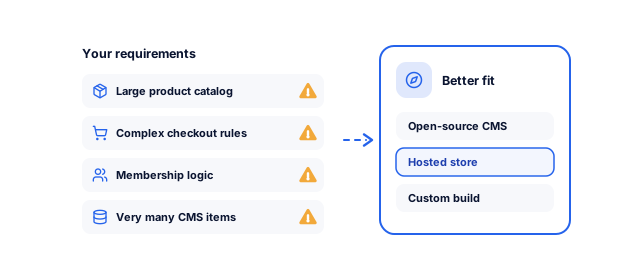
Large product catalogs, complex checkout rules, heavy membership logic or tens of thousands of CMS items often fit other platforms better. For those, the same team builds on WordPress, Shopify or custom code, or pairs a Webflow marketing site with a Shopify store. Switching platforms two years after launch costs more than the right choice now.
Not sure Webflow is right for your site?
Tell us what you need. We look at your content, team and integrations, and tell you in writing whether Webflow fits, with a price range and timeline for the build.
Your free project planFor what you need
1What we would buildYour current site, goals and content
2A price range and timelineFor the budget you pick, with the options that fit
3The stack we would useAnd how your team runs it after launch
We review your goals, current site, content volume, integrations and growth plans, then confirm Webflow fits and which site plan you need. Existing sites are crawled so we know every URL and page type that has to move.
Platform fit summary
Content and URL inventory
Integration list
A confident platform decision
Content model and sitemap
We define the CMS collections, fields and reference fields, page templates, sitemap and URL structure, including locales, so templates are designed for real content rather than placeholder text.
CMS collection plan
Sitemap and URL structure
Template list
Structure agreed before design
Design and style system
Our designers work in Figma, or we review your designs for build risks. The design is then translated into variables, a class naming system and a component list.
Figma designs
Style guide and variables
Component list
A design ready to build
Build in Webflow
Developers build components, static pages and CMS templates, add interactions with reduced-motion fallbacks, and connect forms, analytics and integrations. You comment on real pages on the Webflow staging domain.
Staging site
CMS templates and components
Integrations and tracking
A working site to click through
Migration, QA and launch
Content is imported by CSV or the Data API, and every changed URL gets a 301 redirect. We test forms, devices, speed, accessibility against WCAG 2.2 and SEO settings, then publish and watch Google Search Console.
Redirect map
QA and speed report
Launch checklist
A launch without lost pages
Training and handover
Editors get a live session and a written guide to the Editor, CMS collections and components. The site and billing sit in your Webflow Workspace, and you can keep us on for new pages and support.
Editor training
Site guide
Support plan option
A team that runs the site
Webflow sites for your type of business
Webflow works best for companies that update their marketing site often and care how it looks. These are the teams we build for most.
01 / 05
SaaS and B2B companies
As a B2B Webflow website development agency, we build product, pricing, integration directory and comparison pages from CMS collections, so a new integration or feature page takes minutes. Demo forms go to HubSpot or Salesforce with source data attached. Our work for SaaS companies often adds landing page development for paid campaigns.
Fintech sites have to look credible and stay accurate. We build rate, fee and product pages from CMS fields so figures update in one place, add disclosure blocks editors cannot accidentally delete, and run calculators on tested custom code. Applications hand off to your own secure product rather than collecting sensitive data in website forms.
For Webflow multi-language website development, we set up Localization with translated pages, slugs, SEO metadata and CMS items, plus a clear language switcher. Translation can run through your agency, a tool or your in-country team, with review before publishing, and each locale gets its own analytics and Search Console checks.
Healthcare sites need clear service pages, practitioner profiles, locations and booking paths that work on a phone. We build these as CMS collections, follow accessibility guidelines closely, and send patients to secure booking systems rather than collecting health details in forms. See Nabhaya Clinic and our work for healthcare providers.
Portfolio-led businesses need sites that show work at its best and change as often as the work does. We build project collections with flexible layouts, galleries that load efficiently and interactions that add character without slowing the page, so teams add case studies in the Editor while the design system keeps pages consistent.
Visual Designer outputs HTML and CSS; any layout without a theme
Any design is possible through custom theme and block development
Editing
Content edits in the browser; layout changes in the Designer
Block editor with patterns; flexibility depends on the theme
Hosting and updates
Hosted by Webflow; no core or plugin updates to run
Your choice of host; core, theme and plugin updates are yours to manage
Extending it
Native features, Webflow Apps and custom code
A very large plugin ecosystem plus custom PHP
CMS scale
Collections with reference fields; item and locale limits by plan
Custom post types and fields; scale depends on hosting
Multi-language
Native Localization, locales by plan
Plugins such as WPML or Polylang
Running costs
Site plan and Workspace subscriptions
Hosting, premium plugin licenses and maintenance time
Best when
Design-led marketing sites that marketing owns
Content-heavy sites, complex logic or WooCommerce stores
Based on our build experience and Webflow’s developer documentation. Plan limits change, so we check current plans against your content. For stores, we also compare Shopify.
Your Webflow website development project, week by week
Most marketing sites launch in 5 to 10 weeks; large CMS, multi-language or migration projects take longer.
Our website UI/UX designers, Webflow developers and SEO specialists work under one roof in our 25+ person in-house team in New Delhi. The design is planned with the CMS in mind, and search settings, redirects and structured data are part of the build from day one.
02
Advice that is not tied to one platform
We build on Webflow, WordPress, Shopify and custom code, so our recommendation follows your content, team and budget rather than the platform we happen to sell. When Webflow is not the best fit, the same team builds your site on the platform that is.
03
Your Workspace, open reporting
The site, hosting plan and billing sit in your Webflow Workspace, with us added as collaborators, so you own the design, content and every connected account. Ongoing work runs on rolling agreements with monthly reporting, and clients rate us 4.9 on Clutch from 221 reviews and 4.8 on Google from 189.
Results we can put numbers on
Website, ecommerce and search results from our client case studies, measured on each client’s own analytics.
"From designing a high-converting website to managing our SEO, Google Ads, and Google Business Profile, improveFX delivered exceptional results across every channel."
210%more qualified leads
185%organic and local traffic growth
92%keywords on page one
Maureen CappalloBroker and founder, Momentus Real Estate Group
"They revolutionized our online presence with a 60% increase in web traffic through strategic e-commerce SEO and content optimization."
60%more organic traffic
47%more sales
Eric NoahPresident, Eric Originals & Antiques Ltd.
"Visionstar Technologies' online presence transformed significantly with a 40% boost in customer engagement, all thanks to their exceptional website structuring and SEO tactics."
+40%qualified leads
32%lower cost per acquisition
Thomas MorelFounder, Visionstar Technologies
"Their strategic approach to our website and SEO resulted in a 60% increase in local inquiries, revolutionizing our automobile service business."
60%more local inquiries
87%more organic traffic
Mike SteffanFounder, Sabulski Window Tinting
"Their SEO strategy helped us achieve top search rankings, while their Facebook Ads campaigns drove a steady flow of qualified prospects."
Published 2026 agency pricing we reviewed put typical Webflow marketing sites at about $5,000 to $15,000, and B2B sites with a larger CMS and integrations at about $15,000 to $50,000.
Cost depends on the number of page templates, CMS complexity, interactions, locales, integrations and whether design is included. Webflow's own site plan is a separate subscription paid to Webflow. We quote a fixed price after discovery.
How long does it take to build a Webflow website?
Most marketing sites take about 5 to 10 weeks from discovery to launch, and a small site with a few templates sits at the short end. Sites with large CMS migrations, several languages or complex integrations take longer.
Discovery and content modeling take one to two weeks, design two to three, and the build and QA the rest. Having content ready and a single person who can approve decisions shortens the timeline more than anything on the development side.
Is Webflow better than WordPress?
For design-led marketing sites that a marketing team will run, Webflow is often the better fit. For content-heavy sites, complex logic or WooCommerce stores, WordPress usually is.
Webflow removes plugin and hosting maintenance and gives designers precise control, at the cost of plan limits and a smaller ecosystem. WordPress offers more flexibility and lower lock-in, with more upkeep. The comparison table above sets out the trade-offs.
Can you convert our Figma design into a Webflow website?
Yes. Figma to Webflow is the most common way we work, whether the design comes from our team or yours.
Before building we review the design for anything that will be hard to maintain or slow on mobile, agree how components and CMS templates map to it, and flag missing states such as hover, empty and error. The finished site follows the design closely across every breakpoint.
Can you migrate our WordPress site to Webflow without losing SEO?
Yes, with planning. We crawl the old site, import posts and other content into CMS collections, and add a 301 redirect for every URL that changes.
Titles, descriptions, headings and structured data carry over, images are re-optimized, and Google Search Console is monitored after launch. Some movement in the first weeks is normal; lasting losses come from missing redirects or removed content, which the plan prevents.
Can our team edit the Webflow site without a developer?
Yes. Editors update text, images and CMS items in the browser, and build new pages from the components we create.
We design the CMS and components around the changes your team makes most, so routine updates never need the Designer. Every project ends with live training and a written guide. Layout changes and new components are still best handled by someone who knows the class system.
Does Webflow support multi-language websites?
Yes. Webflow Localization supports one primary locale and secondary locales by plan, with translated pages, slugs, SEO metadata and CMS items.
We plan the locales, URL structure and translation workflow before the build, so templates handle longer text and different formats. If you only need one or two pages in another language, a lighter approach may be enough, and we will tell you.
Is Webflow good for SEO?
Yes. Webflow gives full control over titles, descriptions, headings, redirects, sitemaps and structured data, and its clean code helps performance.
The Web Almanac 2025 reports a median Lighthouse SEO score of 100 for Webflow sites. Rankings still depend on content, links and site structure, not the platform. Our Webflow SEO services handle that ongoing work.
Can Webflow handle ecommerce?
Webflow Ecommerce works for simpler catalogs where design matters most. Larger catalogs, subscriptions or complex shipping and tax rules usually fit Shopify better.
A common setup is a Webflow marketing site with a Shopify store for checkout, or Shopify on its own. We compare options against your catalog size, payment needs and markets before recommending one, and as a Shopify Partner we build both.
Should I hire a freelance Webflow website developer or an agency?
A freelance Webflow website developer suits a small, well-defined build. An agency suits projects that need strategy, design, development, SEO and support together.
When comparing the best companies for Webflow website development, ask to see live CMS-driven sites, how they plan collections and redirects, and who owns the Workspace afterwards. A good partner starts with strategy and content, not with animations.
Who owns the Webflow site, and what happens if we leave?
You do. The site, hosting plan and billing sit in your Webflow Workspace, and we work as invited collaborators.
If you end the engagement, you remove our access and keep everything. If you ever leave Webflow, CMS content can be exported through the Webflow Data API, while page templates and interactions would need rebuilding. We document the build to make any handover simple.
Ready to plan your website?
Tell us what you need built, or book a strategy call with our team.
What we would build, and on which platform
A price range and timeline for your budget
A call with a specialist to plan the next steps, no obligation
A specialist replies personally 4.9 from 566 client reviews