Recommendation engine development measured by revenue, not clicks
Our recommendation engine development service builds personalized product, content and next-best-action recommendations for online stores, marketplaces, media platforms and SaaS products. We combine collaborative filtering, content-based models and your business rules into one AI recommendation engine, serve it in real time on your site, app and emails, and test it against a control group.
Recommendation engine development is the design and build of software that predicts which products, content or actions each user is most likely to want. It covers behavior data, collaborative, content-based or hybrid models, business rules, real-time serving and A/B tests that measure lift.
Clean event tracking (views, add-to-carts, purchases) matters more than the algorithm.
Hybrid models cover new users and new products that collaborative filtering alone cannot.
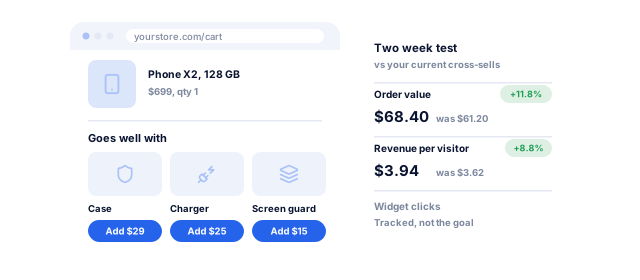
Judge an engine by revenue per visitor in an A/B test, not clicks on the widget.
Stock, margin and compliance rules belong on top of the model.
Best for
Stores, marketplaces, media and SaaS products that want each visitor to see more relevant products or content
What you get
Tracking audit, models, business rules, real-time API, placements, A/B test design, monitoring and retraining
Typical timeline
A proof of concept on historical data in about 4 to 6 weeks. Production launch typically follows in 2 to 4 months.
Pricing
Our AI projects run from under $5,000 to $100,000+, depending on scope. A fixed-price proof of concept on your own data starts from $3,000, so you see results before you commit to a build. Catalog size, data cleanup, channels and real-time needs set the price; Amazon Personalize adds usage fees with no minimum.
Your data
A signed NDA before you share anything, a data processing agreement when you need one, a BAA for US patient data, and your data never trains any model outside your project.
What our recommendation engine development covers
Six components. Most failed personalization projects fail on data or measurement, so those come first.
Recommendations learn from views, searches, add-to-carts, purchases, plays and returns. We audit what GA4, your store or app collect, fix missing events and mismatched IDs, and build one pipeline for training and live sessions that our custom dashboard team can also report on.
Collaborative filtering
Collaborative filtering finds what similar people do: customers who bought this also bought that. We use item-to-item similarity and matrix factorization on views and purchases. It is often the strongest signal but needs history, favors bestsellers and misses new products, so we rarely use it alone.
Content-based filtering and embeddings
Content-based filtering recommends items like those a person engaged with, using attributes, descriptions and images. Embeddings match products by meaning and look, so new items work from day one, and our computer vision team adds visual similarity where appearance sells.
Hybrid ranking and the cold start problem
A hybrid recommendation system gathers candidates from several sources, then a ranking model, often gradient-boosted trees, orders them per person and context. New visitors start with popular items for their location, device and traffic source; new products get exploration slots.
Business rules and merchandising controls
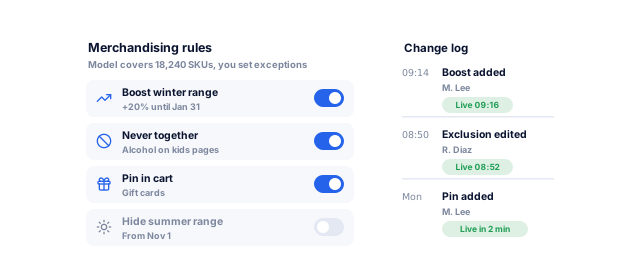
A model does not know your margins or stock. Rules on top hide out-of-stock and low-margin items, skip recent purchases and returns, keep variety, respect age or regulatory limits, and let merchandisers pin or boost items without a developer.
Real-time serving and integration
A fast API with cached results and a feature store such as Redis serves each placement, with a fallback if the service is slow. Our API development team integrates Shopify, WooCommerce, headless storefronts, apps and email tools.
Where a product recommendation engine earns its keep
Personalization pays where it changes what people buy, watch or do next. We test these places first.
Complementary products on product pages and in the cart, such as the case for the phone, are the most direct revenue lever. Our conversion rate optimization team tests them against your current cross-sells on revenue per visitor and order value, not widget clicks.
More of your catalog actually seen
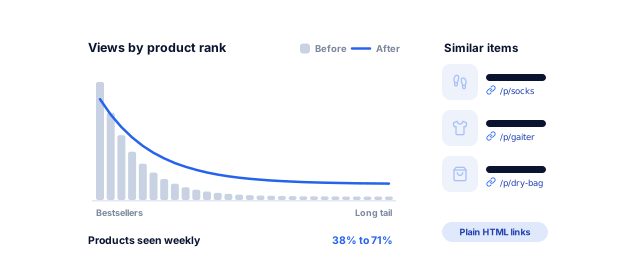
In large catalogs, a few bestsellers take most of the attention. Similar-item blocks surface relevant long-tail products, and when rendered in HTML with a stable default set, they add internal links that support ecommerce SEO.
Return visits in media and SaaS
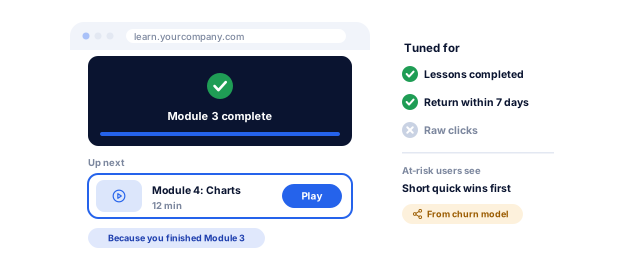
For content and subscription products, the goal is the next good session. We optimize for completion and return visits, not raw clicks, and use churn prediction signals so at-risk users see what is most likely to bring them back.
Personalized emails and push notifications
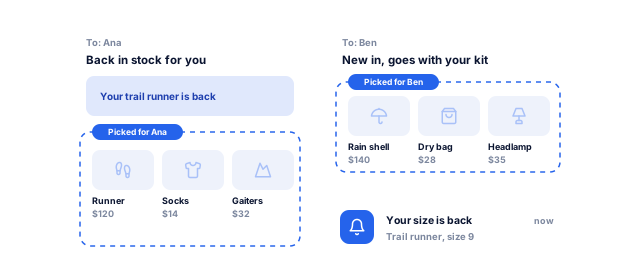
The same engine picks back-in-stock items, related products and new arrivals for every subscriber. Our email marketing and email automation teams send them as dynamic content and measure revenue per email against a control group on your standard email.
Less manual merchandising
Hand-picking related products for thousands of SKUs takes hours and goes stale. The model handles the bulk; your team manages campaign boosts, seasonal ranges and products that must never appear together, with every change logged.
Investment decisions backed by an experiment
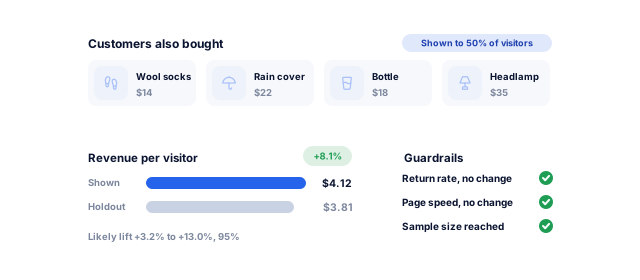
Every engine we launch runs as an A/B test with a holdout group, a preset sample size and guardrails such as return rate and page speed. You see whether revenue per visitor rose, by how much and with what confidence before adding placements.
Not sure your data is ready for personalization?
Tell us what you need. We look at your catalog, traffic and event data, and send a written plan for recommendations you can test against a control group, with a price range and timeline.
Your free AI planFor what you need
1What AI can do with your dataThe decision it supports and how you would measure it
2A fixed-price proof of conceptOn your own data, from $3,000, before you commit to a build
3The approach we would useA ready model, a custom one, or simple rules where they do the job
4Your data stays yoursA signed NDA first, and it never trains any model outside your project
We agree the business metric and first placements, audit tracking, IDs and data volume, and recommend built-in, managed or custom in writing.
Metric and placement plan
Tracking and data audit
Build, managed or built-in recommendation
A clear target and the right route to it
Offline prototype
We score candidate models on held-back history with precision, recall, NDCG and catalog coverage against a popularity baseline. Until one beats bestsellers offline, we launch tuned popularity and rule-based lists.
Candidate models
Offline evaluation report
Sample recommendations for review
Evidence before engineering spend
Rules and ranking design
We add business rules, diversity and exploration, then review real lists with your merchandisers or editors before customers see them.
Business rules layer
Merchandiser controls
Signed-off sample lists
Recommendations your team trusts
Real-time integration
We deploy the serving API, feature store and event stream, integrate placements, and set fallbacks and latency budgets so a slow response never blocks a page.
Recommendation API
Placement integration
Performance and fallback tests
Live, fast and safe to switch off
A/B test
Traffic is split between your current experience and the engine, with sample size and test length fixed in advance and at least one full weekly cycle, and lift reported with confidence intervals.
Test plan and sample size
Experiment readout
Rollout decision
A measured answer, not an opinion
Monitor and retrain
Models are retrained on a schedule and monitored for drift, empty results and falling coverage, with a monthly report on results and next tests.
Retraining pipeline
Drift and quality alerts
Monthly results report
Results that hold up over time
Recommendation engines for ecommerce, media and SaaS
The techniques are shared; signals, placements and success metrics change with the business.
01 / 04
Ecommerce and Shopify stores
A recommendation engine for ecommerce covers similar and complementary products, cart add-ons, a personalized home page and search re-ranking. Shopify's built-in recommendations generate related and complementary products automatically, and its Search & Discovery app adds up to 10 custom picks of each per product, according to Shopify's Help Center. We tune those first, then add a custom engine through an app or a headless storefront from our Shopify development team.
Marketplaces and property portals recommend items that may sell or rent within days, so freshness, location and price matter as much as behavior. We weight new listings, respect filters and balance exposure across sellers. See our work for real estate businesses.
For video, articles, podcasts and courses, we optimize for completion and return visits, mix familiar and new topics, and use content embeddings so new releases are recommended from day one. See our work for education providers.
In software products, recommendations suggest the next feature, template, integration or help article, based on what similar accounts did before they succeeded. Paired with lead scoring, B2B sales teams see who is likely to buy and what to offer.
Related and complementary products generated automatically
Managed machine learning on your interaction, item and user data
Your own models, rules and ranking
Control over logic
Low: manual picks only; automatic results fixed
Medium: use-case recommenders or configurable custom resources
Full: any signal, rule, objective or placement
Real-time behavior
Not controllable by the merchant
Real-time events and recommendations, plus batch jobs
Session-level personalization designed for your pages
Cost
Included with the platform
Usage-based, no minimum fees; free tier in the first two months
Build cost plus hosting and ongoing tuning
Time to launch
Hours
Weeks, mostly spent on data preparation
About 2 to 4 months to production
Best for
Small catalogs and new stores
Teams on AWS wanting results without building models
Large catalogs, unusual objectives, several channels or strict data control
What improveFX does
Tune picks, rules and tracking
Data prep, integration and A/B test
Build, test, host and retrain
Sources: Shopify Help Center (product recommendations) and AWS documentation (What is Amazon Personalize), checked October 2026. Managed service costs grow with data, training and requests, so model expected traffic first.
Your recommendation engine project, week by week
A typical path from data audit to a tested launch, in line with the timelines above.
Every engagement includes an offline test against a popularity baseline and an online A/B test. If a model cannot beat what you show today, we switch to the route that does: tuned built-in picks, a managed service or better rules.
02
Store, marketing and data skills together
As a Shopify Partner, Google Premier Partner and Meta Business Partner, the team building your recommendation system also runs catalogs, email and campaigns and tests picks in each channel against a control group. Our Eric Originals Shopify migration and SEO program grew organic traffic 1,900% and sales 76%.
03
Your data and models stay yours
Models, code, pipelines and event data live in accounts you own. On rolling agreements, clients stay with us 1.6 years on average and rate us 4.9 on Clutch from 221 reviews, and if you take the engine in-house, the handover is complete.
Results we can put numbers on
Your first result from us is a proof of concept scored on your own order history. The numbers below come from our ecommerce, web and growth work.
"From designing a high-converting website to managing our SEO, Google Ads, and Google Business Profile, improveFX delivered exceptional results across every channel."
210%more qualified leads
185%organic and local traffic growth
92%keywords on page one
Maureen CappalloBroker and founder, Momentus Real Estate Group
"They revolutionized our online presence with a 60% increase in web traffic through strategic e-commerce SEO and content optimization."
60%more organic traffic
47%more sales
Eric NoahPresident, Eric Originals & Antiques Ltd.
"Visionstar Technologies' online presence transformed significantly with a 40% boost in customer engagement, all thanks to their exceptional website structuring and SEO tactics."
+40%qualified leads
32%lower cost per acquisition
Thomas MorelFounder, Visionstar Technologies
"Their strategic approach to our website and SEO resulted in a 60% increase in local inquiries, revolutionizing our automobile service business."
60%more local inquiries
87%more organic traffic
Mike SteffanFounder, Sabulski Window Tinting
"Their SEO strategy helped us achieve top search rankings, while their Facebook Ads campaigns drove a steady flow of qualified prospects."
How much does recommendation engine development cost?
It depends on catalog size, data quality, placements and channels, and how real-time it must be. Our AI projects run from under $5,000 to $100,000+, depending on scope. A fixed-price proof of concept on your own data starts from $3,000, so you see results before you commit to a build.
The low end means configuring built-in recommendations or Amazon Personalize on clean tracking; tracking fixes, a custom engine, real-time serving, several channels and a large catalog move it up. Running costs are Personalize usage fees or custom hosting, plus monitoring and retraining. We quote after a free data review.
How long does it take to build a recommendation engine?
A proof of concept on historical data typically takes about 4 to 6 weeks. Production launch typically follows in 2 to 4 months.
Fixing event tracking and IDs often takes longer than the modeling. After launch, the A/B test needs enough traffic and at least a full weekly cycle before you can trust the result.
How much data do we need for personalized recommendations?
Enough repeat interactions for patterns to appear. With a few hundred orders a month, we start with built-in or content-based recommendations, which need little history, and add collaborative signals as data grows.
During the free data review we check order history, catalog size and returning users, then recommend the route that fits today and when a learning model will pay off.
What is the difference between collaborative filtering and content-based filtering?
Collaborative filtering recommends what similar people liked. Content-based filtering recommends items similar to what this person liked, using product attributes, text or images.
Collaborative filtering finds surprising, high-converting pairings but needs history and struggles with new items. Content-based filtering handles new items but can feel repetitive. Most production engines are hybrids that use both, plus business rules.
How do you handle the cold start problem?
For new users, we start with popular items for their context (location, device, traffic source, page) and personalize as the session unfolds. For new items, we use content features and exploration slots.
Some products also ask a short question at signup, such as preferred categories. The engine moves to personalized results as soon as a user's own behavior is strong enough to rely on.
Can recommendations update in real time?
Yes. Real-time personalization uses events from the current session, so recommendations change after a few clicks rather than the next day.
Not every placement needs it. Similar-item blocks can be computed in advance and cached; home pages and carts benefit more from session signals. We decide per placement, because real-time serving adds cost and engineering complexity.
How do you measure whether recommendations work?
With an A/B test that compares revenue per visitor, order value or engagement between users who see the engine and a control group who do not.
Widget clicks can rise while total sales stay flat, because people click recommended items instead of others. We fix sample size and test length in advance, watch guardrails such as returns and page speed, and keep a small holdout group after launch.
Should we use Shopify's built-in recommendations, Amazon Personalize or a custom engine?
Built-in recommendations suit a small catalog, a managed service suits teams on AWS that want results without building models, and a custom engine suits full control, several channels or unusual objectives.
We set up whichever fits: Shopify's picks and rules, Amazon Personalize with clean tracking, or a custom build. The comparison table above covers cost, control and timelines, and our free data review ends with a written recommendation.
Do product recommendations affect SEO?
They can help if recommendation blocks render a stable default set of links in the page HTML that search engines can crawl, with personalized variations loading per visitor.
Relevant links between products and categories help search engines find deep pages; blocks that change on every load or rely only on client-side scripts add little. Our ecommerce SEO services team reviews how recommendation blocks render in technical audits.
How do you protect customer data in a recommendation engine?
We use pseudonymous IDs instead of names or emails in training data, respect consent choices, and keep data in your own cloud account and region. Your data is never used to train any model outside your project, including a provider's own.
We avoid sensitive categories as signals, set retention periods and document which data each model uses, following the privacy rules of each market you sell in, such as GDPR, UK GDPR and India's DPDP Act.
What happens after the recommendation engine launches?
We retrain models on a schedule, monitor quality and drift, and run new tests on a rolling agreement.
Each month you get a report covering revenue per visitor, coverage, model changes and the next experiments. Running costs are hosting or Personalize usage fees plus monitoring. New placements, such as email or app screens, can be added once the first ones prove their value.
Ready to put AI to work?
Tell us what you want AI to do with your data, or book a strategy call with our team.
What AI can do with your data, and how to measure it
A fixed-price proof of concept on your data, from $3,000
A call with a specialist to plan the next steps, no obligation
A specialist replies personally 4.9 from 566 client reviews