Hybrid app development services for iOS and Android from one codebase
Our hybrid app development services are for businesses that need an app on both iOS and Android without paying for two separate builds. We build with React Native, Flutter or Ionic with Capacitor, pick the framework that suits your features and team, and write native Swift or Kotlin code wherever a feature needs it.
Hybrid app development is building one app for iOS and Android from a shared codebase, with React Native, Flutter or Ionic with Capacitor. Hybrid app development services cover framework choice, design, native features, back end, real-device testing and App Store and Google Play release.
"Hybrid" is used loosely: Ionic and Cordova run web code in a WebView; React Native and Flutter render native or engine-drawn screens.
Some device features still need native Swift or Kotlin code, which we write in-house.
Apple rejects apps that are little more than a repackaged website, so we plan real app features.
Choose the framework by features and team skills, not popularity charts.
Best for
Businesses that need the same features on iOS and Android, on one budget and roadmap
What you get
Framework recommendation, UX and UI design, the app and its API, automated tests, store submission and support
Typical timeline
A first release on iOS and Android in about 12 to 24 weeks, depending on features, integrations and design
Pricing
Driven by screens and features, native device features, integrations, the back end and design. Our app projects run from under $5,000 to $80,000+, depending on scope. We quote after a free scoping call, with fixed-scope and monthly team options.
What our hybrid app development services include
Every project starts with the riskiest feature, not the easiest screen.
We compare React Native, Flutter and Ionic with Capacitor against your features, your existing code and the team that will maintain the app. Risky features, such as Bluetooth devices or background location, get a proof of concept first.
React Native app development
React Native suits teams that already use React, because developers, patterns and some logic carry over. We build in TypeScript on Expo, which the React Native documentation recommends for new apps, on the New Architecture, default since version 0.76, sharing standards with our React development team.
Flutter app development
Flutter draws its own interface with the Impeller engine, the default on iOS and on Android API 29 and above according to the Flutter documentation. Screens look near-identical on both platforms, with smooth custom animation. See our Flutter app development service.
Ionic, Capacitor and Cordova apps
Capacitor turns an existing Angular, React or Vue web app into an iOS and Android app with native plugins, a good fit for internal tools and forms-heavy products. We also move Cordova and PhoneGap apps to Capacitor, checking each plugin against Capacitor's list of incompatible Cordova plugins first.
Native modules and device features
Cameras, biometrics, push notifications, maps, Bluetooth, payments and in-app purchases mostly have maintained plugins. Where one is missing or abandoned, we write a small Swift or Kotlin module; our iOS and Android developers sit in the same team, so this does not stall the project.
Back end, testing and store release
Our API development team builds sign-in, data sync, push messaging and analytics against a shared contract. We test on real iPhones and Android devices, then handle App Store and Google Play submission, privacy disclosures, screenshots and review feedback.
What a hybrid approach does for your business
What one shared codebase changes for your business.
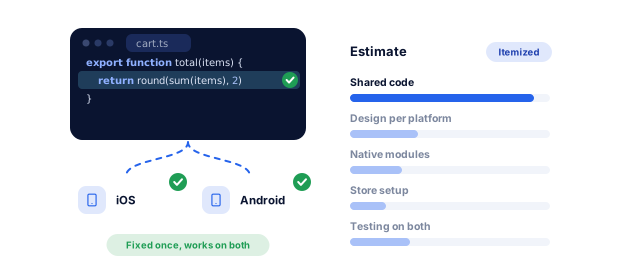
Screens, business rules and API calls are written once, and a bug fixed in shared code is fixed on both platforms. The saving is real but not half the cost: design tweaks, native modules, store setup and two-platform testing still take time, and every estimate shows those lines.
Both app stores in the same launch
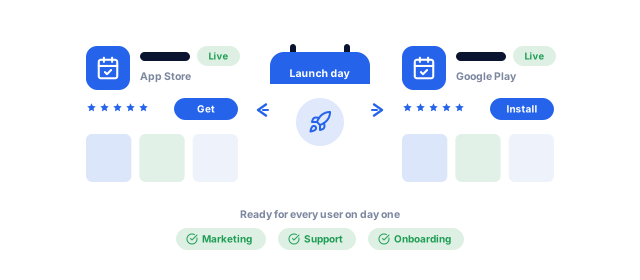
Separate native builds often launch months apart. A shared codebase puts you on the App Store and Google Play together, so marketing, support and onboarding cover every user from day one.
Features that stay in step
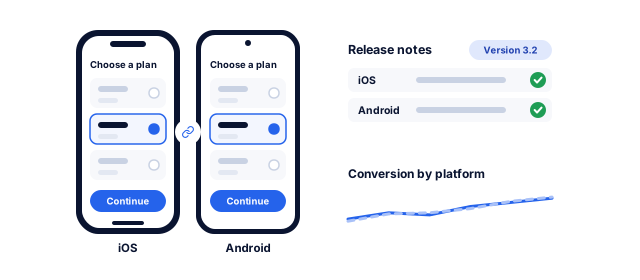
Separate native apps drift apart: a feature lands on iOS first, a fix reaches Android later. With one codebase, features, copy and pricing screens change together, and analytics compare like with like.
Reuse of the web skills and code you already have
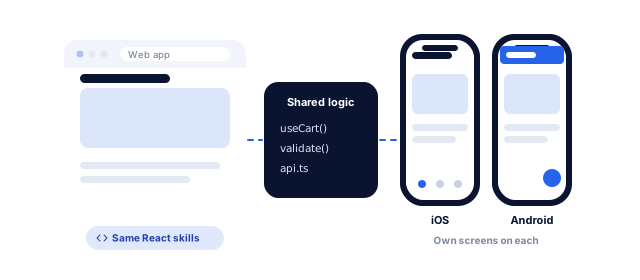
A React web team can contribute to a React Native app, and an existing web app can become a Capacitor app with native features where they matter. Still choosing between an app and a browser-based product? See our web app development service.
Frameworks with a large installed base
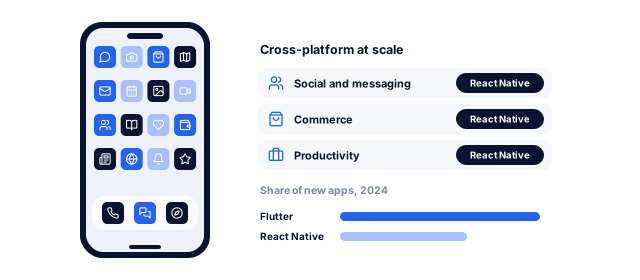
Appfigures data reported by The Pragmatic Engineer found about 11% of apps released in 2024 used Flutter and 7% used React Native. Meta uses React Native in Facebook, Instagram and Messenger, as do Microsoft, Shopify and Discord.
One upgrade path to maintain
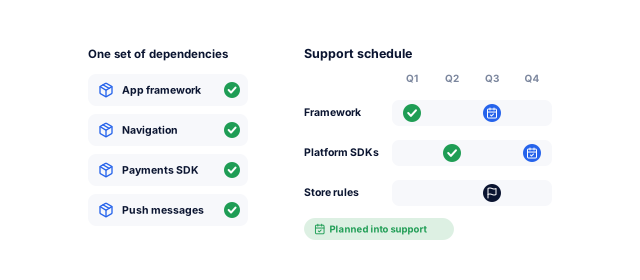
Apple and Google change their rules every year, and frameworks release several versions a year. One codebase means one set of dependencies, and we plan framework and SDK upgrades into support so the app never falls behind what the stores accept.
Not sure whether hybrid or native is right for your app?
Pick what is closest to your situation. We recommend React Native, Flutter, Ionic or native in writing, with the reasons, a price range and a timeline, before you commit to a build.
Your free app planFor what you need
1What we would build firstYour idea, your users and the features that matter first
2A price range and timelineFor the budget you pick, with an MVP option
3The stack we would useAnd how your team runs it after launch
We turn your idea into a prioritized feature list, map each feature to the device capabilities it needs, and test risky ones in a proof of concept. You get a written framework recommendation, release plan and estimate.
Prioritized feature list
Framework recommendation
Estimate and release plan
A plan you can budget against
UX and UI design
Designers map the main journeys, then produce wireframes and a clickable prototype that keeps both platforms consistent while respecting habits such as Android back navigation.
User journeys and wireframes
Clickable prototype
Design system and assets
Screens users understand
Architecture and API contract
We set up structure, state, navigation, sign-in and offline rules, and agree the API contract with the back-end team. CI builds both platforms from week one, so packaging problems surface early.
App architecture
API contract
CI builds for both platforms
A foundation that scales
Build in two-week sprints
Each sprint puts working features on your phone through TestFlight and Google Play internal testing, so you try the real app, not screenshots. Shared code is reviewed and covered by automated tests.
Test builds every sprint
Sprint demo and notes
Automated tests
Progress you can hold in your hand
Device testing and performance
Old and new real devices, screen sizes, OS versions, slow networks and offline use. We profile startup, scrolling and memory, and fix crashes and accessibility issues before release.
Device test matrix
Performance and crash report
Accessibility fixes
Ready for real-world phones
Store launch and ongoing support
We prepare listings, privacy disclosures and screenshots, submit to both stores and answer review feedback, then monitor crashes and reviews, ship fixes and keep frameworks and SDKs current each year.
App Store and Google Play release
Crash and review monitoring
Upgrade and release plan
A live app that keeps improving
Hybrid apps for your type of business
Our hybrid app development services fit most business apps. These are the projects where the approach pays off most.
01 / 05
Startups and MVPs
Learn from real users on both stores before the money runs out. We keep the first release small, with analytics from day one, and add native pieces when the data calls for them. Our app UI/UX design service tests ideas before code.
Fast browsing, saved carts, wish lists, offer notifications and Apple Pay and Google Pay checkout. We connect the app to your store's APIs so stock, prices and orders match the website, and our ecommerce website development team can build the store behind it.
Booking, reminders, video consultations and payments suit one codebase, with role-based access, encrypted on-device storage and audit trails where patient data is involved. See our work for healthcare businesses, or Nabhaya Clinic, our own clinic management product, if ready-made software fits better.
Offline apps for sales reps, technicians and drivers that scan barcodes, capture photos and signatures, and sync when the signal returns. We distribute them privately, connect them to your CRM or ERP, and our workflow automation team automates the steps after each job.
Video, quizzes, progress tracking, offline downloads and reminders, identical on every phone and tablet. If your courses live in Moodle, we connect the app through its web services so learners keep one account and one progress record. See our Moodle development service.
We build with React Native, Flutter, Ionic with Capacitor, and native Swift and Kotlin, so the recommendation follows your features, budget and team. Where native suits part or all of your app, the same team builds it.
02
Design, app and back end in one team
Designers, mobile developers, back-end engineers and testers sit together, so questions are settled in a day, not a week. Nothing goes to freelancers, and the same team supports the app after launch.
03
Your code, accounts and a record you can check
Repositories, the Apple Developer and Google Play accounts the app ships under, signing keys and cloud services are in your name. We work on rolling agreements with monthly reporting, have delivered 170+ projects for 120+ clients, are rated 4.9 on Clutch from 221 reviews, and keep clients 1.6 years on average.
Results we can put numbers on
App and software results from client reviews and case studies, with the full story behind each number.
"From designing a high-converting website to managing our SEO, Google Ads, and Google Business Profile, improveFX delivered exceptional results across every channel."
210%more qualified leads
185%organic and local traffic growth
92%keywords on page one
Maureen CappalloBroker and founder, Momentus Real Estate Group
"They revolutionized our online presence with a 60% increase in web traffic through strategic e-commerce SEO and content optimization."
60%more organic traffic
47%more sales
Eric NoahPresident, Eric Originals & Antiques Ltd.
"Visionstar Technologies' online presence transformed significantly with a 40% boost in customer engagement, all thanks to their exceptional website structuring and SEO tactics."
+40%qualified leads
32%lower cost per acquisition
Thomas MorelFounder, Visionstar Technologies
"Their strategic approach to our website and SEO resulted in a 60% increase in local inquiries, revolutionizing our automobile service business."
60%more local inquiries
87%more organic traffic
Mike SteffanFounder, Sabulski Window Tinting
"Their SEO strategy helped us achieve top search rankings, while their Facebook Ads campaigns drove a steady flow of qualified prospects."
Our app projects run from under $5,000 to $80,000+, depending on scope: screens and features, native device features, integrations, the back end and design. We quote a fixed price or a monthly team cost after a free scoping call.
A simple app with sign-in, a few screens and an existing API sits at the low end; a marketplace with payments, chat, an admin panel and a new back end sits at the high end. Running costs include Apple's $99 yearly developer fee, Google Play's one-time $25 registration, hosting, third-party APIs and OS updates.
How long does it take to build a hybrid app?
A first release on iOS and Android usually takes about 12 to 24 weeks, depending on features, integrations and design.
Discovery and design take the first few weeks, followed by two-week build sprints with test builds on your phone. Store review then adds a few days. Clear priorities and an existing API shorten the timeline; custom native features and late scope changes lengthen it.
What is the difference between hybrid, cross-platform and native apps?
Native apps are built separately for each platform in Swift or Kotlin. Hybrid and cross-platform apps share one codebase, in two ways.
A WebView hybrid app, built with Ionic, Capacitor or Cordova, runs web code inside a native shell and reaches device features through plugins. Cross-platform frameworks render real screens: React Native maps to native components and Flutter draws its own. Most buyers call all of them hybrid, and we build all three.
Is React Native or Flutter better?
Neither wins every project. React Native suits teams that already use React; Flutter suits custom, design-heavy interfaces and teams willing to work in Dart.
Both are mature and widely used. We weigh your existing code, who will maintain the app, the device features you need and the libraries available for them; if you have a React web app, React Native usually wins on reuse.
Do hybrid apps perform as well as native apps?
For most business apps, users cannot tell the difference: React Native and Flutter apps scroll and animate as smoothly as native when built carefully.
Problems usually come from heavy screens, too many re-renders or large images, not the framework; we profile startup, scrolling and memory on older devices. Ionic WebView apps can lag with heavy animation or very long lists, so we keep those screens light or build them natively.
When should we choose native instead of hybrid?
Choose native for games, augmented reality, heavy video or audio processing, and apps built around widgets, watch apps or advanced background tasks. Our Swift and Kotlin teams build those apps in the same studio.
Native also suits single-platform apps and companies with their own Swift and Kotlin teams. Many products start hybrid and add native screens only where needed, keeping most of the shared-code savings.
Will Apple and Google accept a hybrid app?
Yes. Both stores accept apps built with React Native, Flutter and Capacitor, and many top apps use them.
What gets rejected is an app with little purpose beyond a repackaged website, under Apple's App Review Guideline 4.2. We plan real app value, such as offline use or device features, prepare Apple's privacy details and review notes with a demo account and Google Play's data safety form, and handle review feedback.
Should we turn our website into a PWA or a hybrid app?
A progressive web app installs from the browser, works offline and skips store review, but has no store listing and less device access, especially on iOS. A hybrid app goes into both stores and reaches the camera, Bluetooth and push notifications through plugins.
We check which parts of your site work on a phone and which app-only features would justify a download, then build a PWA through our web app development service or a hybrid app here.
Can hybrid apps use the camera, GPS, Bluetooth and push notifications?
Yes. React Native, Flutter and Capacitor all reach these features through plugins, and we write native Swift or Kotlin modules when no reliable plugin exists.
Permissions, background behavior and battery use need care on each platform, especially for location and Bluetooth. We test these features on real devices, because simulators do not behave like phones for sensors, notifications or connectivity.
Can we hire dedicated hybrid app developers or extend our team?
Yes: a dedicated team on your app only, developers added to your existing team, or a fixed-scope project at an agreed price.
Fixed scope suits a well-defined first release, a dedicated team suits a product that keeps evolving, and team extension suits companies with a product lead who need more React Native or Flutter capacity. All our developers are in-house employees.
Can you modernize our Cordova or Ionic app?
Yes. We usually move Cordova apps to Capacitor, which keeps your web code and can run many Cordova plugins, apart from a published list of incompatible ones.
We audit framework and plugin versions, abandoned plugins, and the Xcode version and Android target API level the stores now require. Then we migrate in stages, replacing dead plugins with Capacitor plugins or small native modules and updating Ionic, Angular, React or Vue as we go.
Who owns the app code and the store accounts?
You do. The code repository, the store accounts the app ships under, signing keys and back-end services are created in your name from the start.
We work in your accounts with access you grant and can remove. When an engagement ends, we hand over documentation and build instructions so any team can carry on. Book a strategy call to talk through scope and framework.
Ready to plan your app?
Tell us what you want to build, or book a strategy call with our team.
What we would build first, and on which platforms
A price range and timeline for your budget
A call with a specialist to plan the next steps, no obligation
A specialist replies personally 4.9 from 566 client reviews