Computer vision development services for inspection, documents and video
Our computer vision development services build software that reads images, documents and video, so your team stops checking the same things by eye. We build detection, classification, OCR, visual inspection and video analytics for operations, manufacturing, retail, healthcare and back-office teams, against accuracy targets agreed before any model is trained.
Computer vision is the branch of AI that lets software find, classify, read and measure what appears in images, documents and video. Computer vision development services cover scoping, labeling, model selection or training, accuracy testing, deployment to cloud or edge, and monitoring.
Test a ready-made vision API first; train a custom model only where it falls short.
Measure accuracy per class on images from your own cameras, not one overall score.
Label quality limits a model more often than the choice of algorithm.
Run on the edge when images are sensitive or connections are unreliable; use the cloud when volume varies.
Best for
Teams that check images, documents or video by hand at volume: production lines, warehouses, stores, clinics, insurers and back offices
What you get
Feasibility test, labeled dataset, configured or trained model, accuracy report, integration, cloud or edge deployment and monitoring
Typical timeline
Feasibility on your images in 2 to 4 weeks. A proof of concept typically takes 6 to 10 weeks, and a production system 3 to 9 months, depending on cameras and integrations.
Pricing
Our AI projects run from under $5,000 to $100,000+, depending on scope. A fixed-price proof of concept on your own data starts from $3,000, so you see results before you commit to a build. Data readiness, the number of classes, the accuracy target and where the model runs set the price. We quote after a free scoping call.
Your data
A signed NDA before you share anything, a data processing agreement when you need one, a BAA for US patient data, and your data never trains any model outside your project.
What our computer vision development services include
Six capabilities, scoped to the visual task you need to automate. Every project starts with a test on your images.
Detection models find and count items: products on shelves, parcels on conveyors, hard hats on site. We usually fine-tune a pretrained YOLO-family detector in PyTorch, with OpenCV for image handling, and check the license fits your product: Ultralytics YOLO needs an enterprise license for closed-source commercial use.
Image classification and recognition
Classification sorts whole images into categories: grade A or B, damaged or intact, which product or document. It routes claim photos, grades produce and checks packing. We define classes with the people who make those calls today, because unclear boundaries confuse a model as they confuse new staff.
OCR and document capture
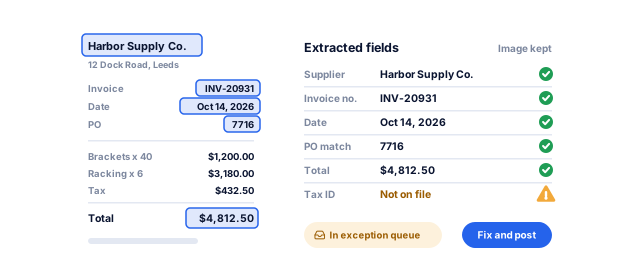
We extract text, tables and fields from invoices, forms, IDs and handwriting with Amazon Textract, Google Document AI or Azure Document Intelligence, add validation rules and a review queue for low-confidence fields, and post clean data to your ERP or CRM, often with our invoice and billing automation.
Automated visual inspection
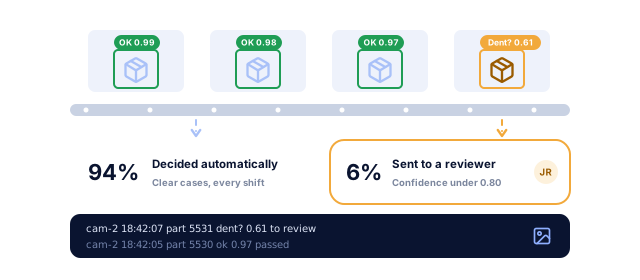
Inspection models flag scratches, dents, missing parts, misprints and wrong labels at line speed. Real defects are rare, so we pair labeled examples with anomaly detection that learns what a good part looks like, and plan camera position and lighting with the model.
Video analytics
Video analytics turns camera streams into counts, queue length, dwell time, zone entry and safety alerts. We reuse existing IP cameras over RTSP where image quality allows and send events to a custom dashboard or your alerting tools, so nobody has to watch screens.
Data labeling and model operations
We write labeling guidelines with hard-case examples, annotate in CVAT or Label Studio, and have a second reviewer check a sample of every batch. Datasets and models are versioned; after launch we track confidence, corrections and image drift, and retrain when the numbers call for it.
What changes when visual checks are automated well
AI is now part of normal business: Stanford's 2026 AI Index reports organizational adoption reached 88%. Computer vision solutions still succeed or fail on specifics.
People judge hard cases well and the thousandth identical item badly. A vision model handles the clear-cut majority to one standard on every shift, sends low-confidence images to a person, and logs every decision beside its image.
Documents that enter systems without retyping
Invoices, delivery notes, forms and IDs arrive as scans and photos. Document capture reads the fields, checks totals, dates and suppliers, and posts clean data to your ERP or CRM. Exceptions wait beside the source image, so a person fixes one field, not the page.
Defects found before they ship
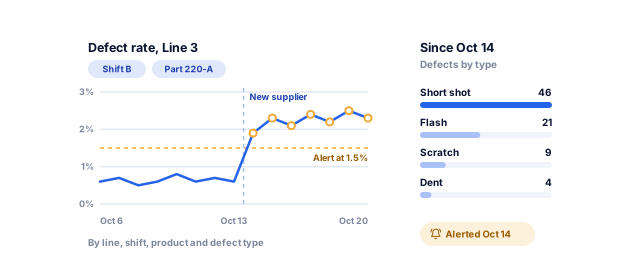
Catching a fault at the station costs less than a return or rework. Results are stored by line, shift, product and defect type, so when a defect rate rises after a supplier or machine change, you see it the same day.
Footage that answers questions
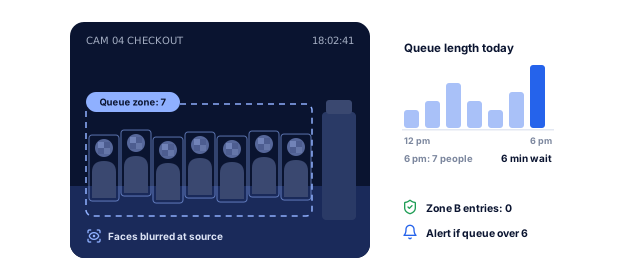
Most businesses record far more video than anyone watches. Video analytics turns it into counts, dwell times and alerts, such as checkout queue length at 6 pm or entry to a restricted zone. Faces can be blurred at the source when identity is not needed.
Decisions based on measured accuracy, not demos
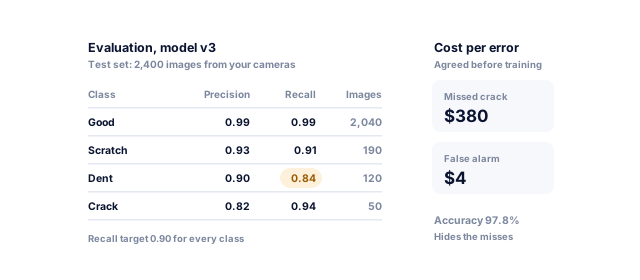
One accuracy figure hides the errors that matter. In Google's machine learning course, a model that always predicts the common answer scores 99% accuracy on imbalanced data and is still useless. We report precision and recall per class on images from your own cameras.
A model that stays accurate after launch
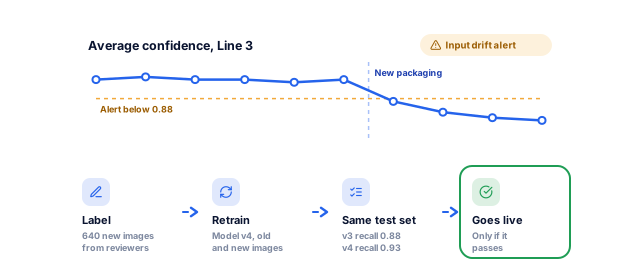
New packaging, a moved camera, seasonal light or a new product line all change the images. We track confidence and reviewer corrections, alert when the input drifts, and retrain on newly labeled examples. A retrained model goes live only after it passes the same test set.
Not sure your images are good enough for AI?
Tell us what you need. We look at sample images or video and the decision you want automated, and send a written plan with the approach, a proof of concept, a price range and a timeline.
Your free AI planFor what you need
1What AI can do with your dataThe decision it supports and how you would measure it
2A fixed-price proof of conceptOn your own data, from $3,000, before you commit to a build
3The approach we would useA ready model, a custom one, or simple rules where they do the job
4Your data stays yoursA signed NDA first, and it never trains any model outside your project
We define the decision, the classes or fields, the speed needed and where it runs, then agree what a miss and a false alarm each cost and set per-class targets before labeling starts.
Use case specification
Acceptance metrics per class
Data and camera inventory
A target everyone signs off before training
Data audit and feasibility test
We run sample images from your cameras, scanners or phones through services such as Amazon Rekognition, Google Cloud Vision or Azure Vision. Where the API meets your target, we build on it; where it falls short, we train a custom model.
Data quality report
API baseline results
Recommended approach and price range
You know which approach meets your target
Labeling and dataset build
We write labeling guidelines, label in CVAT or Label Studio, and have domain experts review hard calls. Test images come from other days, sites or cameras, so scores show how the model handles new data.
Labeling guide
Versioned labeled dataset
Held-out test set
Training data you can trust and reuse
Model training and evaluation
We fine-tune pretrained models and report precision, recall and mAP per class against the API baseline, with a confusion matrix and a failure gallery your team reviews. If a target is missed, we label the data that closes the gap.
Evaluation report
Model card
Failure examples by class
Accuracy measured on your conditions
Integration and deployment
We package the model as an API or edge service, connect it to your app, ERP or line controller, and add a review queue. It runs in shadow mode beside your team until it meets the agreed targets.
Cloud or edge deployment
System integration
Human review queue and runbook
Results flowing into daily work
Monitoring and retraining
Monthly reports cover accuracy from reviewer checks, confidence, drift and system health. We retrain on a schedule or when drift crosses a threshold, and promote a new model only after it passes the test set.
Monitoring dashboard
Monthly accuracy report
Retraining log
Accuracy that holds after launch
Computer vision use cases by industry
Our computer vision development services change with the industry: cameras, data rules and the systems that act on each result all differ.
01 / 05
Manufacturing and quality control
In a March 2026 Cognex survey of 500+ manufacturers, OEMs and integrators, 57% already used AI in machine vision and another 30% planned deployments. We build inspection for defects, assembly, labels, print and dimensions, logged per batch on a custom dashboard your quality team reviews.
Stores use vision for shelf gaps, planogram checks, footfall and queue counts, and loss prevention. Online, it tags catalog images, flags poor product photos and powers search by photo, and its tags can feed recommendation engines. See our work for ecommerce businesses.
Quick wins are often administrative: reading intake forms, insurance cards and lab reports into the patient record. Diagnostic software can be regulated as a medical device, so we scope clinical imaging with your regulatory advisers and de-identify patient images. See Nabhaya Clinic and our healthcare work.
Document capture extracts fields from invoices, statements and IDs with confidence scores, cross-checks them against your records and routes exceptions to a reviewer. Claims teams can triage damage photos by type and severity first. With workflow automation, extracted data triggers approvals and payments without retyping.
Warehouses use vision to count parcels and pallets, read labels scanners miss, spot damaged packaging and check safety gear. Fixed cameras with steady lighting make these some of the most reliable vision tasks, and results can update your inventory management system directly.
A model in a notebook changes nothing. Our 25+ in-house specialists include AI, web, app and software engineers, so one team builds the model, the review screen and the link to your ERP, CRM or mobile app.
02
The simplest approach that meets your target
Where barcodes, fixed rules or a better scanner do the job, we build that and you skip training costs; where they do not, we build the model. Accuracy is reported per class every month, and on rolling agreements clients stay with us 1.6 years on average.
03
Your data, labels and models
Images stay in your own cloud account or on your premises. You own the labeled datasets, labeling guides, trained model weights, evaluation sets and code, and we document how to retrain and redeploy without us. Clients rate us 4.9 on Clutch from 221 reviews, and our case studies show how we report results.
Results we can put numbers on
Your first result from us is a feasibility test on your own images, scored per class. The numbers below come from our software, web and search work, including custom hospital software for AkosMD.
"From designing a high-converting website to managing our SEO, Google Ads, and Google Business Profile, improveFX delivered exceptional results across every channel."
210%more qualified leads
185%organic and local traffic growth
92%keywords on page one
Maureen CappalloBroker and founder, Momentus Real Estate Group
"They revolutionized our online presence with a 60% increase in web traffic through strategic e-commerce SEO and content optimization."
60%more organic traffic
47%more sales
Eric NoahPresident, Eric Originals & Antiques Ltd.
"Visionstar Technologies' online presence transformed significantly with a 40% boost in customer engagement, all thanks to their exceptional website structuring and SEO tactics."
+40%qualified leads
32%lower cost per acquisition
Thomas MorelFounder, Visionstar Technologies
"Their strategic approach to our website and SEO resulted in a 60% increase in local inquiries, revolutionizing our automobile service business."
60%more local inquiries
87%more organic traffic
Mike SteffanFounder, Sabulski Window Tinting
"Their SEO strategy helped us achieve top search rankings, while their Facebook Ads campaigns drove a steady flow of qualified prospects."
How much do computer vision development services cost?
It depends mostly on your data and accuracy target. Our AI projects run from under $5,000 to $100,000+, depending on scope. A fixed-price proof of concept on your own data starts from $3,000, so you see results before you commit to a build.
A project sits near the low end when a ready-made vision API meets the target and we add validation and integration. Custom training, large labeling jobs, many classes, edge hardware, line or ERP integrations, high volume and compliance work move it up. Running costs are per-image API fees or cloud hosting, edge hardware upkeep, and monitoring and retraining.
How long does a computer vision project take?
A feasibility test on your images takes about 2 to 4 weeks. A proof of concept typically takes 6 to 10 weeks, and a production system 3 to 9 months, depending on cameras and integrations.
Labeling is usually the longest single task. Edge deployment, integration with line controllers or ERPs, and a shadow-mode period before going live add time, and we plan each into the schedule.
How many images do we need to train a model?
Fewer than most people expect for a first test, and more than most people expect for production. Google's Vertex AI guidance recommends about 1,000 training images per label for classification, with a minimum of 10.
Fine-tuning a pretrained model needs far less than training from scratch. Variety matters as much as volume: Google advises making training images as close as possible to the images the model will see, across angles, resolutions and backgrounds.
Should we use a ready-made vision API or a custom model?
Start with the API. If it meets your accuracy target on your own test images, it is faster and cheaper to run, and we set it up with validation, a review queue and integration.
Services such as Amazon Rekognition, Google Cloud Vision, Azure Vision and Amazon Textract handle common objects, text and standard documents well, but not your own defect types or product variants. For those we fine-tune a custom model, often a YOLO-family detector, beside the API.
How do you measure computer vision accuracy?
We measure precision and recall for each class on a held-out test set from your own cameras, never a single overall accuracy number.
Precision shows how many flagged items were real; recall shows how many real items were caught. For detection we also report mAP and review a confusion matrix and a failure gallery. Targets follow the cost of each error: a missed safety hazard and a false shelf-gap alarm are not worth the same.
Can computer vision work with our existing cameras?
Often, yes. Many IP cameras stream over RTSP, and if their resolution, angle and lighting show the detail the task needs, we use them.
Security cameras usually cover wide areas, not small defects or label text. In the feasibility step we check sample footage and specify any camera, angle or lighting change before you invest in a model. On-site models can run on edge hardware such as NVIDIA Jetson.
How do you handle privacy when images show people?
We collect only what the task needs, blur faces at the source when identity is not required, and process on site where possible. Your images are never used to train any model outside your project, including a provider's own.
Under GDPR, biometric data used to identify people is special category data, and we also design for HIPAA for patient images and India's DPDP Act. The EU AI Act has banned untargeted scraping of facial images and emotion recognition in workplaces and schools since 2 February 2025, according to the European Commission. Microsoft limits face identification to approved customers under its Limited Access policy.
Can you extract data from invoices, forms and IDs?
Yes. Document capture is one of the computer vision solutions we build most, using Amazon Textract, Google Document AI or Azure Document Intelligence.
Textract, for example, reads printed and handwritten text, forms, tables, invoices, receipts and IDs. We add validation rules, a review queue for low-confidence fields and integration with your accounting or ERP system, so data is checked before anyone relies on it.
What happens after the model goes live?
We monitor accuracy, confidence and drift every month, and retrain when the images change, because products, packaging and lighting all shift over time.
Reviewer corrections become new labeled examples, and each retrained model must pass the same test set before it replaces the live one. You get a monthly report on accuracy, exceptions and system health, and you can book a call at any point to review it.
Ready to put AI to work?
Tell us what you want AI to do with your data, or book a strategy call with our team.
What AI can do with your data, and how to measure it
A fixed-price proof of concept on your data, from $3,000
A call with a specialist to plan the next steps, no obligation
A specialist replies personally 4.9 from 566 client reviews