Python development services for web apps, APIs, data and AI
Our Python development services are for companies that need web applications, APIs, data pipelines or AI features built in Python, by one team that understands both the software and the data behind it. We build with Django, FastAPI and Flask, and you can choose a fixed-scope project, hire dedicated Python developers, or extend your own team.
Python development is building software in Python, from web applications and APIs to data pipelines, automation and machine learning features. Python development services cover architecture, Django, FastAPI or Flask development, data engineering, AI integration, testing, deployment and maintenance.
Django suits full web apps with an admin; FastAPI suits fast, typed APIs; Flask suits small services.
Python's data and machine learning libraries make it the usual choice where software and analytics meet.
Each Python version gets five years of support; Python 3.15 was released on October 9, 2026.
Choose a fixed-scope project, dedicated developers or team extension by how settled your scope is.
Best for
SaaS and web apps, APIs, data platforms, internal automation and products with AI or analytics features
What you get
Architecture, Django or FastAPI code, data models and pipelines, AI integrations, automated tests, CI/CD, documentation, code in your repository
Typical timeline
Discovery in 1 to 2 weeks. An automation job or single API can ship in a few weeks. Published vendor timelines we reviewed put a Python web app at 4 weeks to 3 months, and up to 6 months for complex builds. AI work adds time for data preparation.
Pricing
Driven by scope, data readiness, integrations and team size. One published vendor range we reviewed put Python web apps at $3,000 to $30,000. Our development projects run from under $1,000 to $30,000+, depending on scope. We quote after a free scoping call.
What our Python development services include
Use one workstream, or let us run the whole product from first model to production.
Django gives a complete web application out of the box: ORM, migrations, authentication, an admin panel and protection against SQL injection, CSRF and cross-site scripting. We build SaaS products, portals and internal tools on Django 5.2 LTS or 6.x, with Django REST Framework for APIs and Celery with Redis for background jobs.
FastAPI and Flask APIs
FastAPI builds typed APIs on Starlette and Pydantic, validates every request against Python type hints and generates OpenAPI documentation with Swagger UI automatically. We use it for high-traffic APIs, AI model endpoints and microservices, and Flask for small services. Our API development services cover public and partner APIs.
Data engineering and pipelines
We build pipelines that pull data from your apps, CRMs, ad platforms and files, clean it with pandas or Polars, and load it into PostgreSQL, BigQuery or Snowflake on a schedule run by Airflow. Every pipeline gets tests and alerts, so a broken source is caught before a report goes out. Report and analytics automation builds on the same foundations.
AI and machine learning features
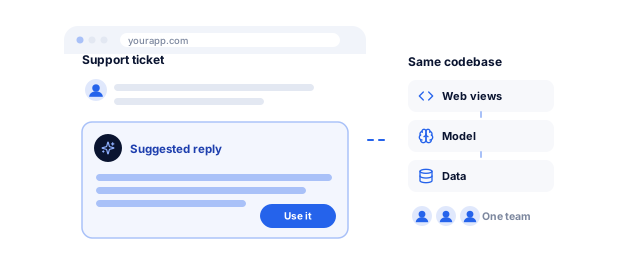
Python is where most AI tooling lives. We add LLM features such as document Q&A, summarization and classification, with retrieval over your own data, and train scikit-learn or PyTorch models for forecasting, scoring and recommendations. Models ship behind FastAPI endpoints with logging and monitoring. Larger programs run with our AI and ML solutions team.
Automation, scripts and integrations
Many Python projects start small: a script that reconciles invoices, syncs two systems or builds a report overnight. We turn these into scheduled jobs with logging, retries and alerts. Larger flows fit our workflow automation services. In our AkosMD case study, automated reminders and follow-up tracking in custom hospital software lifted patient follow-ups 31% month over month.
Testing, DevOps and maintenance
Every pull request runs pytest, Ruff for linting and mypy for type checks in GitHub Actions. Dependencies are pinned with uv or Poetry and scanned with pip-audit. Apps ship in Docker containers to AWS, Azure or Google Cloud, and website maintenance keeps Python, frameworks and packages on supported versions.
What Python software development services change for your business
Python is rarely the only option. Here is where it pays off most, and what we pair it with when another stack does a job better.
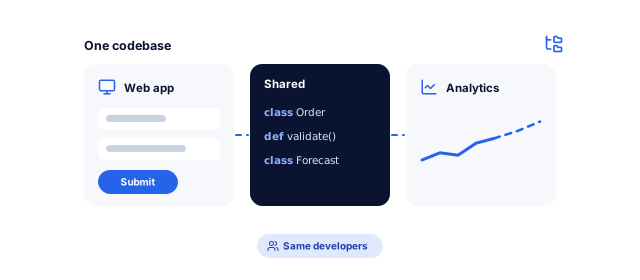
Most companies end up with analytics in Python anyway. Building the product in Python means the same developers, validation rules and models serve both, so a forecast or a scoring model does not need rewriting before it reaches users. In the 2025 Stack Overflow Developer Survey, 57.9% of respondents used Python, up 7 percentage points from 2024.
Business logic delivered sooner
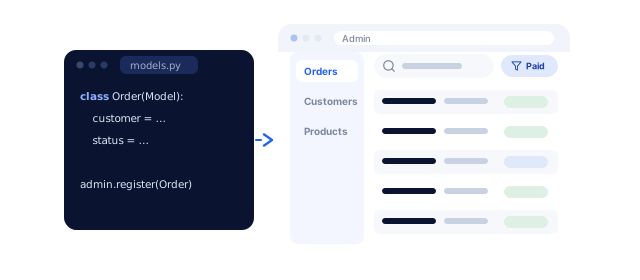
Python reads close to plain English, and its package index covers most needs, from PDF generation to payments. Django's admin can replace a large share of back-office screens you would otherwise build by hand. For the business, that usually means a working first release sooner, and code that a new developer can follow in days rather than weeks.
AI features without a second stack
In the Python Developers Survey 2024 by the Python Software Foundation and JetBrains, with more than 30,000 respondents, web development (23%) and machine learning (13%) were the two most common primary uses of Python. That overlap is the point: your web app and your models can share one codebase and one team.
Frameworks with long, predictable lives
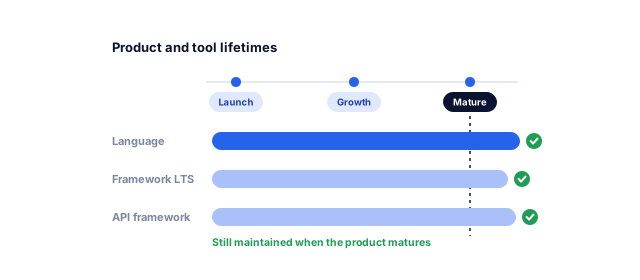
Each Python version gets five years of fixes, and Django publishes its LTS calendar years ahead, with 5.2 LTS supported until April 2028. FastAPI's usage rose 5 points in a year, which Stack Overflow called one of the most significant shifts in its 2025 web framework results.
Automation that pays for itself
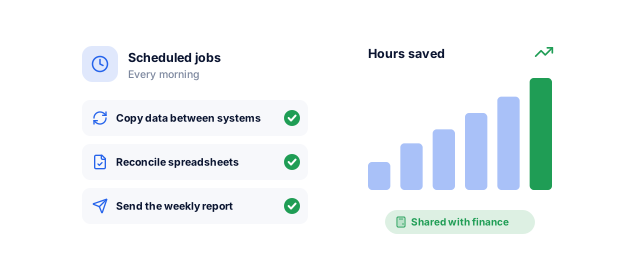
Python jobs remove manual work such as copying data between systems, reconciling spreadsheets or compiling weekly reports. These projects are small, quick to measure and often fund the next one. We agree up front how time saved will be measured, so finance sees the return too.
Where Python fits best, and what we use when it does not
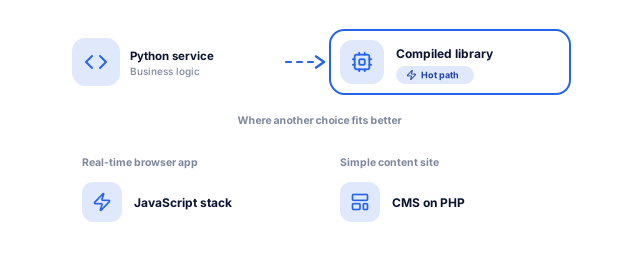
Python fits best where the product, its data and AI meet. For browser-heavy, real-time apps, we build the interface in React on a Python API, or the whole app on MERN for one language from server to screen. Simple content sites cost less to run on WordPress, which we also build. For CPU-bound hot paths, Python calls compiled libraries such as NumPy, or we hand that work to a separate, specialized service.
Have the data, but not sure what to build first?
Tell us what you need. We look at your data, systems and goals, and send a written plan for what to build first, with a price range, a timeline and the stack we would use.
Your free project planFor what you need
1What we would buildYour product, codebase and roadmap
2A price range and timelineFor the budget you pick, with the options that fit
3The stack we would useAnd how your team runs it after launch
A specialist walks you through it on a call
Our Python development process, from idea to production
We map users, workflows and integrations. For data or AI work we also look at the real data: where it lives, how clean it is and whether it can answer the question. Then we agree a first release with a measurable goal.
Scope and success metrics
Data readiness review
Estimate and engagement model
A first release worth building
Architecture
We choose Django, FastAPI or Flask, design the schema or warehouse model, and plan authentication, background jobs, caching and hosting. For AI features we weigh hosted, open or custom models on cost, privacy and accuracy.
Architecture decision records
Data model
AI approach note
Choices made for clear reasons
Build in sprints
Two-week sprints end with a demo on staging, including notebooks or dashboards for data work. Every pull request runs tests, type checks and linting, and you can see the board and repository throughout.
Working build every sprint
Demo notes and updated backlog
Progress you can try
Evaluate and test
Software gets unit, integration and end-to-end tests. Models and LLM features also get an evaluation set built from your real cases, so accuracy is measured, not assumed.
Test report
Model evaluation results
Security review
Evidence that it works
Deploy
We deploy Docker containers running Gunicorn or Uvicorn behind a load balancer, with managed databases, secrets kept out of the code and monitoring from day one. Scheduled jobs and pipelines alert someone when they fail or run late.
Production release
Monitoring and alerts
Runbook
A reliable launch
Support and improve
After launch we patch Python and packages, watch errors, cloud costs and model accuracy over time, and plan the next features from usage data.
Monthly report
Upgrade schedule
Next-release roadmap
Software that keeps earning its place
What our Python developers build
Our Python web development services cover five kinds of work.
01 / 05
SaaS and web applications
Django is a strong base for SaaS: authentication, an admin for your support team, tenant-aware data models and Stripe billing, with Django REST Framework or a React frontend for the product. We design tenant isolation in from the start. Our SaaS application development team covers onboarding and analytics for SaaS companies.
FastAPI suits backends for mobile apps, partner integrations and internal services that need speed, strict validation and clear documentation. We version endpoints, add OAuth 2.0, rate limits and caching, and generate client SDKs from the OpenAPI schema. Our mobile app development team can build the app against the same API.
Teams with data spread across a CRM, an ERP, ad platforms and spreadsheets need one trusted place for numbers. We build the pipelines and warehouse in Python, then dashboards on top, so every report uses the same metric definitions. For forecasting demand, churn or prices, our predictive analytics team adds models, and custom dashboards put them in front of managers.
Customer support assistants, internal knowledge search and document extraction for invoices, contracts or forms are now common Python projects. We combine an LLM with retrieval over your own content, add guardrails and human review where accuracy matters, and measure answers against real customer or staff questions before launch. Our chatbot development and NLP solutions teams go deeper.
Startups often need the product, the data and an AI feature in the first version. We scope the smallest release that tests your riskiest assumption, build it on Django or FastAPI with tests and CI from day one, and add product analytics so the next decision rests on data, on a codebase built to keep. See our web app development service.
A sample of the checklist. Every project gets its own, signed off with you.
Yours to keep, always. Everything is set up in your name, and if you leave we remove our access and hand over the documentation.
Code and repository
Domain and hosting accounts
CMS admin and content
Design files
Documentation and logins
Who Python development from improveFX is for
We build Python software for companies that want the product, its data and AI in one codebase, and route any part Python does not suit to the right improveFX team.
Python projects often stall between the developers who build the app and the analysts who use its data. Our 25+ in-house specialists in New Delhi include engineers, designers, cloud and marketing specialists, so the product, its data and the reports built on it are planned together.
02
Rolling terms and honest reporting
We work on rolling agreements and send a transparent monthly report on what shipped, time or milestones used, pipeline and model health, and open risks. Clients stay with us for 1.6 years on average and rate us 4.9 on Clutch from 221 reviews and 4.9 on Trustpilot from 156.
03
You own the code, data and models
Code sits in your repository, data stays in your own cloud accounts, and trained models, prompts and evaluation sets belong to you. We document pipelines, environments and model versions so your team can run them without us. Our case studies show how we measure results.
Results we can put numbers on
These results come from our wider website, SEO and software projects rather than from Python work alone.
"From designing a high-converting website to managing our SEO, Google Ads, and Google Business Profile, improveFX delivered exceptional results across every channel."
210%more qualified leads
185%organic and local traffic growth
92%keywords on page one
Maureen CappalloBroker and founder, Momentus Real Estate Group
"They revolutionized our online presence with a 60% increase in web traffic through strategic e-commerce SEO and content optimization."
60%more organic traffic
47%more sales
Eric NoahPresident, Eric Originals & Antiques Ltd.
"Visionstar Technologies' online presence transformed significantly with a 40% boost in customer engagement, all thanks to their exceptional website structuring and SEO tactics."
+40%qualified leads
32%lower cost per acquisition
Thomas MorelFounder, Visionstar Technologies
"Their strategic approach to our website and SEO resulted in a 60% increase in local inquiries, revolutionizing our automobile service business."
60%more local inquiries
87%more organic traffic
Mike SteffanFounder, Sabulski Window Tinting
"Their SEO strategy helped us achieve top search rankings, while their Facebook Ads campaigns drove a steady flow of qualified prospects."
Python development services include web application development in Django, FastAPI or Flask, API development, data pipelines, AI and machine learning features, automation, testing, deployment and maintenance.
Most engagements are one of three things: a new product, a data or AI feature added to an existing system, or work on a Python codebase someone else started. Each begins with a one to two week discovery.
How much do Python development services cost?
It depends on scope, data readiness, integrations and team size. One published vendor range we reviewed put Python web apps at $3,000 to $30,000.
Data and AI projects vary more, because cleaning data, building evaluation sets and paying for model usage add cost a plain web app does not have. Dedicated developers are billed monthly instead. We quote after a free scoping call and show the cost of each phase separately.
How long does a Python project take?
Published vendor timelines we reviewed put a Python web app at 4 weeks to 3 months, and up to 6 months for complex builds.
An automation job or a single API can ship in a few weeks. AI features take longer when the data needs work first, so we check data readiness during discovery. Two-week sprints with demos keep progress visible.
Django, FastAPI or Flask: which should we use?
Use Django for full web applications that need an admin, user accounts and a database-heavy back office. Use FastAPI for typed APIs and AI model endpoints. Use Flask for small, simple services.
Many products combine them, for example a Django app for customers and staff with a FastAPI service for model inference. If you already run one framework well, adding to it is usually cheaper than switching.
Can you add AI features to our existing product?
Yes. Most AI features connect to your product through an API, so the existing app needs only small changes.
We start by defining the task and collecting real examples, then compare a hosted model, an open model and a simpler non-AI approach on accuracy, cost and privacy. The winning option ships behind a FastAPI service with logging, so you can see what it answers and how often it is right.
Should we outsource Python development services or hire in house?
Outsource when you need a project delivered, skills such as data engineering or machine learning, or capacity for a set period. Hire in house when Python work is constant and central to your product.
From us you can hire dedicated Python developers who work only on your product on a rolling monthly agreement, or add one or two engineers to your team, and you interview them before they start. Many clients combine both, with an in-house lead who owns the product.
Which Python version do you use?
New projects start on a Python version in its bugfix phase, usually the newest one that all key libraries support.
In October 2026 that means Python 3.14, with 3.15, released on October 9, 2026, adopted once dependencies catch up. Versions 3.11 to 3.13 now receive security fixes only, according to the Python developer guide. Django 6.1 supports Python 3.12 to 3.14, and Django 5.2 LTS is supported until April 2028.
How do I choose a Python development agency?
Ask to see Python code they maintain today, which versions their current projects run on, and how they test and deploy it.
A good Python web development company can explain why it would pick Django or FastAPI for your project, shows how it evaluates AI features, and lets you interview the developers. Check who owns the repositories, cloud accounts and models. Claims to offer the best Python development services mean little without that evidence.
Can you take over or modernize an existing Python codebase?
Yes. We start with an audit of Python and package versions, tests, deployment and security, then fix what blocks safe releases.
Some systems still run Python 2, which stopped receiving any fixes on January 1, 2020, according to python.org. Those are migrated module by module with tests around each step. Larger rewrites of older systems go through our legacy system modernization process.
Is Python fast enough for production web apps?
Yes, for most business applications. The usual bottlenecks are database queries and network calls, not the language.
We profile before optimizing, add indexes and caching, use async FastAPI endpoints for I/O-heavy work and move heavy jobs to Celery queues. Number crunching runs in compiled libraries such as NumPy. If one path is still too slow, it can become a separate service in a faster language.
Ready to plan your website?
Tell us what you need built, or book a strategy call with our team.
What we would build, and on which platform
A price range and timeline for your budget
A call with a specialist to plan the next steps, no obligation
A specialist replies personally 4.9 from 566 client reviews