PHP development services for Laravel, Symfony and legacy PHP apps
Our PHP development services are for businesses that run on PHP or plan to: web applications, portals, APIs and ecommerce backends built in Laravel or Symfony, and older PHP systems that need upgrading before they become a security risk. You can hand us a fixed-scope project, hire dedicated PHP developers, or add engineers to your own team.
PHP development is building server-side web applications, websites and APIs in PHP, usually on a framework such as Laravel or Symfony. PHP development services cover custom builds, APIs, CMS and ecommerce backends, upgrades from unsupported PHP versions, performance tuning and maintenance.
PHP runs 69.2% of websites whose server-side language is known, according to W3Techs in October 2026.
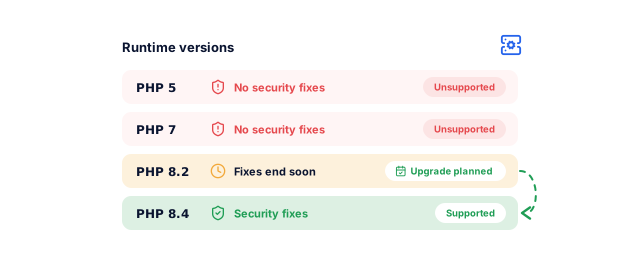
Each PHP branch gets two years of active support and two of security fixes; PHP 8.2 security support ends on December 31, 2026.
Laravel suits fast product development; Symfony suits large, long-lived systems.
Old PHP apps are usually upgraded in steps, not rewritten.
Best for
Web apps, customer portals, ecommerce and CMS backends, APIs, and businesses with existing PHP systems
What you get
Architecture, Laravel or Symfony code, MySQL or PostgreSQL design, APIs, automated tests, CI/CD, upgrade plan, code in your repository
Typical timeline
An audit of an existing app takes 1 to 2 weeks. Published vendor timelines we reviewed: simple apps 4 to 8 weeks, medium 8 to 16 weeks, complex 16 to 24+ weeks.
Pricing
Driven by scope, integrations, legacy debt and team size. Published rates we reviewed ranged from about $20 to $150 an hour by location and seniority. Our development projects run from under $1,000 to $30,000+, depending on scope. We quote after a free audit.
What our PHP development services include
Most clients start with one workstream and add others as the application grows.
Our custom PHP development services cover web applications, portals and SaaS products in Laravel or Symfony on a supported PHP 8 release. Code follows PSR standards, uses Composer for dependencies and strict types where they help, and is checked by PHPStan on every pull request. Need a marketing site too? Our custom website development team builds it alongside.
Laravel development
Laravel 13, released in March 2026, needs PHP 8.3 or newer and receives security fixes until March 2028. We use Eloquent for data, queues with Horizon for background jobs, Sanctum for API tokens and Livewire or Inertia for interfaces. Older Laravel apps are upgraded one major version at a time, with tests at every step.
Symfony development
Symfony suits large, long-lived systems with complex business rules. We build on Symfony 7.4 LTS, which gets bug fixes until November 2028 and security fixes until November 2029, or on 8.x where you want the newest features. Doctrine handles data, Messenger handles queues, and API Platform speeds up REST and GraphQL APIs.
PHP API development and integrations
We build REST and GraphQL APIs in PHP for React, Angular and mobile frontends, with OpenAPI documentation, OAuth 2.0, rate limiting and versioning. Integrations with payment gateways, CRMs, ERPs and shipping providers include retries and logging, so failures are visible. API-first projects follow our API development services.
Legacy PHP upgrades and modernization
Apps on PHP 5.6 or 7.x are upgraded in steps: tests around critical paths first, then Rector for automated code changes, PHPCompatibility checks and a staged move through each version. Monoliths can be split gradually with the strangler pattern. Larger programs run through our legacy system modernization service.
Performance, security and maintenance
We profile slow pages with Blackfire or Xdebug, tune OPcache, add Redis caching and database indexes, and move slow work to queues. Security reviews follow the OWASP Top 10, and composer audit flags vulnerable packages. After launch, website maintenance keeps PHP, the framework and every dependency patched each month.
Why businesses still choose PHP web development services
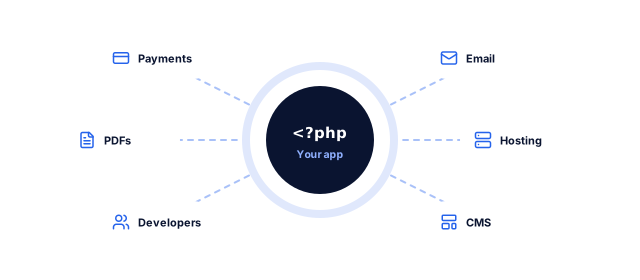
PHP is everywhere, inexpensive to host and quick to build with. Here is why it keeps winning, the one risk to manage, and where it fits best.
PHP is used by 69.2% of websites whose server-side language W3Techs can identify, and WordPress alone runs 39.6% of all websites. That means mature libraries for almost every integration, hosting almost anywhere and developers who are easy to find. In the 2025 Stack Overflow Developer Survey, 18.9% of respondents had used PHP.
Fast product development with Laravel
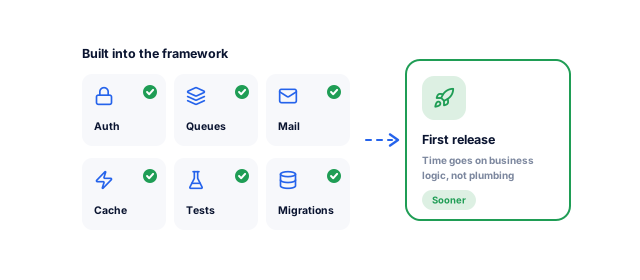
Laravel ships with authentication, queues, mail, caching, testing and database migrations out of the box, so developers spend their time on business logic rather than plumbing. For an MVP, a portal or an internal tool, that shortens the path to a first release. Laravel 13 also added a first-party AI SDK for text generation, embeddings and agents.
Enterprise stability with Symfony
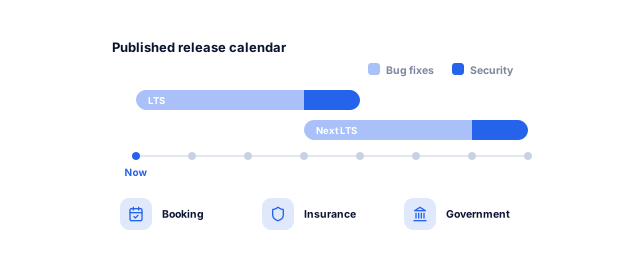
Symfony publishes its release dates years ahead, and its LTS versions get about three years of bug fixes and four of security fixes. Laravel and Drupal both build on Symfony components. That predictability matters for systems expected to run for a decade, such as booking engines and insurance platforms.
Modest hosting and running costs
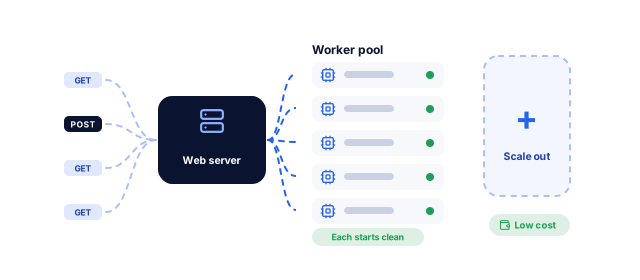
PHP runs on a single virtual server, managed hosting or containers on AWS, Azure and Google Cloud, with PHP-FPM behind Nginx as the common production setup. Each request starts clean and shares nothing, which makes horizontal scaling simple. For many business apps, that keeps hosting bills and operations skills modest compared with heavier stacks.
The real risk: unsupported versions
W3Techs data from October 2026 shows 26.8% of PHP websites still on PHP 7 and 7.7% on PHP 5, versions that no longer receive security fixes. PHP 8.2 joins them after December 31, 2026. An unsupported runtime gets no patches for newly found flaws, and hosts and libraries drop it over time. We plan upgrades before deadlines, not after incidents.
Where PHP fits best, and what we use when it does not
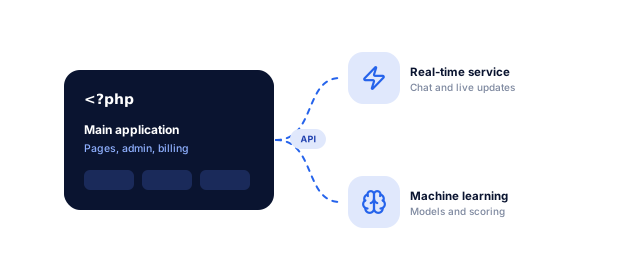
PHP fits best for business apps, portals, APIs, CMS and commerce. Apps built around chat or live collaboration are often simpler on Node.js, though Laravel Reverb now covers many WebSocket needs, so we use Reverb or add a Node.js service beside your PHP app. For data science and machine learning, our Python team builds the model as a service your application calls.
Worried your PHP app is too old to touch?
Tell us what you need. We look at your PHP version, framework and codebase, and send a written plan to upgrade, refactor or rebuild, with a price range and timeline.
Your free project planFor what you need
1What we would buildYour product, codebase and roadmap
2A price range and timelineFor the budget you pick, with the options that fit
3The stack we would useAnd how your team runs it after launch
A specialist walks you through it on a call
Our PHP development process, from audit to support
For a new build we map users, journeys and integrations. For an existing app we audit versions, Composer dependencies, tests, server setup and known vulnerabilities, with PHPStan showing where the risk sits.
Scope or audit report
Dependency and vulnerability list
Engagement model and estimate
A clear picture before any spend
Architecture and plan
We choose Laravel, Symfony or a lighter approach, design the database, and plan authentication, queues, caching and hosting. Upgrades get a version path with a rollback point at every step.
Architecture decision records
Database design
Upgrade or release plan
An agreed route and budget
Build in sprints
Two-week sprints end with a demo on staging. Every pull request runs PHPUnit or Pest tests, PHPStan and style checks in CI, then a human review.
Working build every sprint
Test and static analysis results
Progress you can check
Testing and security
We add feature tests around payments, logins and other critical paths, review the code against the OWASP Top 10, run composer audit and load test the busiest pages before release.
Test report
Security review
Load test results
Confidence before go-live
Release and migration
Releases use zero-downtime deployment, with database migrations rehearsed on a copy of production data. PHP version switches go one environment at a time, staging first.
Production release
Runbook and rollback plan
A launch users barely notice
Support and upgrades
After launch we patch PHP, the framework and Composer packages, watch logs and performance, and schedule the next upgrade before the current version leaves support.
Monthly report
Patch schedule
Version roadmap
An application that stays supported
PHP web application development services for different needs
From PHP website development services to SaaS builds, these are the projects we are asked about most, and how we approach each one.
01 / 05
Customer and partner portals
Custom PHP portal development services for customers, dealers or suppliers usually cover logins with roles, document uploads, order or ticket history and a link to your CRM or ERP. Laravel builds these quickly, with Filament or Nova for admin panels your staff can use. When the portal sits on core processes, our CRM development and ERP development teams join in.
Most online stores run best on a platform, and WooCommerce is written in PHP, so we extend it with custom plugins, checkout rules and integrations instead of rebuilding. Custom Laravel builds make sense for multi-vendor marketplaces, complex B2B pricing or subscription models that a platform cannot handle cleanly. Our WooCommerce development team helps you compare both routes for ecommerce businesses.
WordPress and Moodle are both PHP applications. When a site outgrows standard plugins, we write custom plugins, blocks and integrations with tests, code review and version control, instead of stacking plugins that conflict and slow pages down. For a bespoke editor or a headless setup, see custom CMS development and WordPress website development.
Laravel is a common choice for SaaS: Cashier handles Stripe or Paddle subscriptions, queues send emails and build reports, and multi-tenancy can be designed in from the start. Internal tools such as quoting systems and approval workflows follow the same pattern. Our SaaS application development team covers product design and analytics for SaaS companies.
Many businesses depend on a PHP app built years ago by a developer who has since left, often on PHP 5.6 or 7.x, with no tests or documentation. We stabilize it first with backups, monitoring and security patches, then document it and upgrade in steps, or move it gradually to Laravel when that is the better route.
Each PHP branch gets two years of active support, then two years of security fixes only, then no patches at all. We plan upgrades around this calendar.
Source: php.net supported versions and unsupported branches, checked October 28, 2026. Framework minimums also matter: Laravel 13 needs PHP 8.3 or newer, and Symfony 8.1 needs PHP 8.4 or newer.
Your PHP project, week by week
A typical 12-week build of a medium-sized app; simpler apps need fewer sprints.
A sample of the checklist. Every project gets its own, signed off with you.
Yours to keep, always. Everything is set up in your name, and if you leave we remove our access and hand over the documentation.
Code and repository
Domain and hosting accounts
CMS admin and content
Design files
Documentation and logins
Who PHP development from improveFX is for
Our PHP application development services cover new builds and upgrades for businesses of every size, and we bring in the right improveFX team where another stack or platform serves you better.
Many PHP sites are also marketing assets: WordPress sites, stores and portals that must rank and convert. Our 25+ in-house specialists include developers, SEO specialists and paid media managers, so an upgrade or rebuild protects search rankings and conversion tracking. As a Google Premier Partner, we check analytics before and after every launch.
02
Honest upgrade advice on rolling terms
If a rewrite is not worth the money, we upgrade what you have in steps instead. Work runs on rolling agreements, with a transparent monthly report on what changed, what is next and which versions are approaching end of life. Clients stay with us for 1.6 years on average and rate us 4.9 on Clutch from 221 reviews.
03
Your code, servers and data
Code lives in your Git repository, and hosting, domains and databases are registered in your name. We document environments, deployment steps and configuration, so your team or another vendor can carry on without us. Our case studies show how we measure and report results.
Results we can put numbers on
These results come from our wider website, SEO and software projects, not from PHP work alone.
"From designing a high-converting website to managing our SEO, Google Ads, and Google Business Profile, improveFX delivered exceptional results across every channel."
210%more qualified leads
185%organic and local traffic growth
92%keywords on page one
Maureen CappalloBroker and founder, Momentus Real Estate Group
"They revolutionized our online presence with a 60% increase in web traffic through strategic e-commerce SEO and content optimization."
60%more organic traffic
47%more sales
Eric NoahPresident, Eric Originals & Antiques Ltd.
"Visionstar Technologies' online presence transformed significantly with a 40% boost in customer engagement, all thanks to their exceptional website structuring and SEO tactics."
+40%qualified leads
32%lower cost per acquisition
Thomas MorelFounder, Visionstar Technologies
"Their strategic approach to our website and SEO resulted in a 60% increase in local inquiries, revolutionizing our automobile service business."
60%more local inquiries
87%more organic traffic
Mike SteffanFounder, Sabulski Window Tinting
"Their SEO strategy helped us achieve top search rankings, while their Facebook Ads campaigns drove a steady flow of qualified prospects."
PHP development services include custom web application and website development, API development, CMS and ecommerce customization, upgrades from old PHP versions, performance and security work, and ongoing maintenance.
Most engagements are either a new build in Laravel or Symfony, or work on an existing application. For existing code we always start with an audit, because the version, dependencies and test coverage decide what is safe to change first.
How much do PHP development services cost?
Published rates we reviewed ranged from about $20 to $150 an hour, depending on location and seniority, with large enterprise agencies charging $250 or more.
Fixed-scope projects are priced per milestone after discovery. Cost is driven by the number of user roles and screens, integrations, compliance needs and, for existing apps, how far behind the PHP and framework versions are. We quote after a free audit and show each phase separately.
How long does it take to build a PHP application?
Published vendor timelines we reviewed put simple apps at 4 to 8 weeks, medium apps at 8 to 16 weeks and complex systems at 16 to 24 weeks or more.
Integrations, data migration and how quickly you make decisions move the timeline most. Two-week sprints with demos keep progress visible, and staged releases give users value before the whole scope is done.
Laravel or Symfony: which should I choose?
Choose Laravel for fast product development, MVPs, SaaS and portals; choose Symfony for large, long-lived systems with complex domains and strict architecture needs.
Laravel is more popular, used by 8.9% of respondents in the 2025 Stack Overflow survey against 4% for Symfony, so hiring is easier. Symfony's LTS releases give longer, predictable support. If you already run one, staying with it is usually cheaper than switching.
Can you upgrade our PHP 5.6 or 7.x application to PHP 8?
Yes. We upgrade in stages, with tests and a rollback point at each step, rather than in one risky jump.
First we add tests around critical paths and run PHPCompatibility and PHPStan to list what will break. Rector automates many code changes, then we move through versions on staging before production. For a large app the work is often split into releases over several weeks.
Which PHP version should a new project use?
Start new projects on PHP 8.5 or 8.4, the two branches in active support in October 2026.
Check framework minimums too: Laravel 13 requires PHP 8.3 or newer and Symfony 8.1 requires PHP 8.4 or newer. Avoid starting on PHP 8.2 or 8.3, because both are already limited to security fixes, and PHP 8.2 loses even those after December 31, 2026, per php.net.
Is PHP still a good choice in 2026?
Yes, for most business web applications, portals, CMS and ecommerce work. PHP is actively developed, with a new branch each year and four years of support for each.
The ecosystem is mature, hosting is inexpensive and developers are easy to find. PHP is weaker for heavy real-time features and machine learning, so for those parts we add a Node.js or Python service beside the PHP app, and you keep PHP where it works.
Do you offer core PHP development services without a framework?
Yes, mainly to maintain and improve existing core PHP applications. For new applications we recommend a framework, because security, routing and testing come built in.
In a core PHP codebase we usually add Composer and autoloading first, then tests, a router and prepared statements for every database query. That makes the code safer and easier to hire for, and it opens a gradual path to Laravel or Symfony.
Should we outsource PHP development services or hire in house?
Outsource when you need a project delivered, skills you lack, or capacity for a limited period; hire in house when PHP work is constant and core to your business.
You can hire dedicated PHP developers who work only on your product on a rolling monthly agreement, or add engineers to your team, and you interview them first. Many clients mix both: an in-house lead plus our developers for upgrades and peaks.
Can you take over a PHP project from another developer or agency?
Yes. We start with a handover audit of the code, servers, credentials and deployment process, then fix anything that blocks safe releases.
Typical findings are an unsupported PHP version, outdated Composer packages, no automated tests, credentials stored in the code and manual deployments over FTP. You get a prioritized list with estimates, and we agree what to fix before any new features are built.
Ready to plan your website?
Tell us what you need built, or book a strategy call with our team.
What we would build, and on which platform
A price range and timeline for your budget
A call with a specialist to plan the next steps, no obligation
A specialist replies personally 4.9 from 566 client reviews