Somewhere in your workflow, a simple copy change became a two-week ticket. That is a platform problem, not a people problem. Our custom CMS development services start with your content model, editorial workflow, and integrations, then build the system around them. You own the code and the roadmap.


Companies that chose us for their digital transformation
















Nobody wakes up wanting a new CMS. Something specific broke first: a launch that slipped, a market you could not localize for, an audit you barely passed, and a renewal invoice that made no sense. Find your situation below and see how our custom CMS development services address it.

Plugins patching plugins, custom fields nobody documented, and a staging site everyone fears. Your platform now decides what your roadmap can include.

Website, app, kiosk, partner portal, email. Your team rewrites the same content for each one because nothing shares a single structured source.

You need approval trails, role-based permissions, regional data rules, and version history. Off-the-shelf plugins bolt this on. Regulated industries need it built in.

Seats, add-ons, API call tiers, and premium plugin renewals. You are leasing features you barely use and cannot remove without breaking something.
We turn down custom CMS development projects if they don’t suit your needs and goals. Not often, but often enough that it is worth explaining how we decide. These five factors settle most build-versus-buy conversations, and two of them frequently point toward a licensed platform. Check them out carefully and honestly, and you will know which side you land on before you call any custom CMS development company.
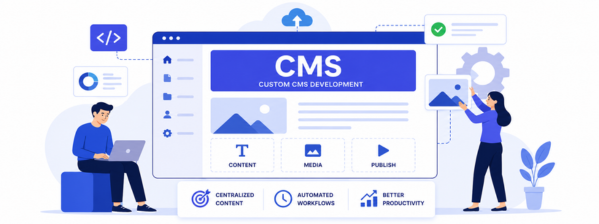
If your team publishes fifty near-identical articles a month, a licensed platform almost certainly wins. WordPress or Webflow CMS development will get you live faster and cheaper than anything bespoke, because those platforms have already solved that motion. Custom earns its cost when your content types are genuinely unusual: structured product data, multi-variant regulatory documents, or content that behaves differently in every market.
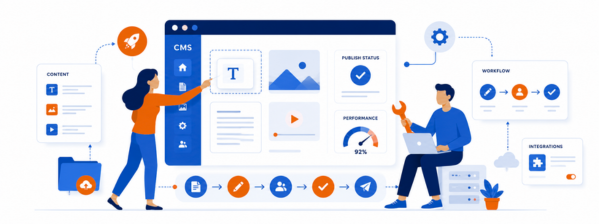
Drafting, reviewing, and publishing are solved problems. Every platform handles it. The question is what happens when your chain runs six approvers deep, splits by region, requires a legal sign-off that expires, and has to produce an audit trail. Drupal CMS development covers a surprising amount of this territory well. Beyond it, you are writing custom code inside someone else’s framework, which is the worst of both options.
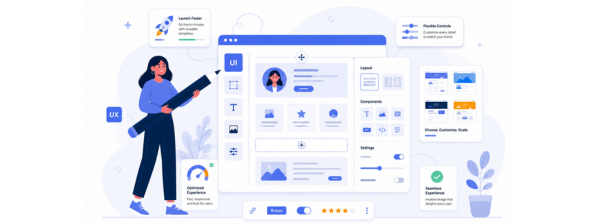
Pulling a HubSpot form or a Shopify product feed into your site is a connector problem, and every platform has connectors. Two-way sync with a proprietary internal system, real-time inventory logic, or content that changes based on a live ERP query is an architecture problem. Once your CMS has to make decisions using data it does not own, custom stops being a preference and becomes the practical answer.
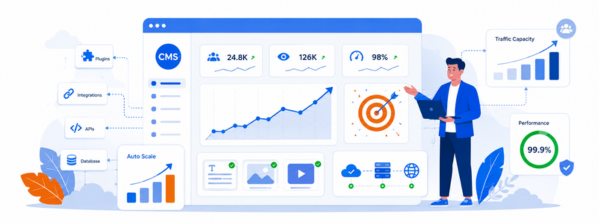
Custom costs more upfront and less to run. Licensed costs less upfront and more every year: seats, add-ons, API tiers, premium plugin renewals, and the developer hours those plugins still require. The crossover usually lands somewhere in year three. If you are planning around a two-year horizon, buy. If this platform has to carry you five years or more, run the full math before you decide.
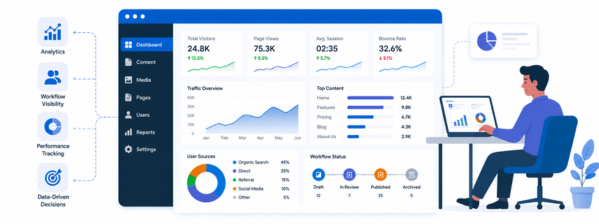
This is the factor that gets skipped, and it sinks more custom builds than budget ever does. A custom CMS has no plugin marketplace and no Stack Overflow thread waiting with your answer. Someone has to own it. If you have no in-house engineering capacity and no plan to retain a partner, buy a platform. We will tell you that on the first call.
Get a free proposal with real numbers, honest timelines, and no lock-in. Judge us on that.
Most custom CMS website development service timelines tell you what happens and not what you receive. Our CMS developer does both. Every stage below closes with a specific artifact you can review, approve, or take to another vendor. If a stage ends and you cannot point at what it produced, we have not finished it.

We inventory every content type, workflow, user role, and integration you run today. You receive a content model document and a full audit spreadsheet, reviewed and signed off before anyone writes code.

We apply the five-factor framework to your situation and write down the reasoning. You receive an architecture plan and a written recommendation, including the case against building custom if that case exists.

We design the schema and the screens your editors will actually live in. You receive a content model diagram and a clickable prototype of the admin interface before development begins, tested by the editors themselves.

Two-week sprints, each ending in a working demo you can click through. Every integration ships with error handling and written API documentation, so nothing lives only in a developer's head. Progress is demonstrated, never described.
Content migrates in a rehearsed dry run first, never straight to production. You receive a URL redirect map, a migration validation report, and Core Web Vitals benchmarks measured against the targets we agreed.

You receive the source code repository, deployment runbooks, editor training sessions, and recorded documentation. We stay on for thirty days of hypercare and ninety days of search ranking monitoring. After that, you owe us nothing.
These are the six things that go wrong on custom CMS projects. Not hypothetical risks, actual ones we have hit. Ask every CMS web development company you are considering these questions, including us. The specificity of the answer tells you more than any portfolio will. Vague reassurance means they have not hit the problem yet.
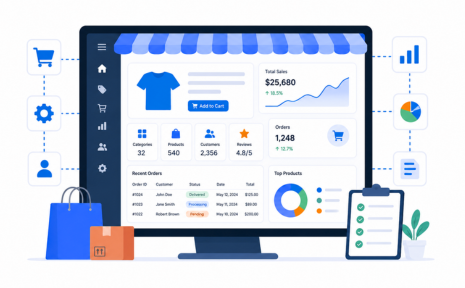
Discovery is priced and delivered separately, so you get the architecture plan and a real estimate before committing to the build. Scope changes are quoted before they are built, never absorbed, and invoiced later. Honest caveat: integrations with undocumented legacy systems are the one line item that genuinely moves. We flag those in Discovery and price them as ranges, not fixed numbers.
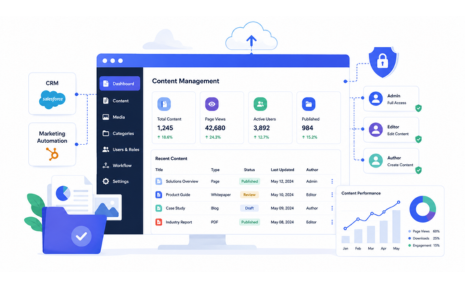
Two-week sprints ending in a working demo mean you see slippage in week four, not month five. There is no status report standing in for a clickable build. Honest caveat: the most common cause of delay is not our velocity; it is content and approvals waiting on your side. We name the owner and the date for every dependency in Discovery, so the delay is visible early.
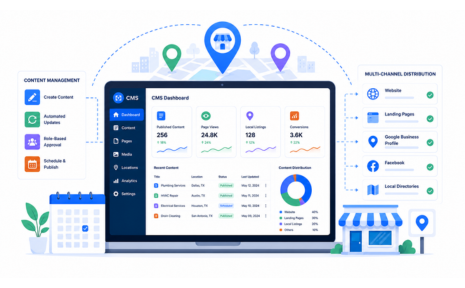
This is the risk that keeps marketing leads awake, and rightly. Our method: full URL inventory and crawl of the current site, a redirect map reviewed before cutover, metadata and structured data parity checks, and a staging crawl compared against production. After launch, we monitor rankings for ninety days. Honest caveat: a short dip in weeks one and two is normal. Recovery is what we hold ourselves to.
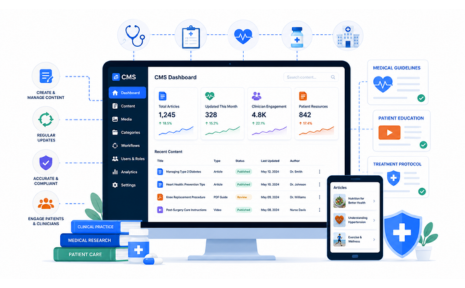
Adoption failure is almost always a design failure, and it happens when editors first see the system at training. We put a clickable prototype of the admin interface in front of your actual editors before development starts, then again at every sprint demo. The people who will use it daily get a vote, not a briefing. Training at launch should feel like a refresher, not an introduction.
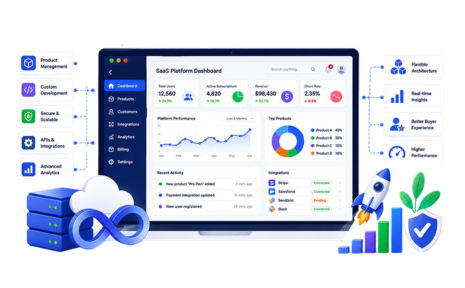
Three options, and we will tell you which fits. Retain us on a support agreement. Hire a CMS developer in-house, and we train them during handover. Or take the documentation to any competent agency, since the stack is standard and deliberately boring. Honest caveat: a custom CMS has no plugin marketplace to rescue you. If none of the three options is realistic, buy a platform instead.
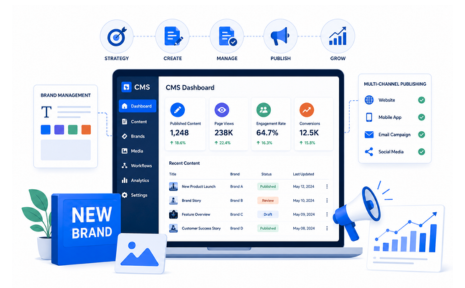
You leave with everything. Source code in your own repository from sprint one, not handed over at the end. Deployment runbooks, content model diagrams, and API documentation written for a developer who has never met us. No proprietary framework, no license we control, no encrypted modules. We have handed projects to in-house teams and to other agencies. It is a normal Tuesday, not a negotiation.
A CMS build almost never arrives alone. It comes attached to a redesign, a migration, a commerce catalog, or an application that needs the same content. These are the services most often scoped alongside custom CMS work, with a note on where each one starts and where CMS development ends.
Most people land here looking for one service and leave having scoped a different one. If your content model is the problem, start with CMS. If the content is fine and the site simply looks dated, a redesign is cheaper and faster. Ask us, and we will say which.
When content has to reach a website, an app, and a partner API from one source. Same modeling discipline as custom CMS, different delivery architecture.
If the five-factor framework pointed you toward a licensed platform, this is where to go. Custom themes, custom post types, and performance work without the bespoke build.
When users log in, submit, calculate, or transact, you have crossed from content into application. CMS manages what you publish. This manages what your users do.
If you are the person who will actually vet this work, these three layers are where you should push any CMS website development company hardest. They rarely appear in a proposal because they are difficult to write about without having done them. Here is how we approach each, in enough detail that you can argue with it.
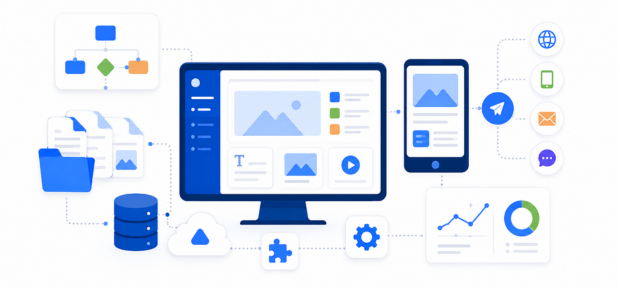
Most CMS pain traces back to a model built around pages instead of meaning. Model a case study as a page, and it lives on one URL. Model it as an entity with typed fields and references, and it feeds a listing, a related block, and a partner API. We settle reference depth and localization level upfront, whether the build runs on Contentful, WordPress, or a fully custom schema.
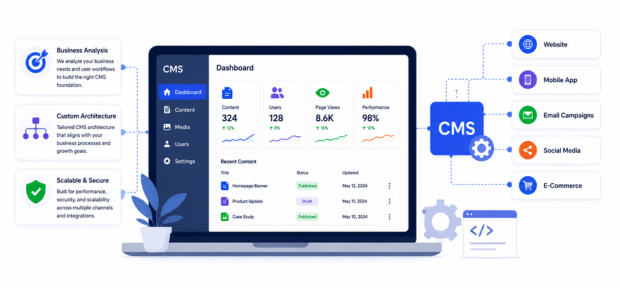
Slow sites are rarely slow because of the CMS. They are slow because nobody set a budget and marketing kept adding tags. We assign a millisecond cost to every third-party script, choose a rendering strategy per template, and treat INP as seriously as LCP. Budgets are enforced in CI, so a regression fails the build instead of surfacing in a quarterly audit.
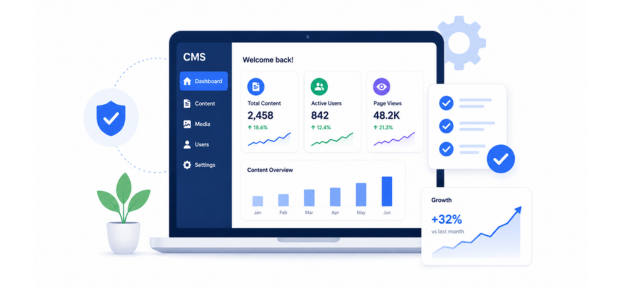
We crawl the existing site and the staging build, then diff them: titles, canonicals, structured data, internal link depth, and orphan pages. Redirects are mapped one hop, because chains leak authority and nobody notices for months. Server logs tell us which URLs Googlebot actually requests, which is rarely the list in your sitemap. We keep the old sitemap live during transition and monitor rankings for ninety days after cutover.
These are the questions that come up most often in first conversations, answered as directly as we can. Where the honest answer is a range or a qualified no, we have said so. If yours is not here, ask it on the consultation call, and we will answer it the same way.