
Baseline and service-level objectives
We record p95 and p99 latency per journey with the four golden signals and agree objectives, such as 95% of checkout requests under 300 milliseconds.
Our cloud performance optimization services are for businesses whose websites, APIs or SaaS products on AWS, Azure or Google Cloud feel slow, wobble under traffic or need ever bigger servers. We measure where the time goes, then fix the biggest delays first: slow queries, missing caches, late autoscaling and heavy code.
 4.9
 Written by Abhishek Kumar, Content Writer



















Cloud performance optimization is making cloud applications respond faster and stay stable under load without overspending. Cloud performance optimization services cover tracing, profiling, query tuning, caching, autoscaling and load testing, with every gain measured at high percentiles.
Applied in the order your data points to.
Get a free proposalWe record p95 and p99 latency per journey with the four golden signals and agree objectives, such as 95% of checkout requests under 300 milliseconds.
OpenTelemetry, AWS X-Ray, Application Insights or Cloud Trace show where each request spends its time; profilers find hot functions, memory leaks and ORMs making hundreds of queries per page.
We rank queries by total time, fix indexes, rewrite the worst and add pooling with RDS Proxy or PgBouncer. Ongoing care sits with cloud database management.
Cacheable content moves to CloudFront, Azure Front Door or Cloud CDN, and repeated reads to Redis. Every cache gets a written rule for when it clears.
We scale on leading signals such as requests per target or queue depth, keep warm capacity and pre-scale for known peaks. Container scaling is tuned with our Kubernetes team.
Ramp, spike and soak tests in k6, Locust or JMeter find the breaking point before customers do; a small suite then runs in your CI/CD pipeline to catch regressions.
A 0.1 second gain in mobile speed lifted conversions 8.4% for retail and 10.1% for travel sites in a study Google commissioned from 55 and Deloitte, reports web.dev.
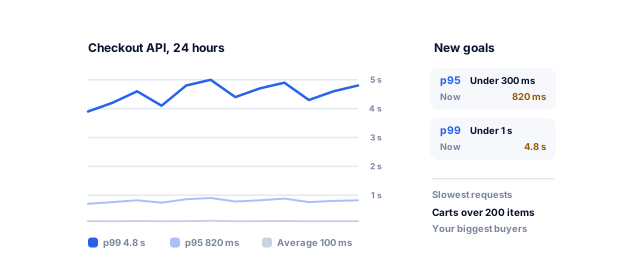
Google's SRE book describes a service averaging 100 milliseconds where 1% of requests might easily take 5 seconds. So we set goals at p95 and p99.
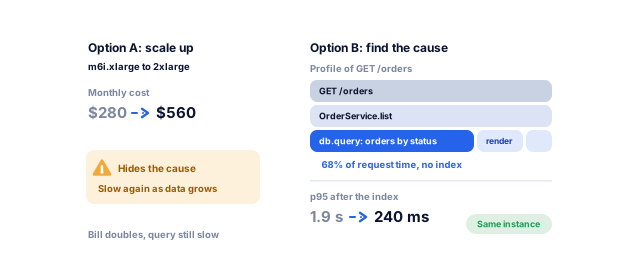
A bigger instance hides a slow query until data grows. Where capacity really is the answer, we size it with our cloud cost optimization team.
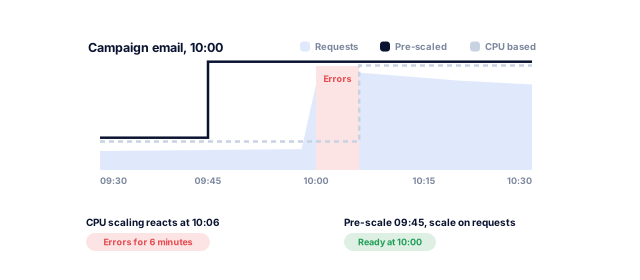
Traffic jumps in seconds; new instances take minutes. Scaling on request rates and pre-scaling before campaigns turns a peak into a normal busy hour.
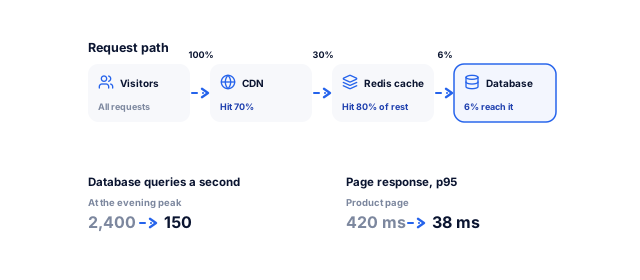
Product pages are often rebuilt from the database for every visitor, though they rarely change. Caching them in Redis or at the CDN frees the database.
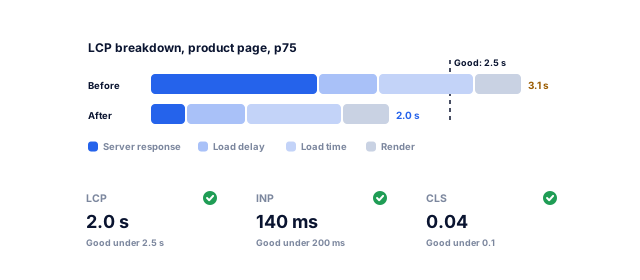
Google's Core Web Vitals judge loading, responsiveness and layout, and server response time starts every load. Our technical SEO team handles the front end.
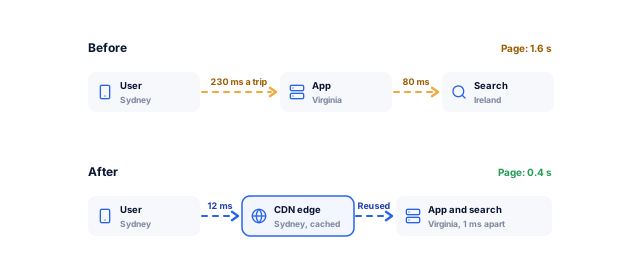
A user in Sydney calling a server in Virginia pays for distance on every request. CDNs cut that; for global users we plan regional deployments within your data rules.
Give us access to your monitoring or a staging environment. We will trace your slowest user journeys, show where the time goes and estimate the gain from each fix, free and without obligation.
We measure latency, errors and traffic for key journeys and agree objectives.
A clear starting point in numbersTraces and query statistics show where time goes; we rank findings by impact and cost.
An agreed order of workOur developers change code, queries and caching through tested pull requests, and measure each fix in production.
Faster journeys, proven one by oneAutoscaling, instance sizes and CDN rules follow measured demand, with headroom for peaks.
Capacity that follows demandLoad tests confirm objectives hold at expected traffic plus a margin.
Known limits before the next peakPerformance budgets fail a build that slows key journeys, and a monthly report tracks latency, errors and cost.
Gains that do not slip backThe method stays the same; the hot spots change.
We cache catalog data, keep checkout lean, load test before sales and pre-scale for campaign emails. Our ecommerce website development team handles storefront fixes.
We track p99 latency per tenant, move exports to background queues and add rate limits, and our SaaS application development team makes the code changes.
CloudWatch and X-Ray traces, CloudFront, ElastiCache for Redis, RDS Proxy for connection spikes, and request-based scaling. Our AWS management team runs the wider account.
Application Insights and Azure Front Door on Azure; Cloud Trace, Cloud CDN and Memorystore on Google Cloud. Our Azure and Google Cloud management teams run the platforms.
We cache full pages at the CDN, optimize images and trim third-party scripts, so a press mention does not slow the site. Our WordPress development team handles theme changes.
Every fix changes the cloud bill too, sometimes downward, so we rank fixes on both.
Book a strategy call| Fix | Best for | Typical effect on the bill | Watch out for |
|---|---|---|---|
| Query and index tuning | Pages and APIs waiting on the database | Often lower: a smaller database may do | Extra indexes slow writes; test on a copy |
| Application caching (Redis) | Repeated reads, computed results, sessions | Adds a cache; can shrink the database | Stale data without clear invalidation rules |
| CDN and HTTP caching | Static files, images, distant users | Adds CDN charges; cuts origin load | Caching logged-in pages by mistake |
| Autoscaling tuning | Traffic spikes and quiet periods | Often lower: less idle capacity | Scaling in too fast, then cold starts |
| Code profiling and fixes | Hot functions, memory leaks, N+1 queries | Often lower: less compute per request | Needs developer time and good tests |
| Bigger instances | Proven CPU or memory limits | Higher, and it compounds | Hides the real cause until data grows |
Typical direction; we measure the real effect of each change on your bill. Our cloud cost optimization review is free, and you pay for that work only if the savings justify it.
Baseline and first fixes take 2 to 4 weeks; the full program with load testing about 4 to 8.
Book a strategy callBy week 2, you know where the time goes and what to fix first.
By week 4, your slowest journeys are measurably faster.
By week 8, you know your limits before the next peak.
You approve each step before we change anything, and everything we set up stays in your accounts.
Yours to keep, always. Everything is set up in your name, and if you leave we remove our access and hand over the documentation.
Teams whose apps should be faster without a bigger cloud bill.
Book a strategy callA slow page can be a query, a cache rule or a scaling setting. We build custom software and run cloud platforms, so we fix the cause.
Every fix comes with latency, errors and cost from your monitoring, before and after. If a change does not move the numbers, we roll it back.
Accounts stay in your name, and we work through roles you can remove, after an NDA. Scripts and runbooks stay in your repository.
These numbers come from our SEO, marketing and software work, measured in each client’s own analytics. Your cloud numbers start with the free review.
See all case studies
MastersBuddyStudy abroad consulting
160+
keywords in Google's top 10
AkosMDHealthcare, Arizona
+57%
patient footfall
Eric OriginalsJewelry ecommerce
+1,900%
organic traffic
"From designing a high-converting website to managing our SEO, Google Ads, and Google Business Profile, improveFX delivered exceptional results across every channel."
 Maureen CappalloBroker and founder, Momentus Real Estate Group
"They revolutionized our online presence with a 60% increase in web traffic through strategic e-commerce SEO and content optimization."
 Eric NoahPresident, Eric Originals & Antiques Ltd.
"Visionstar Technologies' online presence transformed significantly with a 40% boost in customer engagement, all thanks to their exceptional website structuring and SEO tactics."
"Their strategic approach to our website and SEO resulted in a 60% increase in local inquiries, revolutionizing our automobile service business."
"Their SEO strategy helped us achieve top search rankings, while their Facebook Ads campaigns drove a steady flow of qualified prospects."
 Amita NaithaniCo-founder, Amita Naithani Resort Wear
Not seeing yours? Ask us directly and a specialist will reply personally.
Cloud performance optimization services include measuring latency and errors, tracing and profiling, query tuning, caching and CDNs, autoscaling and load testing.
With improveFX, our own developers make the code changes, and you get agreed objectives, pipeline checks and a monthly report. Run it as a one-off project before a launch, or as monthly tuning where an engineer responds to critical incidents 24x7.
Projects are quoted after a free performance review. Ongoing cloud management with improveFX runs from under $1,000 to $15,000+ a month, depending on your environment.
One application in one environment sits at the low end; several applications, clouds and environments, code changes, compliance needs and 24x7 cover sit at the high end. Your cloud bill from AWS, Microsoft or Google is separate from our fee.
Baseline measurement and the first fixes usually take 2 to 4 weeks. A full program with load testing typically takes 4 to 8 weeks.
Quick wins such as a missing index or a caching rule can land in the first week. Deeper changes, such as moving slow work to background queues, take longer because they need code changes and testing.
Often the opposite. Fixing slow queries and adding caching usually means fewer and smaller servers, so speed and cost improve together. Some fixes, such as a CDN, add cost.
We show the expected effect on the bill before each change. For savings beyond performance, our cloud cost optimization review is free, and you pay for that work only if the savings it finds justify it.
Measure first. If profiling shows a hard CPU or memory limit on well-written code, scaling up is reasonable; if it shows slow queries or wasted work, fix those first.
Bigger servers can be a sensible bridge before a busy season, as long as the cause is on the plan. Otherwise the problem returns as data grows, on a larger bill.
We test against a production-like staging environment with realistic data. When a production test is needed, we run it in an agreed low-traffic window with limits and a stop switch.
We follow your cloud provider's testing policies, warn third-party services the test will call, and watch error rates live. Scripts are written in tools such as k6 or Locust and handed over to you.
Partly. Server response time is the first part of Largest Contentful Paint, so a slow back end hurts LCP. Google's good thresholds are LCP within 2.5 seconds, INP of 200 milliseconds or less and CLS of 0.1 or less.
Images, scripts and fonts matter just as much. We handle server, caching and CDN work, and our technical SEO team handles the page side.
Yes. We work on applications built by other teams, in Node.js, Python, PHP and other languages, on any major cloud, after signing an NDA.
We start with read-only access to monitoring and code, propose changes through pull requests your team reviews, and document everything we touch. If your developers prefer to make the changes, we provide the analysis and fix list.
Tell us what worries you about your cloud, or book a strategy call with our team.


 A specialist replies personally 4.9 from 566 client reviews