
Impact analysis and recovery targets
Systems ranked by what an hour down costs, with an RPO and RTO for each, so the standby bill stays in proportion.
Our cloud backup and disaster recovery services protect the systems your business stops without. We agree how much data and downtime each system can afford, keep backups ransomware cannot delete, build a recovery environment on AWS, Azure or Google Cloud, and test it until recovery is routine.
 4.9
 Written by Abhishek Kumar, Content Writer



















Cloud backup and disaster recovery is the practice of copying data and systems to a separate cloud location and keeping a tested plan to restore them after an outage, ransomware attack or human error, within agreed RPO and RTO targets.
Targets come first, because they decide how much protection each system needs.
Get a free proposalSystems ranked by what an hour down costs, with an RPO and RTO for each, so the standby bill stays in proportion.
AWS Backup, Azure Backup, Google Cloud Backup and DR or Veeam, with retention tiered by our cloud storage team.
One copy locked with S3 Object Lock or Azure immutable vaults, in a separate account with its own keys.
Pilot light, warm standby or a second region, defined in Terraform, with Elastic Disaster Recovery or Azure Site Recovery replicating servers.
Who declares a disaster, the restore order, DNS failover and failback, with slow steps scripted.
Automated restore tests and timed drills, each with a report. Failed jobs alert our cloud infrastructure monitoring team the same day.
Most outages are attacks, mistakes and bad releases.
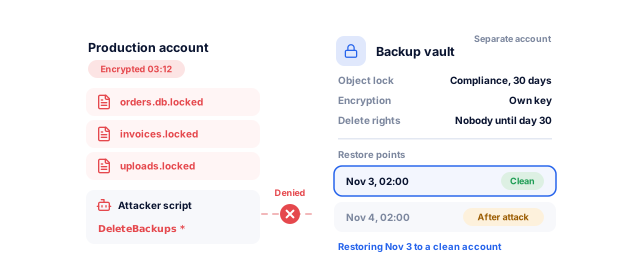
Ransomware was involved in 48% of breaches in the Verizon 2026 Data Breach Investigations Report, and the CISA #StopRansomware Guide warns that many variants delete or encrypt reachable backups. Immutable copies give you a clean restore point.
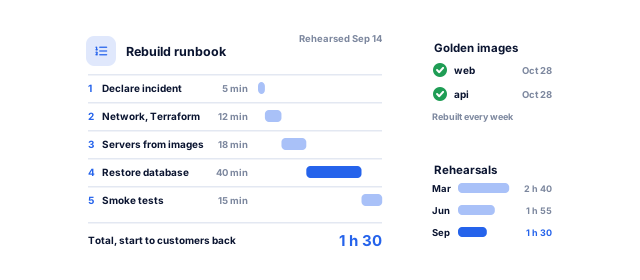
Attacks encrypted data in 56% of cases in Sophos's State of Ransomware 2026, a survey of 2,158 organizations in 17 countries, and the average recovery cost was $1.7 million. A rehearsed runbook shortens that.
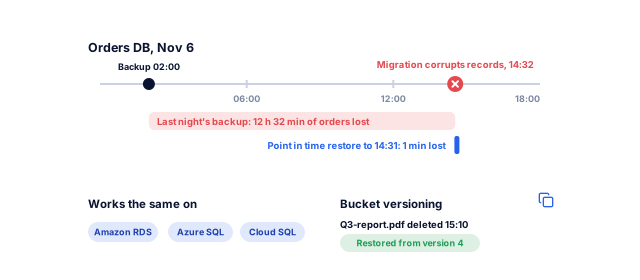
Point-in-time recovery for cloud databases and object versioning rewind a dropped table or bad migration to the minute before, not to last night.
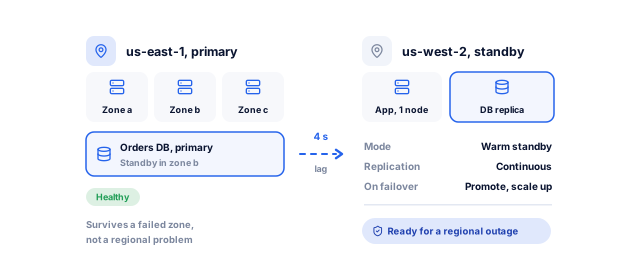
Availability zones cover a failed data center, not a regional or account-level incident. A standby in a second region does.
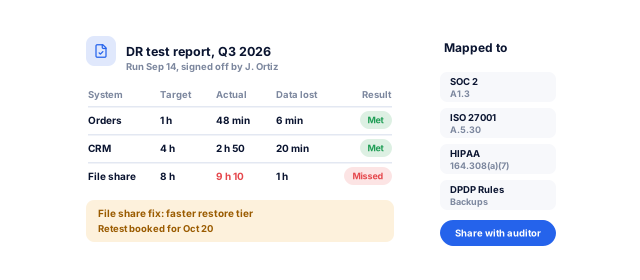
SOC 2, ISO 27001, HIPAA and India's DPDP Rules, 2025 expect a working recovery plan. Dated test reports answer with evidence, mapped by our security and compliance team.
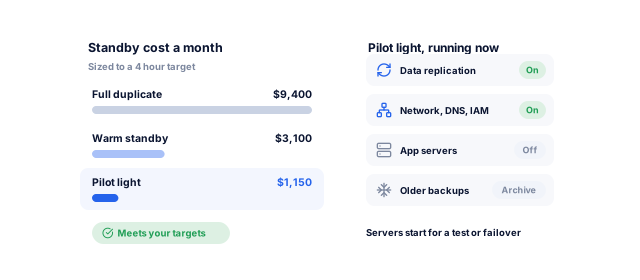
A pilot light runs only replication and core services until you fail over, so standby cost matches your targets.
Tell us how your backups run today. We will review coverage, immutability and restore readiness for free, and show where your real recovery times differ from the ones you assume.
Systems and forgotten dependencies such as DNS and identity mapped, with downtime cost per system.
You know what matters mostAn RPO and RTO per system, then the cheapest pattern that meets them, priced per tier.
Targets signed offGaps closed, an immutable copy in a separate account, delete rights limited and logged.
Backups attackers cannot eraseStandby built in Terraform, with replication, DNS failover and scenario runbooks.
A plan anyone on call can followTabletop walkthrough, single-system restores, then a full failover timed against target.
Recovery provenDaily backup monitoring, scheduled restore tests and a review after every major change.
A plan that stays currentWhat you protect, and how fast it must return, depends on how the business runs.
Order databases with point-in-time recovery, a warm standby for checkout where it pays, DNS failover, and versioned product feeds.
The HIPAA Security Rule requires a data backup plan, a disaster recovery plan and an emergency mode operation plan. We build them around systems such as clinic management software, and sign a BAA for US patient data.
Per-tenant restore paths, Kubernetes volumes backed up with Velero and database replicas in a second region, with our Kubernetes team handling cluster recovery.
AWS Elastic Disaster Recovery or Azure Site Recovery replicate office servers to the cloud, so a failed server means starting a machine, not buying one, and often begins a cloud migration.
The provider keeps the service running; protecting mail and files from deletion is your job. A separate backup keeps independent restore points.
The right pattern is the cheapest one that meets each system's RPO and RTO.
Book a strategy call| Strategy | How it works | Typical RPO and RTO | Standby cost | Best for |
|---|---|---|---|---|
| Backup and restore | Backups copied to another region or account; infrastructure rebuilt from code | Hours | Lowest: storage only | Internal tools and systems that can wait |
| Pilot light | Data replicated; core services ready, app servers off until failover | Tens of minutes | Low | Important systems with some downtime tolerance |
| Warm standby | A scaled-down working copy that scales up on failover | Minutes | Medium | Customer-facing and revenue systems |
| Hot standby | A full-size copy in a second region, idle until failover | Near zero to minutes | High: close to running production twice | Critical systems that cannot wait to scale |
| Multi-site active/active | Every region serves live traffic | Near zero for outages | Highest, plus data consistency work | Global platforms with strict uptime needs |
| Replication only | Changes copied within seconds, with no point-in-time copies | Near zero for outages; none for deletion or corruption | Medium | Never alone: pair it with backups |
Based on AWS: Disaster recovery options in the cloud, which also warns that continuous replication may not protect against corruption or malicious deletion. Real figures depend on data volume, automation and testing.
Targets, then backups, then a recovery you have watched work.
Book a strategy callBy week 3, the business has signed off targets and costs.
By week 7, your backups are out of an attacker's reach.
Within 3 months, you know your real recovery time, not the assumed one.
You approve each step before we change anything, and everything we set up stays in your accounts.
Yours to keep, always. Everything is set up in your name, and if you leave we remove our access and hand over the documentation.
For businesses that cannot afford to find out during an outage.
Book a strategy callEvery engagement includes restore tests and at least one rehearsed failover, with a report of the recovery times you actually achieved. When a test fails, we fix the cause and test again.
Ransomware is a security and a recovery problem, so the same certified engineers plan isolated accounts, separate keys, locked backups and early detection.
Vaults, keys, runbooks and test reports live in your accounts and repository. We sign an NDA before access and work through roles you can remove.
These numbers come from our SEO, marketing and software work, measured in each client’s own analytics. For your cloud, the first numbers come from the free review: what you spend, what is exposed, and how long a restore really takes.
See all case studies
MastersBuddyStudy abroad consulting
160+
keywords in Google's top 10
AkosMDHealthcare, Arizona
+57%
patient footfall
Eric OriginalsJewelry ecommerce
+1,900%
organic traffic
"From designing a high-converting website to managing our SEO, Google Ads, and Google Business Profile, improveFX delivered exceptional results across every channel."
 Maureen CappalloBroker and founder, Momentus Real Estate Group
"They revolutionized our online presence with a 60% increase in web traffic through strategic e-commerce SEO and content optimization."
 Eric NoahPresident, Eric Originals & Antiques Ltd.
"Visionstar Technologies' online presence transformed significantly with a 40% boost in customer engagement, all thanks to their exceptional website structuring and SEO tactics."
"Their strategic approach to our website and SEO resulted in a 60% increase in local inquiries, revolutionizing our automobile service business."
"Their SEO strategy helped us achieve top search rankings, while their Facebook Ads campaigns drove a steady flow of qualified prospects."
 Amita NaithaniCo-founder, Amita Naithani Resort Wear
Not seeing yours? Ask us directly and a specialist will reply personally.
These services copy your data and systems to separate cloud locations and keep a tested plan to bring them back after an outage, attack or mistake. Backup covers the copies: schedules, retention, immutability and restore tests. Disaster recovery adds a standby environment, replication, runbooks and failover, so whole applications come back, not just files. improveFX designs, builds and runs both.
RPO (recovery point objective) is the maximum data loss you accept, measured in time: an RPO of 15 minutes means losing at most 15 minutes of data. RTO (recovery time objective) is the maximum time a system can be down. Set both per system from the cost of downtime: a checkout database might need minutes, a wiki a day. Tighter targets cost more.
Backup protects data. Disaster recovery restores whole working systems, including servers, networks, configuration and access, within a target time. You can have perfect backups and still be down for days if nobody knows how to rebuild the servers, DNS and identity setup around them, so disaster recovery adds infrastructure as code, a standby environment and tested runbooks an on-call engineer can follow.
Ongoing cloud management with improveFX runs from under $1,000 to $15,000+ a month, depending on your environment. A few systems on backup and restore sit at the low end; more servers, environments and clouds, tighter RPO and RTO targets, longer support hours or compliance needs move it up. Your cloud bill from AWS, Microsoft or Google, including storage and standby compute, is separate from our fee.
The 3-2-1 rule means three copies of your data, on two types of storage, with one copy off-site. In the cloud, off-site means another region and ideally another account. Many teams now use 3-2-1-1-0: one copy immutable or offline, and zero errors in restore tests, because ransomware targets backups as well as production. We set up and check all five parts.
An immutable backup cannot be changed or deleted until its retention period ends, even by an administrator, so attackers with admin access cannot destroy it. We use S3 Object Lock or Azure Backup immutable vaults, keep those copies in a separate account with separate keys, and alert on any attempt to change retention, sized to your recovery and legal needs.
Run automated restore tests for critical data at least monthly, a full failover test at least once a year, and another after any major infrastructure change. Quarterly tabletop exercises, where the team walks through a scenario, are cheap and catch gaps in contact lists and decision rights. Each test records the RPO and RTO achieved, so auditors and leadership can see whether the plan works.
An engineer responds to critical incidents 24x7, including a failover; other issues are handled in business hours. The runbook names who declares a disaster, and you get a written report afterward. Backup vaults, encryption keys, runbooks and infrastructure code stay in your accounts and repository, ready for your team or another provider. We sign an NDA before access, and a BAA for US patient data.
Tell us what worries you about your cloud, or book a strategy call with our team.


 A specialist replies personally 4.9 from 566 client reviews