
Readiness check and platform choice
We match each workload to EKS, AKS, GKE, Rancher, OpenShift, ECS, Cloud Run or Azure Container Apps, with cost and upkeep in writing. Whichever fits, we run it.
Our Kubernetes management services are for teams running containers on Amazon EKS, Azure Kubernetes Service or Google Kubernetes Engine, or deciding whether they should. We containerize applications with Docker, build and upgrade clusters, ship releases with Helm and set up autoscaling, security and monitoring, with a bill tied to real usage.
 4.9
 Written by Abhishek Kumar, Content Writer



















Kubernetes and container management is packaging applications into containers and running them reliably on a platform such as Amazon EKS, AKS or GKE. Kubernetes management services cover clusters, upgrades, deployments, autoscaling, security and cost.
From the first Dockerfile to the tenth cluster upgrade.
Get a free proposalWe match each workload to EKS, AKS, GKE, Rancher, OpenShift, ECS, Cloud Run or Azure Container Apps, with cost and upkeep in writing. Whichever fits, we run it.
Production Dockerfiles with small images, non-root users and health endpoints. Databases usually move to managed databases, which keeps upgrades simple.
Clusters are defined in Terraform. Each minor version gets about one year of patch support, so upgrades run on a calendar: staging first, deprecated APIs checked, node pools one at a time.
Each service is a Helm chart, deployed by Argo CD or your pipeline, so a rollback is a revert. Our DevOps and CI/CD team builds the pipelines.
We right-size requests from real usage, then add pod and node autoscaling, with spot nodes for interruptible jobs. Our cloud cost optimization work covers the wider bill.
Least-privilege RBAC, Pod Security Standards, network policies and image scanning, plus dashboards and alerts on service-level objectives, run with our infrastructure monitoring team.
In the CNCF 2024 survey, 80% of organizations ran Kubernetes in production. Running it well is a separate skill.
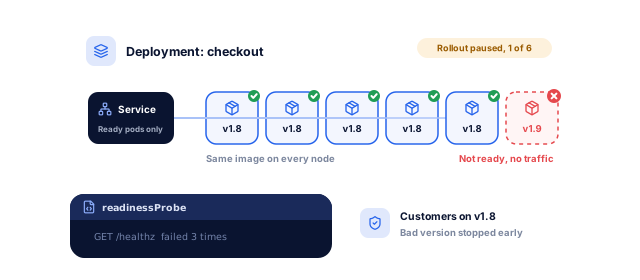
Containers ship the same image everywhere, and Kubernetes rolls it out gradually to pods that pass readiness checks, so a bad version stops early.
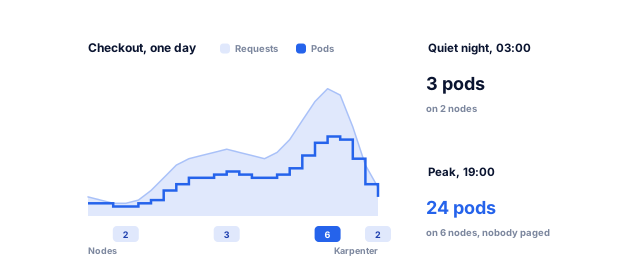
The HorizontalPodAutoscaler adds pods as load rises, and Karpenter or Cluster Autoscaler adds and removes machines, so capacity follows demand both ways.
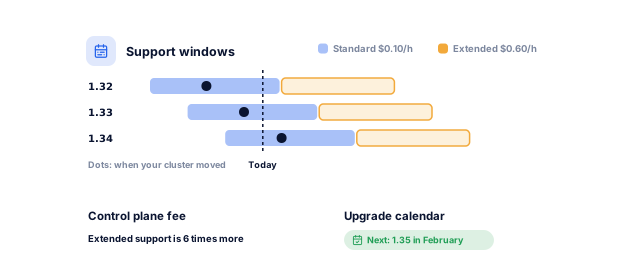
On EKS, a version gets 14 months of standard support at $0.10 per cluster per hour, then 12 months of extended support at $0.60 (AWS pricing). Our upgrade calendar avoids the higher fee.
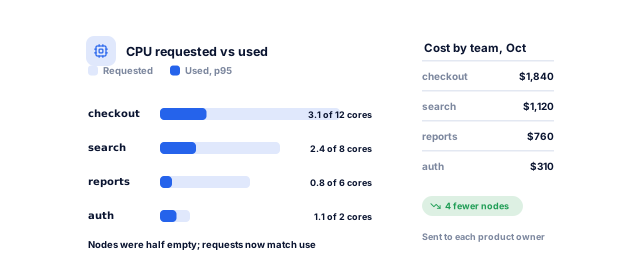
Generous CPU and memory requests reserve capacity that sits idle on half-empty nodes. We compare requests with real usage, right-size them and report cost per namespace or team.
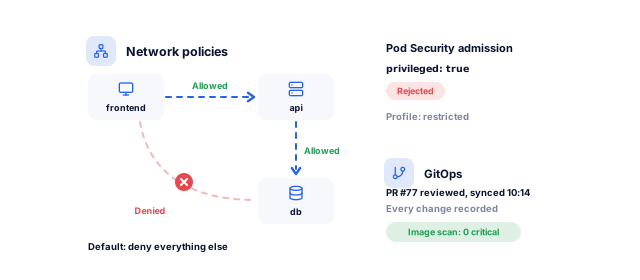
By default any pod can talk to any other. Pod Security admission and network policies close that, and GitOps, adopted by 77% of organizations per CNCF, records every change.
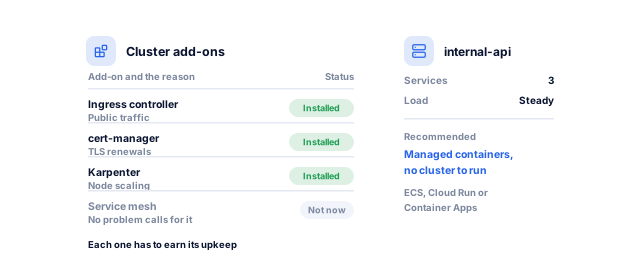
CNCF found service mesh adoption fell from 50% to 42% over operational overhead. We add components only when needed, or run a managed container service where it does the job.
Tell us what you run today. We will compare Kubernetes with simpler container services for your workloads, with the running cost and upkeep of each, before you commit to anything.
We compare Kubernetes with managed container services for each app. Whichever fits, we build and run.
A clear platform decision, in writingNode pools, networking, identity and a small set of add-ons. You approve before we build.
An approved design and budgetDockerfiles, Helm charts and clusters from Terraform, with pipelines that build, scan and deploy every image.
A working platform in stagingTraffic shifts gradually with a tested way back. No big-bang weekend cutover.
Services live without a risky cutoverLoad tests, alerts and failure drills prove the platform recovers on its own.
A platform proven under stressMonthly patching, cost reviews and calendar upgrades. We run the platform, or hand it over documented.
A cluster that stays currentThe big three differ in pricing and support windows.
Managed node groups or EKS Auto Mode, Karpenter, and EKS Pod Identity so pods get AWS permissions without stored keys. Our AWS management team runs the account.
AKS has three pricing tiers: Free, with no cluster fee; Standard, with a 99.95% API server SLA across availability zones; and Premium, with 24-month Long Term Support. See Azure management.
In Autopilot, Google manages nodes and bills general-purpose pods by requested resources. Google lists $0.10 per cluster per hour and a $74.40 monthly credit per billing account. See Google Cloud management.
Namespaces with quotas for most tenants, and separate node pools or clusters for strict isolation or data residency under GDPR, UK GDPR or India's DPDP Act. See SaaS application development.
For a few stateless services, Cloud Run, ECS on Fargate or Azure Container Apps costs less to own. We set that up and run it; where it does not do the job, we run Kubernetes.
All four run the same images; they differ in how much platform you take on. We run any of them.
Book a strategy call| Factor | Managed Kubernetes (EKS, AKS, GKE) | Amazon ECS | Google Cloud Run | Azure Container Apps |
|---|---|---|---|---|
| What you look after | Add-ons, upgrades and node pools | Task definitions and services | The container and its settings | The app and its environment |
| Scaling | HPA or KEDA for pods; Karpenter for nodes | Service auto scaling | Request-based, including scale to zero | KEDA-based rules, including scale to zero |
| Portability | Same manifests on any cloud or on premises | AWS only; images stay portable | Google Cloud only; images stay portable | Azure only; images stay portable |
| Best for | Many services, custom networking, several clouds | AWS teams wanting less upkeep | Stateless services with uneven traffic | Microservices and event-driven jobs |
| Main trade-off | Most control, most upkeep | Tied to AWS and its tooling | Designed for stateless services | No direct access to the Kubernetes API |
Based on provider documentation, including Azure Container Apps and Kubernetes autoscaling, checked October 2026.
Assessment takes 1 to 2 weeks; production follows in about 4 to 10 more.
Book a strategy callBy week 2, you have a platform decision and an approved design.
Within a few weeks, your first services run on the platform in staging.
Between week 6 and week 12, your first services run in production.
You approve each step before we change anything, and everything we set up stays in your accounts.
Yours to keep, always. Everything is set up in your name, and if you leave we remove our access and hand over the documentation.
Teams that want containers run well without hiring a platform team.
Book a strategy callECS, Cloud Run, Container Apps, EKS, AKS, GKE, Rancher or OpenShift: we build and run whichever fits your workloads.
Engineers answer critical incidents 24x7 and other issues in business hours. We also build custom software, so we fix leaks and missing health checks in code.
Accounts stay in your name, and we work through roles you can remove. Terraform, Helm charts and runbooks sit in your repository, ready for another team.
These numbers come from our SEO, marketing and software work, measured in each client’s own analytics. Your cloud numbers start with the free review.
See all case studies
MastersBuddyStudy abroad consulting
160+
keywords in Google's top 10
AkosMDHealthcare, Arizona
+57%
patient footfall
Eric OriginalsJewelry ecommerce
+1,900%
organic traffic
"From designing a high-converting website to managing our SEO, Google Ads, and Google Business Profile, improveFX delivered exceptional results across every channel."
 Maureen CappalloBroker and founder, Momentus Real Estate Group
"They revolutionized our online presence with a 60% increase in web traffic through strategic e-commerce SEO and content optimization."
 Eric NoahPresident, Eric Originals & Antiques Ltd.
"Visionstar Technologies' online presence transformed significantly with a 40% boost in customer engagement, all thanks to their exceptional website structuring and SEO tactics."
"Their strategic approach to our website and SEO resulted in a 60% increase in local inquiries, revolutionizing our automobile service business."
"Their SEO strategy helped us achieve top search rankings, while their Facebook Ads campaigns drove a steady flow of qualified prospects."
 Amita NaithaniCo-founder, Amita Naithani Resort Wear
Not seeing yours? Ask us directly and a specialist will reply personally.
Kubernetes management services include cluster design and setup, containerizing applications, Helm or GitOps deployments, autoscaling, security, monitoring, upgrades and cost control.
With improveFX, they also include a platform choice between Kubernetes and managed container services, infrastructure as code for every cluster, runbooks, failure drills and a monthly report. You choose whether we run the platform each month or hand it over.
Builds are quoted as a project after a free review. Ongoing cloud management with improveFX runs from under $1,000 to $15,000+ a month, depending on your environment.
Clusters, environments, clouds, support hours and compliance needs set where you sit. Your cloud bill is separate from our fee: EKS and GKE list $0.10 per cluster per hour, and nodes usually cost far more.
Not always. For a few stateless services, Amazon ECS, Google Cloud Run or Azure Container Apps often cost less to own, and we set those up and run them.
Kubernetes earns its place with many services, fine control over networking and scheduling, or one platform across clouds; then we build and run that. The free review compares both for your workloads.
Usually the cloud where your data and identity already live. GKE Autopilot is among the most hands-off; EKS fits AWS teams; AKS suits Microsoft shops using Entra ID.
For clusters across clouds or on premises, Rancher manages them from one place, and Red Hat OpenShift suits teams standardized on Red Hat, including its managed versions on AWS and Azure. We compare costs on your workload first.
A production cluster with the first services migrated usually takes about 4 to 10 weeks, after a 1 to 2 week assessment.
The range depends on how many services move, whether they are already containerized, and how much infrastructure is already code. Services that write to local disk or depend on fixed IP addresses need changes before they can move.
Plan on at least one minor version upgrade a year: Kubernetes maintains the three latest minor releases, each with about a year of patches.
Providers add their own windows: EKS gives 14 months of standard support, then charges more for extended support, and AKS offers 24-month Long Term Support on Premium. We keep an upgrade calendar, test in staging and check deprecated APIs first.
Least-privilege RBAC, the baseline or restricted Pod Security Standards, network policies, private API endpoints where possible and image scanning in the pipeline. Secrets come from your cloud's secret store, and pods use workload identity, not stored keys.
Our cloud security and compliance team maps these controls to SOC 2, ISO 27001, HIPAA or PCI DSS when you need audit evidence.
Yes. After an NDA, we start with a read-only review of versions, add-ons, security settings and costs, then fix the riskiest issues first: versions near end of support, root containers, missing network policies, oversized requests.
Hand-built clusters come under Terraform step by step. From day one of management, an engineer responds to critical incidents 24x7, and other issues are handled in business hours.
Tell us what worries you about your cloud, or book a strategy call with our team.


 A specialist replies personally 4.9 from 566 client reviews