
Health check and baseline
Slow query logs and the platform's insights tools read, and a recent backup restored to a copy and timed.
Our cloud database management services keep Amazon RDS and Aurora, Azure SQL, Google Cloud SQL and MongoDB Atlas fast, recoverable and affordable without a full-time DBA. Certified engineers tune slow queries, test backups and point-in-time recovery, design for failover, plan migrations and keep the bill in proportion.
 4.8
 Written by Abhishek Kumar, Content Writer


















Cloud database management is the ongoing work of keeping cloud databases fast, available and recoverable: tuning, backups and point-in-time recovery, high availability, security, migrations and cost control, on managed services such as Amazon RDS, Azure SQL and Cloud SQL or on your own virtual machines.
Health check and backups come first: tuning a database you cannot restore is the wrong order.
Get a free proposalSlow query logs and the platform's insights tools read, and a recent backup restored to a copy and timed.
Query plans read, indexes fixed and chatty ORM patterns rewritten, alongside cloud performance optimization.
Retention set from business needs, cross-region copies where risk calls for it, and scheduled restore tests, linked to our disaster recovery work.
Multi-AZ, Aurora replicas, Cloud SQL regional instances or Azure SQL failover groups, with application retries and failover drills in staging.
Moves from servers or other clouds, version upgrades and engine changes with each cloud's migration service, alongside our cloud migration team.
Encryption, private networking and least-privilege roles first; then rightsizing, snapshot cleanup and off-hours schedules.
Managed services remove routine work, not these problems.
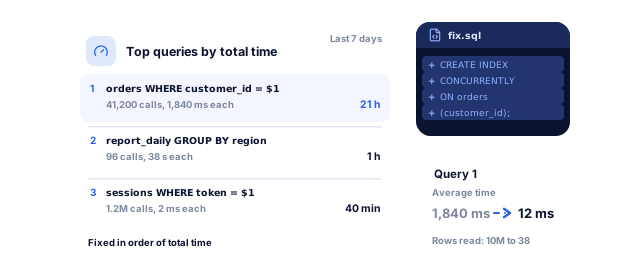
A query that takes 20 milliseconds on 10,000 rows can take seconds on 10 million if it scans the whole table. We fix the slowest queries first and show the before and after.
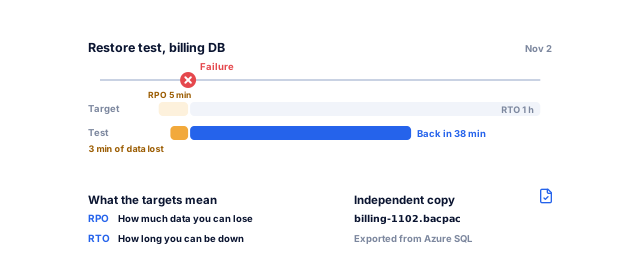
We agree an RPO and RTO, then test against both. On Azure SQL, automatic backups cannot be downloaded, so we export a BACPAC when you need an independent copy.
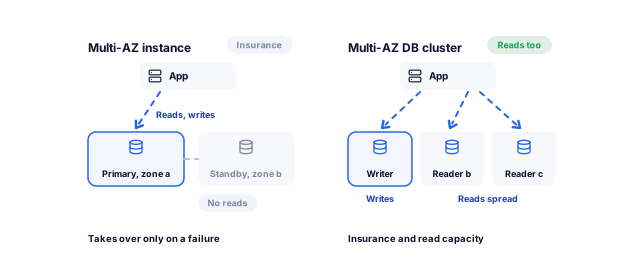
In an RDS Multi-AZ instance deployment the standby cannot serve read traffic: it is insurance, not capacity. When you need reads too, a Multi-AZ DB cluster or read replicas fit better.
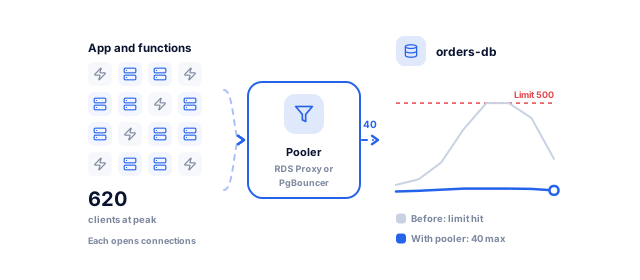
Autoscaled apps can open more connections than a database handles. RDS Proxy or PgBouncer shares a small pool across many clients.
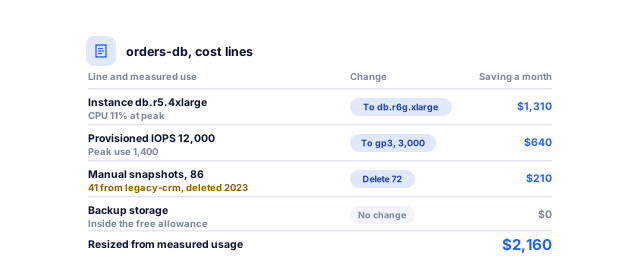
Oversized instances, unused IOPS and manual snapshots RDS keeps after a database is deleted. We resize from measured usage, with your cloud cost optimization plan in view.
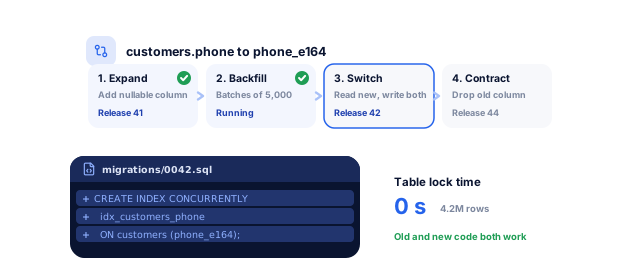
We run migrations through the pipeline, build PostgreSQL indexes concurrently and split risky changes into expand and contract steps, wired in by our DevOps and CI/CD team.
Give us read-only access and we will run a health check covering slow queries, backup settings, failover readiness and cost, including a restore test on a copy. You keep the report either way.
Configuration, slow queries, backups, access and encryption reviewed, and a restore timed on a copy.
Speed, safety and cost measuredRisks that could lose data or cause an outage fixed first, with alerts on storage, connections and lag.
Data protected, problems visibleHeaviest queries, indexes, pooling, replicas and parameters, each change tested on a copy first.
Faster queries you can measureRPO and RTO agreed in writing, high availability and recovery set to match, and a failover drill in staging.
Recovery rehearsedCompatibility checked, cutover rehearsed on a copy, and the old database kept until you sign off.
A move without surprisesMonthly review of performance, growth, cost and alerts, maintenance in agreed windows and scheduled restore tests.
Databases that stay healthyEach service handles backups and failover differently. This is what we check first.
Retention set within the 0 to 35 day range, the right Multi-AZ option, RDS Proxy where connections spike, and Aurora I/O-Optimized checked once I/O reaches 25% of spend, with our AWS management team.
Point-in-time restore for 1 to 35 days (7 by default), long-term retention for compliance, Query Store and failover groups, with our Azure management team.
Google says to expect about 60 seconds of unavailability during a failover, so we make sure your application retries cleanly, with our Google Cloud management team.
Continuous Cloud Backup restores within a window that cannot exceed your hourly snapshot retention. We review indexes and slow operations, and support MERN stack teams.
PostgreSQL was used by 55.6% of respondents and MySQL by 40.5% in the Stack Overflow 2025 Developer Survey. We tune autovacuum and bloat on PostgreSQL, and buffer pools and replication on MySQL, on any host.
All four take routine work off your team. They differ in engines, recovery windows and failover behavior.
Book a strategy call| Factor | Amazon RDS and Aurora | Azure SQL Database | Google Cloud SQL | MongoDB Atlas |
|---|---|---|---|---|
| Engines | MySQL, PostgreSQL, MariaDB, SQL Server, Oracle; Aurora for MySQL and PostgreSQL | SQL Server engine | MySQL, PostgreSQL, SQL Server | MongoDB |
| Point-in-time recovery | Within automated backup retention of 0 to 35 days (0 turns backups off) | 1 to 35 days, 7 by default; long-term retention up to 10 years | From retained logs; retention set per instance | Window set by policy; cannot exceed hourly snapshot retention |
| High availability | Multi-AZ instance (one standby) or Multi-AZ DB cluster (two readable standbys); Aurora storage across three zones | Failover groups for regional recovery; built-in replicas in Business Critical | Regional instance with a standby in a second zone | Replica set elects a new primary automatically |
| Built-in tuning tools | CloudWatch Database Insights | Query Store | Query Insights | Performance Advisor |
| Watch out for | A Multi-AZ instance standby cannot serve reads | Automatic backups cannot be downloaded; export a BACPAC for your own copy | About 60 seconds of unavailability during failover | Cloud Backups apply to M10 and larger clusters |
Based on documentation from AWS, Microsoft, Google Cloud and MongoDB, checked October 2026.
Protect the data first, then make it fast.
Book a strategy callBy week 2, you know your real recovery time and slowest queries.
By week 6, backups are tested and the slowest pages are faster.
From then on, recovery is rehearsed and migrations run as 4 to 12 week projects.
You approve each step before we change anything, and everything we set up stays in your accounts.
Yours to keep, always. Everything is set up in your name, and if you leave we remove our access and hand over the documentation.
For teams whose product depends on its database.
Book a strategy callMany slow databases are slow applications: chatty ORMs, full-table reports, a missing cache. Our team also builds custom software, so we fix the query in your code too.
Databases, backups and credentials stay in your accounts, under an NDA signed before access, and we work through roles you can remove.
A monthly report on speed, storage, cost and restore tests. Critical incidents reach an engineer 24x7; other issues are handled in business hours.
These numbers come from our SEO, marketing and software work, measured in each client’s own analytics. For your cloud, the first numbers come from the free review: what you spend, what is exposed, and how long a restore really takes.
See all case studies
MastersBuddyStudy abroad consulting
160+
keywords in Google's top 10
AkosMDHealthcare, Arizona
+57%
patient footfall
Eric OriginalsJewelry ecommerce
+1,900%
organic traffic
"From designing a high-converting website to managing our SEO, Google Ads, and Google Business Profile, improveFX delivered exceptional results across every channel."
 Maureen CappalloBroker and founder, Momentus Real Estate Group
"They revolutionized our online presence with a 60% increase in web traffic through strategic e-commerce SEO and content optimization."
 Eric NoahPresident, Eric Originals & Antiques Ltd.
"Visionstar Technologies' online presence transformed significantly with a 40% boost in customer engagement, all thanks to their exceptional website structuring and SEO tactics."
"Their strategic approach to our website and SEO resulted in a 60% increase in local inquiries, revolutionizing our automobile service business."
"Their SEO strategy helped us achieve top search rankings, while their Facebook Ads campaigns drove a steady flow of qualified prospects."
 Amita NaithaniCo-founder, Amita Naithani Resort Wear
Not seeing yours? Ask us directly and a specialist will reply personally.
Cloud database management services include health checks, performance tuning, backup and restore testing, high availability design, security, migrations, monitoring and cost control. With improveFX that covers Amazon RDS and Aurora, Azure SQL, Google Cloud SQL and MongoDB Atlas, plus PostgreSQL, MySQL and SQL Server on virtual machines, with a monthly report, scheduled restore tests and migration projects when you need them.
With a managed database, or database as a service (DBaaS), such as Amazon RDS, Azure SQL or Cloud SQL, the provider runs the hardware, patching, automated backups and failover. With a self-managed database on virtual machines, your team runs every layer. Managed services cut routine work, but query speed, schema design, restore testing and cost stay with you, which is the work we take on.
Ongoing cloud management with improveFX runs from under $1,000 to $15,000+ a month, depending on your environment. One or two databases on one engine sit at the low end; more databases, engines, environments and clouds, tighter uptime targets, longer support hours or compliance needs move it up. Migrations are quoted as projects. Your cloud bill from AWS, Microsoft or Google is separate from our fee.
You need DBA skills, but rarely a full-time DBA. The provider handles hardware, patching and backups; nobody at the provider will fix your slow queries or test your restores. Remote DBA services fill that gap: someone who tunes queries and indexes, reviews schema changes, tests recovery and plans capacity. As you grow, we can help you hire and hand over to an in-house DBA.
Point-in-time recovery restores a database to a specific moment, for example one minute before a bad deployment deleted rows, using backups plus the transaction logs recorded since. The window depends on retention: Amazon RDS allows 0 to 35 days and Azure SQL 1 to 35 days. A restore usually creates a new database, so the application must be pointed at it, and we rehearse that switch.
Run a standby in a second availability zone that takes over automatically, such as RDS Multi-AZ or Cloud SQL's regional high availability, and make the application reconnect cleanly. For regional outages, add a cross-region replica or Azure SQL failover groups with a tested runbook. Expect brief downtime during failover, and keep backups too, because a mistake replicates to the standby instantly.
Typically 4 to 12 weeks from assessment to cutover, depending on database size, engine changes and how much downtime you can accept. A same-engine move into a managed service is at the short end; changing engines, for example SQL Server to PostgreSQL, takes longer because queries, procedures and data types need converting. We rehearse every cutover on a copy and keep the source until you sign off.
Yes. We sign an NDA before any access is shared, and a DPA when you need one. Your databases, backups and accounts stay in your name, and we work through least-privilege roles you can remove at any time. We test with masked or synthetic data, and keep runbooks and scripts in your repository, so another team can take over. Critical incidents reach an engineer 24x7.
Tell us what worries you about your cloud, or book a strategy call with our team.


 A specialist replies personally 4.9 from 566 client reviews