Express.js development services for lean, secure Node.js APIs
Our Express.js development services are for teams that need a fast, well-structured API or web back end on Node.js, or an existing Express app brought up to date. We build on Express 5 with TypeScript, add validation, security middleware, tests and monitoring, and migrate Express 4 apps without breaking the clients that depend on them.
Express.js development is building web servers and APIs with Express, the minimal, unopinionated web framework for Node.js. Express.js development services cover API design, routing and middleware, authentication, validation, database integration, testing, deployment and upgrades such as Express 4 to 5 migrations.
Express 5 is the current major version and has been the default on npm since March 2025.
Express 5 needs Node.js 18 or later and passes async errors to your error handlers.
Express 4 has been in maintenance since April 2025, so plan the move to Express 5.
Express is minimal by design: structure, validation and security are choices your team makes.
Best for
REST APIs, back ends for web and mobile apps, integration services and small to mid-size platforms
What you get
API design, an Express 5 build, validation and security middleware, tests, CI/CD, monitoring and documentation
Typical timeline
A focused API in about 4 to 8 weeks. An Express 4 to 5 migration in about 1 to 4 weeks for most apps.
Pricing
Driven by endpoints, integrations, security needs and test coverage. Published agency pricing we reviewed for Node.js back-end projects runs from about $10,000 to $50,000 and up. Our development projects run from under $1,000 to $30,000+, depending on scope. We quote after a free scoping call.
What our Express.js development services include
Most new projects start with the API; most existing ones start with a review and the Express 5 upgrade.
We design REST APIs contract-first in OpenAPI, agreeing errors, pagination, versioning and authentication before coding, so front-end and mobile teams can build against mock servers. Our API development team adds gateway and integration planning for multi-system work.
Custom Express.js development
Not every back end is a public API. We build custom Express.js back ends for React and mobile apps, admin panels, server-rendered pages, webhook receivers and file processing, with routes, services and data access in separate layers.
Middleware, authentication and validation
Express leaves security to the middleware you choose: Helmet headers, strict CORS, rate limits on login and public endpoints, and Zod validation on every request body. Authentication uses sessions, JWT or OpenID Connect, with roles checked on the server for every route.
Express 4 to Express 5 migration
We run the official codemods, then fix what they cannot: named wildcard routes, removed methods, new body parsing defaults and async error handling. Tests around critical routes come first, so changes from the Express 5 migration guide are verified, not assumed.
Integrations and real-time features
Express services often sit between payment, CRM, ERP, shipping and email platforms. We handle webhooks with signature checks, retries and idempotency, and queue slow jobs. For chat or live dashboards, Socket.IO runs on the same server, with Redis across instances.
Express.js maintenance and support
We apply Express and middleware security releases, update dependencies and keep Node.js on a supported release through our website maintenance plans, with infrastructure run by our cloud DevOps team.
Why teams build on Express, and what to watch for
Express is the most used Node.js back-end framework in the 2026 Stack Overflow survey, and its strengths and weaknesses both come from being small.
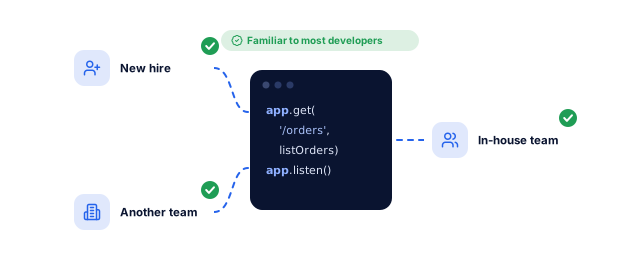
In the 2026 Stack Overflow Developer Survey, 15.6% of the 10,281 developers who answered had done extensive work with Express in the past year, against 5.8% for NestJS and 3.5% for Fastify. That familiarity helps when you hire or hand over.
A small core that starts quickly
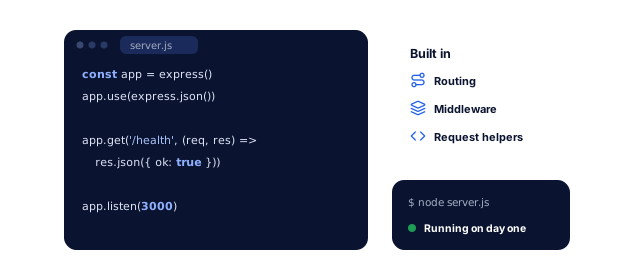
Express gives you routing, middleware and request and response helpers, and little else. A working API can run on day one, which suits APIs and integration services where the business logic is the hard part.
Cleaner error handling in Express 5
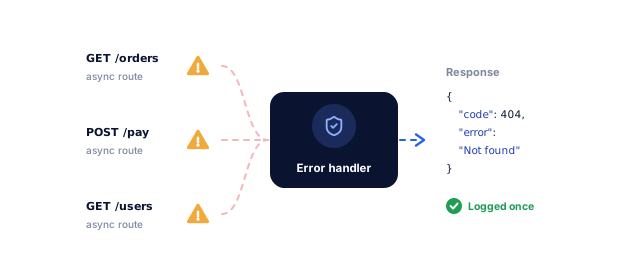
In Express 4, an error thrown inside an async route could escape the error handler unless every route caught it. Express 5 forwards rejected promises to error-handling middleware automatically, so errors are logged and returned consistently from one place.
Structure is your responsibility
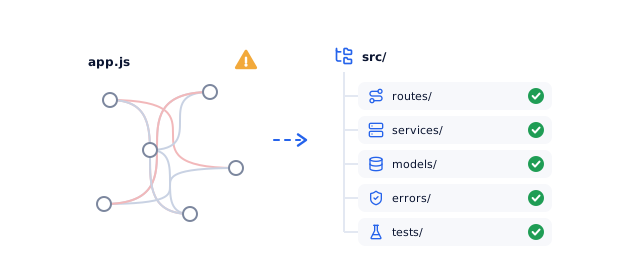
Because Express imposes no structure, a fast-growing app can become a tangle of routes. We set conventions from day one: layered modules, typed requests and responses, a shared error format and tests on every pull request.
Security depends on the packages you add
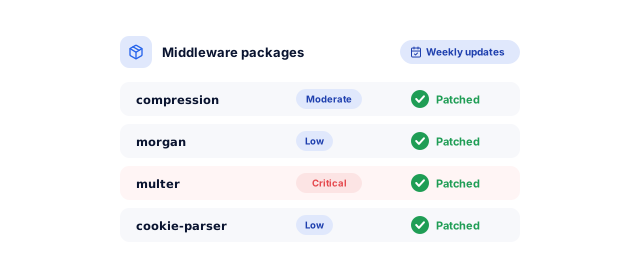
Most Express apps rely on middleware for compression, logging, uploads and cookies, and those packages need patching too. On September 30, 2026, the Express team released fixes for seven of them, including compression, morgan and multer, one rated critical.
When we use NestJS, Fastify or Next.js instead
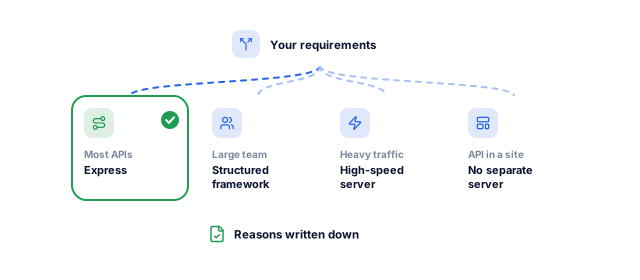
Large teams that want enforced structure get it from NestJS, which can run on Express. High-throughput services suit Fastify, and a small API inside a Next.js site needs no separate server. Our Node.js team builds with all three, so you get the right tool from the same team.
Still running Express 4, or an older Node.js release?
Tell us what you need. We look at your codebase, dependencies and roadmap, and send a written plan with a price range, a timeline and what we would change first.
Your free project planFor what you need
1What we would buildYour product, codebase and roadmap
2A price range and timelineFor the budget you pick, with the options that fit
3The stack we would useAnd how your team runs it after launch
A specialist walks you through it on a call
Our Express.js development process
Migrations follow the same steps, with more testing before anything changes.
We map who calls the API, what it connects to and what data it holds. For an existing app we review routes, middleware, dependencies, Express and Node.js versions and test coverage, which shape the estimate.
Integration and client map
Code and dependency review
Estimate and plan
A clear scope with known risks
API contract and architecture
Endpoints, data models, errors and authentication are written up in OpenAPI and reviewed with the teams that will use them. We agree module structure, database and hosting, and record each decision with its reason.
OpenAPI specification
Architecture decision records
Mock server
Every team builds to one contract
Build in two-week sprints
We write TypeScript in a layered structure, with pull request reviews and Supertest route tests in Vitest or Jest. Each sprint ends with a demo on staging.
Working endpoints on staging
Route test suite
Sprint notes
Progress you can test every sprint
Security testing and deployment
We check every endpoint against the OWASP API Security Top 10, scan dependencies and load test the busiest routes, then ship in containers through CI/CD with health checks, logs, metrics and alerts from the first request.
Security checklist and load test report
Production deployment
Dashboards, alerts and runbook
Known limits, and issues caught by alerts
Maintenance, upgrades and growth
After launch you can keep dedicated developers for new features or move to a maintenance plan for security releases and upgrades. Documentation and a recorded walkthrough let your team take over at any point.
Monthly report
Upgrade calendar
Handover documentation
An API that stays supported
Express.js back ends for the product you are building
The Express back ends we build most often.
01 / 05
Back ends for React and mobile apps
The most common Express project is the API behind a React web app and an iOS or Android app, often with MongoDB or PostgreSQL. Versioned endpoints keep older app releases working. See MERN stack development and React development.
Small Express services suit receiving Stripe, Shopify or CRM webhooks and passing the data to an ERP, warehouse or email platform. We verify signatures, store every event, retry failures and alert on anything stuck. For a whole process, our workflow automation team designs it end to end.
Operations teams often outgrow spreadsheets long before they need an ERP. An Express API with role-based access, audit logs and exports can power admin panels, approvals and reporting at a fraction of a large platform's cost, with screens from our custom dashboard development team.
We use Express for focused microservices such as billing, notifications or file processing, or as an early-stage product's core API, with tenant isolation, usage metering and versioned public APIs from the start. See SaaS application development and web app development.
APIs handling patient, financial or personal data need encryption, strict access control, audit trails and logs that never store sensitive fields, documented for your compliance reviews. We also build healthcare software, including our own Nabhaya Clinic product; see our work for healthcare businesses.
Our Express.js development services are delivered by 25+ in-house specialists in New Delhi who also build the React and Next.js front ends, mobile apps and cloud setups those APIs serve. Nothing is passed to freelancers, so when a bug crosses from front end to back end, one team traces it.
02
Your code, servers and credentials
Repositories sit in your GitHub or GitLab organization, hosting in your cloud accounts and secrets in your vault, with our access removed when work ends. We work on rolling agreements with transparent monthly reporting on what shipped and what is next.
03
A record you can check
We have delivered 170+ projects for 120+ clients in the US, UK, Canada, Australia, Europe and India. Clients rate us 4.9 on Clutch from 221 reviews and 4.8 on Google from 189, and stay with us 1.6 years on average. Read our case studies, or book a call about your API.
Results we can put numbers on
Results from our website and software projects, with the full story behind each number.
"From designing a high-converting website to managing our SEO, Google Ads, and Google Business Profile, improveFX delivered exceptional results across every channel."
210%more qualified leads
185%organic and local traffic growth
92%keywords on page one
Maureen CappalloBroker and founder, Momentus Real Estate Group
"They revolutionized our online presence with a 60% increase in web traffic through strategic e-commerce SEO and content optimization."
60%more organic traffic
47%more sales
Eric NoahPresident, Eric Originals & Antiques Ltd.
"Visionstar Technologies' online presence transformed significantly with a 40% boost in customer engagement, all thanks to their exceptional website structuring and SEO tactics."
+40%qualified leads
32%lower cost per acquisition
Thomas MorelFounder, Visionstar Technologies
"Their strategic approach to our website and SEO resulted in a 60% increase in local inquiries, revolutionizing our automobile service business."
60%more local inquiries
87%more organic traffic
Mike SteffanFounder, Sabulski Window Tinting
"Their SEO strategy helped us achieve top search rankings, while their Facebook Ads campaigns drove a steady flow of qualified prospects."
Our development projects run from under $1,000 to $30,000+, depending on scope, and an Express 5 migration or a single focused API sits at the lower end. Published agency pricing we reviewed for Node.js back-end projects runs from about $10,000 to $50,000 and up.
Cost depends on endpoints, integrations, security and compliance needs, and how much testing already exists. Dedicated developers are billed monthly per engineer. We send a written estimate after a free scoping call.
How long does it take to build an Express.js API?
A focused API usually takes about 4 to 8 weeks to a first production release. Larger back ends with many integrations take longer and ship in phases.
An agreed API contract, existing designs and sandbox access to third-party systems all shorten the schedule. Unclear data rules and slow access to partner systems lengthen it. You see working endpoints on staging every two weeks.
Should we upgrade from Express 4 to Express 5?
Yes, for any app you plan to keep. Express 4 has been in maintenance since April 2025, and Express 5 has been the default on npm since March 2025.
Official codemods handle the mechanical changes; the real work is route paths, body parsing defaults and error handling. A Node.js upgrade often happens alongside. We add tests around critical routes first, so nothing changes silently.
Express, NestJS or Fastify: which should we use?
Express suits most APIs and teams. NestJS suits large teams that want enforced structure, and Fastify suits services where raw throughput matters most.
NestJS can run on top of Express, so the choice is often about structure rather than speed, and a small API inside a Next.js site may need only Route Handlers. Our Node.js development team works with all three and will explain its recommendation in writing.
Can I hire dedicated Express.js developers from improveFX?
Yes. You can hire dedicated Express.js developers, one or a small team, who work only on your product from your backlog, billed monthly.
You can also extend your existing team with our engineers, an approach often called staff augmentation, or buy a fixed-scope project such as an Express 5 migration at an agreed price. All our developers are in-house employees in New Delhi, on rolling agreements.
Do you write Express apps in TypeScript?
Yes, by default. TypeScript catches many errors before runtime and makes request and response shapes explicit, which helps every developer who joins later.
We share types with the React or mobile front end where possible, and generate API documentation from the same definitions, so the docs, the code and the clients agree. Existing JavaScript apps can move to TypeScript one module at a time.
Can you take over an existing Express app built by someone else?
Yes. We start with a review of the code, dependencies, Express and Node.js versions, tests and hosting, then agree a plan with you before changing anything.
Typical first steps are adding tests around the most important routes, upgrading to supported versions, replacing abandoned packages and adding monitoring. We change things in small, reversible steps, so the app keeps serving customers throughout.
What should I look for in an ExpressJS development company?
Look for a team that can explain how it structures large Express apps, how it handles security releases, and which Express and Node.js versions it builds on today.
Ask to see a sample OpenAPI contract and a test suite, check who owns the repository and hosting, and ask how they would migrate an Express 4 app. Specific answers matter more than a list of logos.
Ready to plan your website?
Tell us what you need built, or book a strategy call with our team.
What we would build, and on which platform
A price range and timeline for your budget
A call with a specialist to plan the next steps, no obligation
A specialist replies personally 4.9 from 566 client reviews