

















Enterprise digital marketing built for governance, scale and proof

Our enterprise digital marketing services are for large organizations that run marketing across several business units, brands or countries and need it planned, governed and measured as one program. We work inside your approval routes, security rules and martech stack, connect campaign data to your CRM and finance numbers, and report results each business unit can defend.

  • 120+clients served across six markets
  • 4.8
    189 reviews
  • 1.6 yrsaverage client relationship
Campaign approvalsQ3 launch
  1. DraftMarketing
  2. Brand reviewApproved
  3. Legal reviewClaims checked
  4. Live in 4 marketsScheduled
  • Consent mode on
  • Access reviewed

120+ businesses chose us for their digital growth

  • AkosMD Hospital
  • Amita Naithani Resort Wear
  • Momentus Real Estate Group
  • CleverBoss
  • MastersBuddy
  • Foley Mansfield
  • Pomegranate Health
  • Trunk Box Baby
  • Hunt Ortmann
  • Immigration Desk
  • Urology Partners
  • Jodi Carlton
  • Ecom Fashion
  • Eye on Security
  • Disability Solutions
  • One400
  • Eric Originals
  • Sabulski Window Tinting
  • History of Soccer

Enterprise digital marketing at a glance

Enterprise digital marketing is the planning, running and measurement of online marketing for large organizations with several business units, brands or markets. It covers search, paid media, content and lifecycle channels, plus the governance, martech integration, data protection and attribution that let many teams work from one plan and report numbers finance accepts.

  • Agree who approves what, and how fast, before anything launches.
  • Use one measurement framework across business units, or every team reports its own version of success.
  • Ad platforms, GA4 and the CRM will disagree; decide which number each decision uses.
  • Start with one unit or market, prove it, then scale.
Best for
Organizations with several business units, brands or markets, an in-house marketing team and a formal procurement process
What you get
Governance model, channel execution, martech and data integration, an attribution framework, monthly and quarterly reporting
Typical timeline
Onboarding and security review 2 to 8 weeks, depending on your process. Discovery 3 to 6 weeks. A first unit or market live in about 3 months.
Pricing
Driven by the number of business units, markets and channels, and the data and integration work involved. Our programs run from under $750 to $10,000+ a month; enterprise scopes are quoted after a scoped discovery.

What our enterprise digital marketing services cover

Six workstreams. Most clients hand us two or three and keep the rest in-house, so each one is built to plug into your existing teams.

Get a free proposal

Enterprise marketing strategy across units

We build one plan that respects each business unit's goals: shared KPIs, a channel mix per unit and market, and a calendar tied to your fiscal year and budget cycle. Overlaps get resolved on paper first, such as two divisions bidding on the same keywords. Our digital marketing strategy team writes the plan with your leads, not for them.
Marketing governance and approvals

Large teams slow down at approvals, not ideas. We agree a RACI for every workstream, service levels for brand and legal review, a shared UTM and campaign naming taxonomy, and a change log for every account. Brand guidelines become templates and checklists, so regional teams can launch faster without drifting off brand or skipping a required review.

Enterprise SEO and content at scale

Sites with thousands of URLs, several CMSs and regional teams need SEO run as a program: crawl monitoring, template-level fixes, release checks on staging, and content briefs that work across markets. Our enterprise SEO service handles the technical and governance side, and headless CMS builds help when content has to reach several sites at once.

Paid media across brands and markets

Google Ads manager accounts, Microsoft Advertising, LinkedIn and Meta are structured so each unit has its own budget and reporting while sharing negative keyword lists, audiences and conversion definitions. Brand-term rules stop internal teams bidding against each other. Budgets are paced weekly against plan. Our PPC management team runs the accounts day to day.

Martech stack and data integration

We map your stack before adding anything: CRM (Salesforce, HubSpot or Dynamics 365), marketing automation such as Marketo or HubSpot, analytics, consent tools and ad platforms. Then we connect what should talk to each other, remove duplicate tools, and route GA4 data to BigQuery. Our marketing automation and CRM automation teams handle the builds.

Measurement, attribution and reporting

GA4 with consent mode, offline conversion imports from your CRM, and dashboards that show spend, pipeline and revenue by unit and market. We agree which number each decision uses before the first report, because platforms, GA4 and the CRM never match exactly. Custom dashboards or automated reports keep leaders on one version of the truth.

What changes when digital marketing for large organizations is run as one program

Enterprise marketing problems are rarely about channels. They come from coordination, measurement and risk. These are the changes we work toward first.

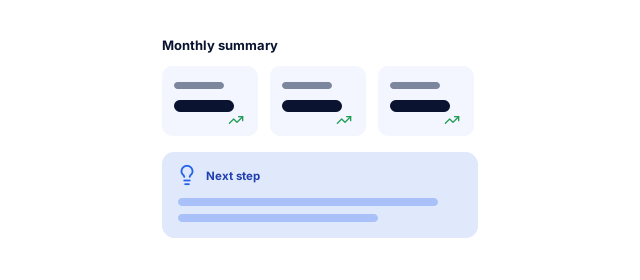
A short report for leadership with three clear numbers and a recommended next step, the evidence finance asks for

Budgets defended with evidence

Gartner's 2025 CMO Spend Survey of 402 marketing leaders, mostly at companies with revenue above $1 billion, found budgets flat at 7.7% of revenue, with 59% saying they lack the budget to execute their strategy. Flat budgets get defended with pipeline and revenue numbers finance already trusts, which is what our reporting is built around.

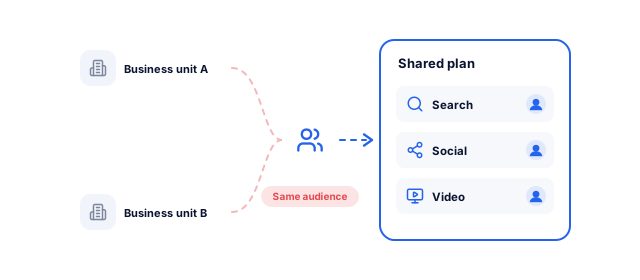
Two business units bidding on the same audience brought together in one shared plan with one owner per channel

One plan instead of competing ones

When each business unit plans alone, the company pays twice: two teams buying the same audience, two agencies targeting the same keywords, three tools doing one job. A shared plan with shared definitions removes the overlap. The savings often show up in paid media first, where internal competition raises costs most directly.

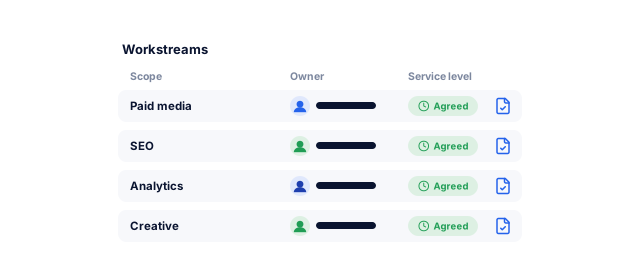
Workstreams listed with a named owner, written scope and an agreed service level for each partner

Fewer vendors, clearer accountability

The same Gartner survey found 39% of CMOs planning to cut back on agency budgets. Consolidation only helps if accountability survives it. We take on defined workstreams with written scope, named owners and service levels, and work alongside your other partners rather than pretending to replace all of them at once.

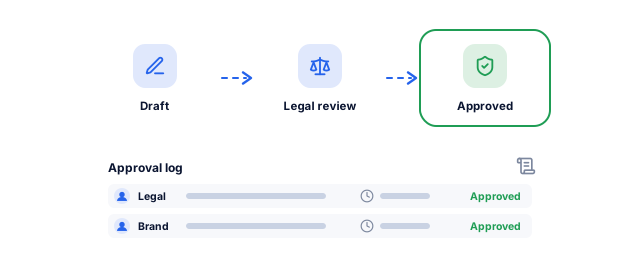
A campaign moving from draft through legal review to approval, with each sign-off logged

Launches that clear review faster

A campaign that waits three weeks for legal sign-off misses its window. Pre-approved claim libraries, templates and review service levels shorten the queue without bypassing anyone. Each approval is logged, so when an auditor or a regulator asks who signed off on an ad, the answer takes minutes rather than days.

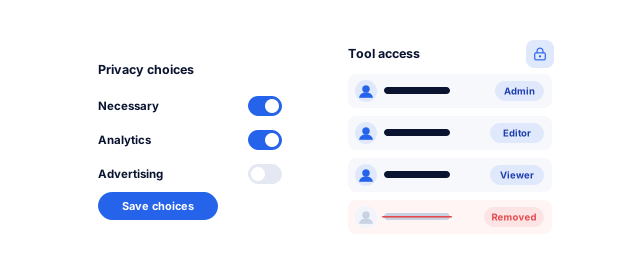
Visitor consent choices beside a named access list where a departed user has been removed

Privacy and access risk under control

Marketing tools hold customer data and connect to many systems. We configure consent with Google consent mode, respect regional law such as GDPR, UK GDPR, CCPA and India's DPDP Act, use named accounts with the least access needed, and remove access the day someone leaves. Our cloud security and compliance team helps when infrastructure is involved.

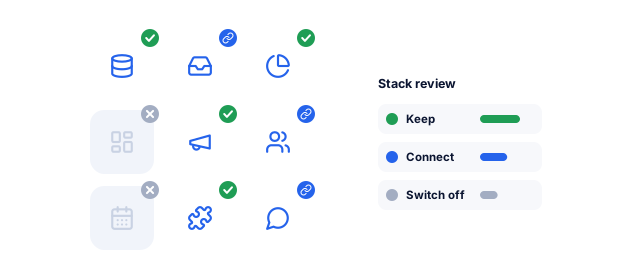
Every marketing tool listed with a decision to keep it, connect it or switch it off

A martech stack people actually use

Large stacks grow by purchase, not design. We list every tool, what it costs, who uses it and what data it holds, then recommend what to connect, consolidate or switch off. The result is fewer logins, cleaner data in the CRM and reports that do not depend on someone exporting spreadsheets every Monday.

Not ready to put another vendor through procurement?

Tell us where marketing is slowing down. We start with a scoped look at one business unit or market and send a written plan your team can act on, with or without us.

What is the main problem?

Free, with no obligation. Rather talk? Book a 30-minute call

Our enterprise engagement process, from procurement to scale

  1. Discovery and stakeholder interviews

    We interview marketing, sales, IT, legal and finance leads, review current plans, accounts and reports, and map the martech stack and data flows. The goal is to find where coordination, measurement or risk is costing the most before proposing any work.

    • Stakeholder map
    • Current-state audit of channels, stack and data
    • Risk and opportunity register
    A shared view of where to start
  2. Procurement, security and onboarding

    We complete your security questionnaire, sign your NDA and data processing agreement, and agree a statement of work with named owners and service levels. Access is granted through named accounts with the least privilege each role needs, using SSO where your tools support it.

    • Completed security questionnaire
    • Signed SOW and DPA
    • Access register
    Cleared to work, with an audit trail
  3. Strategy and governance model

    We write the plan by business unit and market, the RACI and approval service levels, the UTM and naming taxonomy, and a KPI tree linking channel metrics to pipeline and revenue. Each unit lead reviews their part before we sign off.

    • Plan by unit and market
    • RACI and approval service levels
    • KPI tree and naming taxonomy
    One plan everyone has agreed
  4. Measurement foundation

    We configure GA4 and consent mode, connect the CRM, set up offline conversion imports for Google Ads and LinkedIn, route data to BigQuery, and build the dashboards. Platform, GA4 and CRM numbers are reconciled so the gaps are explained, not argued about.

    • GA4 and consent configuration
    • CRM and offline conversion links
    • Dashboards by unit and market
    Numbers finance will accept
  5. Pilot, then scale

    We launch with one business unit, market or channel and run it for a full quarter against agreed targets. What works becomes the playbook for the next unit; what does not is fixed first. Expansion is planned around your budget cycle.

    • Pilot plan and targets
    • Quarter-end results review
    • Rollout plan for the next unit
    Proof before the bigger commitment
  6. Reporting and quarterly reviews

    Each month every unit gets a report on spend, pipeline, revenue and the work done, with a change log. Quarterly business reviews with leadership cover results against plan, budget shifts and the next quarter's priorities.

    • Monthly report per unit
    • Quarterly business review
    • Annual planning input
    Decisions leadership can defend

Enterprise marketing for your kind of organization

The governance and data work is similar everywhere. The channels, rules and buying journeys are not.

01 / 05

B2B technology and SaaS

Enterprise software deals take months and involve buying committees, so a form fill means little on its own. We pass opportunity stages from Salesforce or HubSpot back to Google Ads and LinkedIn as offline conversions, run account-based campaigns at named companies, and report on pipeline sourced and influenced by marketing. Pair it with SaaS SEO for comparison and integration pages that buyers read before a demo.

02 / 05

Multi-brand groups and business units

Groups with several brands need a shared service model: common tools, data standards and reporting, with each brand keeping its own voice and budget. We set brand-term rules between units, share audiences where your privacy terms allow it, and price work per unit so each one sees its own cost. Dealer and location networks may also need our franchise digital marketing approach.

03 / 05

Global and multi-market organizations

Regional teams, languages, currencies and privacy laws multiply every marketing decision. We agree what is global (brand, data standards, core campaigns) and what is local (offers, language, channel mix), set consent per region, and report each market on its own. Our international SEO service covers hreflang and localized content, while paid media runs on local time zones, currencies and holidays.

04 / 05

Regulated industries

Healthcare, financial services and legal brands work under advertising restrictions, platform certifications and strict review. We build claim libraries with your compliance team, keep sensitive data out of ad pixels, and log every approval. Google and Meta limit how some health and financial products can be targeted, so plans are built inside those policies. See finance SEO and our healthcare work.

05 / 05

Enterprise ecommerce and retail

Large catalogs live or die on feeds and templates. We manage Merchant Center feeds across countries, split Shopping and Performance Max by margin and stock, and fix category and product templates at scale rather than page by page. Store, marketplace and app sales are reported together where your data allows. Our ecommerce SEO team handles organic visibility for the catalog.

Marketing attribution methods compared

No single attribution method answers every question on a long buying journey. This is how we decide which one to trust for which decision.

Book a strategy call
MethodWhat it answersStrengthLimitationUse it for
Platform-reported conversionsWhat each ad platform says it droveFast, and feeds automated biddingEach platform counts its own way, so totals overlapDay-to-day optimization inside one platform
GA4 data-driven attributionHow credit splits across tracked digital touchpointsCross-channel and built into GA4Misses offline steps and users who decline consentComparing digital channels
CRM pipeline attributionWhich campaigns sourced or influenced deals and revenueTies marketing to numbers finance seesNeeds clean lead source data and offline conversion importsBudget decisions on long B2B journeys
Marketing mix modelingHow each channel contributes to sales over time, from aggregate dataCovers offline media; no user-level tracking neededNeeds a long, consistent history of spend and sales dataAnnual and quarterly budget allocation
Incrementality testsWhat would have happened without a campaign, using geo or holdout groupsClosest to cause and effectAnswers one question at a time; the holdout group misses the adsSettling disputes about a channel's real value

GA4 now offers data-driven, paid and organic last click, and Google paid channels last click models; first click, linear, time decay and position-based were retired in November 2023, per Google Analytics Help. We usually combine at least two methods.

Your first 90 days of enterprise digital marketing

Day 1 is the day a scoped discovery is signed. If your security review takes longer, the dates move but the order does not.

Book a strategy call
  1. 1Days 1 to 30

    Scoped discovery and onboarding

    • Signed NDA, data processing agreement and statement of work
    • Completed security questionnaire and access register
    • Stakeholder interviews across marketing, sales, IT, legal and finance
    • Current-state audit of channels, martech stack and data flows

    By day 30, we are cleared to work with an audit trail, and discovery is underway.

  2. 2Days 31 to 60

    Plan and governance

    • Risk and opportunity register showing where to start
    • Plan by business unit and market, starting with the pilot
    • RACI, approval service levels and naming taxonomy
    • KPI tree linking channel metrics to pipeline and revenue

    By day 60, each unit lead has reviewed their part and one plan is agreed.

  3. 3Days 61 to 90

    Measurement and pilot launch

    • GA4 and consent mode configured for each region
    • CRM connected, with offline conversion imports set up
    • Dashboards for the pilot unit or market
    • Pilot launched against agreed targets

    By day 90, a first unit or market is live and measured. It runs for a full quarter before any rollout decision.

What you see every month

Each month you get a written report and a review call. It leads with the numbers that matter to your business, says what we changed and why, and sets out what we test next.

Every report includes

  • Pipeline and cost per opportunity, by unit and market
  • Review times, and what slowed them
  • Spend across brands, without double counting
  • Decisions needed from leadership next month
Monthly reportSample figures
Pipeline from marketing$2.4MPer your CRM
Cost per opportunity$1,8507% lower
Campaigns through review14Six days on average
Markets reporting4 of 4One dashboard
Last six months
What we changed
  • Moved two business units onto one approval workflow
  • Merged duplicate audiences across brands
Next month

Pilot the shared claim library in the US market

A sample of the report. Every client's report uses their own numbers.

Yours to keep, always. Everything is set up in your name, and if you leave we remove our access and hand over the documentation.

  • Every ad, analytics and data account
  • Dashboards, integrations and code
  • Approval workflows and claim libraries
  • Content and creative
  • Documentation and access records

Who enterprise digital marketing from improveFX is for

We plan enterprise programs around your teams, your procurement and a first unit or market, so leadership sees proof before the bigger commitment.

Book a strategy call

A good fit if

  • You run marketing across several business units, brands or markets
  • You have an in-house marketing team and a formal procurement process
  • You want one measurement framework that finance will accept
  • You want to prove the approach in one unit before scaling it

We can also help when

  • You want one partner across many countries and channels: we start with a scoped pilot market, work alongside your existing agencies with shared naming and one dashboard, and extend market by market
  • You need campaigns live within weeks: we scope a narrow pilot, such as paid search in one market, with discovery sized to match, and paid media and tracking fixes show results within weeks of launch
  • Your security review is strict: we complete questionnaires in writing, sign your NDA and data processing agreement, and use named accounts with the least access each role needs
  • You want guaranteed rankings or revenue: we commit to a statement of work, agreed KPIs, a monthly report per unit and quarterly reviews instead of promises nobody can keep

Why work with improveFX as your enterprise marketing agency

01

Marketing and engineering together

Most enterprise marketing problems end in a technical fix: a tag, an integration, a template, a data pipeline. Our 25+ in-house specialists put marketing and engineering under one roof, so the people who find the problem can also fix it, inside your change process. The daily GA4 BigQuery export for standard properties caps at 1 million events, and we plan for limits like that up front.

02

Built to work inside your governance

We work on rolling agreements with transparent monthly reporting and a change log for every account. As a Google Premier Partner, Meta Business Partner and Microsoft Advertising Partner we keep current with platform changes. We are comfortable as one partner among several and will tell you plainly when a workstream is better kept in-house or with a specialist.

03

Your accounts, data and code

Every ad account, analytics property, dashboard, integration and line of code we build belongs to you, set up under your organization's ownership from day one. Clients in the US, UK, Canada, Australia, Europe and India rate us 4.9 on Clutch from 221 reviews and stay 1.6 years on average. Read our case studies for the detail.

Certified partners on the platforms we manage for you

  • Google Premier Partner
  • Meta Business Partner
  • Microsoft Advertising Partner

Results we can put numbers on

Search and paid media results from client reviews and case studies. They come from focused engagements; an enterprise program applies the same work unit by unit, with governance around it.

See all case studies
MastersBuddyStudy abroad consulting

160+

keywords in Google's top 10

A new consultancy broke into one of India's most competitive markets

Read the case study
CleverBossB2B services

185%

conversion growth

PPC rebuilt around smarter targeting and creatives

Read the review
Momentus Real Estate GroupReal estate

210%

more qualified leads

Website, SEO, Google Ads and Business Profile working as one

Read the review

What our marketing clients say

"Their SEO strategy helped us achieve top search rankings, while their Facebook Ads campaigns drove a steady flow of qualified prospects."
55%more organic traffic
4.7xreturn on ad spend
75%keywords on page one
Amita NaithaniCo-founder, Amita Naithani Resort Wear
"improveFX transformed our PPC campaigns with smarter targeting, compelling ad creatives, and continuous optimization."
185%conversion growth
42%lower cost per lead
210%more qualified leads
Nadya SmolskayaCo-founder, CleverBoss
"From designing a high-converting website to managing our SEO, Google Ads, and Google Business Profile, improveFX delivered exceptional results across every channel."
210%more qualified leads
185%organic and local traffic growth
92%keywords on page one
Maureen CappalloBroker and founder, Momentus Real Estate Group
"We now rank for highly competitive keywords while our PPC campaigns deliver qualified leads at a lower cost."
80%keywords on page one
620%return on investment
52%lower cost per lead
Divyanshi HirparaFounder, Trunkboxbaby
"Our marketing reach expanded by 50% after implementing their innovative SEO and content writing services. They truly understand the e-commerce landscape."
43.6%more sales
621%return on investment
63%keywords on page one
Allen RayFounder, Ecom Fashion

Enterprise digital marketing questions, answered

Not seeing yours? Ask us directly and a specialist will reply personally.

What is enterprise digital marketing?

Enterprise digital marketing is online marketing for organizations with several business units, brands or markets, run as one governed and measured program.

The channels are the same as for any business: search, paid media, content, email and social. What changes is the work around them: approvals across teams, security and procurement, regional privacy law, connected data across many tools, and attribution over long buying journeys.

How is enterprise digital marketing different from small business marketing?

Scale and coordination. An enterprise has more stakeholders, more tools, more markets and more risk, so governance and measurement matter as much as the campaigns.

A small business can change a campaign in an afternoon. An enterprise needs approvals, change logs and agreed definitions so that ten teams do not report ten versions of the truth. Budgets are larger, but so is the cost of a mistake in a regulated market or a broken tag across thousands of pages.

How much do enterprise digital marketing services cost?

Cost depends on the number of business units, markets and channels, and on how much data and integration work is needed. We quote after a scoped discovery.

Agencies rarely publish enterprise prices. Inquiry forms we reviewed offered monthly fee bands from about $2,500 to $50,000+. Media spend is separate and paid to the platforms. We price by workstream and unit, so each budget holder sees what they pay for. For paid media, our fee is a fixed monthly amount, or 10% to 15% of ad spend once your monthly spend is above our minimum.

How long does it take to see results?

Expect onboarding and security review to take 2 to 8 weeks and discovery another 3 to 6 weeks. A first unit or market usually goes live in about three months.

Paid media and tracking fixes show results within weeks of launch. SEO and content usually take 4 to 6 months to move, longer on very large sites. We agree leading indicators for each quarter so progress is visible before revenue catches up, and we commit to those indicators and a written plan rather than guaranteed rankings or revenue.

Can you work alongside our in-house team and other agencies?

Yes. We take defined workstreams with written scope and named owners, and share data and plans with your other partners.

Typical splits are your team owning brand and strategy while we run SEO, paid search and measurement, or a creative agency producing assets that we deploy and test. Shared naming conventions and a common dashboard stop the partners from reporting conflicting numbers.

Can you pass our procurement and security review?

We complete security questionnaires in writing, sign NDAs and data processing agreements, and work inside your access policies. If a requirement is something we do not meet, we tell you early.

In practice that means named user accounts, the least access each role needs, SSO where your tools support it, no shared passwords, and access removed the day someone rolls off. Assets are created under your ownership, so nothing depends on our accounts.

How do you handle data privacy across regions?

We configure consent and tracking per region, in line with laws such as GDPR, UK GDPR, CCPA and India's DPDP Act, and with your legal team's policy.

That includes Google consent mode with your consent platform, limiting the data sent to ad platforms, and keeping sensitive categories out of pixels. Your legal team makes the final call on interpretation; we make sure the setup does what the policy says.

How do you measure attribution across long B2B buying journeys?

We combine methods: CRM pipeline attribution for budget decisions, GA4 for comparing digital channels, and incrementality tests when a channel's value is disputed.

Opportunity stages from Salesforce, HubSpot or Dynamics 365 are imported into Google Ads and LinkedIn as offline conversions, so bidding learns from pipeline rather than form fills. For large media budgets, marketing mix modeling adds a view that does not depend on user-level tracking.

Is a team of 25+ specialists big enough for an enterprise?

Yes, for the workstreams we take on. When a brief spans many countries and every channel, we start with a scoped pilot market or one workstream, work alongside your other agencies, and extend as results justify it.

Our model suits a business unit, a group of markets, or a function such as SEO, paid search or measurement. The specialists who run discovery stay on your account, and engineering is in the same building when a fix needs code.

How do you choose an enterprise digital marketing agency?

Ask how they would govern the work and measure it, not just which channels they run. Good answers name approval routes, data owners and attribution methods.

Also check who does the work after the pitch, how they handle security and access, whether you own every account and asset, and how they report when platform and CRM numbers disagree. Ask for a scoped discovery before a long contract.

Ready to get more from your marketing?

Tell us what is holding your marketing back, or book a strategy call with our team.

  • A look at what you spend and what it brings in
  • Fixes ranked by their effect on leads and cost
  • A call with a specialist to plan the next steps, no obligation
Vikash Kumar PalRoshan Kumar JhaAbhishek Kumar Jha A specialist replies personally 4.9 from 566 client reviews
What do you need help with?

Pick all that apply.

Next, a few details about your business on our contact page. It takes about a minute.

Prefer to talk now? Book a strategy call