



















Digital marketing strategy services that end in a plan you can run

Our digital marketing strategy services give you a written plan for where to spend, what to say and how to measure it: an audit of what you do today, a clear audience and position, a channel mix and budget split, KPIs with a measurement plan, and a 90-day roadmap. They suit founders, marketing leads and leadership teams who spend on marketing without a shared plan, or who are about to launch, enter a new market or reset after results stalled.

  • 120+clients served
  • 170+projects delivered
  • 1.6 yrsaverage client relationship
Channel planNext quarter
Search adsCapture demand
SEO and contentCompound
Meta adsCreate demand
EmailBring buyers back
  • Target cost per lead agreed
  • One report for every channel

120+ businesses chose us for their digital growth

  • AkosMD Hospital
  • Amita Naithani Resort Wear
  • Momentus Real Estate Group
  • CleverBoss
  • MastersBuddy
  • Foley Mansfield
  • Pomegranate Health
  • Trunk Box Baby
  • Hunt Ortmann
  • Immigration Desk
  • Urology Partners
  • Jodi Carlton
  • Ecom Fashion
  • Eye on Security
  • Disability Solutions
  • One400
  • Eric Originals
  • Sabulski Window Tinting
  • History of Soccer

Digital marketing strategy at a glance

Digital marketing strategy is the plan that connects business goals to the audiences, messages, channels, budget and measures a company uses online. Digital marketing strategy services build that plan from an audit and research, then turn it into a channel mix, budget split, KPIs and a 90-day roadmap that a team can execute and review.

  • Start from unit economics: what a customer is worth sets what you can pay to win one.
  • Fewer channels done well beat many done thinly, especially on smaller budgets.
  • Agree KPIs and how they are measured before spending, or every report becomes an argument.
  • A strategy is only useful when it names owners, dates and the first 90 days of work.
Best for
Businesses spending without a shared plan, launching a product or market, or resetting after results stalled
What you get
Audit, audience and positioning, channel mix and budget split, KPI and measurement plan, 90-day roadmap and a handover workshop
Typical timeline
4 to 6 weeks from kickoff to the finished strategy, then a 90-day roadmap with reviews at days 30, 60 and 90.
Pricing
A fixed fee based on channels, markets, business units and data work. Published prices we reviewed started at about $3,500 for a full written strategy. We quote a fixed scope after a free call.

What our digital marketing strategy services include

Six parts, delivered as one written strategy. Each part answers a question your team, your agency or your board will ask before money is spent.

Get a free proposal

Marketing and measurement audit

We review what runs today: website, analytics, search, ad accounts, social, email, CRM and how leads are handled, with results by channel for the last 6 to 12 months. Tracking is checked first. GA4 now offers data-driven and last-click attribution only, so we agree which view the business will judge channels by before any recommendation is made.
Audience and positioning

We define who you sell to and why they choose you, using customer interviews, CRM and sales data, competitor messaging and keyword research that shows how buyers describe their problem. The output is an ideal customer profile, a positioning statement and a messaging hierarchy that ads, pages and sales conversations can all use.

Channel mix and budget allocation

Each channel is judged on its role, expected cost to win a customer, time to results and what your team can sustain. Search captures existing demand, social and video create it, email and CRO make both pay. We show two or three budget scenarios as ranges, keep a testing reserve, and explain why each channel is in or out.

KPIs and measurement plan

We build a KPI tree from revenue down to channel metrics, define each one in writing, and specify the GA4 events, Google Tag Manager setup, CRM fields and consent settings needed to measure them. Dashboards follow from that plan, and our reporting automation team can build them so nobody assembles reports by hand.

90-day roadmap

The strategy ends in a roadmap: quick wins for the first two weeks, builds and tests for months two and three, each with an owner, a date, dependencies and a success measure. Later quarters are written as direction rather than detail, because the first 90 days of results should shape them.

Handover into execution

We walk your team through the plan in a recorded workshop and hand over a one-page summary and briefs for each channel. Your team, another agency or our digital marketing services team can run it. Reviews at days 30, 60 and 90 check progress against the KPIs and adjust the roadmap.

The problems a digital marketing strategy solves

A digital marketing plan without a strategy behind it tends to fail in the same few ways. These are the ones we see most often.

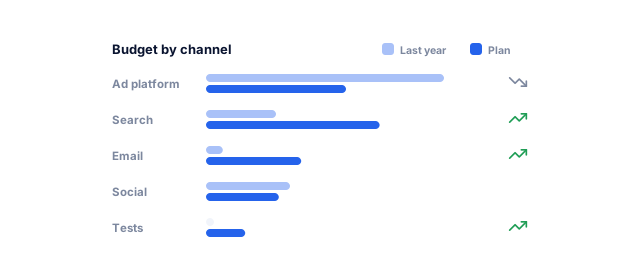
Budget moved from habit to the channels that win customers at the lowest cost, with a reserve kept for tests

Budget spread by habit

Many businesses split budget the way they did last year: most to one ad platform, a little to social, nothing to search or email. We rank channels by what it costs to win a customer and how quickly each pays back, then move money to the best return while keeping a reserve for tests. Habit becomes a decision you can explain.

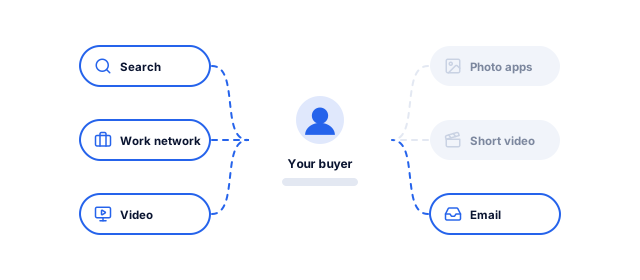
A buyer profile at the center, with the channels where that buyer researches highlighted and the rest faded

Channels chosen for reach, not fit

Reach varies a lot by platform. Pew Research Center's 2026 survey found 84% of US adults use YouTube, 70% Facebook and 51% Instagram. But where your buyers research and decide matters more than total reach: a B2B buyer may watch YouTube at home and still research suppliers on search and LinkedIn at work. That is why audience research comes before channel choice, not after.

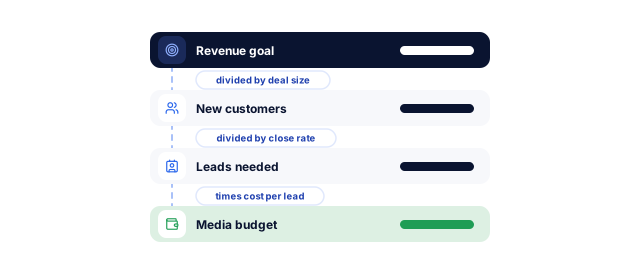
A growth target worked backward into the customers, leads and media budget needed to reach it

Growth targets with no arithmetic

A target only becomes a plan when it is worked backward. To add $600,000 in revenue at an average deal of $6,000, you need 100 new customers. At a 20% close rate that is 500 leads, and at $120 per lead a $60,000 media budget, before fees and content. The strategy shows this math for your numbers.

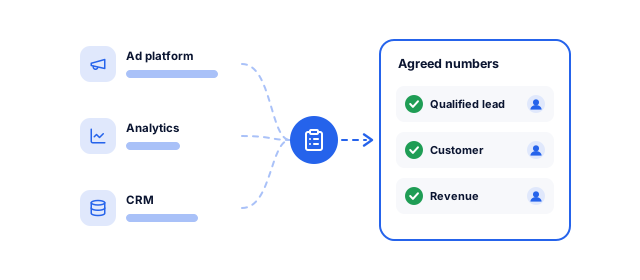
An ad platform, analytics and the CRM each reporting a different number, reconciled into one agreed set of definitions

Reports nobody trusts

Ad platforms, analytics and the CRM count conversions differently, so each team brings its own number to the meeting. A measurement plan agreed before spending defines what counts as a lead, a customer and revenue, which source wins when they disagree, and who owns each report. Budget decisions then rest on one set of numbers that finance, sales and marketing all accept.

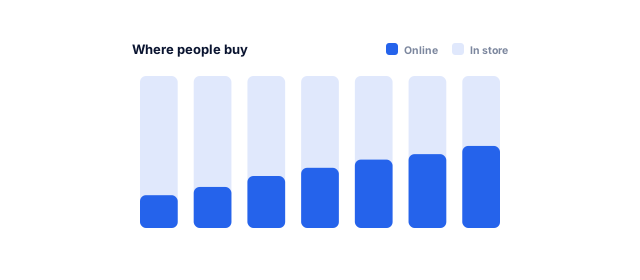
Online sales taking a larger share of retail each year, shown as a growing part of every bar

More buying moves online every year

In Great Britain, the Office for National Statistics reports that 28.3% of retail sales were made online in September 2026. Whether you sell online or are only researched there, a strategy decides how much of that attention you plan to win, through which channels, and what it is worth paying to win it in each market you serve.

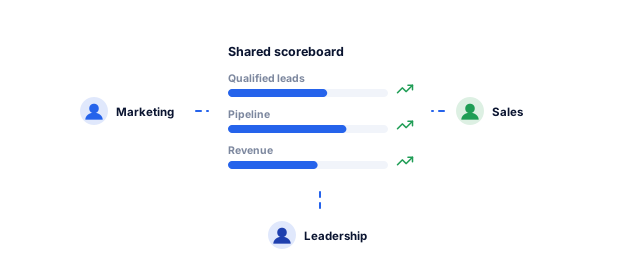
Marketing, sales and leadership looking at one shared scoreboard with agreed definitions

Teams pulling in different directions

Marketing chases leads, sales wants better ones and leadership wants revenue. A shared strategy agrees definitions such as a qualified lead, sets one scoreboard and gives each team its part of the roadmap, with handoffs between marketing and sales written down. Fewer meetings are spent arguing about whose numbers are right, and more on what to do next.

Not sure a full strategy is worth it right now?

Tell us what is not working. We look at your channels, spend and goals and tell you honestly whether you need a full strategy, a smaller fix or simply better execution.

What is the main problem?

Free, with no obligation. Rather talk? Book a 30-minute call

Our digital marketing strategy development process

  1. Discovery (week 1)

    We run working sessions with leadership, marketing and sales to agree goals and constraints, and collect the economics that shape everything else: margins, customer value, close rates, sales capacity and seasonality. We also set up read-only access to your data.

    • Stakeholder interviews
    • Goals and constraints summary
    • Data access checklist
    Shared goals and real numbers
  2. Audit and research (weeks 1 to 3)

    We audit channels, tracking, website and lead handling, review three to five competitors, and research customers through interviews, reviews, sales calls and search demand. Gaps in data are noted honestly, with a plan to close them.

    • Channel and tracking audit
    • Competitor review
    • Customer and search research
    An honest baseline
  3. Positioning and options (weeks 3 to 4)

    We draft your positioning and messaging, then model two or three channel and budget scenarios, each with expected cost per acquisition, time to results and risk shown as ranges. You choose the direction with the trade-offs in front of you.

    • Positioning and messaging
    • Channel scenarios
    • Budget ranges
    Choices with trade-offs visible
  4. Plan and measurement (weeks 4 to 5)

    The chosen scenario becomes the written strategy: channel roles, budget split, KPI tree, measurement plan and the 90-day roadmap with owners and dates. Every recommendation links back to evidence from the audit or research, so you can see why it is there.

    • Written strategy
    • KPI and measurement plan
    • 90-day roadmap
    One plan everyone can read
  5. Handover workshop (weeks 5 to 6)

    We present the strategy to your team, answer questions and record the session. Each channel owner gets a brief with goals, budget, first tasks and success measures, so work can start the following week without another round of planning.

    • Workshop and recording
    • Channel briefs
    • One-page summary
    Your team knows what to do next
  6. Review and adjust (days 30, 60, 90)

    At each review we compare results with the KPIs, decide what to stop, keep or scale, and update the roadmap. The day-90 review sets priorities for the next quarter, so the strategy stays current instead of sitting in a folder.

    • 30, 60 and 90-day reviews
    • Updated roadmap
    • Next-quarter priorities
    A strategy that stays current

Strategy for your stage and business model

A startup testing its first channel and a multi-market brand need very different plans. The engagement is scoped to where you are now.

01 / 05

Marketing strategy for startups and launches

With limited budget and little data, the strategy focuses on one or two channels and on learning fast. Small paid search and social tests check positioning and price before larger commitments, and organic work starts early because it takes longest. For a new study abroad consultancy, we paired Google Ads for immediate leads with SEO, as the MastersBuddy case study explains.

02 / 05

Ecommerce brands

An ecommerce marketing strategy is built on contribution margin, not revenue, so channels are judged on profit after ad spend, discounts and returns. We plan the split between acquisition and retention, product feeds and Shopping campaigns, organic category pages and email, and set targets per product line where margins differ. Our ecommerce SEO and email marketing teams can run those parts of the plan.

03 / 05

B2B digital marketing strategy and SaaS

Long sales cycles and buying committees mean the strategy is measured in pipeline, not leads. We map content and channels to each stage, plan LinkedIn, search and partner activity against accounts that matter, and connect the CRM so marketing is judged on qualified opportunities and revenue rather than form fills. Sales and marketing agree lead definitions in writing. Our SaaS SEO team handles the organic side.

04 / 05

Local and multi-location businesses

For businesses that serve an area, the strategy starts with local search, Google Business Profile, reviews and location pages, then adds paid search for high-intent services and seasonal peaks. Multi-location plans set budgets and targets per branch, so a strong location does not hide a weak one, and give local managers clear responsibilities. Our local SEO and reputation management teams cover the foundations.

05 / 05

Expanding into new markets

Entering a new country changes search terms, competitors, prices, regulations and buying habits. We size each market, decide the order of entry and plan the channels and budget per market, with KPIs reported separately so one market cannot hide another. Currency, language, consent rules and local time zones are built into the plan. Our international SEO team handles multi-country search.

Five ways to get a digital marketing plan, compared

There is more than one way to get a plan. This is how the common options compare. We offer a paid strategy engagement and strategy inside an execution retainer, and we can review a plan made any other way.

Book a strategy call
OptionWhat you getTypical costBest whenWatch out for
DIY with templatesA plan your team writes from guides and templatesYour team's timeSomeone on your team has time to learn and you run one or two channelsBlind spots in channels nobody on the team has run
Free agency proposalA pitch with recommendations for the services that agency sellsFreeYou already know which channel you needAdvice limited to what that agency sells; ask for the data behind it
Paid strategy engagementAudit, research, channel mix, KPIs and a roadmap any team can runFixed fee; published prices we reviewed from about $3,500Several channels, a meaningful budget or a big decision aheadA document with no owners or dates; insist on a roadmap
Fractional or in-house marketing leadAn ongoing owner who plans and manages the workMonthly fee or salaryYou need leadership week to week, not just a planOne person's channel experience shaping every choice
Strategy inside an execution retainerA plan written and run by the same agencyIncluded in a monthly retainerYou want one accountable team from plan to resultsMake sure KPIs and accounts stay yours if you switch

Costs reflect published pricing we reviewed in October 2026 and vary by market and scope. Whichever route you choose, make sure the plan includes a measurement plan and a 90-day roadmap with named owners.

Your first 90 days of digital marketing strategy

The strategy takes 4 to 6 weeks to build. The rest of the first 90 days puts it to work and checks it against real results.

Book a strategy call
  1. 1Days 1 to 30

    Discovery, audit and research

    • Stakeholder interviews and a goals and constraints summary
    • Read-only access to analytics, ad accounts and CRM
    • Channel, tracking, website and lead handling audit
    • Competitor review plus customer and search research
    • Draft positioning and messaging for you to react to

    By day 30, you have an honest baseline of what works today and why.

  2. 2Days 31 to 60

    Scenarios, plan and handover

    • Two or three channel and budget scenarios, shown as ranges
    • Written strategy with KPI tree and measurement plan
    • 90-day roadmap with owners, dates and success measures
    • Recorded handover workshop, channel briefs and one-page summary

    By day 60, the strategy is finished and the roadmap's first quick wins are underway.

  3. 3Days 61 to 90

    First results and first review

    • Quick wins live, run by your team or ours
    • Tracking from the measurement plan checked and working
    • First roadmap review, 30 days in: stop, keep or scale
    • Updated roadmap and forecast based on actual results

    By day 90, channels are judged on agreed KPIs rather than opinions, and you know what changes next.

What you see every month

Each month you get a written report and a review call. It leads with the numbers that matter to your business, says what we changed and why, and sets out what we test next.

Every report includes

  • Leads, cost per lead and pipeline, across every channel
  • Each channel's share, so budget follows results
  • What we changed, and what moved because of it
  • The plan for next month, with owners and dates
Monthly reportSample figures
Leads21210% more
Cost per lead$586% lower
Pipeline from marketing$186,000Per your CRM
Best channel this monthSearch44% of leads
Last six months
What we changed
  • Shifted budget from display to search and email
  • Fixed the call tracking that was missing a third of calls
Next month

Launch the comparison page and point retargeting at it

A sample of the report. Every client's report uses their own numbers.

Yours to keep, always. Everything is set up in your name, and if you leave we remove our access and hand over the documentation.

  • Every ad and analytics account
  • Dashboards and tracking
  • Content and creative
  • Data, audiences and lists
  • Reports and documentation

Who digital marketing strategy services from improveFX are for

We scope every strategy to your stage, budget and deadline, so the plan fits the decisions in front of you.

Book a strategy call

A good fit if

  • You spend across several channels without a shared written plan
  • You are launching, entering a new market or resetting after results stalled
  • Your leaders can join discovery and share margins, close rates and sales data
  • You want a plan your own team, another agency or ours can run

We can also help when

  • You need new leads this month: we start with a short audit and a quick-win plan, such as search ads or fixes to pages that already convert, and build the full strategy once first results are in
  • You already know your channel: our team runs it, such as PPC management or SEO, with KPIs agreed before launch
  • Another agency already wrote your plan: we review it against your data and tell you what to keep, change or drop, as a smaller engagement
  • Nobody on your side has time to own the roadmap: our digital marketing services team runs it and reports against the same KPIs

Why choose improveFX to build your digital marketing strategy

01

Written by people who run the channels

Your strategy is built by our in-house specialists in SEO, paid media, content, CRO and engineering, so every recommendation is costed and timed from real campaign experience. As a Google Premier Partner, Meta Business Partner, Microsoft Advertising Partner and Shopify Partner, we know what each platform can deliver and what it costs to test.

02

Independent of who executes it

The plan is written so any capable team can run it, and you are under no obligation to hire us afterward. If you do, we report against the same KPIs the strategy set, on rolling agreements with transparent monthly reporting. Your accounts, data and strategy documents stay yours either way.

03

Proven when strategy meets execution

For MastersBuddy, a new consultancy in a crowded market, the plan paired Google Ads for immediate leads with SEO for the long term. Google Ads brought 90 to 100 leads a week at under $1 per lead (₹72, as reported in rupees), and SEO put 160+ keywords in Google's top 10, as the case study shows.

Certified partners on the platforms we manage for you

  • Google Premier Partner
  • Meta Business Partner
  • Microsoft Advertising Partner

Results we can put numbers on

Results from search, paid media and website programs we planned and ran for clients, with the full story behind each number.

See all case studies
MastersBuddyStudy abroad consulting

160+

keywords in Google's top 10

A new consultancy broke into one of India's most competitive markets

Read the case study
CleverBossB2B services

185%

conversion growth

PPC rebuilt around smarter targeting and creatives

Read the review
Momentus Real Estate GroupReal estate

210%

more qualified leads

Website, SEO, Google Ads and Business Profile working as one

Read the review

What our marketing clients say

"Their SEO strategy helped us achieve top search rankings, while their Facebook Ads campaigns drove a steady flow of qualified prospects."
55%more organic traffic
4.7xreturn on ad spend
75%keywords on page one
Amita NaithaniCo-founder, Amita Naithani Resort Wear
"improveFX transformed our PPC campaigns with smarter targeting, compelling ad creatives, and continuous optimization."
185%conversion growth
42%lower cost per lead
210%more qualified leads
Nadya SmolskayaCo-founder, CleverBoss
"From designing a high-converting website to managing our SEO, Google Ads, and Google Business Profile, improveFX delivered exceptional results across every channel."
210%more qualified leads
185%organic and local traffic growth
92%keywords on page one
Maureen CappalloBroker and founder, Momentus Real Estate Group
"We now rank for highly competitive keywords while our PPC campaigns deliver qualified leads at a lower cost."
80%keywords on page one
620%return on investment
52%lower cost per lead
Divyanshi HirparaFounder, Trunkboxbaby
"Our marketing reach expanded by 50% after implementing their innovative SEO and content writing services. They truly understand the e-commerce landscape."
43.6%more sales
621%return on investment
63%keywords on page one
Allen RayFounder, Ecom Fashion

Digital marketing strategy questions, answered

Not seeing yours? Ask us directly and a specialist will reply personally.

How much do digital marketing strategy services cost?

A full strategy engagement is usually a fixed, one-time fee. Published prices we reviewed started at about $3,500, with larger, multi-market or multi-unit strategies costing more.

The fee depends on the number of channels, markets and business units, how much research is needed and the state of your data. Very low-cost packages exist, but they usually cover a single call rather than an audit, research and a roadmap. On a smaller budget, we scope the strategy to one or two channels. If we then run them, our fee is a fixed monthly amount, or 10% to 15% of ad spend once your monthly spend is above our minimum. We quote a fixed scope after a free call.

What is included in your digital marketing strategy services?

An audit, audience and positioning work, a channel mix and budget split, a KPI and measurement plan, a 90-day roadmap and a recorded handover workshop.

You receive a written strategy, a one-page summary, briefs for each channel and reviews at days 30, 60 and 90. If research shows a bigger problem first, such as broken tracking or a website that cannot convert, we say so and put it at the top of the roadmap.

How long does it take to build a digital marketing strategy?

Four to six weeks from kickoff to the finished strategy for most businesses, then a 90-day roadmap with reviews.

The first week covers discovery and data access, weeks one to three cover audit and research, and the plan is written and handed over in weeks four to six. Multi-market or multi-brand strategies can take longer. Missing data slows things down less than people expect, because the plan includes how to collect it.

What is the difference between a digital marketing strategy and a marketing plan?

A strategy decides who you target, how you position yourself, which channels you use and how success is measured. A marketing plan schedules the campaigns and tasks that carry it out.

Our engagement delivers both: the strategic choices and a 90-day roadmap of specific work with owners and dates. A plan without a strategy tends to become a list of activities, and a strategy without a plan rarely gets executed.

Do we have to hire you to execute the strategy?

No. The strategy is written so your team, another agency or freelancers can run it, and the briefs are detailed enough to hand over.

Many clients run part of it themselves and ask us for the channels they lack in-house. If we execute, we report against the KPIs the strategy set, so you can judge our work against the same plan any other team would follow.

How do you decide the channel mix and budget?

From your economics and your buyers: what a customer is worth, how they research and buy, and what each channel costs and how fast it pays back.

We estimate cost per acquisition and time to results for each candidate channel, using your data where it exists and test budgets where it does not. Budgets are shown as ranges across two or three scenarios, with a testing reserve, and each channel has a stated role so its results are judged fairly.

How much should we spend on digital marketing?

Work it out backward from your goal: revenue target, customers needed, leads needed at your close rate, and the cost per lead you can afford at your margin.

Rules of thumb based on a percentage of revenue ignore your margin, sales cycle and growth stage. The strategy shows the calculation for your numbers, sets a budget you can sustain for at least a quarter, and reserves part of it for tests that tell you where to spend next.

Which KPIs should a digital marketing strategy track?

Start with business results such as revenue, qualified pipeline and customer acquisition cost, then add the channel metrics that explain them.

Typical KPIs include cost per acquisition, return on ad spend, lifetime value, conversion rate by page, qualified lead rate and organic visibility for priority topics. Each KPI gets a written definition, a source of truth and an owner, so reports answer questions instead of starting arguments.

Can you review a strategy another agency wrote?

Yes. We review the plan against your data, check its assumptions and measurement, and tell you what we would keep, change or drop.

A review is a smaller engagement than a full strategy and is useful before you commit budget to someone else's plan, or when results have not matched what was promised. You get a written assessment with specific recommendations.

How often should a digital marketing strategy be updated?

Review it every quarter and rewrite it when something fundamental changes, such as a new product, market, pricing model or a big shift in channel costs.

The 90-day roadmap is updated at each review based on results. The core choices about audience, positioning and channel roles usually hold for a year or more, unless the data shows they are wrong.

How do you forecast leads and revenue from a marketing budget?

We run your numbers through each channel: budget divided by expected cost per lead gives leads, your close rate turns leads into customers, and average deal value turns customers into revenue. Every forecast is a range, not a promise.

Cost per lead comes from your account history, or from small test budgets where there is none. Each scenario also shows time to results, since paid search can bring leads within weeks while SEO takes months. Each roadmap review replaces assumptions with actual results.

How is the budget split across channels, and can it move during the year?

Yes, it should move. The starting split follows each channel's role and expected cost to win a customer, with a testing reserve held back.

Proven channels get the larger share, and new ones run on the reserve until they earn more. The strategy sets the rules in advance: what result earns more budget, what triggers a cut and how long a channel runs before it is judged. Moves are agreed at the 30, 60 and 90-day reviews, then quarterly, not after one bad week.

What do we get with strategy only versus strategy plus execution?

Strategy only gives you the written strategy, channel briefs, handover workshop and reviews at days 30, 60 and 90, and your team or another partner runs the work. Strategy plus execution adds our specialists running the channels the plan names, judged against the same KPIs.

Strategy only suits teams that can run the channels, or that want an independent plan before choosing an agency. Execution avoids a second handover and gives you one accountable team, on rolling agreements with monthly reporting. Many clients keep some channels in-house and give the rest to our digital marketing services team.

Ready to get more from your marketing?

Tell us what is holding your marketing back, or book a strategy call with our team.

  • A look at what you spend and what it brings in
  • Fixes ranked by their effect on leads and cost
  • A call with a specialist to plan the next steps, no obligation
Vikash Kumar PalRoshan Kumar JhaAbhishek Kumar Jha A specialist replies personally 4.9 from 566 client reviews
What do you need help with?

Pick all that apply.

Next, a few details about your business on our contact page. It takes about a minute.

Prefer to talk now? Book a strategy call