Flutter app development services that ship iOS and Android together
Our Flutter app development services are for businesses that need the same app on iOS and Android, and often the web, without paying for two builds. We design and build one Dart codebase, connect it to your backend and native device features, and take it through App Store and Google Play review.
Flutter app development is building mobile, web and desktop apps from one Dart codebase with Google's open-source Flutter framework. Flutter app development services cover design, architecture, native integrations, testing, store release and maintenance, so one team ships iOS and Android instead of two native builds.
Flutter suits most business apps; payments, health data, Bluetooth or widgets may add small native modules.
You should own the repository, store accounts and signing keys from day one.
After launch, budget for store fees, hosting, third-party APIs and OS updates.
Best for
Businesses that need the same app on iOS and Android, with one design and one team
What you get
Discovery, UX and UI design, the Flutter build, integrations, automated tests, store release and support
Typical timeline
Discovery in 1 to 3 weeks. A focused MVP usually takes 2 to 4 months; complex apps take 6 months or more.
Pricing
Driven by screens, user roles, integrations and backend work. A published agency estimate we reviewed puts Flutter apps at about $25,000 to $300,000+. Our app projects run from under $5,000 to $80,000+, depending on scope. We quote after a free discovery call.
What our Flutter app development services include
Discovery comes first, because the native work it uncovers sets the real cost.
We map every feature against what Flutter and its plugins handle well. Payments, maps, camera and push are routine; background Bluetooth, CarPlay, widgets or heavy AR need native modules. You get a risk-sorted feature list, an architecture sketch and a release plan.
UX and UI design for both platforms
One design system, adapted to each platform's habits: back navigation on Android, sheets and swipe gestures on iOS, Material 3 and Cupertino widgets where they fit. Our app UI/UX design team builds Figma components that map to reusable Flutter widgets.
Custom Flutter app development
Dart 3 in clear layers: widgets, state management (Riverpod or Bloc), repositories and services. Code passes static analysis and unit and widget tests before review, and Codemagic or GitHub Actions with Fastlane turn every merge into a TestFlight and Google Play internal testing build.
Native integrations and plugins
Platform features are written in Swift or Kotlin and called from Dart through typed Pigeon bindings. We vet each pub.dev package for maintenance and license, because an abandoned plugin can block an OS upgrade. Typical: payments, maps, biometrics, HealthKit, Health Connect, Bluetooth.
Backend, APIs and cloud
REST or GraphQL APIs, Firebase or Supabase for sign-in and real-time data where they fit, and offline storage for poor connections. Larger backends come from our API development team, hosted on AWS, Google Cloud or Azure.
Store release, monitoring and upkeep
We prepare signing, listings, privacy labels and review notes with a demo account, release in stages, and track crashes in Crashlytics or Sentry. After launch we keep pace with each Flutter release and store deadline, such as Google Play's yearly target API level rule.
Why businesses choose Flutter, and how we handle native features
What Flutter brings to your product, and how we cover the features it does not.
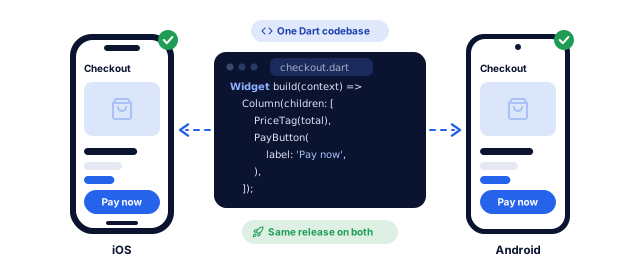
With two native apps, every feature is built, tested and fixed twice, and the apps drift apart. One Dart codebase ships each feature to iOS and Android in the same release, and after launch each fix is made once.
A widely adopted framework backed by Google
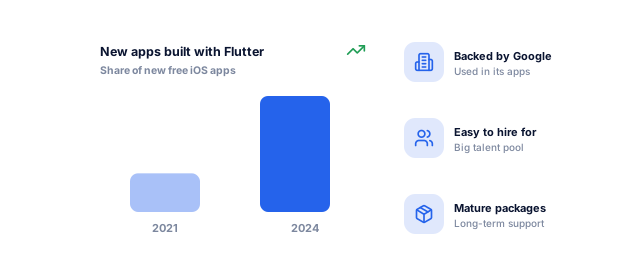
Apptopia found Flutter in nearly 30% of new free iOS apps in 2024, up from about 10% in 2021, as reported by the Flutter team. Google builds its own products with it, including NotebookLM, which matters for long-term support and hiring.
Consistent design and smooth rendering
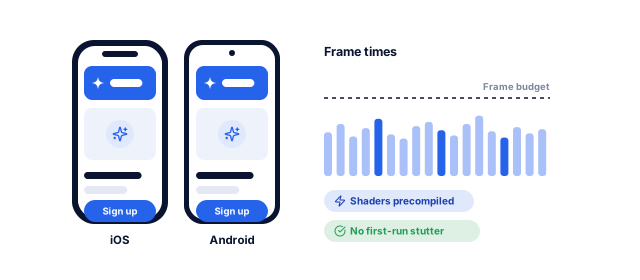
Flutter draws its own interface with the Impeller engine, which precompiles shaders to avoid first-run animation stutter. The Flutter documentation lists it as the only renderer on iOS and the default on Android API 29 and later, so your brand looks the same on a Pixel and an iPhone.
Faster feedback while the app is built
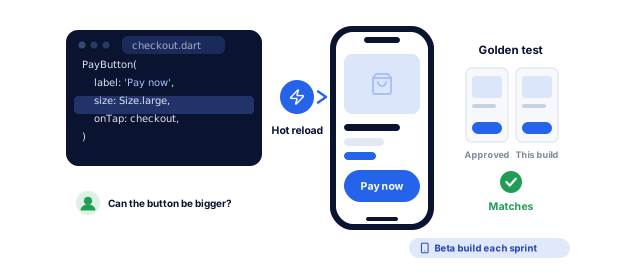
Hot reload shows code changes in a running app without a restart, speeding up design reviews and bug fixes. You install real builds every sprint through TestFlight and Google Play internal testing, and golden tests catch unintended UI changes.
Room to grow to web and desktop
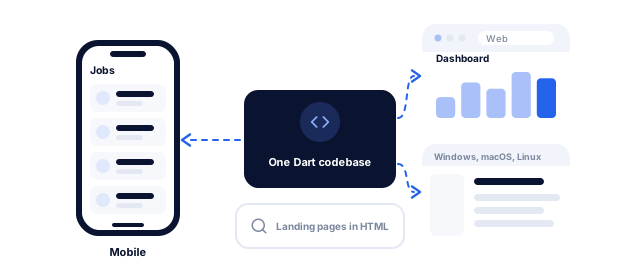
The same codebase can target web, Windows, macOS and Linux for internal tools, dashboards and companion apps. The Flutter web FAQ says its output does not align with what search engines need, so our custom website development team builds landing pages in HTML.
Native modules or a native app, when needed
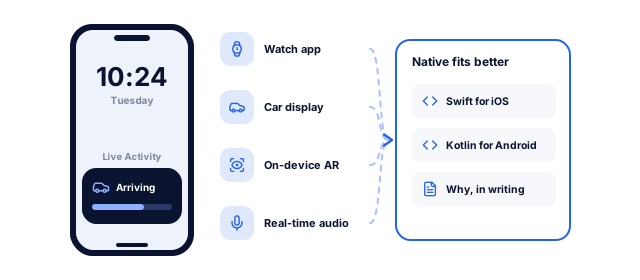
Live Activities, CarPlay, Wear OS, visionOS and real-time audio, video or AR are simpler in platform code. We build those features as Swift or Kotlin modules inside your Flutter app, or build the whole app natively with our Swift app development and Kotlin app development teams.
Not sure Flutter is right for your app?
Pick what is closest to your situation. We look at your feature list or current app, and send a written plan: which parts Flutter handles well, which need native code, a price range and a timeline.
Your free app planFor what you need
1What we would build firstYour idea, your users and the features that matter first
2A price range and timelineFor the budget you pick, with an MVP option
3The stack we would useAnd how your team runs it after launch
A specialist walks you through it on a call
Our Flutter app development process
Our Flutter app development services follow six steps, each ending in a deliverable.
Workshops on users, features and goals, a review of any existing app or backend, and risky features tested against plugins. Discovery takes one to three weeks and ends in a scope, estimate and release plan.
Feature and risk map
Architecture and package plan
Estimate and release plan
A scope you can budget against
UX and UI design
User flows, wireframes and a clickable Figma prototype, tested with real users where possible. Approved screens become a component library that maps directly to Flutter widgets.
User flows and wireframes
Clickable prototype
Component library
Screens agreed before code
Architecture and setup
Repository and CI in your Git account, with development, staging and production flavors. Analytics, crash reporting and feature flags go in now, not after launch.
Repository and CI pipeline
Environments and flavors
Coding and review standards
A codebase ready to grow
Sprint development
Two-week sprints, each ending with a demo and an installable build. Features ship with unit, widget or integration tests, and native modules are tested on real devices alongside their screens.
Sprint demo and test build
Automated tests
Written change log
Progress you can install
QA and store release
Tests on real iPhones and Android phones, older and low-memory models included, plus screen reader, text scaling and Flutter DevTools checks. Then listings, privacy labels, review notes and a staged release.
Device and accessibility test report
Store listings and privacy labels
Staged rollout plan
A clean first review
Support and new features
We watch crash and performance reports, upgrade Flutter and packages on a schedule, and test against iOS and Android betas before public release. New features follow the same sprint rhythm.
Crash and performance monitoring
Flutter and package upgrades
Feature roadmap
An app that keeps passing review
Flutter apps for different products and stages
Our Flutter app development services start from where your product is today.
01 / 05
Flutter MVP development for startups
One small team tests your idea on both stores at once. We cut the first release to the features that prove demand, add analytics from day one, and build a structure that grows without a rewrite. Our SaaS application development team can build the web dashboard alongside.
We build catalog browsing, wishlists, Apple Pay and Google Pay, order tracking and deep links from emails and ads. Flutter connects to Shopify's Storefront API, WooCommerce or a custom backend, so your ecommerce website and app share products, accounts and orders.
Patient apps need booking, reminders, secure messaging and sometimes HealthKit or Health Connect data, with HIPAA or GDPR shaping where data is stored and what notifications show. improveFX runs its own healthcare product line, Nabhaya; see our work for healthcare businesses.
Offline field apps that scan barcodes and capture photos and signatures, on whatever mix of Android and iOS devices your staff carry, and on Windows in the office. We connect them to your ERP or CRM, and our workflow automation team removes the paperwork.
Two aging native apps do not need a full rewrite: Flutter's add-to-app support lets us move one feature at a time into an existing iOS or Android app. We also take over Flutter apps from other teams, starting with a code audit. Comparing options? See hybrid app development.
SwiftUI or UIKit, Jetpack Compose or Android Views
New OS features
Plugins or custom platform code, sometimes after a delay
Community modules or custom native code, sometimes after a delay
Available as soon as Apple or Google release them
Web and desktop
Web, Windows, macOS and Linux from the same code
Web via React Native for Web; desktop as separate projects
Separate builds per platform
Relative build cost for two platforms
Lower: one build
Lower: one build
Highest: two builds
Best fit
Branded apps, MVPs and multi-platform products
Teams already strong in React and TypeScript
Apps built around platform features or heavy on-device processing
Based on Flutter, React Native, Apple and Android developer documentation, October 2026. Savings are largest when most features are shared; apps needing many native modules save less.
Your Flutter app project, week by week
A typical 12-week MVP; complex apps follow the same phases over 6 months or more.
We build in Flutter, Swift and Kotlin, so we have no reason to force one answer. Features Flutter handles poorly become native modules, or the app goes native, decided in discovery before you spend on design.
02
App, backend and growth under one roof
Marketing and engineering work together here, so the people who build your app can also set up analytics, store listings, landing pages and mobile SEO for the website that sends users to it, with no handover between agencies.
03
Your code, accounts and keys
The app ships under your own Apple Developer and Google Play accounts, with its bundle ID, package name, signing keys and repository in your name; we are added to your accounts. We work on rolling agreements, and clients rate us 4.9 on Clutch from 221 reviews and stay 1.6 years on average.
Results we can put numbers on
Client results from case studies and reviews, with the full story behind each number.
"From designing a high-converting website to managing our SEO, Google Ads, and Google Business Profile, improveFX delivered exceptional results across every channel."
210%more qualified leads
185%organic and local traffic growth
92%keywords on page one
Maureen CappalloBroker and founder, Momentus Real Estate Group
"They revolutionized our online presence with a 60% increase in web traffic through strategic e-commerce SEO and content optimization."
60%more organic traffic
47%more sales
Eric NoahPresident, Eric Originals & Antiques Ltd.
"Visionstar Technologies' online presence transformed significantly with a 40% boost in customer engagement, all thanks to their exceptional website structuring and SEO tactics."
+40%qualified leads
32%lower cost per acquisition
Thomas MorelFounder, Visionstar Technologies
"Their strategic approach to our website and SEO resulted in a 60% increase in local inquiries, revolutionizing our automobile service business."
60%more local inquiries
87%more organic traffic
Mike SteffanFounder, Sabulski Window Tinting
"Their SEO strategy helped us achieve top search rankings, while their Facebook Ads campaigns drove a steady flow of qualified prospects."
How much do Flutter app development services cost?
Our app projects run from under $5,000 to $80,000+, depending on scope. For comparison, a published agency estimate we reviewed in October 2026 puts Flutter apps at about $25,000 to $300,000 or more.
A single-role app with a few screens and an existing API sits at the low end; more roles, an admin panel, a new backend, native modules or HIPAA compliance push it higher. Running costs include Apple's $99 yearly developer fee, Google Play's one-time $25 registration, hosting, third-party APIs and OS updates. We quote after a free discovery call.
How long does it take to build a Flutter app?
A focused MVP usually takes 2 to 4 months from discovery to store release. Complex apps with many integrations, roles or offline features take 6 months or more.
Discovery takes one to three weeks and design runs a few weeks ahead of development. Store review adds a few days, or longer after a rejection, so we build that buffer into the release date.
Is Flutter a good choice for app development in 2026?
Yes, for most business apps. Flutter is maintained by Google, ships regular stable releases (3.47 is current), and Apptopia data reported by Google found it in nearly 30% of new free iOS apps in 2024.
Estimates vary by method: Appfigures found 15% of all new apps and games in 2024 used Flutter or React Native. Either way, the talent pool is large, so you are not locked into one vendor.
Flutter vs React Native: which should I choose?
Both build iOS and Android apps from one codebase. Flutter suits apps that should look identical everywhere and may target desktop; React Native suits teams already working in React and TypeScript.
Flutter draws its own UI, giving tight control over design and animation; React Native maps to native platform components. If your web team writes React, that knowledge carries over. We build both and compare them against your features.
Is a Flutter app as fast as a native app?
For most business apps, users cannot tell the difference. Flutter compiles to native machine code, and Impeller precompiles shaders to avoid first-run animation stutter.
Slow Flutter apps are usually slow because of code: too many widget rebuilds, oversized images or heavy work on the main thread. We profile with Flutter DevTools on low-end devices before release, and write real-time video, audio or AR processing in native Swift or Kotlin.
Can a Flutter app use native device features?
Yes. Camera, location, biometrics, payments and push notifications are available through maintained plugins, and anything else can be written in Swift or Kotlin and called from Dart.
Custom native code connects through platform channels with typed Pigeon bindings, so the Dart and native sides cannot drift apart silently. We check each third-party plugin's maintenance history and platform support on pub.dev before relying on it.
Can you migrate our existing native app to Flutter?
Yes, without a full rewrite. Flutter's add-to-app support lets us embed Flutter screens in your existing iOS or Android app and move one feature at a time.
We start with the features that change most often, because they gain most from shared code, and ship each before the next begins. Add-to-app supports Swift, Objective-C, Kotlin and Java host apps; Android hosts must use AndroidX.
Can Flutter build a web version of our app?
Yes, for app-like experiences such as dashboards, booking tools, portals and progressive web apps. For marketing pages or blogs that must rank in search, we use HTML instead.
Flutter's own documentation says its web output does not align with what search engines need to index. Flutter web supports the latest Chrome, Firefox and Edge releases and Safari 15.6 or newer.
Which iOS and Android versions does Flutter support?
Flutter 3.47, the current stable release, supports iOS 15 and later and Android API level 24 (Android 7.0) and later, according to the Flutter supported platforms page.
The stores add their own rules: Apple requires uploads built with Xcode 26 and the iOS 26 SDK, and Google Play requires new apps and updates to target API level 36. We set your minimum version from your users' devices in analytics.
Can we hire dedicated Flutter developers instead of a full project team?
Yes. If you have a product owner and an existing codebase, you can hire Flutter developers from our in-house team to work inside your sprints, tools and code review process.
Team extension suits companies needing more capacity or specific skills, such as native modules or CI, for a few months; full project delivery suits companies without a mobile lead. The code stays in your repository.
Ready to plan your app?
Tell us what you want to build, or book a strategy call with our team.
What we would build first, and on which platforms
A price range and timeline for your budget
A call with a specialist to plan the next steps, no obligation
A specialist replies personally 4.9 from 566 client reviews