Kotlin app development services for native Android and Multiplatform apps
Our Kotlin app development services are for businesses that want a fast, stable native Android app, and for teams with Java or older Android code that needs a modern base. We build in Kotlin and Jetpack Compose, Google's recommended toolkit for native Android UI, and use Kotlin Multiplatform when you want to share business logic with your iOS app.
Kotlin app development is building native Android apps, and code shared with iOS, in Kotlin, the language Android's Jetpack Compose toolkit is built on. Kotlin app development services cover architecture, Compose UI, coroutines, testing, Google Play release, Java migration and Kotlin Multiplatform.
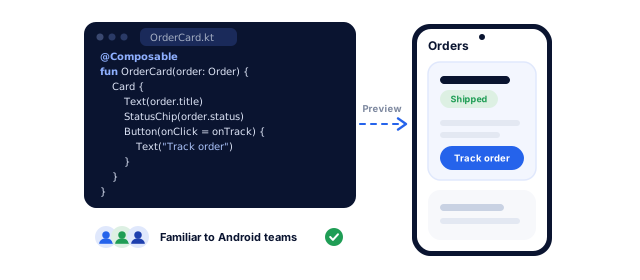
Jetpack Compose is Google's recommended toolkit for native Android UI, and it works alongside existing Views.
Java and Kotlin call each other directly, so migration can run file by file without a rewrite.
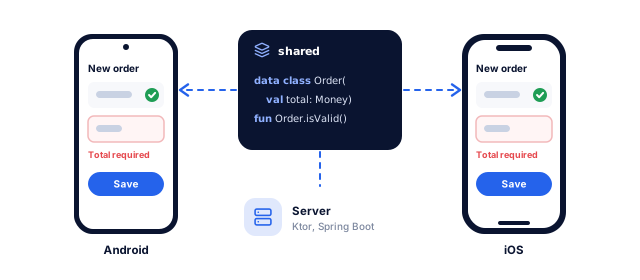
Kotlin Multiplatform shares business logic with iOS while each app keeps a native UI.
Since August 31, 2026, new apps and updates on Google Play must target Android 16 (API level 36).
Best for
Android-first products, apps with heavy device or hardware integration, and teams modernizing Java or View-based code
What you get
Architecture, Compose UI, integrations, automated tests, Play Store release and, where it fits, shared Multiplatform modules
Typical timeline
Discovery in 1 to 3 weeks. A focused MVP in about 2 to 4 months. Java and Views migrations run in stages alongside releases.
Pricing
Driven by features, device range, integrations and how much code is shared with iOS. Our app projects run from under $5,000 to $80,000+, depending on scope. We quote after a free discovery call, with each workstream priced separately.
What our Kotlin app development services include
Most projects combine two or three of these six workstreams.
Screens in Jetpack Compose with Material 3, on Google's recommended architecture: UI state in ViewModels, data in repositories, one-way data flow. Adaptive layouts serve phones, foldables, tablets and Chromebooks from one codebase, Compose for Wear OS reaches the wrist, and existing XML screens keep working.
Kotlin coroutines and app architecture
Coroutines and Flow keep network calls, database reads and background work off the UI thread, and cancel it when a screen closes. Hilt handles dependency injection, Room or DataStore local data, WorkManager background sync, and Gradle modules let features build and test independently.
Java to Kotlin migration
Kotlin and Java call each other directly, so migration needs no rewrite. We convert file by file behind tests, starting with code that changes most, and move XML layouts to Compose screen by screen. Larger rebuilds follow our legacy system modernization approach.
Kotlin Multiplatform development
Kotlin Multiplatform is officially supported by Google for sharing business logic between Android and iOS. Networking, data models, validation and storage go in shared modules with Ktor, kotlinx.serialization, Room and DataStore, while each app keeps a native UI, the iOS side built by our Swift app development team.
Device and platform integrations
Native Kotlin reaches every Android API directly: CameraX, Bluetooth Low Energy, NFC, Health Connect, foreground services, biometrics, Google Pay and Play Billing. We also handle background limits and battery settings that differ by manufacturer, the source of bugs that appear on one brand of phone only.
Testing, Play Store release and upkeep
JUnit and coroutine tests, Compose testing APIs and Espresso for UI, and Firebase Test Lab across screen sizes and Android versions. We release through Play Console testing tracks with staged rollouts, watch crashes and ANRs in Android vitals, and keep you on the required target API level.
Why businesses choose Kotlin, and how we cover iOS too
What Kotlin brings, and how we add iOS when you need it.
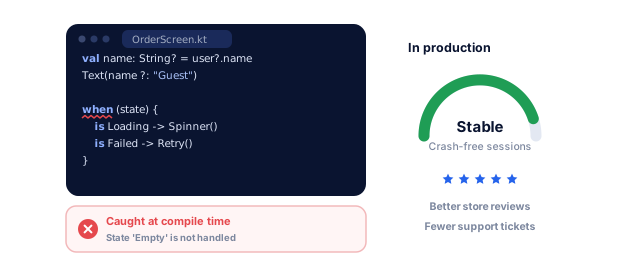
Kotlin's null safety turns a missing value into a compile-time question instead of a runtime crash, and sealed types make the compiler check every state. Google reports on its Android Kotlin page that apps using Kotlin are 20% less likely to crash: better reviews, fewer support tickets.
The language Android teams already use
Google says over 60% of professional Android developers use Kotlin, and Jetpack Compose, Android's modern UI toolkit, is built on it with Kotlin-only APIs. That makes it easier to hire Kotlin developers later, or hand the app to your own team without retraining.
The biggest mobile audience
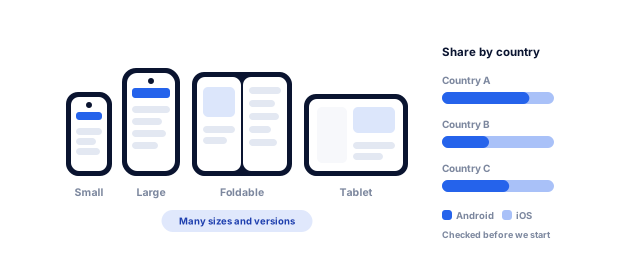
Android ran on 69.17% of mobile devices worldwide in September 2026, according to StatCounter, across many screen sizes, versions and hardware types that a native app handles best. Share varies by country, so we check where your users are before choosing which platform comes first.
Code that is quicker to change
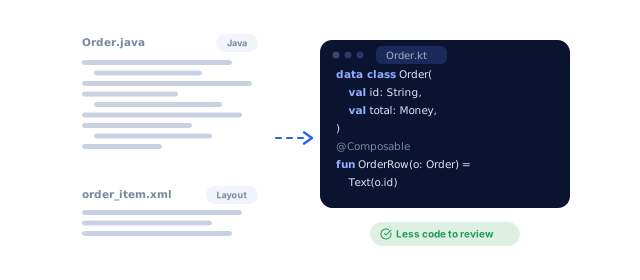
Data classes, extension functions, sealed types and coroutines express the same logic in less code than Java, leaving fewer places for bugs to hide. Compose removes the separate XML layout layer, so a screen and its behavior live and change together.
One language from phone to server
Kotlin also runs on the server, with Ktor and Spring Boot, and in shared Multiplatform modules for iOS, so data models and validation rules can be shared across both apps and the backend, designed by our API development team.
iOS too, from the same team
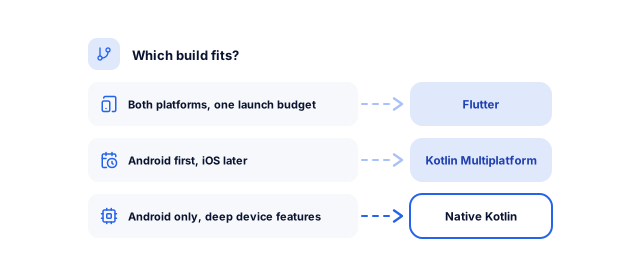
Need iOS and Android at launch on one budget, with few device-specific features? Our Flutter app development team builds it, usually at a lower cost. Android-first with iOS to follow? Kotlin Multiplatform shares your logic with a native iOS app. Our hybrid app development page compares every cross-platform option.
Building or modernizing an Android app?
Tell us what you need. We look at your idea or your repository, its Kotlin and Java mix and its dependencies, and send a written plan with a price range, a timeline and what we would do first.
Your free app planFor what you need
1What we would build firstYour idea, your users and the features that matter first
2A price range and timelineFor the budget you pick, with an MVP option
3The stack we would useAnd how your team runs it after launch
For a new app, workshops on users, features, devices and goals. For an existing one, we read the code first: Kotlin and Java mix, architecture, Gradle setup, dependencies, Android vitals and test coverage.
Scope and feature list
Technical risk register
Estimate and release plan
Decisions made on evidence
Architecture and design
We agree modules, data layer, navigation and what is shared with iOS through Kotlin Multiplatform. Designers produce flows and a clickable Material 3 prototype in your brand, for the screen sizes you support.
Architecture decision notes
Clickable prototype
Shared code plan
A plan your team can review
Project setup and CI
The project lives in your Git account and Play Console from day one, with Play App Signing on, Gradle version catalogs, development, staging and production variants, static analysis and CI that tests every pull request.
Repository and Gradle modules
CI with automated tests
Signing and build variants
Builds that are repeatable
Sprint development
Two-week sprints, each ending with a demo and a build on the Play internal testing track. On migrations, each sprint also converts a defined part of the Java or XML code.
Installable build every sprint
Tests with each feature
Written change log
Progress you can install
Testing and Play Store release
Real devices from several manufacturers plus Firebase Test Lab, TalkBack, font scaling and dark theme checks, and performance profiling. Then the listing and Data safety form, closed and open testing, and a staged rollout.
Device and accessibility report
Store listing and Data safety form
Staged rollout plan
A launch you can control
Android release cycle and support
After launch we watch crashes and ANRs, keep Kotlin, Gradle and libraries current, test against Android betas and raise your target API level before Google Play's yearly deadline.
Android vitals monitoring
Yearly target API upgrade
Feature roadmap
An app that stays on the store
Kotlin app development for your situation
Our Kotlin app development services start from where your app and team are today.
01 / 06
New native Android apps
We design the first release around the features that prove value, in Compose with Multiplatform-ready modules, so adding iOS later does not mean starting over. Our app UI/UX design team shapes layouts for phones, foldables and tablets.
Many working Android apps use Java, XML layouts and older libraries. We modernize them in place: new features in Kotlin and Compose, old code converted as it is touched, and the target API level raised to keep the app on Google Play.
Separate Android and iOS apps write the same business rules twice, and they drift apart. We move those rules into shared Kotlin Multiplatform modules one area at a time, starting with networking and data, while both apps keep native interfaces.
Rugged handhelds, barcode scanners, payment terminals and kiosks often run Android. We build Kotlin apps that work offline, scan quickly, print receipts and lock into kiosk mode, connected to your inventory management system or POS system.
Health Connect gives Android apps steps, heart rate, sleep and other health data, with permission per data type. We design consent flows, encrypt data at rest and keep identifiable details out of logs. improveFX runs its own healthcare product line, Nabhaya; see our work for healthcare businesses.
Have an Android lead and a roadmap but not enough hands? Hire Kotlin developers from our in-house team to work in your sprints, tools and code review, with Compose, Multiplatform or CI specialists for just the weeks you need.
We build in Kotlin, Swift and Flutter, so we recommend what fits your roadmap, not what we prefer. If Kotlin Multiplatform or Flutter serves you better than native Android, we build it and show the trade-offs in discovery.
02
Engineering and growth in one team
The people who build your app can also set up analytics, Play Store listings, deep links and the website that sends users to it, and our cloud DevOps and CI/CD team runs builds and releases from the same plan.
03
Your code, keys and Play Console
You own the Git repository, the Google Play Console account the app ships under, its package name and the app signing setup from day one; we are added as users. We work on rolling agreements, and clients rate us 4.9 on Clutch from 221 reviews and 4.9 on Trustpilot from 156, and stay 1.6 years on average.
Results we can put numbers on
Client results from case studies and reviews, with the full story behind each number.
"From designing a high-converting website to managing our SEO, Google Ads, and Google Business Profile, improveFX delivered exceptional results across every channel."
210%more qualified leads
185%organic and local traffic growth
92%keywords on page one
Maureen CappalloBroker and founder, Momentus Real Estate Group
"They revolutionized our online presence with a 60% increase in web traffic through strategic e-commerce SEO and content optimization."
60%more organic traffic
47%more sales
Eric NoahPresident, Eric Originals & Antiques Ltd.
"Visionstar Technologies' online presence transformed significantly with a 40% boost in customer engagement, all thanks to their exceptional website structuring and SEO tactics."
+40%qualified leads
32%lower cost per acquisition
Thomas MorelFounder, Visionstar Technologies
"Their strategic approach to our website and SEO resulted in a 60% increase in local inquiries, revolutionizing our automobile service business."
60%more local inquiries
87%more organic traffic
Mike SteffanFounder, Sabulski Window Tinting
"Their SEO strategy helped us achieve top search rankings, while their Facebook Ads campaigns drove a steady flow of qualified prospects."
Planning a whole Android product, from budget to Play Store launch? Start with our Android app development services; these services are planned with your Android app.
Our app projects run from under $5,000 to $80,000+, depending on features, user roles, device range, integrations and backend work. We quote after a free discovery call, with each workstream priced separately.
A phone-only app with a few screens and an existing API sits at the low end. Tablet, foldable or Wear OS layouts, Bluetooth or NFC, compliance, a new backend, code shared with iOS and Java or XML to convert push it higher. Running costs include Google Play's one-time $25 registration, Apple's $99 yearly fee if you add iOS, hosting and yearly target API upgrades.
How long does it take to build an Android app in Kotlin?
A focused MVP usually takes 2 to 4 months, including one to three weeks of discovery. Larger apps with several roles, offline sync or hardware integrations take 6 months or more.
Migrations from Java or XML Views run in stages alongside normal releases, so progress is measured in modules per sprint, not one switchover date. Google Play review and testing tracks add a few days to any release plan.
How is this different from your Android app development services?
Our Android app development services cover the whole product: situations, budget, devices, compliance and Play policy. This page focuses on the Kotlin engineering underneath.
Choose this service if you already want native Kotlin, need to modernize Java or XML code, want to share logic with iOS through Kotlin Multiplatform, or need Kotlin developers in your team. Both are delivered by the same in-house mobile team.
Kotlin or Java for Android: which is better?
Kotlin, for new Android code. Jetpack Compose is built on Kotlin, Google says over 60% of professional Android developers use it, and Google reports apps using Kotlin are 20% less likely to crash.
Java still runs fine and needs no urgent rewrite. Because the two interoperate, we write new features in Kotlin and convert Java files when you next change them, starting with the parts that change most.
Can you migrate our Java Android app to Kotlin?
Yes. We migrate file by file behind tests, so the app keeps shipping and users see no disruption.
We first map the codebase, add tests around critical flows such as sign-in and payments, and agree the conversion order. Remaining Java gets nullability annotations so Kotlin sees accurate types. XML layouts move to Jetpack Compose screen by screen, and outdated libraries are replaced along the way.
Should we use Jetpack Compose or XML Views?
Jetpack Compose for new screens. Google describes it as Android's recommended modern toolkit for native UI, and it works alongside existing Views.
In an existing app, we build new screens in Compose inside current navigation, or embed Views inside Compose where a mature View-based component still does the job. We convert the screens you are changing anyway, not all at once.
What is Kotlin Multiplatform, and is it ready for production?
Kotlin Multiplatform shares Kotlin code, usually business logic, networking and data, between Android, iOS and other platforms. Google calls it stable and production-ready, and officially supports it for sharing logic between Android and iOS.
Each app can keep a native UI in Compose and SwiftUI, or share UI with Compose Multiplatform, which JetBrains lists as Stable on Android and iOS. It fits best when you want one source of truth for the rules behind both native apps.
Kotlin, Kotlin Multiplatform, Flutter or React Native: which should we choose?
Choose native Kotlin if Android is your main platform or your app depends on deep device features. Choose Flutter for iOS and Android together on one budget with one team, or React Native if your team already writes React.
Kotlin Multiplatform sits in between: shared logic with native interfaces on each platform. We build all four and compare them for your features in discovery; see Flutter app development and hybrid app development for the cross-platform options.
Which Android versions should our app support?
Set the minimum version from your own analytics, and keep the target version current. They are different settings: the minimum decides which phones can install the app; the target decides which Android rules it follows.
Google Play requires new apps and updates to target Android 16 (API level 36) since August 31, 2026, and existing apps must target API level 35 or higher to stay available to new users on newer devices.
Can we hire dedicated Kotlin developers?
Yes. You can hire Kotlin developers from our in-house team to work inside your sprints, tools and code review process, for a fixed period or on a rolling basis.
This suits teams with an Android lead who need more capacity or skills such as Compose migration, Kotlin Multiplatform or CI. Code stays in your repository, our developers follow your standards, and the team scales with your roadmap.
Ready to plan your app?
Tell us what you want to build, or book a strategy call with our team.
What we would build first, and on which platforms
A price range and timeline for your budget
A call with a specialist to plan the next steps, no obligation
A specialist replies personally 4.9 from 566 client reviews