

















HR management system development for rules off-the-shelf HRMS cannot handle

Our HR management system development service builds custom HRMS software for organizations whose pay rules, leave policies, shift patterns or reporting needs no longer fit a packaged product. We build employee records, leave and attendance, onboarding, performance reviews and self-service around your actual policies, connect them to your payroll provider, ERP and identity systems, and give HR one accurate record of every person you employ.

  • 170+projects delivered
  • 25+in-house specialists
  • 4.9
    221 reviews
Leave requests3 to review
A. SharmaAnnual leave, 3 daysNov 18 to 20Review
J. OkaforSick leave, 1 dayNov 12Approved
L. ChenWork from homeNov 15Review
R. PatelAnnual leave, 5 daysDec 23 to 27Team clash
Flows into payroll
  • Balances update on approval
  • Attendance and shifts in one place
  • Payslips generated each month

120+ businesses chose us for their digital growth

  • AkosMD Hospital
  • Amita Naithani Resort Wear
  • Momentus Real Estate Group
  • CleverBoss
  • MastersBuddy
  • Foley Mansfield
  • Pomegranate Health
  • Trunk Box Baby
  • Hunt Ortmann
  • Immigration Desk
  • Urology Partners
  • Jodi Carlton
  • Ecom Fashion
  • Eye on Security
  • Disability Solutions
  • One400
  • Eric Originals
  • Sabulski Window Tinting
  • History of Soccer

HR management system development at a glance

HR management system development is the design and build of custom software that stores employee records and runs HR processes such as leave, attendance, onboarding, performance reviews and payroll inputs. A custom HRMS follows your own policies, connects to payroll, ERP and identity systems, and keeps sensitive employee data under your control.

  • We connect your payroll provider rather than rebuild tax calculations, so statutory updates stay with specialists.
  • Custom HR software pays off when your policies, integrations or data rules are unusual.
  • Effective-dated records keep history intact when pay, roles or managers change.
  • Decide who can see salary, bank and health data before the first screen is designed.
Best for
Growing organizations with unusual pay, leave or shift rules, several entities or countries, or strict data hosting needs
What you get
Policy map, HRMS modules, payroll and ERP integrations, data migration, self-service portal, documentation and source code
Typical timeline
Discovery in 2 to 4 weeks. A first module live in about 3 to 4 months. A full platform in 6 to 9 months or more.
Pricing
Driven by modules, integrations, countries and data migration. Our software projects run from under $5,000 to $100,000+, depending on scope. We quote after a free discovery call.

What our HR management system development covers

Our HR software development services cover six modules, each built around your written policies. Most projects start with employee records and one high-value process, then add the rest.

Get a free proposal

Employee records with full history

One employee record holds people, positions, contracts, managers, cost centers and locations. Changes carry effective dates, so a promotion dated next month does not overwrite today's record, and audits can see what was true on any date. Contracts, IDs and visas carry expiry reminders, and every edit is logged.
Payroll integration, not a homemade tax engine

Statutory payroll changes every year in every country, so building your own tax engine rarely pays. The HRMS calculates the inputs (hours, overtime, allowances, unpaid leave, bonuses), and we connect it to your payroll provider, such as ADP, Gusto, Deel or Xero Payroll, by API or validated file. Pay results return for payslips, and journals post to your accounting or ERP system.

Leave and attendance management

We model your real leave policies: accrual by tenure, carry-forward caps, probation rules, half days, holiday calendars per location and approval chains with delegates. Attendance comes from biometric devices, geofenced check-in or timesheets, and rosters handle night premiums and overtime. Employees see their balance before they apply.

Employee onboarding and offboarding

Onboarding starts when the offer is signed: documents, e-signature, policy acknowledgements, equipment requests and a day-one checklist. Accounts can be created automatically in Microsoft Entra ID, Okta or Google Workspace through SCIM or their APIs. Offboarding reverses the steps, so access ends on the last day and the final settlement has every input.

Performance reviews and goals

Review cycles that match how you manage: annual, quarterly or probation reviews, goals or OKRs, 360-degree feedback and calibration. Managers see their team's status, and HR sees who is overdue. We keep forms short at launch, because long ones get filled in carelessly, and ratings can feed pay reviews without exposing salaries.

Security, privacy and access control

Employee files hold some of your most sensitive data. We build role-based and field-level permissions (a line manager sees leave, not salary or medical notes), single sign-on with SAML or OpenID Connect, encryption in transit and at rest, audit logs and retention rules per record type, following our cloud security and compliance practice.

Problems good HRMS software development solves

Each of these problems costs HR hours every month. We look for them first.

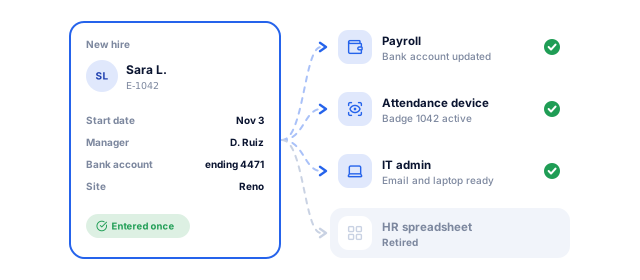
A new hire entered once in the HR system, with name, start date, manager and bank account, pushed to payroll, the attendance device and IT admin, while the old HR spreadsheet is retired

The same data typed into four systems

A new hire is often typed into an HR spreadsheet, the payroll portal, the attendance device and the IT console, and each copy drifts. A custom HRMS makes the employee record the source and pushes changes everywhere else, so a new manager or bank account is entered once. Our API development team builds and monitors those connections.

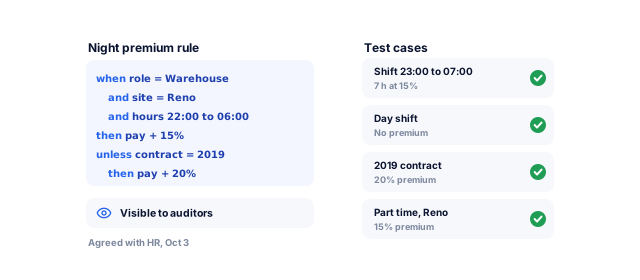
A night premium rule written down with HR in plain logic, with an exception for an older contract, and the agreed test cases that prove the system applies it the same way every time, visible to auditors

Policies that only live in someone's head

Many leave and overtime rules exist as exceptions: a different accrual at one site, a night premium for some roles, a grandfathered contract. Packaged tools push these into manual adjustments. We write each rule down with HR, agree test cases, and encode it so the system applies it the same way every time, visible to auditors.

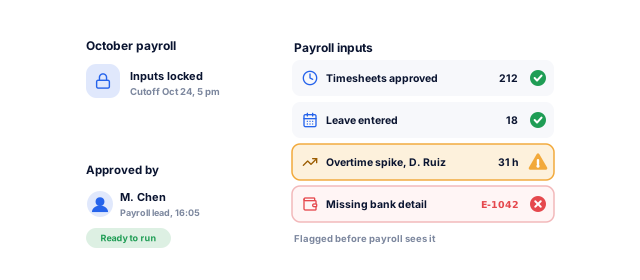
Payroll inputs locked at the cutoff with approved timesheets and leave in, an overtime spike and a missing bank detail flagged before payroll runs, and the approver recorded with a time

Payroll inputs that arrive late or wrong

Payroll problems usually start upstream: unapproved timesheets, leave entered after cutoff, overtime worked out by hand. The HRMS locks inputs at a cutoff, flags anomalies such as an overtime spike or a missing bank detail before they reach payroll, and records who approved each item.

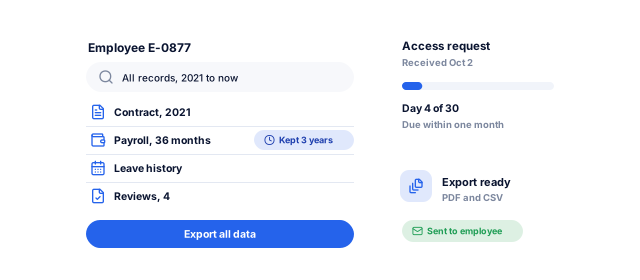
One employee's records found in one search, with payroll kept for three years under a retention rule, a subject access request tracked against its one month deadline and a full data export ready to send

Audits and data requests that take days

When an auditor, regulator or employee asks for records, HR often searches inboxes and shared drives. In the US, the Department of Labor requires employers to keep payroll records for at least three years. Under UK GDPR, a subject access request must be answered within one month, according to the ICO. Searchable history, retention rules and a one-click export of a person's data make both routine.

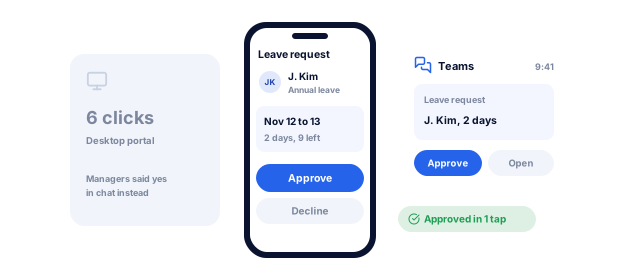
A leave request approved in one tap on a phone or straight from a Teams message, instead of six clicks on a desktop portal that managers used to skip

Managers who work around the system

If approving leave takes six clicks on a desktop, managers approve it in a chat message and HR re-keys it later. We design self-service for phones first, send approvals to email, Slack or Microsoft Teams, and build a mobile app when offline check-in is needed. If people avoid a screen, we change the screen.

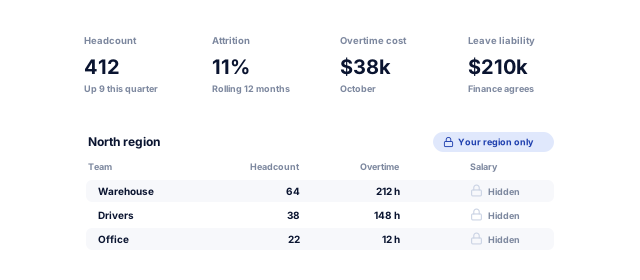
Headcount, attrition, overtime cost and leave liability read the same by HR and finance, with a regional manager drilling into their own region while salaries stay hidden for their role

Workforce numbers nobody trusts

Headcount, attrition, overtime cost and leave liability are often calculated differently by HR and finance. With one effective-dated record, both read the same numbers. We add standard reports and a custom dashboard for leadership, with drill-down limited by role, so nobody sees salaries they should not.

Not sure whether to build or buy?

Tell us what you need. We look at your HR processes, headcount and payroll setup, and send a written plan to configure an HR platform, connect it, or build one you own, with a price range and timeline.

What do you need?

Free, with no obligation. Rather talk? Book a 30-minute call

Our HR software development process

  1. Policy and systems discovery

    We interview HR, payroll, finance and IT, collect your handbook, contracts and spreadsheets, and list every system holding employee data. Each policy rule is written down with a worked example, because a rule nobody can state cannot be coded.

    • Policy and rules register
    • Systems and data flow map
    • Build, buy or extend recommendation
    A decision based on your rules, not a demo
  2. Design and data model

    We design the data model with effective dates, a permission matrix for every role and sensitive field, and screens for employees, managers and HR. Real managers test a clickable prototype before development starts.

    • Data model and permission matrix
    • Clickable prototype
    • Integration specification
    Agreed scope and access rules
  3. Build in two-week sprints

    We start with employee records and one high-value process such as leave, with a staging demo every two weeks. Automated tests built from discovery examples stop a later overtime change from breaking leave accruals.

    • Working modules every two weeks
    • Automated rule tests
    • Sprint demos and notes
    Progress you can see and test
  4. Integrations and data migration

    We connect payroll, accounting, identity and attendance systems, then map, clean and migrate employee history from spreadsheets or the old HRMS with repeatable scripts. Headcount, leave balances and salaries must reconcile with the source.

    • Integration connectors with error alerts
    • Migration scripts and reconciliation
    • Data cleanup log
    Clean history in the new system
  5. Parallel run and launch

    We run at least one pay period in parallel and compare payroll inputs line by line with the old process. Admins and managers get short, role-based training, and we launch by location or module when one switchover is too risky. The old system retires after your sign-off.

    • Parallel payroll comparison
    • Role-based training and guides
    • Go-live checklist
    No surprises on payday
  6. Support and improvement

    After launch we monitor errors and adoption, apply security updates, and update rules when policies or local requirements change. A monthly review agrees the next improvements and modules, on a rolling agreement.

    • Monitoring and security updates
    • Monthly improvement review
    • Handover documentation
    A system that keeps up with your policies

Custom HRMS and HRIS development for your situation

The modules look similar everywhere. What changes is where the complexity sits.

01 / 05

Organizations in several countries

Each country has its own payroll reporting, leave and privacy law. UK payroll data reaches HMRC through a Full Payment Submission sent on or before payday. The US adds federal and state withholding and I-9 checks; India has PF, ESI, professional tax and TDS; Canada has CPP, EI and T4 slips; Australia has Single Touch Payroll and superannuation. We keep country rules in configuration, confirmed with your advisers.

02 / 05

Hospitals, clinics and shift-based teams

Healthcare and other 24-hour operations run on rosters: night premiums, minimum staffing per ward, license expiry and supervisor-approved shift swaps. We build rostering that applies those rules and warns before a shift goes uncovered. HR data can sit beside a hospital management system without exposing patient records. See our healthcare work.

03 / 05

Field, retail and multi-site teams

When people clock in at stores, sites or customer locations, attendance has to work on a phone with poor signal. We build geofenced check-in that syncs when the connection returns, QR or photo verification where policy requires it, and site views for area managers, while workflow automation handles reminders.

04 / 05

Replacing spreadsheets or an outgrown HR tool

Many projects start with HR on spreadsheets, or with a packaged HRMS outgrown after growth or an acquisition. We migrate clean records and one process first, then replace the rest in stages, so nobody loses a working tool before its replacement is proven. Older on-premise systems move step by step through legacy system modernization.

05 / 05

HR tech products and SaaS

If you are building an HR, payroll or workforce product to sell, HRIS development changes shape: multi-tenant data, per-customer policies, an admin console and the integrations prospects ask for. We build it through our SaaS application development practice, with tenant isolation and audit logs that pass enterprise security reviews.

Off-the-shelf HRMS vs custom HR software

Three paths, and we deliver all three. Many organizations choose the middle: a packaged HRMS, with custom modules where their rules differ.

Book a strategy call
FactorOff-the-shelf HRMSOff-the-shelf plus custom modulesCustom HRMS
Upfront costLowest: setup and implementation feesMedium: integrations and a few custom modulesHighest: full design and build
Ongoing costPer-employee subscription that grows with headcountSubscription plus maintenance of the custom partsHosting and maintenance, no per-seat fee
Time to launchWeeks to a few monthsAbout 2 to 4 months for the custom partsAbout 3 to 4 months for a first module, 6 to 9+ for a full platform
Fit for unusual rulesLimited to the product's settingsGood for the processes you customizeBuilt around your policies
Statutory payroll updatesHandled by the vendor in supported countriesHandled by the vendor or payroll providerIntegrate a payroll provider rather than rebuild
Data hosting and controlVendor's cloud and regionsMixed: core data with the vendorYour cloud account, region and retention rules
Best forStandard policies, one or two countries, a small HR teamMostly standard needs with a few hard exceptionsComplex rules, several entities, strict data needs or an HR product

Timelines and costs are typical ranges, not quotes. Compare total cost over three to five years, including implementation, integrations and staff time spent on manual workarounds.

Your HRMS project, week by week

A first module is usually live in 3 to 4 months; a full platform takes 6 to 9 months or more.

Book a strategy call
  1. 1Weeks 1 to 4

    Policy discovery and design

    • Policy register with a worked example per rule
    • Data model, permission matrix and integration map
    • Clickable prototype tested with real managers
    • From you: HR, payroll and IT owners, plus handbook and spreadsheets

    By week 4, you have a written recommendation, agreed scope and a quote.

  2. 2Weeks 5 to 12

    Build the first module

    • Employee records plus leave or onboarding on staging
    • Sprint demo every two weeks
    • Automated tests for every policy rule
    • From you: feedback at demos and answers to policy questions

    By week 12, the first module is complete on staging.

  3. 3Weeks 13 to 16

    Integrate, migrate and launch

    • Payroll, identity and accounting connections with alerts
    • Migration rehearsal with reconciliation reports
    • Parallel pay period and role-based training
    • From you: testers from HR and payroll, and launch sign-off

    By week 16, your first module is live, and the code and data are yours.

What you sign off, step by step

You approve each stage before the next one starts, and the project ends with software you own and the documents to run it.

Along the way you get

  • A process map and clickable prototype before any build
  • Working software to review every sprint
  • A rehearsed data migration before go-live
  • Training for each role before launch
Go-live checklistSample
  1. 1Process map and requirementsApproved
  2. 2Data model and integrations planApproved
  3. 3Clickable prototypeApproved
  4. 4Automated testsPassing
  5. 5Data migration rehearsalDone
  6. 6User acceptance testingSigned off
  7. 7Roles and security reviewPassed
  8. 8Training and handoverBooked
A sample of the checklist. Every project gets its own, signed off with you.

Yours to keep, always. Everything is set up in your name, and if you leave we remove our access and hand over the documentation.

  • Source code and repository
  • Your database and all your data
  • Cloud and hosting accounts
  • Design files
  • Documentation and admin logins

Who HR management system development from improveFX is for

For HR teams that have outgrown spreadsheets or a standard tool.

Book a strategy call

A good fit if

  • Organizations with pay, leave or shift rules a packaged HRMS cannot hold
  • Groups with several entities or countries on one employee record
  • Hospitals, retailers and field teams running rosters across sites
  • Teams that want employee data in their own cloud account

We can also help when

  • A packaged HRMS covers most of it: we set it up, connect payroll and identity, and build only the missing module
  • Budget is tight this year: we build the module that saves HR the most time first, then add the rest in phases
  • Your current HR system still works: we replace it one process at a time and keep it running meanwhile
  • You also need orders or billing in one place: our business management software work joins them to the same record

Why choose improveFX as your HRMS development company

01

A written plan to build, buy or extend

Discovery ends with a written recommendation. If an HRMS subscription with two integrations covers you, we set it up and build those integrations, for a fraction of a custom system's cost. When your rules, data or scale call for custom, we build it. Clients stay with us 1.6 years on average.

02

Software, cloud and automation in one team

Developers, designers, cloud engineers and automation specialists work in one in-house team in New Delhi, so integrations, hosting and dashboards need no vendor handoffs. We built custom hospital software for AkosMD in Arizona and run our own healthcare product line, Nabhaya.

03

Your code, your data, your servers

You own the source code, database and documentation, and the system runs in a cloud account in your name, with our access added to it, so employee data stays where your policies require. If you move it in-house later, the handover includes everything your team needs. Clients rate us 4.9 on Clutch from 221 reviews.

Results we can put numbers on

Software and growth results from client reviews and case studies, with the full story behind each number.

See all case studies
AkosMDHealthcare, Arizona

+57%

patient footfall

An Arizona hospital became the first call for urgent care

Read the case study
MastersBuddyStudy abroad consulting

160+

keywords in Google's top 10

A new consultancy broke into one of India's most competitive markets

Read the case study
Eric OriginalsJewelry ecommerce

+1,900%

organic traffic

A struggling jewelry website became a steady source of buyers

Read the case study

What our clients say

"From designing a high-converting website to managing our SEO, Google Ads, and Google Business Profile, improveFX delivered exceptional results across every channel."
210%more qualified leads
185%organic and local traffic growth
92%keywords on page one
Maureen CappalloBroker and founder, Momentus Real Estate Group
"They revolutionized our online presence with a 60% increase in web traffic through strategic e-commerce SEO and content optimization."
60%more organic traffic
47%more sales
Eric NoahPresident, Eric Originals & Antiques Ltd.
"Visionstar Technologies' online presence transformed significantly with a 40% boost in customer engagement, all thanks to their exceptional website structuring and SEO tactics."
+40%qualified leads
32%lower cost per acquisition
Thomas MorelFounder, Visionstar Technologies
"Their strategic approach to our website and SEO resulted in a 60% increase in local inquiries, revolutionizing our automobile service business."
60%more local inquiries
87%more organic traffic
Mike SteffanFounder, Sabulski Window Tinting
"Their SEO strategy helped us achieve top search rankings, while their Facebook Ads campaigns drove a steady flow of qualified prospects."
55%more organic traffic
4.7xreturn on ad spend
75%keywords on page one
Amita NaithaniCo-founder, Amita Naithani Resort Wear

HR management system development questions, answered

Not seeing yours? Ask us directly and a specialist will reply personally.

How much does HR management system development cost?

Our software projects run from under $5,000 to $100,000+, depending on scope. One module such as leave, for one country with a clean spreadsheet to migrate, sits at the low end. Several countries, many roles, payroll and ERP integrations and years of history push it to the high end.

Hosting and maintenance continue after launch but replace per-employee fees that grow with headcount. We quote after a free discovery call, pricing each module separately so you can phase the work.

How long does custom HRMS development take?

A first module, usually employee records plus leave or onboarding, typically takes about 3 to 4 months. A full platform with payroll integration, performance reviews and self-service usually takes 6 to 9 months or more.

Discovery and design take 2 to 4 weeks. After that, the schedule depends most on how quickly policy questions are answered, how clean your data is, and how many systems must be connected. HR uses working modules early.

Should we build a custom HRMS or buy an off-the-shelf one?

If your policies are standard and a packaged HRMS supports your countries, we set it up and connect it to payroll and identity systems. When your rules, integrations, data hosting or scale make it a constant workaround, we build custom modules or a full HRMS.

A useful test: list the HR work done outside your system each month. A few exceptions call for configuration; whole processes kept in spreadsheets, such as shift rostering, call for a custom module.

Do you build payroll into the HRMS?

We build payroll inputs and the rules around them, and connect a payroll provider for statutory calculations, payslips and filings, because providers update tax tables and filing formats every year as their core business.

The HRMS handles hours, overtime, leave deductions, allowances and approvals, sends them to the provider, and pulls results back for payslips and journals. We build, monitor and maintain that connection, whether you use ADP, Gusto, Deel or Xero Payroll.

What is the difference between an HRMS and an HRIS?

An HRIS (human resources information system) usually means the system of record for employee data. An HRMS (human resources management system) usually adds processes such as leave, attendance, payroll inputs, onboarding and performance on top of that record.

Vendors also use HCM (human capital management), which often adds talent and workforce planning. For HRMS software development, we scope by module and integration rather than by label.

How do you protect employee data?

With role-based and field-level permissions, single sign-on, encryption in transit and at rest, audit logs and retention rules for each record type, all agreed before development starts.

We design for the privacy laws that apply to you, such as GDPR in the EU and UK or India's Digital Personal Data Protection Act, 2023: exports for access requests, deletion when retention ends, and logs of who viewed sensitive fields. Your legal adviser sets the policy; the software enforces it.

Can the HRMS integrate with our ERP, accounting and identity systems?

Yes. We integrate with ERP and accounting systems such as SAP, NetSuite, QuickBooks and Xero, identity providers such as Microsoft Entra ID, Okta and Google Workspace, and attendance devices, through APIs or scheduled file exchanges.

Each field has one owner system, and every integration has error alerts and retries, so a failed sync is noticed the same day. Systems without a usable API get a validated file import.

Can you migrate data from our current HR system or spreadsheets?

Yes. We migrate employee records, job history, leave balances and documents with repeatable scripts and reconciliation reports that prove the totals match the source.

Migration usually exposes duplicates, missing start dates and inconsistent job titles. We log every cleanup decision with HR, run trial migrations on staging, and do the final load just before launch, so nothing entered in the meantime is lost.

Can one HRMS handle employees in several countries?

Yes, if it is designed for it from the start, with separate legal entities, currencies, holiday calendars, leave policies, payroll connectors and data residency rules per country.

We confirm statutory requirements with your local advisers or payroll provider rather than encoding our own reading, and keep country rules in configuration, so adding a market does not mean rewriting the system.

What support do you provide after launch?

We offer ongoing support on a rolling agreement: monitoring, security updates, bug fixes and rule changes when your policies or local requirements change.

Each month you get a report of incidents, changes and adoption, plus a review of what to improve or add next. You own the code and documentation, so you can move maintenance in-house or to another team at any time.

Ready to plan your software?

Tell us how the work runs today, or book a strategy call with our team.

  • What we would build first, or what to buy and configure
  • A price range and timeline for your budget
  • A call with a specialist to plan the next steps, no obligation
Vikash Kumar PalRoshan Kumar JhaAbhishek Kumar Jha A specialist replies personally 4.9 from 566 client reviews
What do you need help with?

Pick all that apply.

Next, a few details about your business on our contact page. It takes about a minute.

Prefer to talk now? Book a strategy call