



















Custom business management software development that runs your operation in one system

Our custom business management software development service builds one system for work now spread across spreadsheets, inboxes and separate subscriptions: quotes, orders, jobs, stock, purchasing, invoicing and the handoff to your accountant. It suits growing companies that have outgrown off-the-shelf tools but do not need a full ERP.

  • 170+projects delivered
  • 4.9
    221 reviews
  • 1.6 yrsaverage client relationship
Today across the businessLive
Open orders38+5 today
Invoices due$22,6007 this week
Jobs running143 late
One system for every team
  • Sales, jobs and invoices linked
  • Approvals by role
  • Reports without spreadsheets

120+ businesses chose us for their digital growth

  • AkosMD Hospital
  • Amita Naithani Resort Wear
  • Momentus Real Estate Group
  • CleverBoss
  • MastersBuddy
  • Foley Mansfield
  • Pomegranate Health
  • Trunk Box Baby
  • Hunt Ortmann
  • Immigration Desk
  • Urology Partners
  • Jodi Carlton
  • Ecom Fashion
  • Eye on Security
  • Disability Solutions
  • One400
  • Eric Originals
  • Sabulski Window Tinting
  • History of Soccer

Business management software at a glance

Business management software development is the design and build of one custom system that runs a company’s core operations: quotes and orders, jobs, inventory, purchasing, invoicing and reporting, with clean handoffs to accounting, so every team works from the same live record.

  • If your process is standard, a suite such as Zoho One, Odoo or QuickBooks costs less and starts faster, and we set it up and connect it for you.
  • Build when the way you quote, schedule or deliver sets you apart, or when workarounds and per-user fees keep growing.
  • Keep the accounting package your accountant knows and sync to it, rather than rebuilding the ledger.
  • Ship one module at a time, starting with the handoff that costs the most hours.
Best for
Growing companies running sales, operations, stock and billing across spreadsheets and several disconnected apps
What you get
Process map, data model, web app (plus mobile where needed), accounting and tool integrations, data migration, training and support
Typical timeline
Discovery in 2 to 4 weeks. First module live in about 3 to 4 months. A multi-department system in 6 to 12 months, released in phases.
Pricing
Driven by modules, user roles, integrations and data migration. Our software projects run from under $5,000 to $100,000+, depending on scope. Fixed quote per phase after a free discovery call, with no per-user subscription afterward.

What our custom business management software development covers

Six connected modules on one data model, built in the order that removes the most manual work first, and only the ones you need.

Get a free proposal

Process map and shared data model

Before any code, we follow a real order from first inquiry to paid invoice and note every place someone re-types data or waits. From that we design one data model of customers, products, price lists, jobs, stock locations and permissions, shared by every module.
Quotes, orders and customer records

Quotes follow your price rules, discounts and approval limits, then become orders in one step, visible to sales, operations and finance. Customer history and documents sit on one record. For pipeline forecasting and follow-ups, our custom CRM development team adds a connected module.

Jobs, scheduling and field work

Orders become jobs, work orders or service visits with assigned people, checklists, due dates and capacity limits. Field staff update progress, photos and signatures from a phone, offline where needed. For client projects with budgets and time tracking, see our project management software service.

Inventory and purchasing

Stock is tracked by warehouse, van or store and reserved when an order is confirmed. Reorder points raise purchase orders for approval, goods received update stock and cost, and batch or serial numbers are tracked where needed. For complex warehousing, see our inventory management system work.

Billing and finance handoffs

Invoices are created from delivered orders or completed jobs, never typed again. Instead of rebuilding a ledger, we sync invoices, payments, customers and items to QuickBooks Online, Xero, Zoho Books or TallyPrime, with tax codes mapped. Our invoice and billing automation team adds reminders and payment links.

Reports, roles and audit trail

Live views of open orders, overdue jobs, stock value and margin. Role-based access means a warehouse user sees stock but not margins, and every change is logged. For one screen across several systems, see custom dashboard development.

What changes when the business runs on one system

A business management system earns its cost by removing handoffs, not adding features. These are the changes we scope first and measure.

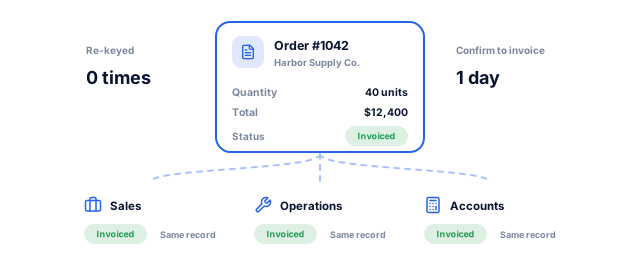
One order record that sales, operations and accounts all read, showing the same invoiced status, with the order never re-keyed and one day from confirmation to invoice

One version of every order

When sales, operations and accounts each keep their own copy, the same order is typed three times and checked by email. On one system it is entered once and every team reads the same status. We measure re-keying and the days between confirmation and invoice.

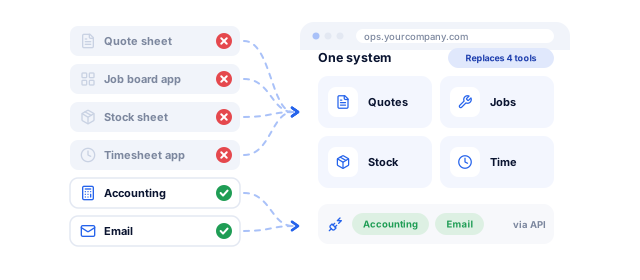
Four separate tools for quotes, jobs, stock and time replaced by one system with those modules, while accounting and email are kept and connected to it

Fewer disconnected tools

Most businesses add an app for each problem, then pay people to move data between them. MuleSoft’s 2026 Connectivity Benchmark Report found the average organization manages 957 applications and only 27% are connected, as reported by CIO Dive. Smaller firms run fewer apps, but the pattern holds. We replace tools that duplicate work and integrate the ones worth keeping.

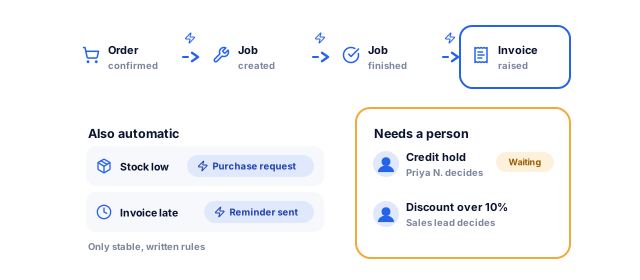
An order that moves itself from confirmed to job created to job finished to invoice raised, rules that raise purchase requests and payment reminders, and credit holds and discounts left to named people

Handoffs that do not need chasing

Rules move work forward: a confirmed order creates a job, a finished job raises an invoice, low stock raises a purchase request and an overdue invoice sends a reminder. People handle exceptions, and judgment calls such as credit holds stay with a named person.

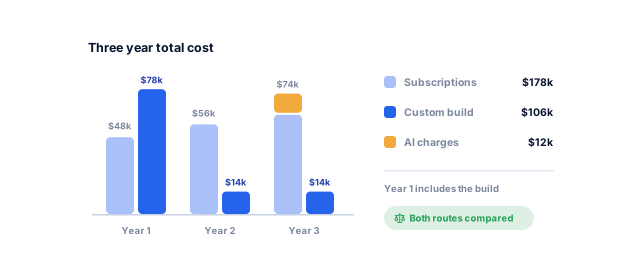
A three year total cost comparison: per user subscriptions rising each year with surprise AI charges, against a custom build that costs more in year one and then only hosting and support

Running costs you can plan

Subscription suites charge per user, and prices change. Zylo’s 2026 SaaS Management Index found that 78% of IT leaders hit unexpected charges tied to AI features or consumption-based pricing. Custom software swaps subscriptions for build, hosting and support costs, so we compare three years of total cost for both routes and set up whichever wins.

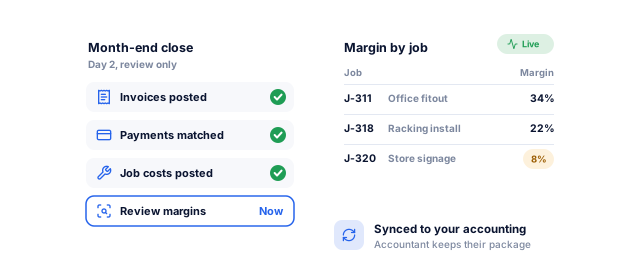
A month-end close where invoices, payments and job costs have already posted, leaving only a margin review, beside live margin by job and a sync to the accountant's own package

Month-end without the scramble

When invoices, payments and job costs flow into accounting as they happen, month-end becomes a review, not a reconstruction. Margin by job, customer or product is live, and your accountant keeps the package they know.

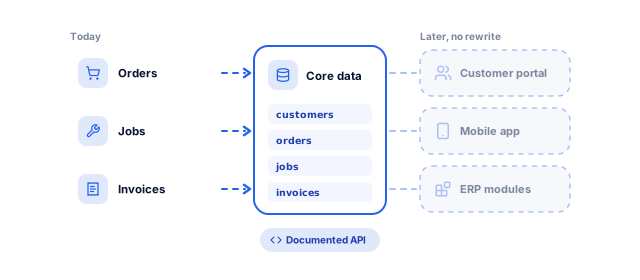
A core data model running orders, jobs and invoices today, with a customer portal, a mobile app and ERP modules ready to plug into its documented API later without a rewrite

Room to grow without starting over

A clean data model and documented APIs let you add modules, a portal or a mobile app later without a rewrite. If you need multi-entity accounting or manufacturing planning, the system can feed an ERP rather than be replaced, and our ERP software development team plans for that early.

Not sure whether to build, buy or configure?

Tell us what you need. We look at how your teams work today and the tools they use, and send a written plan to build, buy or configure, with a price range and timeline.

What do you need?

Free, with no obligation. Rather talk? Book a 30-minute call

Our business software development process

Our business management software development services run in six phases, with working software early and a decision point before any large spend.

Book a strategy call
  1. Discovery and process mapping

    We interview the people doing the work in sales, operations, stores and accounts, trace real orders end to end and collect your spreadsheets and tool list. This takes two to four weeks.

    • Current-state process map
    • Tool and data inventory
    • Pain points ranked by hours lost
    A shared picture of how work really flows
  2. Build or buy decision

    We compare a configured SaaS suite, a packaged ERP and custom software, sometimes combined, against your must-have workflows, with three-year costs and risks for each. If buying wins, we set up and connect the product, then build only what it cannot do.

    • Options comparison
    • Three-year cost estimate
    • Written recommendation
    A decision you can defend
  3. Scope, data model and prototype

    We define modules, user roles, integrations and data migration, design the database and APIs, and build a clickable prototype your team tests before development. Then you get a fixed quote for the first phase.

    • Module and role scope
    • Data model and integration plan
    • Clickable prototype
    • Fixed quote for phase one
    No surprises during the build
  4. Build in two-week sprints

    We build the module that removes the most manual work first, on Laravel or Node.js with PostgreSQL, and demo it on staging every two weeks. You can change priorities between sprints.

    • Fortnightly demos on staging
    • Release notes and test reports
    • Updated backlog
    Working software early, not at the end
  5. Migration, integration and go-live

    We clean and import customers, products, open orders and opening stock, connect accounting and other tools, and reconcile totals before switching. Old and new run side by side, and each team is trained on its own screens.

    • Migrated and reconciled data
    • Live integrations
    • Role-based training
    A cutover your team trusts
  6. Support and next modules

    After launch we monitor errors and performance, fix issues under an agreed support plan and review usage monthly to plan the next module. You hold the source code, documentation and hosting accounts throughout.

    • Monitoring and support plan
    • Monthly usage review
    • Roadmap for the next phase
    A system that keeps fitting the business

Business management software for the way you operate

The modules stay much the same from sector to sector. What changes is which handoff hurts most, and that is where business management software development should start.

01 / 05

Distributors and wholesalers

Distribution runs on price lists, credit limits, stock across locations and orders by phone, email and portal. We build customer-specific pricing, order entry that checks stock and credit together, pick lists, delivery notes and synced invoices, plus a B2B portal. The same stock can feed an ecommerce website.

02 / 05

Field and home services

Service businesses lose money between booking and invoice. We build scheduling by skill and area, a technician app with checklists, photos and signatures, van stock, and invoices raised when a job closes. Bookings can come from your website through appointment scheduling software.

03 / 05

Manufacturing and workshops

Small manufacturers and workshops need job costing long before full material requirements planning. We build bills of materials, work orders, material issue and labor capture per job, so you know whether a job made money while it is on the floor. When multi-site planning arrives, we extend it with ERP development.

04 / 05

Professional services firms

Firms that bill for time need proposals, timesheets, retainers and utilization in one place. We connect proposals to projects, time to invoices and invoices to your accounting package, with a client portal for approvals, so partners see unbilled time weekly. See our professional services work.

05 / 05

Clinics and healthcare groups

For clinics, the fastest route is often our own Nabhaya Clinic, which handles appointments, patient records, pharmacy counter billing, inventory and GST invoices for clinics in India. We set it up and build custom work for what it cannot cover, such as group reporting across sites. See our healthcare work.

Custom business management software vs SaaS suites vs ERP

Three ways to get one system for your operations. Compare running costs and fit, not only the first-year price.

Book a strategy call
FactorSaaS suite (Zoho One, Odoo Online, QuickBooks plus apps)Packaged ERP (NetSuite, Business Central, SAP Business One)Custom business management software
Upfront costLow: setup and configurationMedium to high: licenses plus an implementation partnerHigh: discovery, design and build
Ongoing costPer-user subscription that rises with headcount and plan changesPer-user licenses plus partner support and upgradesHosting, support and change requests, with no subscription
Time to first useDays to weeksMonths, depending on modulesFirst module in about 3 to 4 months
Fit to your processYou adapt to the product's workflowHighly configurable, but customizations add cost at every upgradeBuilt around your workflow and rules
IntegrationsApp marketplace and APIs, within the vendor's limitsPartner connectors and APIsAny system with an API, designed in from the start
OwnershipVendor controls roadmap and pricing; you can export your dataVendor controls the platform; you and your partner control configurationYou own the code, data and hosting accounts
Best whenYour process is standard and the team is smallYou need multi-entity accounting, consolidation or manufacturing planning at scaleYour process is what sets you apart, or per-user costs and workarounds keep growing

Vendor prices are left out because they vary by edition, region, user count and contract term; check each vendor’s pricing page. Many businesses combine routes, such as a custom operations system that syncs to QuickBooks Online or Xero.

Your business management software project, week by week

Your first module goes live in about 3 to 4 months; later modules repeat the build and go-live phases.

Book a strategy call
  1. 1Weeks 1 to 4

    Discovery and route decision

    • Process map traced from real orders
    • Tool and data inventory, pain points ranked by hours lost
    • Build, buy or configure comparison with three-year costs
    • From you: process owners from sales, operations, stores and accounts

    By week 4, you have a route you can defend and the first module chosen.

  2. 2Weeks 5 to 12

    Prototype and first module build

    • Module scope, data model and clickable prototype
    • Fixed quote for phase one
    • Two-week sprints demoed on staging
    • From you: spreadsheets, exports and access to accounting and current tools

    By week 12, your team is testing the first module on staging.

  3. 3Weeks 13 to 16

    Migration, training and go-live

    • Customers, products, open orders and opening stock imported
    • Accounting sync tested and totals reconciled
    • Role-based training and a side-by-side run
    • From you: testers from each team and opening balance sign-off

    By week 16, the first module is live, reconciled and in daily use.

What you sign off, step by step

You approve each stage before the next one starts, and the project ends with software you own and the documents to run it.

Along the way you get

  • A process map and clickable prototype before any build
  • Working software to review every sprint
  • A rehearsed data migration before go-live
  • Training for each role before launch
Go-live checklistSample
  1. 1Process map and requirementsApproved
  2. 2Data model and integrations planApproved
  3. 3Clickable prototypeApproved
  4. 4Automated testsPassing
  5. 5Data migration rehearsalDone
  6. 6User acceptance testingSigned off
  7. 7Roles and security reviewPassed
  8. 8Training and handoverBooked
A sample of the checklist. Every project gets its own, signed off with you.

Yours to keep, always. Everything is set up in your name, and if you leave we remove our access and hand over the documentation.

  • Source code and repository
  • Your database and all your data
  • Cloud and hosting accounts
  • Design files
  • Documentation and admin logins

Who business management software development from improveFX is for

We build one system for growing companies that want every team on the same live record.

Book a strategy call

A good fit if

  • Companies running orders, jobs, stock and billing across spreadsheets
  • Distributors, field service teams, workshops and professional services firms
  • Teams whose way of quoting, scheduling or delivering sets them apart
  • Businesses paying for several per-user subscriptions they work around

We can also help when

  • Zoho One or Odoo covers most of your process: we set it up, connect it and build only the missing part
  • You only need your current tools to talk: our workflow automation team connects them
  • Your budget is tight this year: we build the module that saves the most hours first and add the rest in phases
  • You run a clinic: we set up Nabhaya Clinic and build only what it does not cover

Why choose improveFX as your business management software development company

01

When a product fits, we set it up and connect it

Discovery can point to a product. If Zoho One, Odoo or a packaged ERP fits your process, we set it up and our API development team connects it to the tools you keep. We build only what the product cannot do, so your budget goes to the part of the business that sets you apart.

02

We build and run our own software

improveFX builds, hosts and supports its own healthcare product line, Nabhaya, used by clinics daily, so access control, audit trails, backups and monitoring are planned from the start. Our 25+ in-house specialists in New Delhi keep design, engineering and QA under one roof.

03

Your code, your data, rolling terms

You own the source code, database, documentation and cloud accounts, with no per-user license from us. Support runs on rolling agreements with monthly reporting on issues fixed and work delivered. Clients rate us 4.9 on Clutch from 221 reviews and stay 1.6 years on average. See our case studies.

Results we can put numbers on

Results from our case studies and client reviews, including the custom hospital software we built for AkosMD.

See all case studies
AkosMDHealthcare, Arizona

+57%

patient footfall

An Arizona hospital became the first call for urgent care

Read the case study
MastersBuddyStudy abroad consulting

160+

keywords in Google's top 10

A new consultancy broke into one of India's most competitive markets

Read the case study
Eric OriginalsJewelry ecommerce

+1,900%

organic traffic

A struggling jewelry website became a steady source of buyers

Read the case study

What our clients say

"From designing a high-converting website to managing our SEO, Google Ads, and Google Business Profile, improveFX delivered exceptional results across every channel."
210%more qualified leads
185%organic and local traffic growth
92%keywords on page one
Maureen CappalloBroker and founder, Momentus Real Estate Group
"They revolutionized our online presence with a 60% increase in web traffic through strategic e-commerce SEO and content optimization."
60%more organic traffic
47%more sales
Eric NoahPresident, Eric Originals & Antiques Ltd.
"Visionstar Technologies' online presence transformed significantly with a 40% boost in customer engagement, all thanks to their exceptional website structuring and SEO tactics."
+40%qualified leads
32%lower cost per acquisition
Thomas MorelFounder, Visionstar Technologies
"Their strategic approach to our website and SEO resulted in a 60% increase in local inquiries, revolutionizing our automobile service business."
60%more local inquiries
87%more organic traffic
Mike SteffanFounder, Sabulski Window Tinting
"Their SEO strategy helped us achieve top search rankings, while their Facebook Ads campaigns drove a steady flow of qualified prospects."
55%more organic traffic
4.7xreturn on ad spend
75%keywords on page one
Amita NaithaniCo-founder, Amita Naithani Resort Wear

Business management software questions, answered

Not seeing yours? Ask us directly and a specialist will reply personally.

How much does business management software development cost?

Our software projects run from under $5,000 to $100,000+, depending on scope. We give a fixed quote for each phase after a free discovery call.

A system sits near the low end with one module, a few user roles and clean data. It moves toward the high end with more modules, accounting and tool integrations, a large migration, mobile apps for field teams and complex approval rules. Budget for hosting and support too, against per-user subscriptions that grow with your team.

How long does it take to build custom business management software?

A first module is usually live in about three to four months, including two to four weeks of discovery. A multi-department system typically takes six to twelve months, released in phases.

You see working software much earlier, in demos on staging every two weeks. Timelines stretch mainly with data migration, integrations and slow decisions, so we agree one decision owner on your side at the start.

What is the difference between business management software and ERP?

ERP is business management software built for larger, multi-entity organizations, with full accounting, procurement and often manufacturing planning. A custom business management system can be much lighter.

Many growing companies need orders, jobs, stock and billing in one place, but not their own general ledger. A focused system synced to their accounting package covers that at lower cost. When multi-entity finance or complex production planning arrives, we move you to ERP software development.

Should we buy off-the-shelf business management software or build our own?

When a product covers your must-have workflows, we set it up and connect it to your tools. Build when the way you quote, schedule or deliver sets you apart, or when workarounds and per-user fees keep growing.

Common products include QuickBooks Online or Xero, Zoho One or Odoo, Shopify, and NetSuite or Business Central. Many firms keep a product for accounting and have us build only the operational layer.

Can custom software integrate with QuickBooks, Xero or Tally?

Yes. QuickBooks Online, Xero and Zoho Books offer APIs, and TallyPrime supports XML-based integration, so invoices, payments, customers and items can sync automatically.

We map products, tax codes and ledger accounts so entries land correctly, decide which system is the master for each record, and log every sync so failures are visible and retried. Your accountant keeps working in the package they know.

What features should business management software include?

At minimum: customer records, quotes and orders, jobs or projects, inventory and purchasing, invoicing with an accounting sync, reporting, and role-based access with an audit trail.

Beyond that, include only what your process needs: an offline mobile app for field teams, customer price lists for distributors, timesheets and retainers for service firms. We push back on features nobody will use, because every module costs money to build and maintain.

Is custom business management software worth it for a small business?

Not always as a first step. For a small business with standard processes, we set up a subscription suite and accounting package and connect them.

Custom becomes worth it when staff spend hours each week moving data between tools, when your process creates errors products cannot prevent, or when several per-user subscriptions cost more than running your own system. In between, our workflow automation team connects the tools you already have.

Who owns the source code and the data?

You do. The source code, database, documentation and cloud hosting accounts belong to you from the start, with admin logins in your name and our access added to your accounts.

If you later move development in-house or to another team, you take everything with you, including deployment scripts and API documentation. Ownership is written into the agreement rather than left to trust.

How do you move us off spreadsheets without disrupting work?

We migrate in phases and run the old and new process side by side until the numbers match. Nothing is switched off until each team signs off.

First we remove duplicates, standardize product codes and agree opening balances for stock and receivables. We import open orders in test runs, reconcile totals against your spreadsheets, then cut over one team or location at a time.

Ready to plan your software?

Tell us how the work runs today, or book a strategy call with our team.

  • What we would build first, or what to buy and configure
  • A price range and timeline for your budget
  • A call with a specialist to plan the next steps, no obligation
Vikash Kumar PalRoshan Kumar JhaAbhishek Kumar Jha A specialist replies personally 4.9 from 566 client reviews
What do you need help with?

Pick all that apply.

Next, a few details about your business on our contact page. It takes about a minute.

Prefer to talk now? Book a strategy call