Price prediction model development you can test before you trust
Our price prediction model development service builds and runs price forecasting models for your business: done for you, not a tutorial or a one-off notebook. We forecast prices, or the demand expected at a given price, for procurement and commodity buyers, retailers using dynamic pricing, property businesses, travel operators and marketplaces, backtest every model against simple baselines, and run it in production with monitoring.
Price prediction model development means building, testing and running machine learning models that forecast prices, or demand at a given price, for a business decision. As an improveFX service, it runs from data and backtests to deployment and monitoring, for procurement and commodity buying, dynamic pricing, real estate valuation and markdown planning.
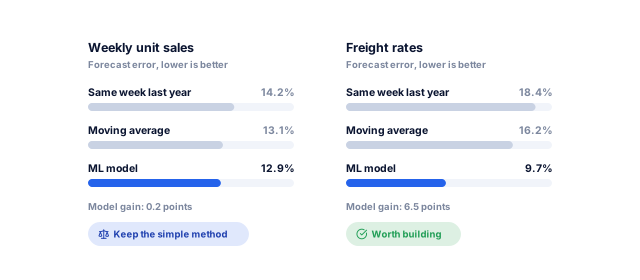
A model earns its place only if it beats a naive or seasonal naive forecast on data it has not seen.
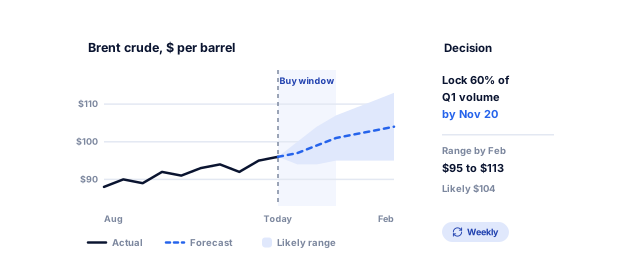
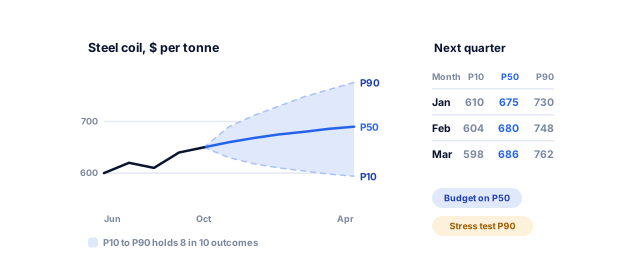
Forecasts should come with a range. A single number hides the risk you are taking.
Gradient boosted trees such as LightGBM are a strong default for tabular price data.
Markets shift, so every model needs drift monitoring and a retraining schedule.
Best for
Procurement, retail, property, travel and marketplace teams that make repeated pricing, buying or valuation decisions
What you get
Feasibility report, backtested model, forecasts by API or dashboard, monitoring and a retraining plan
Typical timeline
Feasibility and baselines in 3 to 4 weeks; a production model typically in 8 to 14 weeks, depending on data and integrations.
Pricing
Driven by data sources, products or markets forecast, forecast frequency and integration work. Our AI projects run from under $5,000 to $100,000+, depending on scope. The fixed-price feasibility stage, our proof of concept on your own history, starts from $3,000. We quote after a free data review.
Your data
A signed NDA before you share anything, a data processing agreement when you need one, a BAA for US patient data, and your data never trains any model outside your project.
What our price prediction model development covers
Six workstreams, from the first data check to monitoring after launch.
We define what to predict (a price, a price change or demand at a price), the horizon and the decision, then score naive, seasonal naive and exponential smoothing forecasts on your history. Those baselines set the bar.
Feature engineering
Most accuracy comes from inputs: lagged prices, calendar effects, promotions, costs, stock, competitor prices from our price analysis work, and outside drivers such as exchange rates, each checked for leakage so the model never sees what it could not have known on the day.
Model selection
We test models in order of complexity: regularized regression, ARIMA and exponential smoothing, then gradient boosted trees such as LightGBM, XGBoost and CatBoost, with quantile regression for ranges and deep learning only for large datasets. The simplest model that meets the target wins.
Backtesting and accuracy reporting
Rolling-origin backtests train on the past, forecast the next period, move forward and repeat, with MAE, RMSE and MASE by product, segment and horizon. Forecasting: Principles and Practice explains why MAPE breaks down near zero, so we use it only where it fits.
Deployment and integration
We package the model with Docker and serve forecasts in batches or through a FastAPI endpoint on AWS SageMaker, Google Vertex AI, Azure Machine Learning or your servers, feeding your ERP, pricing tool or dashboard through API development we build and document.
Model monitoring and retraining
We track forecast error against the baseline weekly, watch inputs for drift and alert your team when accuracy drops or a feed breaks. Retraining runs on a schedule and on drift, every version is logged in MLflow for rollback, and the runbook covers manual overrides during market shocks.
What machine learning price prediction makes possible
A tested forecast changes decisions now made on instinct.
Procurement teams can time purchases of raw materials, energy or freight with a forecast and its range. Even expert forecasts move: the US Energy Information Administration raised its 2026 Brent crude forecast from $91 to $96 a barrel in its October 2026 Short-Term Energy Outlook, so we refresh ranges as data arrives.
Dynamic pricing with guardrails
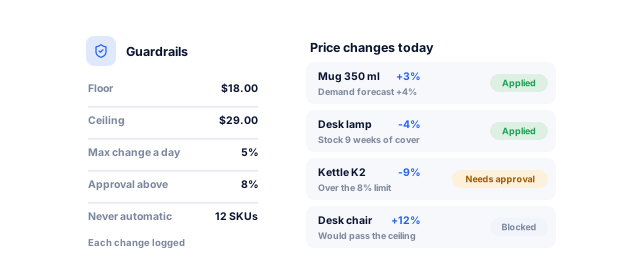
A dynamic pricing model predicts demand at different prices, and a pricing engine picks the best price within your rules: floors, ceilings, daily change limits and products that never move automatically. Large changes wait for approval, and every change is logged with its forecast.
Faster, more consistent valuations
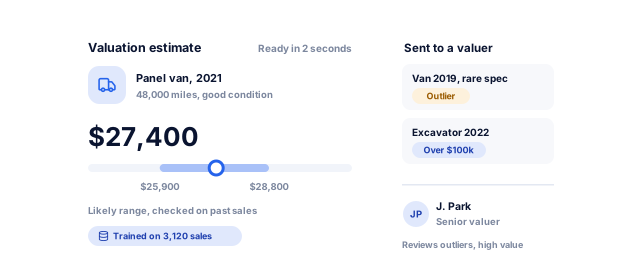
Property, vehicle and equipment businesses value items one at a time, slowly and inconsistently. A valuation model trained on past sales gives a first estimate with an error range in seconds, and valuers review outliers and high-value items.
Markdowns and stock planned earlier
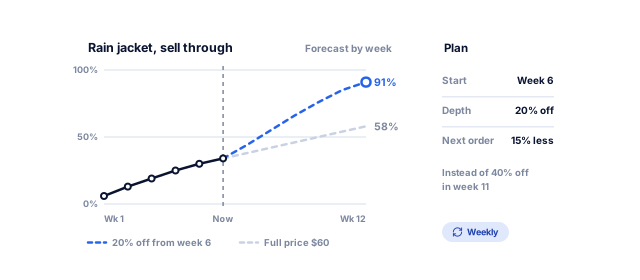
Forecasting sell-through at different prices shows which products will not clear at full price weeks before season end, so markdowns start earlier and shallower. Forecasts refresh weekly, and our inventory management systems can read them directly.
Machine learning only where it beats simple forecasts
In the M5 retail forecasting competition, only 415 of 5,507 teams beat every simple benchmark across 42,840 Walmart sales series, according to the results paper in the International Journal of Forecasting. So our feasibility stage tests baselines first: where a simple forecast wins, we put it into production; where machine learning adds accuracy, we build the model.
Plans built on ranges, not single numbers
Quantile forecasts give a low, likely and high price, such as P10, P50 and P90, for each period. Finance can budget on the likely case and stress-test the high one, and buyers see how much risk a contract or stock position carries.
Not sure your data can support a price forecast?
Tell us what you need. We look at your price history and what drives it, and send a written plan with a baseline forecast to beat, a price range and a timeline.
Your free AI planFor what you need
1What AI can do with your dataThe decision it supports and how you would measure it
2A fixed-price proof of conceptOn your own data, from $3,000, before you commit to a build
3The approach we would useA ready model, a custom one, or simple rules where they do the job
4Your data stays yoursA signed NDA first, and it never trains any model outside your project
A specialist walks you through it on a call
Our price forecasting model process, from feasibility to monitoring
We agree the decision the forecast supports, the target, horizon and useful accuracy, then audit history, gaps, price variation and the outside drivers available on forecast day.
Forecast specification
Data audit report
Accuracy target agreed with you
A clear target and the right approach for your data
Data pipeline and features
A repeatable pipeline brings ERP, sales, pricing and external data into BigQuery or your warehouse with documented, leakage-checked features, then feeds the live model too, so training and production match.
Automated data pipeline
Feature catalog
Leakage test results
Clean, reusable training data
Baselines and experiments
Baselines come first, then candidate models in order of complexity, each logged with its settings and backtest scores so you can see why the winner won.
Baseline scores
Experiment log
Shortlisted models
Evidence that the model beats simple methods
Backtest review and sign-off
We present backtests by product, segment and horizon, including where the model does worst and how often actuals fell inside the range. Your team signs off, or we fix weak spots first.
Backtest report
Interval coverage check
Known limitations list
A model you understand before it runs
Deployment in shadow mode
The model runs beside your current process for several weeks without changing any price, checked against actual outcomes and your team's calls, before we connect it to your pricing tool, ERP or dashboard.
Forecast API or batch job
Shadow-mode results
Runbook and documentation
Live forecasts with proof they work
Monitoring and retraining
Weekly error tracking, drift alerts and scheduled retraining keep the model accurate, with a monthly report against the baseline and a quarterly data review.
Monitoring dashboard
Monthly model report
Retraining schedule
Accuracy that holds up as markets move
Price prediction models by use case
Our AI price prediction solutions change model, features and checks with what you forecast.
01 / 05
Retail and ecommerce demand at a price
Retailers need to know how many units sell at each price they might set. We combine demand forecasting with elasticity, promotions and competitor prices for markdown plans or a pricing engine, usually with boosted trees trained across products. See our work for ecommerce businesses.
Dynamic pricing for travel, rentals and marketplaces
Hotels, rentals, ticketing and marketplaces sell perishable capacity, so price depends on lead time and capacity left. We model booking curves, then set prices inside floors and ceilings you control, logging every change and sending large ones to a person.
Valuation models use location, size, age, condition, amenities and recent comparable sales. We build hedonic regression and gradient boosted models, report error by area and price band, and flag properties too unusual to value, for first estimates and portfolio checks rather than formal appraisals. See our work for real estate businesses.
Buyers of metals, energy, farm inputs or freight want to know whether to lock in a price or wait. We combine futures curves, published outlooks, exchange rates and your purchase history into a range with a stated horizon, fed to your ERP software so purchasing and finance share the numbers.
We do not sell trading signals or promise profitable stock or crypto predictions, because liquid markets quickly price in public information and strong backtests often fail live. For financial teams we build research, risk and scenario tools instead, such as volatility and scenario dashboards.
Many related products or locations with many drivers
Thousands of rows across series
Poor at prices outside the range seen in training
Deep learning (LSTM, transformers)
Very large datasets with long histories
Large volumes and compute budget
Costly to train and explain; often no better than boosted trees
Quantile and probabilistic models
Decisions that depend on risk, not just the likely case
Same as the underlying model
Ranges must be checked against actual outcomes
Data thresholds are rules of thumb from our projects, not hard limits. In the M5 competition, most methods examined used LightGBM, and the winning team beat the best statistical benchmark by 22.4%.
Your price prediction project, week by week
A typical production build of about 14 weeks; feasibility alone ends at week 4.
Every report shows the simple baseline next to the model, so you see what machine learning adds. Where a dashboard or simple forecast does the job, we build that through our predictive analytics or reporting work; where it does not, we build the model.
02
From notebook to production in one team
Data scientists, backend developers and cloud engineers among our 25+ in-house specialists build the model, its API and its infrastructure as one team, and our AWS management and DevOps people keep pipelines and retraining jobs running after launch.
03
Your models, code and data
Models, pipelines, training data and backtest reports live in cloud accounts you own, and you keep every line of code if we part ways. We work on rolling agreements with monthly reporting; clients stay 1.6 years on average.
Results we can put numbers on
These results come from our SEO, paid media and software projects, measured in each client's own analytics. For proof on your own data, the 3 to 4 week feasibility stage backtests forecasts on your history before any build is quoted.
"From designing a high-converting website to managing our SEO, Google Ads, and Google Business Profile, improveFX delivered exceptional results across every channel."
210%more qualified leads
185%organic and local traffic growth
92%keywords on page one
Maureen CappalloBroker and founder, Momentus Real Estate Group
"They revolutionized our online presence with a 60% increase in web traffic through strategic e-commerce SEO and content optimization."
60%more organic traffic
47%more sales
Eric NoahPresident, Eric Originals & Antiques Ltd.
"Visionstar Technologies' online presence transformed significantly with a 40% boost in customer engagement, all thanks to their exceptional website structuring and SEO tactics."
+40%qualified leads
32%lower cost per acquisition
Thomas MorelFounder, Visionstar Technologies
"Their strategic approach to our website and SEO resulted in a 60% increase in local inquiries, revolutionizing our automobile service business."
60%more local inquiries
87%more organic traffic
Mike SteffanFounder, Sabulski Window Tinting
"Their SEO strategy helped us achieve top search rankings, while their Facebook Ads campaigns drove a steady flow of qualified prospects."
How much does price prediction model development cost?
Our AI projects run from under $5,000 to $100,000+, depending on scope. A feasibility stage with baseline forecasts on clean data sits at the low end; a production system with several feeds, an API, shadow testing, ERP integration and retraining sits toward the high end.
Running costs are cloud compute for forecasts and retraining, any paid data feeds, and monitoring, estimated before the build. The fixed-price feasibility stage, our proof of concept, starts from $3,000 and shows whether a model beats simple baselines before you pay for the build.
How long does it take to build a price prediction model?
Feasibility and baseline forecasts usually take 3 to 4 weeks. A production model with integration and monitoring typically takes 8 to 14 weeks.
Data access and cleaning take the most time, not modeling, so projects move faster when prices and sales live in one system. Shadow mode then adds several weeks, while the model runs alongside your current process without changing prices.
How much data do I need for a price prediction model?
As a rule of thumb, two or more years of history at the frequency you want to forecast, so the model sees two seasonal cycles. Valuation models need hundreds or more comparable sales.
Variation matters as much as volume: if a price never changed, no model can learn how demand responds. Where history is short, the feasibility stage sets out what we can forecast now and what to start collecting.
How accurate will the price forecasts be?
Nobody can promise a number before testing your data. Accuracy depends on how predictable the market is, the history available and the forecast horizon.
What we promise is a measurement you can check: rolling-origin backtests on periods the model never saw, error by product and horizon, and a comparison with naive forecasts. Short horizons are almost always more accurate than long ones, and every forecast comes with a range.
Which machine learning model is best for price prediction?
There is no single best model. For tabular data across many products, gradient boosted trees such as LightGBM are a strong default; for a few long series, exponential smoothing or ARIMA often does as well.
In the M5 competition, most methods examined used LightGBM, yet most teams failed to beat a simple benchmark, so we test the simple options first and choose the least complex model that meets your target.
How do you backtest a price forecasting model?
We train on data up to a cutoff date, forecast the following period, then move the cutoff forward and repeat, so every score comes from data the model did not see.
Features are rebuilt at each cutoff using only information available then, which prevents leakage. Results are reported by segment and horizon with MAE, RMSE and MASE, plus how often actual prices fell inside the predicted range.
Can you build a dynamic pricing model?
Yes. A dynamic pricing model forecasts demand at different prices, and a rules layer chooses the price within floors, ceilings and change limits you set.
We start in shadow mode, comparing recommended prices with your current ones, and log every automated change, with large ones approved by a person. Personalized pricing from individual customer data raises legal and trust issues, so we design around product, time and capacity.
Do we need price analysis before price prediction model development?
Often, yes. Price analysis builds the clean sales, cost and competitor data a model needs, and sometimes a dashboard answers the question without forecasting.
If your data is already clean and your team knows what it needs to predict, we go straight to feasibility. Otherwise our price analysis services are the cheaper first step, and their outputs become model features later.
Where does the model run, who owns it, and how is our data handled?
The model runs in your cloud account or on your servers, and you own the code, the trained model, the backtest reports and the data, documented so another team can run and retrain it.
Most price models need no personal data. Where customer-level data is involved, such as bookings or property records, the build is designed for GDPR, UK GDPR, US state privacy laws, Canada's PIPEDA, Australia's Privacy Act and India's DPDP Act, and data handling is agreed in writing. To talk it through, book a call with a sample of your data.
Ready to put AI to work?
Tell us what you want AI to do with your data, or book a strategy call with our team.
What AI can do with your data, and how to measure it
A fixed-price proof of concept on your data, from $3,000
A call with a specialist to plan the next steps, no obligation
A specialist replies personally 4.9 from 566 client reviews