
Consulting & Data Readiness
Our AI/ML consulting services for predictive analytics and machine learning start here: we audit your data, score which use cases can be modeled, and hand you a costed roadmap ranked by business value.
improveFX builds predictive data analytics services around one question: what decision changes when you know what’s coming? Our data scientists audit your data, model the outcome that matters (churn, demand, credit risk, parts usage) and push scores into the CRM, ERP or dashboard your team already opens, so forecasts get acted on.
 Written by Abhishek Kumar, Content Writer
















Predictive data analytics services use your historical data and machine learning to forecast what is likely to happen next, such as churn, demand, credit risk or parts usage, then deliver scores with reasons into the CRM, ERP or dashboard where decisions are made.
Some teams arrive with a clean warehouse, others with spreadsheets and a hunch; both work. Our predictive analytics consulting services come as four engagements, taken separately or end to end, from a two-week readiness assessment to managed predictive analytics as a service.
Get a free proposalOur AI/ML consulting services for predictive analytics and machine learning start here: we audit your data, score which use cases can be modeled, and hand you a costed roadmap ranked by business value.
Our data scientists build and validate forecasting models on your data and prove each beats your current process before production.
We wire predictions into Salesforce, HubSpot, your ERP system, or support desk, so the people making the decision see the score in context.
Monitoring, drift alerts and scheduled retraining on a monthly retainer, so accuracy holds as customers, pricing and markets shift.
What changes by industry is the data you can legally use, the cost of a wrong prediction and how fast someone must act. A churn model for a bank carries regulatory weight a retailer’s never will.
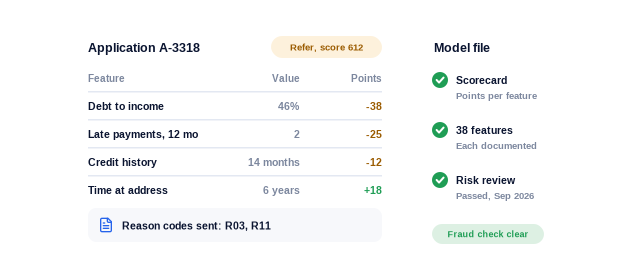
Credit risk scoring, transaction fraud detection, deposit attrition, and collections prioritization. Predictive analytics for banking and financial services carries a burden retail models don’t: every decline needs a defensible reason, so we build with explainable methods and document every feature for model risk review.
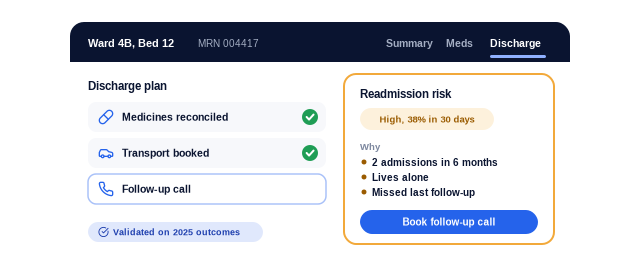
Readmission risk, no-shows, bed and staffing demand, and medication stockouts. Healthcare work depends on PHI handling designed for HIPAA and on clinician trust. We use de-identified environments wherever possible, validate against clinical outcomes and surface predictions in the EHR, hospital management system or Nabhaya Clinic workflow.
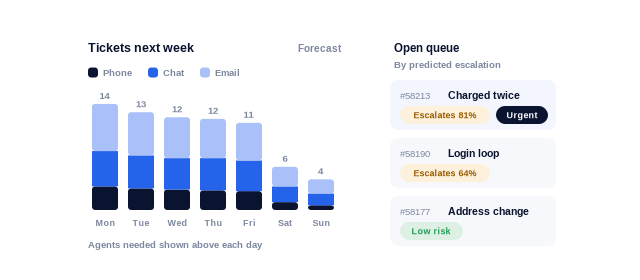
Support data is the most underused predictive asset most companies own. Customer service predictive analytics forecasts ticket volume by channel, flags tickets likely to escalate and scores accounts heading for cancellation, using sentiment analysis of ticket text. Signals land in Zendesk, Intercom or Freshdesk as queue priority.
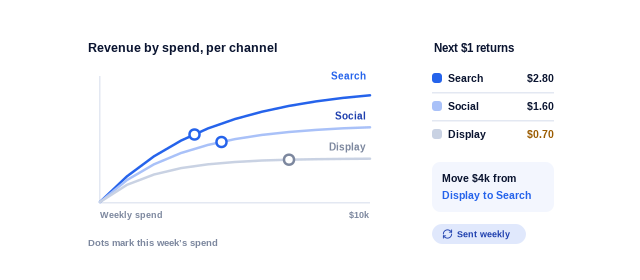
SKU-level demand forecasting, lifetime value, next-best-offer and markdown timing. Our predictive analytics marketing services also forecast which channel returns the most on the next dollar, combining purchase history with campaign data and feeding budget recommendations into Google Ads and other ad platforms weekly.
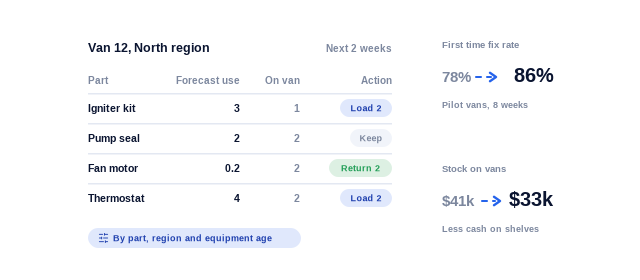
Field service teams lose margin to idle parts and second truck rolls when a tech arrives without the right part. Predictive analytics for parts usage in service businesses forecasts consumption by part, region and equipment age and sets van stock to match, raising first-time fix rates and freeing cash.
Tell us what you need. We look at your data and the decisions you make from it, and send a written plan with what to forecast first, the baseline to beat, a price range and a timeline.
Two checkpoints decide what we build next: if the data cannot support a reliable forecast yet, we fix it or start with a simpler model; if a model cannot beat what you do today, we change the approach before integration.
Book a strategy callWe start with the decision, not the data: who acts on this forecast, what they do differently, and what that is worth. Where nobody owns that yet, we work it out with you first.
We profile your sources for volume, history depth, label quality and gaps. You get a written verdict (ready to model, fixable in weeks, or needing more history) with a plan for each, such as segmentation while history builds.
Before building anything, we measure how accurate your current process is, whether a planner’s spreadsheet or gut feel. That number is the bar every model has to clear.
We test candidate models on data they have never seen, report MAPE for forecasts or precision and recall for classification, and review the biggest misses with your team. If none beats your baseline yet, we show why and build the data or approach that will.
Scores go into the system your team already uses, with reason codes, so a rep sees why an account is flagged and trusts it enough to act.
We watch for drift and accuracy decay, retrain on a set schedule, and review performance with you quarterly, because models degrade as markets move.
There’s no single predictive model, only the right one for a question. Choosing well is most of the job, and it separates the best data analytics service for business predictions from a team that defaults to a neural network.
Demand, revenue, ticket volume, cash flow and parts consumption. We use Prophet, ARIMA or gradient-boosted regressors depending on how seasonal and noisy your history is; two to three years of clean history separates seasonality from noise. Accuracy is reported as MAPE against your current forecast.
Churn risk, credit default, fraud, lead conversion and ticket escalation. Each record gets a probability, not a yes or no, so you set the threshold: a retention team chasing the top 5% of risk needs a different cutoff than one chasing the top 30%.
Predictive customer segmentation groups accounts by how they actually behave, not by old personas, and surfaces segments nobody defined. It needs no labeled outcomes, so it is often the first useful output, with something to act on within weeks.
Fraudulent transactions, equipment about to fail, a supplier drifting out of spec. Anomaly detection works when the event is rare and examples are few. We use it where a miss is costly and a false alarm manageable, and tune that balance with you.
Product recommendations, cross-sell prompts and next-best-offer for a rep on a call, ranked by expected value rather than raw likelihood, because recommending what someone would buy anyway adds nothing. Our recommendation engine builds are tested on incremental revenue.
When a prediction affects credit, employment, insurance or care, the model has to justify itself. We favor interpretable methods such as gradient-boosted trees with SHAP attribution, with per-decision factor breakdowns your compliance team can document.
We work with all three, and most clients keep their BI dashboards. The question is which layer answers the decision you need to make.
Book a strategy call| Factor | BI reporting | Built-in CRM or ERP predictions | Custom predictive models |
|---|---|---|---|
| Question it answers | What happened | What is likely, by the vendor’s model | What is likely, for your decision |
| Data it uses | Your warehouse or reports | Data inside that one platform | Any source you hold, joined together |
| Fit to your business | Not a forecast | General patterns, tuned by settings | Trained on your own history |
| Checked against your current process | Not applicable | Up to your team | Always, before production |
| Reasons behind each prediction | Not applicable | Varies by vendor and edition | Reason codes per prediction |
| Cost model | BI licenses and analyst time | Often a higher edition or add-on | Staged build, then optional retainer |
| Best fit | Tracking performance | Standard use cases inside one platform | Decisions that depend on data no vendor has |
| What improveFX does | Build or tidy the dashboards | Switch it on and connect your data | Build, validate, integrate and retrain |
Based on our delivery experience, October 2026. Built-in predictive features, their data requirements and the editions that include them vary by platform; we check yours in the readiness assessment.
A first production model typically runs six to twelve weeks from kickoff. This is the usual path.
Book a strategy callBy week 2, you know what to forecast first and what it will cost.
By week 8, you have a model scored against today's method.
By week 12, your team acts on forecasts in the tools it already uses.
You approve each stage before the next one starts, and nothing goes live until it beats the agreed baseline on data it has never seen.
Yours to keep, always. Everything is set up in your name, and if you leave we remove our access and hand over the documentation.
We offer predictive analytics consulting, solutions and services to teams with a decision a better forecast would change.
Book a strategy callA model is half the work; acting on it is the other half. The people building your churn score also know what a retention campaign costs.
Get a free proposalOur data scientists sit alongside the people who run paid media, email and CRM for the same clients, so when a model flags a churn risk, the same team builds the email automation sequence that responds. Nothing is lost between predicting and acting.
The data scientist who scopes your project stays through go-live. In a team of 25+ specialists, the person who learns your business on day one is the one building on day thirty.
Every engagement runs under an NDA with scoped, revocable access to only the systems a model needs. We work in your own cloud where you prefer, never feed client data into third-party AI tools to train anything, and hand over models, code and documentation.
Your first result from us is a model tested against your current method on your own history. The figures below come from our case studies and client reviews.
See all case studies
MastersBuddyStudy abroad consulting
160+
keywords in Google's top 10
AkosMDHealthcare, Arizona
+57%
patient footfall
Eric OriginalsJewelry ecommerce
+1,900%
organic traffic
"From designing a high-converting website to managing our SEO, Google Ads, and Google Business Profile, improveFX delivered exceptional results across every channel."
 Maureen CappalloBroker and founder, Momentus Real Estate Group
"They revolutionized our online presence with a 60% increase in web traffic through strategic e-commerce SEO and content optimization."
 Eric NoahPresident, Eric Originals & Antiques Ltd.
"Visionstar Technologies' online presence transformed significantly with a 40% boost in customer engagement, all thanks to their exceptional website structuring and SEO tactics."
"Their strategic approach to our website and SEO resulted in a 60% increase in local inquiries, revolutionizing our automobile service business."
"Their SEO strategy helped us achieve top search rankings, while their Facebook Ads campaigns drove a steady flow of qualified prospects."
 Amita NaithaniCo-founder, Amita Naithani Resort Wear
These are the questions that come up on almost every discovery call. If yours isn’t here, ask us and we’ll give you a straight answer.
Predictive data analytics services use your historical data to forecast what is likely to happen next, then turn that forecast into an action someone can take. A provider handles the full cycle: assessing your data, selecting and training models, validating accuracy, integrating results into your systems, and retraining as conditions change. Typical uses are churn, demand, credit risk, ticket volume, and parts usage.
Business intelligence tells you what happened. Predictive analytics tells you what is likely to happen next. A BI dashboard shows last quarter’s churn rate; a predictive model names the specific accounts likely to churn next month and why. Most companies need both, and predictive analytics usually works best built on top of a BI foundation, which we can set up first if it is missing.
It depends on what you’re predicting. Seasonal forecasting like demand or revenue usually needs two to three years, so the model can see repeating patterns rather than noise. Classification tasks like churn or lead scoring need enough examples of the outcome, roughly a few hundred at minimum. Our readiness assessment tells you exactly where you stand and what to start collecting if history is thin.
Financial services predictive analytics has to be explainable as well as accurate. For predictive analytics for banking services such as credit risk, deposit attrition, fraud and collections, we use gradient-boosted trees with SHAP attribution, document feature lineage for model risk review, and keep adverse action reasons traceable.
Regulation adds weight to explainable predictive analytics. Financial services firms in the EU face the AI Act, which classes credit scoring of individuals as high-risk, according to the European Commission, so we build in logging and human oversight from the start.
Accuracy varies by problem, and any provider quoting a number before seeing your data is guessing. The question that matters more is whether the model beats what you do today. We measure your current process first, then report model performance against it using MAPE for forecasts or precision and recall for classification. Until a model beats your baseline, your current method keeps running while we improve the data or approach.
A data readiness assessment takes about two weeks. A first production model typically runs six to twelve weeks from kickoff, depending on data condition and how many systems it has to integrate with. Projects that stall almost always stall on data access, so the faster we get credentials and sample extracts, the faster everything else moves. Later models reuse the same pipeline and move faster.
Our AI projects run from under $5,000 to $100,000+, depending on scope. We price in stages: a fixed-price proof of concept from $3,000 that starts with a data readiness check, builds quoted per use case, then an optional retainer.
Clean data, one use case, scores sent to a tool you already use, or a platform's built-in predictions keep a project at the low end. Data cleanup, several use cases, integrations or a custom dashboard, high volume and compliance work move it up. Running costs are cloud hosting and compute, monitoring and retraining.
When a platform covers your need, such as standard ecommerce churn scoring, generic demand forecasting or basic lead scoring, we set it up and connect it to your data. Custom earns its keep when the prediction depends on data no vendor has, like your service history, pricing logic or equipment fleet. The readiness assessment compares both and recommends the faster payback.
Yes. Code, trained model artifacts, feature definitions, and documentation transfer to your repository at handover. We don’t host models on infrastructure you can’t access or license them in a way that forces a renewal. If you take the work in-house or move to another partner, everything you need goes with you, including the data pipelines and the validation reports behind each model.
Models lose accuracy as customer behavior, pricing, and markets shift, so maintenance is not optional. We offer predictive analytics as a service on a monthly retainer covering drift monitoring, scheduled retraining, and a quarterly accuracy review. If you’d rather build the capability internally, we document everything and train your analysts to take it over, then stay on call for the harder retraining questions.
Every engagement runs under an NDA with scoped, revocable access limited to the systems a model actually needs. We work inside your own cloud environment where you prefer, design for GDPR, HIPAA and India's DPDP Act where they apply, and do not feed client data into third-party AI tools or use it to train anything outside your project. We sign a data processing agreement when you need one, and a BAA for US patient data. Access is removed at handover.
Tell us what you want AI to do with your data, or book a strategy call with our team.


 A specialist replies personally 4.9 from 566 client reviews