A score tells you a ticket went badly. We tell you what caused it. improveFX reads your calls, chats, emails, reviews, and survey comments, then labels emotion, intent, and root cause together. You get customer service sentiment analysis for your CX, product, and quality teams to act on this week, not another dashboard nobody opens.
Companies that chose us for their digital transformation



















Customers rarely complain in one place. The same broken promise shows up as a clipped phone call, a two-line chat, a one-star review, and a blank survey box, and read separately, none of it looks urgent. We pull all four streams into a single taxonomy, so sentiment analysis in customer service stops producing four disconnected reports and starts producing one clear answer.

We transcribe and score live and recorded calls, tracking tone, silence, interruptions, and escalation moments that a written summary never captures.

Live chat, email, SMS, WhatsApp, and in-app threads get read end to end, so messaging analytics reveal sentiment shifting mid-conversation, not only at the close.

Public reviews, app store ratings, NPS and CSAT verbatims and social mentions are scored together, connecting what customers say publicly to what support already knew.

Bot transcripts from your AI-driven customer service tools get the same scrutiny as human agents, showing where automated replies lose patience, trust, or the thread.
The same conversation answers a different question depending on who reads it. A QA lead wants to know which agent moment went wrong. A patient access manager wants to know why callers abandon. A BPO director wants proof of service quality across accounts. We tune the taxonomy to the decision each team is making, then report against it in language that team already uses.
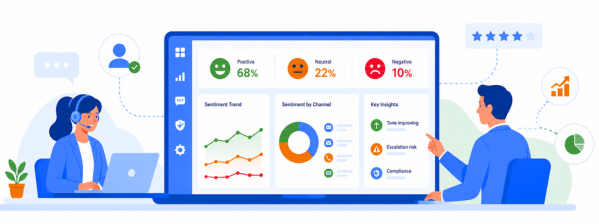
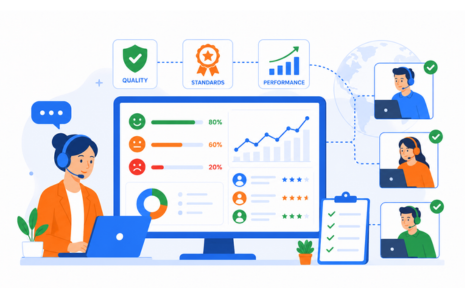
Manual QA scores a handful of calls per agent per month, and the sample rarely includes the ones that mattered. We score every interaction and break it into moments, so you can see whether the customer service greeting set the tone, where the conversation turned, and which behaviors reliably recover a frustrated caller. Coaching stops being opinion and starts being evidence.
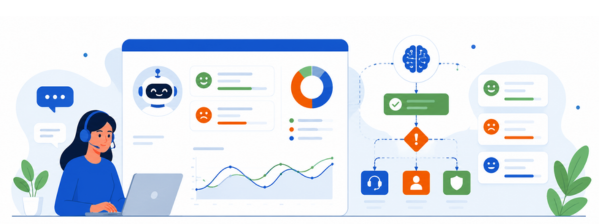
Ticket volume tells you what broke. Sentiment tells you what it cost you. We tie negative moments to causes: a shipping promise, a refund policy, a handoff between teams, a form that fails on mobile. Then we rank those causes by how many customers they anger and how often those customers stop buying, so your roadmap argues from evidence instead of the loudest recent complaint.
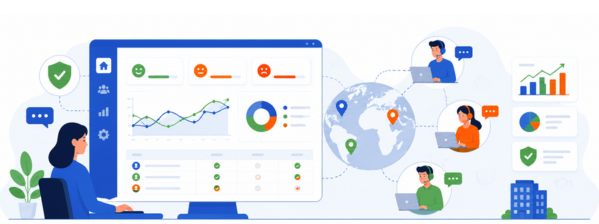
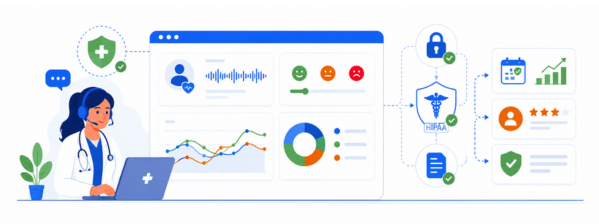
Scheduling calls carry PHI, so most sentiment vendors are simply not an option. We run HIPAA-compliant sentiment analysis on healthcare scheduling calls under a signed BAA, with PHI redacted before analysis, access restricted by role, and retention set by your policy. The output shows where patients grow frustrated: hold times, insurance verification, referral delays, or the third transfer before anyone books an appointment.
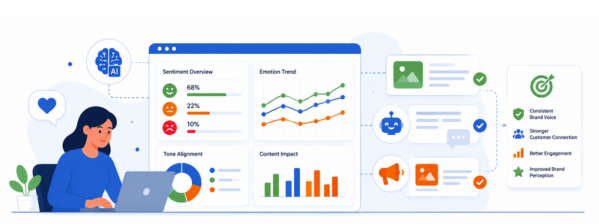
BPO firms live or die on provable service quality, and clients no longer accept a monthly CSAT slide. Our customer sentiment analysis services give providers per-client, per-queue, and per-agent reporting they can put in front of a customer without flinching. It also works the other way: brands running outsourced support use the same reporting to compare vendors on evidence rather than promises.
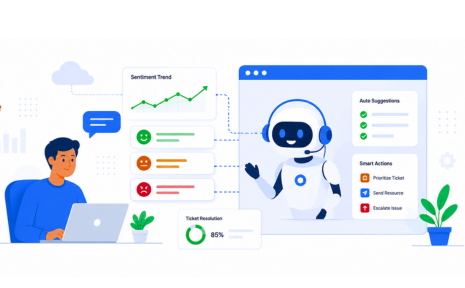
Deflection rates make automation look successful. Sentiment often disagrees. Virtual assistant customer service sentiment analysis shows what happens inside those contained conversations: where the assistant answered confidently and wrongly, where it looped, and where the customer gave up quietly instead of escalating. For teams shipping AI-generated replies at scale, we score tone consistency against your brand voice so quality does not quietly drift from release to release.
Reviews, app store ratings, and social posts are the only feedback your prospects also read. We analyze them alongside support conversations, which surface the gap between what customers complain about privately and what they warn others about publicly. Product teams get ranked feature friction, brand teams get early warning on reputation risk, and both work from the same evidence rather than competing dashboards.
Get a free proposal with real numbers, honest timelines, and no lock-in. Judge us on that.
Most vendors describe sentiment analysis as three tidy steps: collect, analyze, and report. The hard parts sit between them. Deciding what negative actually means for your business, proving accuracy before you commit, and getting findings in front of the people who can act. Here is how we run every customer service sentiment analysis engagement and what you get at each stage.
We start by defining what negative means in your business. A delayed refund and a rude agent are not the same problem, so your taxonomy is built from your policies, queues, and known friction points.

We connect to your helpdesk, CCaaS platform, review sources, and survey tools, then redact PII and PHI before anything is analyzed. Access is role-restricted, and retention follows your policy, not ours.

You see the model work on a sample of your own past conversations first. Real findings, real edge cases, judged against outcomes you already know, before anything long-term is signed.

Trained analysts review a scored sample, and we measure agreement between them and the model. Disagreements go straight back into tuning, which is how sarcasm, negation, and mixed sentiment stop being excuses.

Findings land where work happens: tags in your helpdesk, alerts to the right queue owner, dashboards for leadership, and a weekly readout that names the three issues worth fixing first.

Products ship, policies change, and customers find new things to be annoyed about. We re-check accuracy on a set schedule and update the taxonomy so the model keeps describing today, not last quarter.
Six questions come up in almost every scoping call, and the answers separate vendors more than any feature list does. We have written ours out in full, including the parts that make us look less magical, because you are going to ask anyway, and a straight answer now saves a bad quarter later.

Often the cloud APIs are enough. Azure Cognitive Services sentiment analysis (now Azure AI Language), Amazon Comprehend, and Google Cloud Natural Language all score general text well, and if you need a positive or negative flag on product reviews, start there. They struggle with industry vocabulary, internal shorthand, and the difference between annoyed and about to churn. We will tell you honestly which situation you are in.

Anyone quoting a single accuracy number without naming the dataset is selling you something. Accuracy depends on the task: flagging clearly angry messages is close to solved, while separating mild irritation from genuine churn risk is much harder. We benchmark on your data, report the number we actually hit, and tell you which categories are still shaky, so nobody builds a policy on a weak signal.

You own it, start to finish. We process under your retention rules, restrict access by role, and your conversations are never used to train models that serve anyone else. Sub-processors are disclosed before work begins, and we will complete your security review rather than pointing at a badge on a website. Deletion on request, with written confirmation that it happened.
Yes, and this is where most sentiment programs stall. We push tags and scores back into Zendesk, Salesforce, Freshdesk, Intercom, Genesys, Five9, and Talkdesk, or into your warehouse if your BI team would rather own the reporting. If a system has no API, we work from scheduled exports. Nobody should have to open a second dashboard to do their job.
Multilingual coverage is normal now; the honest caveat is that quality varies by language and by audio. Translating everything into English first loses the sentiment cues that matter, so we score in the original language wherever a reliable model exists. For voice, transcription quality sets the ceiling, so we test your actual recordings before promising anything about accented or noisy calls.
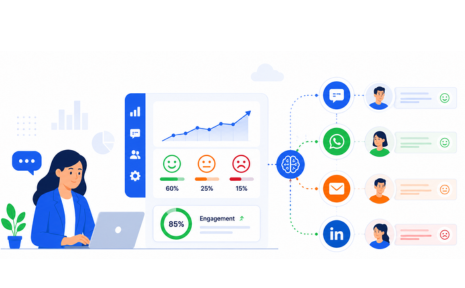
Built-in scores tell you a ticket felt negative. They rarely tell you why; they treat every industry the same, and they almost never cover voice calls or the conversations your AI assistant handled. Ours are trained on your taxonomy and tied to causes you can assign to an owner. If your built-in score is already answering your questions, keep it.
Plenty of firms can run a model over your tickets. The difference shows up in month four, when the easy findings are exhausted, and someone has to keep the program useful. Three things make that difference, and all three are the reason clients extend rather than re-shortlist sentiment analysis services every year.
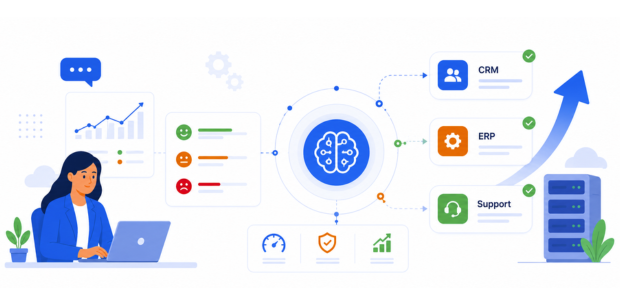
Most vendors now run conversations through a large language model and ship whatever comes back. We do not. Trained reviewers check scored samples, argue with the model, and correct it before anything reaches your inbox. It is also why we can be trusted to analyze AI-generated content fairly, since we are not simply grading one machine’s work with another and calling it a finding.
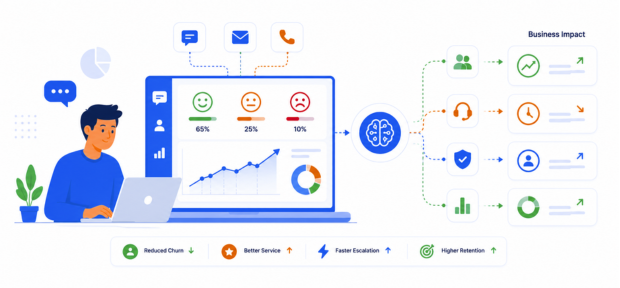
Everything we build for you is yours: the taxonomy, the labeled datasets, the category definitions, and the reporting logic. If you bring the work in-house or move to another provider, it goes with you. We would rather earn the next quarter than hold your data hostage to win it, and that tends to make the first contract an easier decision.
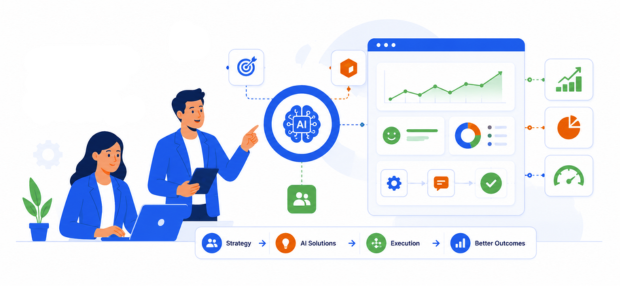
Activity reports are easy to produce and easy to ignore. Ours opens with the metric you told us to move, whether that is repeat contacts, escalation rate, CSAT in a specific queue, or churn among a segment. If it has not moved, that is the first line of the report, along with what we think is blocking it and what we would try next.
Sentiment analysis answers what customers feel and why. It rarely stays a standalone project because the moment you can see friction clearly, the next questions are who is about to leave, what the automated replies should say instead, and what the pattern predicts. These are the improveFX services that most often run alongside it.
You do not need a bundle. Most teams begin with sentiment analysis, prove the findings on real conversations, then add one adjacent service where the evidence points. We will tell you which one that is after the pilot, and it is often not the one you expected.
Sentiment tells you who is unhappy today. Churn models tell you which of them will actually leave, so retention effort goes to accounts that are genuinely at risk.
Once you know which conversations frustrate customers, we build assistants that handle those cases properly instead of deflecting them into a longer, angrier second contact.
The broader language work behind sentiment: intent classification, entity extraction, topic modeling and summarization, built when scoring emotion alone stops answering the questions your team keeps asking.
Sentiment becomes a leading indicator once it sits beside your operational data, forecasting volume spikes, seasonal complaint patterns and the downstream cost of a problem you have not fixed.
The same language models that read complaints can read buying signals, ranking inbound conversations by intent so sales works the ones actually worth a call.
Knowing what a customer disliked is as useful as knowing what they bought. We use both to build recommendations that avoid repeating a bad experience.
These come up often enough that answering them here saves everyone a call. If your question is more specific to your stack, your industry, or your compliance requirements, ask it directly. We would rather answer a hard question early than discover a mismatch three weeks into a scoping process that was never going to fit.